
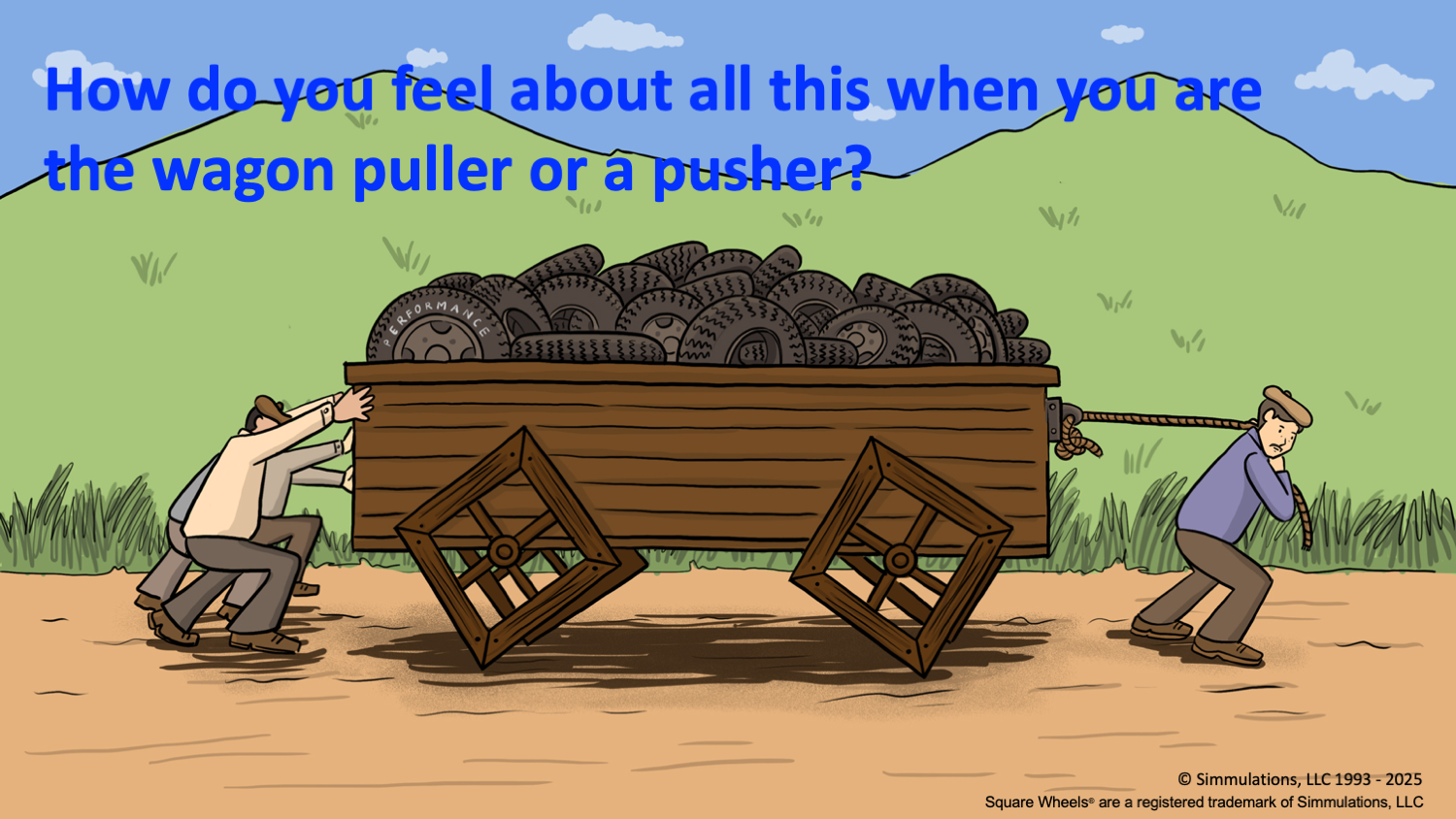
Sustainable change is not just cognitive, it’s also somatic, so If we want real change and sustainable improvement, we must invite people to FEEL their current status and act to improve things.
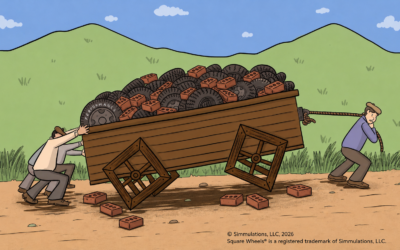
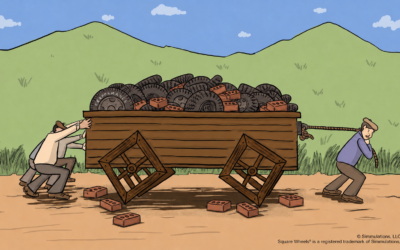
You can easily create an organizational focus and a compelling dialog around performance by using the metaphors of Square Wheels®, round wheels, mud, spectator sheep, and silos to create an impetus for understanding the divergent opportunities for engagement and real improvement. To do so, we have to invite people to feel their current reality, not just analyze it. Changing behavior involves cognitive processing of ideas and a somatic focus on how things feel if they were done differently, and anchoring to positive resource states.
When Your Wagon Lives In Your Body
Most coaching and training stays in the neck‑up space: concepts, models, scripts, and action plans. We talk about habits and mindset, but we rarely ask, “What’s happening in your body when you pull that wagon?”
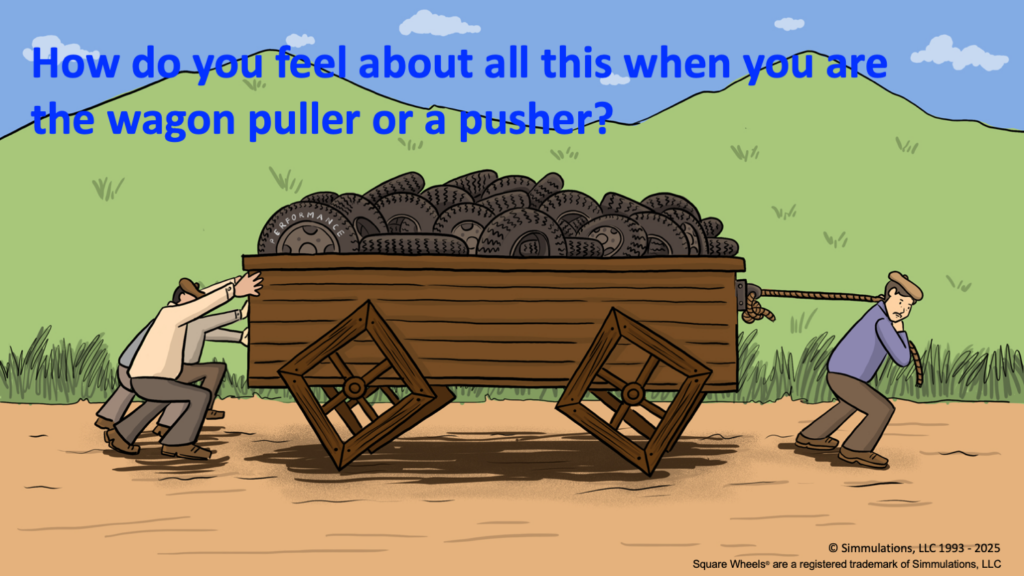
One has obvious emotions when dealing with how things are really working in your organization.
My friend Dr. Peter Vajda’s perspective is that our patterns live not only in our thoughts, but in our nervous systems, muscle memory, breathing, and posture. When you picture the Square Wheels wagon:
-
Where do you feel the “pulling” in your body—neck, shoulders, back, stomach?
-
What happens to your breathing when you imagine dragging that heavy thing through mud?
-
How does your body respond when you see yourself as a spectator sheep—do you collapse, tighten, go numb?
These are not abstract questions. They help people notice the somatic signatures of their current habits: the tension of over‑efforting, the constriction of fear, the heaviness of resignation. If you ignore that layer, most change stays theoretical.
Bringing Feelings Into The Square Wheels Conversation
In a typical Square Wheels discussion and innovation session, you ask, “What do you see?” and get a flood of cognitive insights. To add Peter Vajda’s somatic lens, follow up with, “What do you feel as you look at this picture?”
Consider inviting people to slow down for a moment and scan:
-
“As you imagine yourself pulling this wagon, notice what happens in your shoulders, your jaw, your chest. What do you feel?”
-
“When you recognize a familiar ‘mud’ in the picture—a policy, a system, a relationship—where does that show up in your body?”
-
“If you see yourself as one of the spectator sheep, what emotions come with that image—frustration, safety, relief, anger, numbness?”
You’re not asking for therapy. You’re legitimizing the emotional and physical reality of work. Change is not just “installing Round Wheels”; it is changing how your nervous system experiences effort, risk, and possibility. Dr. Peter has been pushing me to expand on how I have been using and supporting the use of my images in the performance improvement initiatives of my clients and image / tool users. It deepens the impact and increases the likelihood of real change.
Now your coaching conversations using the metaphors can include:
-
The story (the wagon and wheels) and the possibilities that exist.
-
The behavior and the choices (what people do now vs. what they could choose to do differently).
-
The somatic experience (how it feels to keep doing what they’re doing vs. how it could feel to change).
That third piece is where a lot of resistance actually lives. People may agree to change but they resist if it does not feel right. Many people are kinesthetic decision-makers or they need that “this feels right” in order to actually do things differently.
The Felt Experience of Square Wheels vs. Round Wheels
Intellectually, everyone likes to think they operate on Round Wheels. No one argues against smoother progress and less friction. But at a somatic level, Round Wheels can feel:
-
Unfamiliar. “I don’t know how to move this way; my body is used to pushing harder, not smarter.”
-
Vulnerable. “If I stop over‑efforting, will I still be seen as committed?”
-
Exposing. “If I try a new behavior, I might feel awkward or visible.”
In Dr. Vajda’s terms, the body often clings to the old recipe because it feels safer, even when it’s painful. Square Wheels are uncomfortable but predictable. (Note: Peter does some very interesting stuff and I really appreciate his perspective along with his push for me to Think Different. Connect with him on his LinkedIn site.)
You can work directly with this somatic viewpoint by contrasting:
-
Embodied Square Wheels
-
Ask people to imagine one current Square Wheel behavior (for example, rushing into presenting instead of doing deep discovery).
-
Have them briefly step into that scenario, feeling their typical posture, breathing, pacing of speech to notice: “How does this feel?”
-
-
Embodied Round Wheels
-
Now imagine the Round Wheel alternative (for example, slowing down, asking three deeper questions, tolerating silence).
-
Invite them to stand or sit as they would in that conversation, breathe a bit more slowly, and sense: “How does this feel different?”
-
Often, they report:
-
Square Wheels: tight, rushed, shallow breathing, leaning forward, clenching.
-
Round Wheels: more grounded, slower, more open chest, less strain and improved perspective.
Naming those sensations helps people recognize, in the moment at work, “Oh, I’m back in Square Wheel mode because my body feels like this.” It also helps them deliberately choose Round Wheel behaviors by shifting breath, posture, and pace, not just words.
Mud As Somatic Overload
Mud isn’t just a process problem; it is a somatic one. Constant friction creates:
-
Chronic tension and fatigue.
-
A background sense of overwhelm or irritability.
-
A narrowed window of tolerance for stress and change.
When you ask a team to identify “mud,” go one click deeper:
-
“As you describe this mud—this approval step, system issue, or internal politics—what happens in your body?”
-
“Do you feel heavier, tighter, checked out?”
This does two important things:
-
It validates that “this mud is exhausting” is not an excuse, it’s a real, felt impact on people’s nervous systems.
-
It makes a strong case that removing mud is not just operational cleanup; it is an act of care for people’s long‑term capacity and health.
In my playing with the Mud Metaphor, I have defined more effective people as “better mud managers” and I have used the metaphor that it may not be mud: it certainly might be grinding paste that is wearing people down and it may actually be cement, the stuff that will prevent progress and cause real problems.
Leaders who grasp this idea are more motivated to tackle structural Square Wheels, because they see the human cost in real time.
The Big Idea is to get out of the ditch and up on the road!
We can use these images and ideas to generate better perspectives.
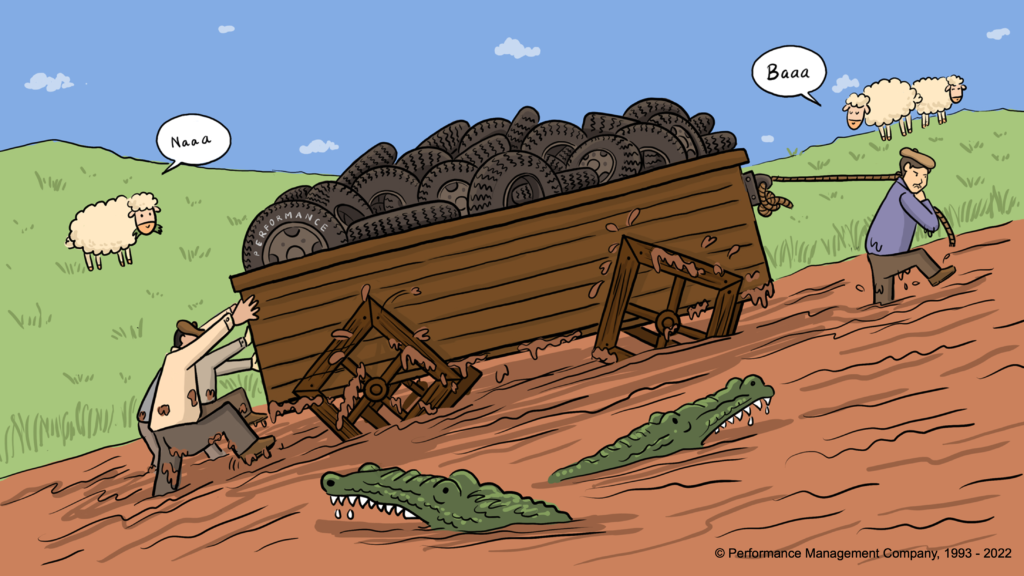
It’s just a cartoon, but can we use it to get people thinking differently?
Spectator Sheep And Emotional Safety
Spectator sheep are somatic creatures, too. I show them above, standing in a bit of isolation and voicing their opinions about how things are working: “Naaaaaaaa,” “Baaaaaaaa…”
People often become spectators not because they lack ideas, but because it feels unsafe in their bodies to step in: heart rate spikes, stomach knots, shoulders hunch, breath shortens. Their nervous system is remembering past experiences of being ignored, criticized, or punished. So, they react.
Talking with Spectator Sheep is often very educational, since they see things differently and are generally dissatisfied with the way things are. They CAN be engaged. When you talk with spectator sheep, you can ask:
-
“Think of a time you wanted to speak up but stayed on the sidelines. Where did you feel that in your body?”
-
“What would need to change—in how we respond, how we listen, how we follow up—for your body to feel safe stepping forward?”
You can help them choose to be active participants in changing things. And, here, the psychological safety isn’t just a concept. It’s anchored in physical sensations of openness vs. contraction. The team can design not only new behaviors (“We’re asking for your ideas”) but new energetic norms (“We’ll actually pause, breathe, and receive ideas before reacting”).
MOST people do want to add value if they feel respected and engaged.
Learning Projects That Include The Body
The Coaching School’s secret sauce is Learning Projects, those small, real‑world experiments that keep coaching alive between sessions. You can enrich these by adding a somatic reflection:
Instead of just:
-
“Next week, bring two examples where you replaced a Square Wheel question with a deeper Round Wheel question.”
Try:
-
“Next week, bring two examples where you replaced a Square Wheel question with a deeper Round Wheel question—and notice how your body felt before, during, and after you tried it.”
Invite people to report on:
-
What fear or tension showed up beforehand.
-
How their body reacted when they actually used the new behavior.
-
How they felt afterward—more drained, more energized, more grounded?
This turns Learning Projects into mini somatic experiments. People start to discover that some of their round wheels not only work better in the marketplace or workspace; they feel better internally. That positive somatic feedback becomes fuel for continued change.
Coaching The Whole Person, Not Just The Role
When you weave Vajda’s somatic lens into the Square Wheels metaphors and The Coaching School structure, you end up coaching the whole person:
-
Cognitively: They understand the wagon, the mud, the sheep, the silos, and the idea of Round Wheels.
-
Behaviorally: They design and test specific new actions in peer coaching, group coaching, and Learning Projects.
-
Somatically: They notice how old and new patterns live in their bodies and learn to self‑regulate as they change.
That third layer is often the difference between “We talked about this last quarter” and “I’m actually doing something differently now.”
People don’t just leave with better recipes and better metaphors. They leave with a felt sense of what it’s like to move through their workday on Round Wheels instead of Square ones—less strain, more flow, more choice.
And that felt difference is what keeps them coming back to making changes, long after the workshop is over. That is the essence of real continuous continuous improvement,
—
For the FUN of It!
 Dr. Scott Simmerman is a designer of team building games and organization improvement tools.
Managing Partner of Performance Management Company since 1984, he is an experienced presenter and consultant who is trying to retire!! He now lives in Cuenca, Ecuador.
You can reach Scott at scott@squarewheels.com
Learn more about Scott at his LinkedIn site.
Note that I often use Perplexity AI to help research and generate ideas for my posts.
Square Wheels® are a registered trademark of Simmulations, LLC
and images have been copyrighted since 1993,
© Simmulations, LLC 1993 – 2026
Connect with Peter Vajda, Ph.D. at his LinkedIn site: https://www.linkedin.com/in/petervajdaphd/
What I’m About:
My Square Wheels blog and website exist to help leaders, trainers, and facilitators make work smoother, more engaging, and more human. I focus on practical tools for process improvement, organizational change, and workplace collaboration that spark insight and deliver measurable results.
And I am convinced, after 30+ years of using Square Wheels®, that it is the best facilitation toolset in the world. One can use it to involve and engage people in designing workplace improvements and building engagement and collaboration. It is a unique metaphorical approach to performance improvement and we can easily license your organization to use these images and approaches.
By blending proven facilitation methods, creative problem-solving, and engaging team activities, my mission is to support organizations in building energized, sustainable cultures of involvement and innovation.
Through accessible — and often free — resources and virtual facilitation tools, I aim to help teams everywhere collaborate more effectively, innovate continuously, and take ownership of their improvement journey.
#SquareWheels #InnovationAtWork #TeamEngagement #FacilitationTools #WorkplaceImprovement #EmployeeEngagement #CreativeProblemSolving #OrganizationalDevelopment #LeadershipTools #collaboration #leadership #motivation #communications #enablement #leadership #CreativeCommons #enablingperformance #teamwork #storytelling #storyasking

0 Comments