
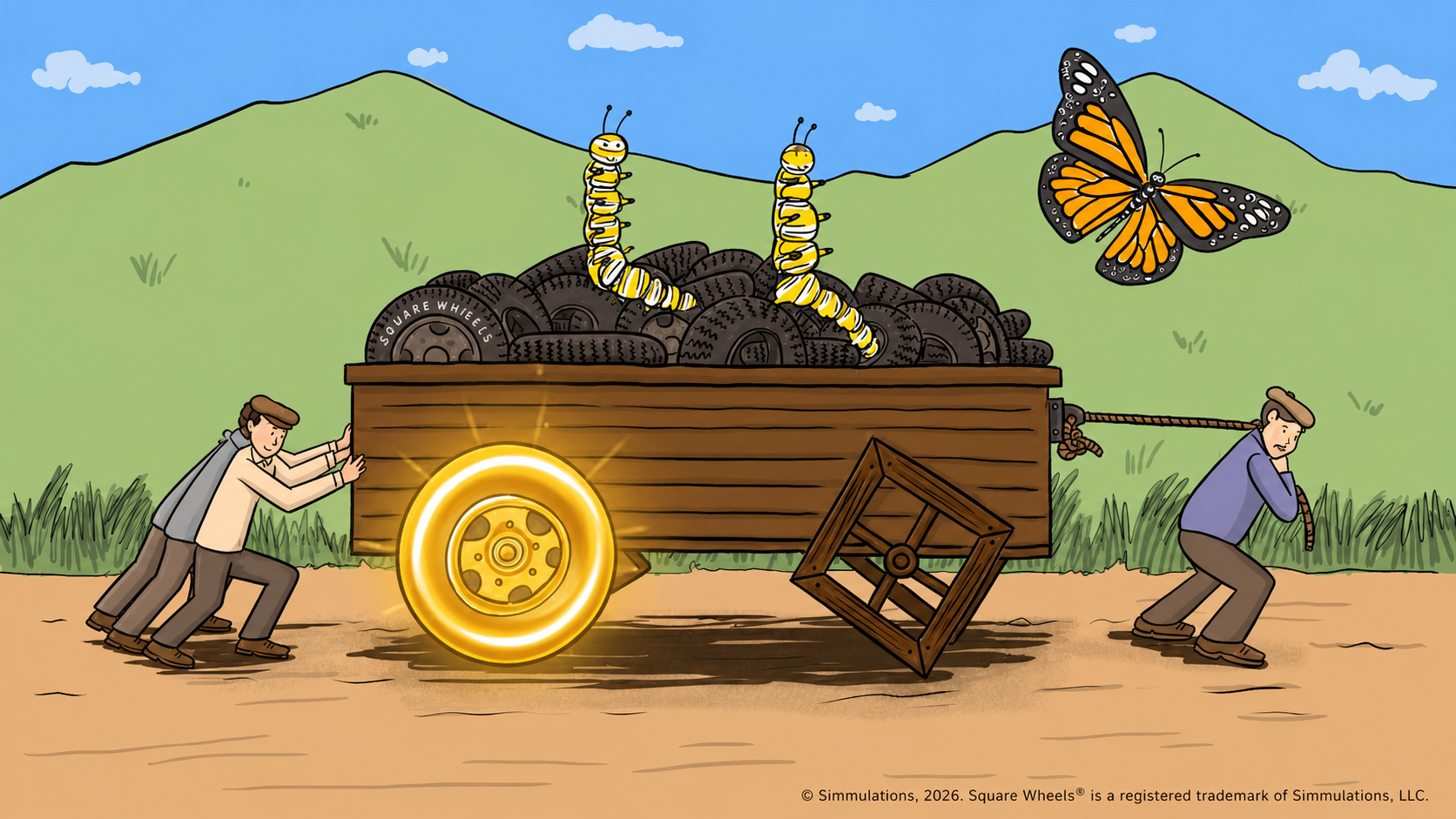
The next five years of AI at work will come from the managers who best involve and engage their people in the change and implementation process. People and organizations that can design simple, reusable systems that help their people “roll past resistance” and keep improving the way work actually gets done.
And they will involve and engage their people in the design and implementation of those tools, doing things WITH them rather than TO them and generating a sense of support and ownership rather than resistance and defense.
In other words: it’s not about wordsmithing requests and prompts to AI or creating agents; it’s about building repeatable loops of thinking and doing and then using tools like Square Wheels to make those loops visible, discussable, and fixable.You can read a solid explanation of the technical side of this in Inc.article (link).
Prompting Is Not the Performance Play
Over the past two years, “prompt engineering” became the hot new skill in AI. People took pride in having secret formulas that could coax better answers from ChatGPT, Claude, or whatever tool they were using.
But a growing chorus of practitioners and analysts are pointing out that this is a short‑lived advantage. Interfaces are getting easier; systems are becoming more autonomous; and the tricks that worked last year often don’t matter much this year. As Sam Altman has noted, the real leverage is shifting from “how do I prompt?” to “what problem am I actually trying to solve, and what questions should I be asking?”And there are the realities that workers (and even their managers) are actively resisting the implementation of AI tools. (See this HBR article, for example.)
That shift towards effectively using AI tools is critical for organizational performance: if our people obsess over prompts but never fix the wagon, we simply get faster, more polished answers to fundamentally misaligned questions.
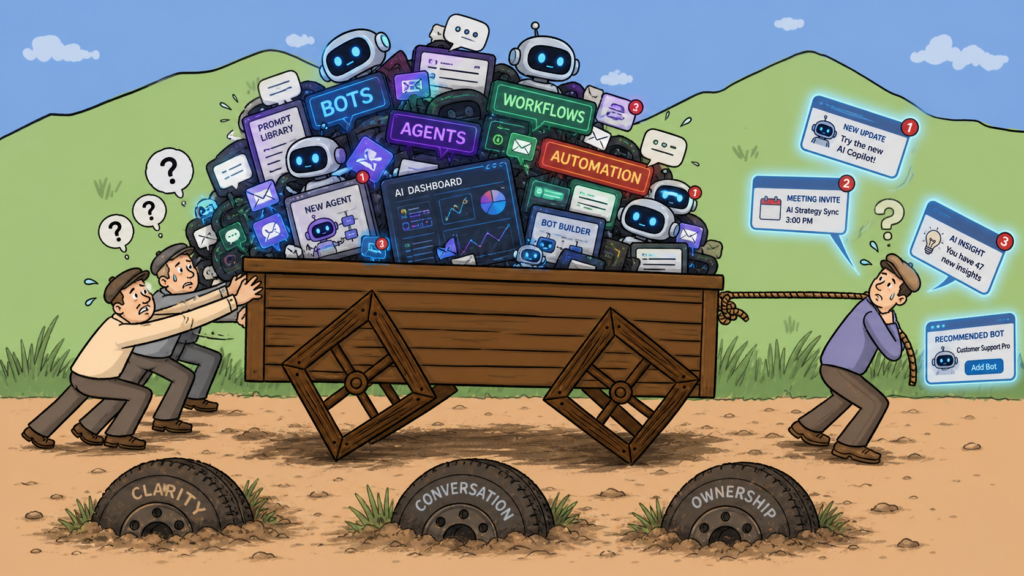
More AI tools in the wagon will probably not improve the journey.
The New AI Skill: Designing Loops, Not One‑Off Prompts
A key idea emerging in current writings about AI is that the most valuable skill is building loops or systems that are sustainable, not single interactions. Instead of typing a prompt, getting an answer, and moving on, high‑value users are designing workflows where AI keeps working until the job is actually done. And many of these tools can be shared and the process thus duplicated across a workgroup. It is similar to a best practice, a better way of doing things.
Effective AI loops operate something like this: define a goal, break it into steps, let AI plan and execute, check outputs against clear criteria, fix what’s not working, and repeat until you hit the target. Then share it. That’s dramatically different from “ask one clever question, hope for one great answer.”
From a leadership and OD perspective, this is exactly the territory where human skills matter: clarifying objectives, designing the workflow, and deciding where AI adds value versus where humans must stay fully in control.
And it’s where a visual metaphor like Square Wheels can turn invisible loops into visible, improvable systems.
Why AI Feels Like a Square‑Wheeled Wagon
In my recent article “Rolling Past Resistance: A Bombproof Visual Tool for Implementing AI at Work,” I framed AI implementation as yet another wagon we’re trying to pull over bumpy terrain. My Square Wheels One illustration below with some added caterpillars and a butterfly, is familiar to many since I first shared it in 1993: a wooden wagon rolling on wooden Square Wheels, with a cargo of round rubber tires. In other words, better tools are readily available (at hand? (grin), but not being used and everyone needs to stop pushing and pulling to step back and see the obvious things we can choose to do differently. Improvement is about reflection, perspective and observation.
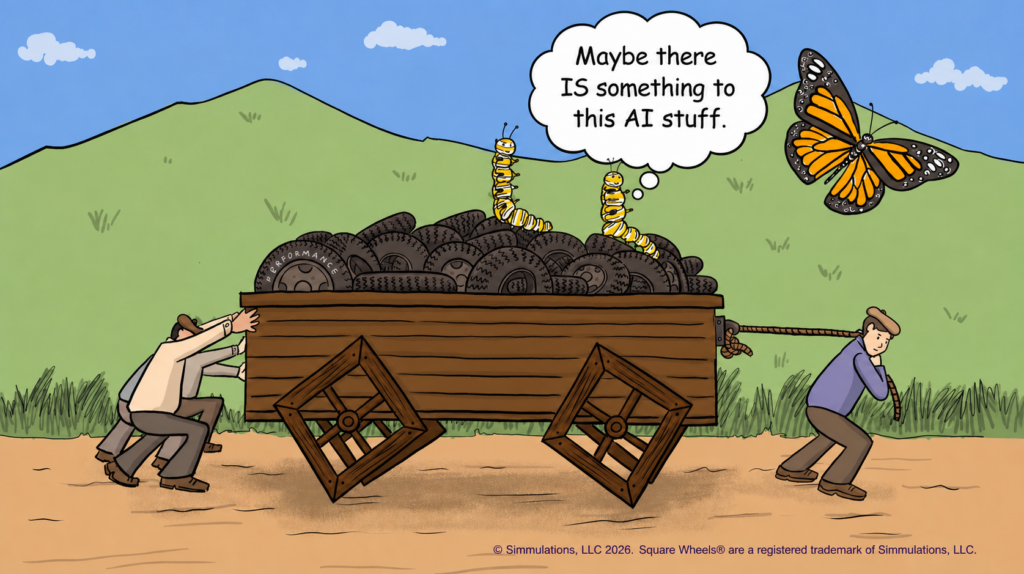
We must ask our people for their perspectives on what is not working well and what we should improve because they DO have perspective and they need ownership.
That image above captures several common realities of AI adoption:
-
We already have tools (round wheels) that could make work smoother, but they’re probably not well integrated into the current wagon operations.
-
Leaders and teams are sweating to pull the wagon, focused on today’s tasks, with little time or permission to stop and “change the wheels” to improve effectiveness.
-
Resistance often comes not from people being anti‑AI, but from people being buried under boxes, ambiguous goals, and unclear benefits. And, Fear is the mindkiller. (Dune) — People are scared of what all this means to them, personally.
When you combine today’s AI landscape with that wagon image and discussion from it, you get a clear insight: prompt engineering is mostly about pulling the wagon a bit faster. System design, with visual tools that let people understand how to improve the wagon and the journey forward, is about stopping long enough to mount the round wheels and change the ride.
Framing AI as a Shared Problem, Not a Magic Tool
One of the consistent findings in behavioral research and practice is that people engage more when they can see the problem and feel some ownership of the solution. In the AI domain, that means shifting from “Here’s a tool you must use” to “Here’s a shared workflow we can improve together.”
The Square Wheels approach and framework does exactly that. It takes something fuzzy like “AI adoption” and turns it into a simple picture that invites questions:
- What are our Square Wheels that we need to address?
- What round wheels already exist but aren’t being used?
- What AI loops and tools can function as round wheels to help us go more better and faster?
- Who owns what part of this wagon and what can we choose to do differently?
Recent commentary on building and implementing AI skills emphasizes that the enduring advantage isn’t knowing the latest trick, but understanding context: how your business really works, where friction lives, what fears and concerns are blocking adoption, and which changes will actually matter. Square Wheels images and tools simply give you a context canvas that frontline people, managers, and executives can literally point to and discuss.
The AI Loop Meets the Square Wheels Wagon
Let’s connect two dots:
-
The emerging AI skill is building loops and systems that keep working toward a goal, instead of relying on one‑off prompts.
-
Square Wheels® is an elegantly simple tool for making work systems visible, surfacing issues and opportunities, and creating simple language and momentum for improvement.
Put them together, and you have a practical enabling approach: use Square Wheels to map the current wagon operations and then design AI loops to reduce specific sources of friction. Instead of vague aspirations like, “we need more AI,” you get concrete targets like “we’ll use AI to shorten this approval cycle” or “we’ll use AI to clean this data stream.”
In this framing, AI is not the star of the show. The wagon is. AI becomes one of the round wheels we install, test, and refine as we roll forward.
A Simple Example: Automating a Clunky Reporting Process
Take a common scenario: a manager spends hours every week pulling data, cleaning it in spreadsheets, writing commentary, and emailing reports up the chain. That process is a classic Square Wheel—slow, inconsistent, and highly dependent on individual heroics.
Using Square Wheels, you’d first get people in a room and sketch the reporting wagon: the data sources, the manual steps, the delays, and the frustrations. People would quickly identify Square Wheels such as duplicated effort, copy‑and‑paste rework, unclear templates, and last‑minute changes.
Once the wagon is visible, you can introduce AI not as a shiny gadget but as a potential round wheel:
-
AI can help pull data from multiple sources into a single structure.
-
It can clean, standardize, and categorize data using rules you define.
-
It can draft summaries or interpretations that managers then review and refine.
Here’s where the loop skill shows up. You’d design a recurring workflow where AI does the first pass each week, the manager reviews and edits, and feedback is fed back into the system so the next round is better. Over time, you aren’t just “using AI”; you’re building a continuous improvement loop around the reporting wagon.
The visual metaphor keeps everyone grounded: if the loop introduces a new square wheel—bad data, confusing output—people can point to that wheel, name it, and work on fixing it.
The Loop becomes that Golden Round Wheel that generates continuous improvement and impacts the team, allowing the butterflies to fly.
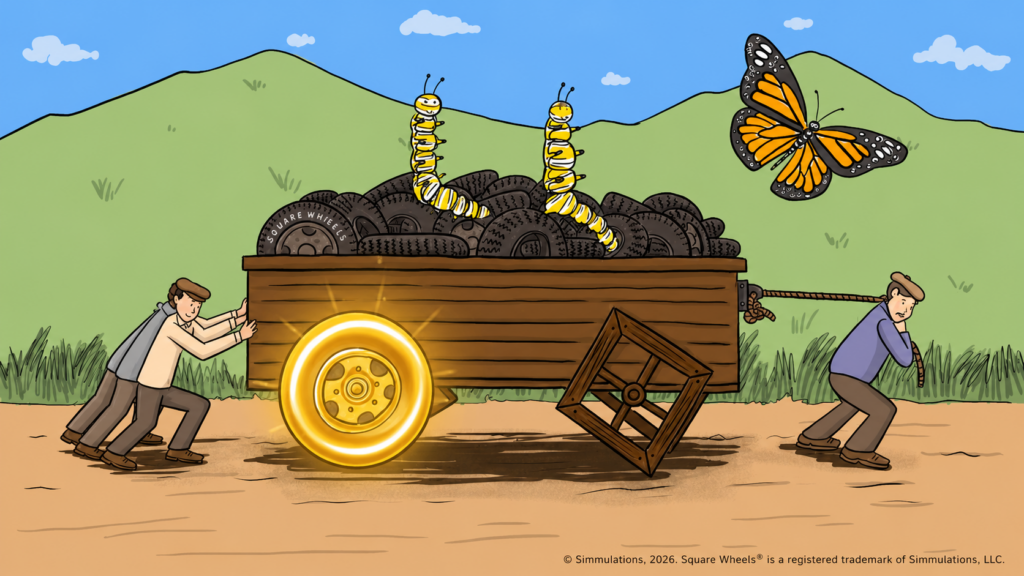
Implementing a round wheel is that GOLD we are looking for in our organizational improvement.
Rolling Past Resistance by Lowering the Cognitive Load
A major source of resistance to AI is cognitive overload: people already struggle to keep up with their current work; now we’re asking them to learn new tools, new jargon, and new workflows. The usual narrative, that “You just need better prompts,” adds pressure but rarely adds clarity.
Square Wheels reduce cognitive load by simplifying the conversation:
-
Everyone can understand a wagon rolling on Square Wheels and see that it’s hard to pull and push.
-
Everyone can see that round wheels might make things easier and speed the journey, even if they’re not yet sure what those wheels look like in practice and improvement will happen one wheel at a time.
-
Everyone can contribute ideas on which parts of the wagon they’d most like to improve.
When you align this with the new AI skills conversation, you send a helpful message for your teams:
“We’re not asking anyone to become prompt engineers. We’re asking you to help us see where the wagon thumps and drags, so we can experiment with AI loops that really help. Your expertise is in knowing where the work hurts and what ‘better’ would look like.”
That reframing turns resistance into curiosity, and curiosity into collaboration.
Leadership’s Role: Guiding the Wagon, Not Tweaking the Prompts
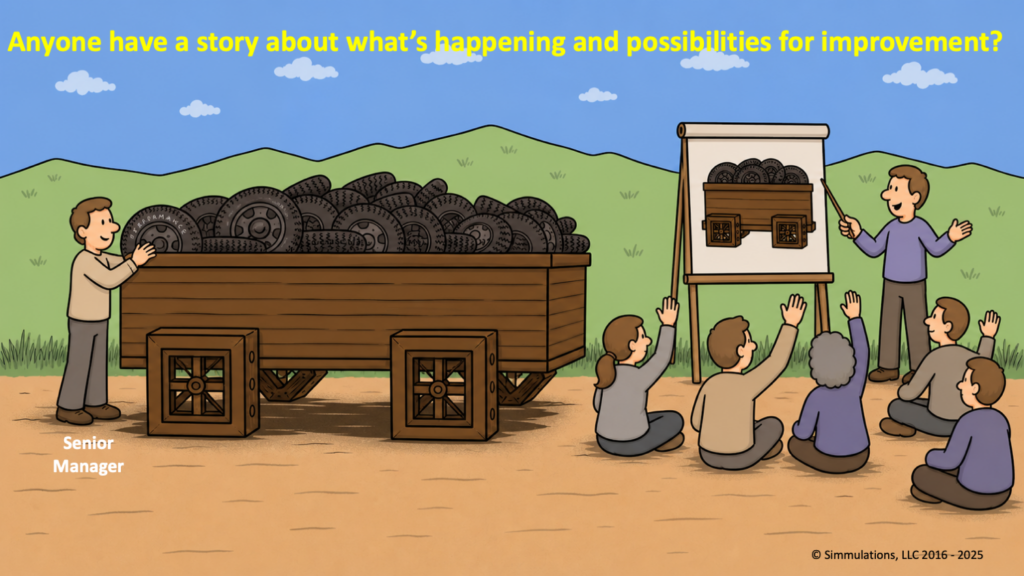
Thought leaders are increasingly stressing that the enduring AI skills are leadership skills: judgment, communication, and the ability to design workflows where AI serves clear objectives and improves performance. Leaders must decide where AI belongs, what constraints apply, and how success will be measured. Leaders must offer support more than solutions, especially when those might be resisted.
Square Wheels-facilitated conversations can anchor that leadership conversation around enabling people to roll farther faster. Rather than debating tools in the abstract, leaders can stand in front of the wagon improvement ideas and ask:
-
Which Square Wheels are we willing to tackle this quarter?
-
Where could AI realistically provide a round wheel?
-
How will we know if we’ve actually improved the ride?
By focusing on the wagon rolling metaphor, leaders avoid getting stuck in “tool debates” and keep attention on performance outcomes: less friction, more engagement, and smarter use of human capability.
Making AI Implementation “Bombproof” with Visuals and Loops
In the “Rolling Past Resistance” piece (see it here), I described the Square Wheels metaphor as “bombproof” — it’s simple, robust, and works across levels, cultures, and industries because people quickly and always see themselves in the picture. That’s exactly the kind of foundation we need to enable AI implementation, which can otherwise feel abstract, threatening, or fad‑driven.
If you combine that bombproof visual with the emerging insight that AI mastery means building loops and systems, not memorizing prompts, you get a practical path forward:
-
Use Square Wheels images and metaphors to map the current state of work—where the wagon drags, where effort is wasted, where delays and frustrations live.
-
Collaboratively identify specific Square Wheels where AI could credibly help: information overload, repetitive analysis, manual routing, or pattern recognition.
-
Design simple AI loops around those wheels: clear inputs, clear outputs, review steps, and feedback mechanisms.
-
Iterate visually—update the wagon drawing as you add round wheels and retire square ones, making progress visible and discussable.
Over time, teams don’t just “adopt AI”; they develop a shared capability to redesign wagons and loops together.
From “Better Prompts” to “Better Wagons”
The message for the next five years is straightforward:
-
Prompt engineering is becoming table stakes; systems and loop design are where real leverage will live.
-
AI skills will increasingly be about leadership, judgment, and workflow design, not just clever wording. People are afraid of this technology so help them feel a bit of active ownership involvement.
-
Visual projective tools like Square Wheels give you a way to actively involve and engage people in those conversations and make invisible systems visible.
If you want AI to actually improve performance, stop obsessing over getting the model to answer perfectly in one shot. Focus instead on building wagons that roll better, loops that learn, and conversations where people can see, and change, their own Square Wheels and support others in the improvement initiative because they own their ideas.
What part of your current “AI wagon” feels most square‑wheeled right now, the decision to use AI at all, the way you pick use cases, or how you involve your managers and teams in the design?
—
For the FUN of It!
 Dr. Scott Simmerman is a designer of team building games and organization improvement tools.
Managing Partner of Performance Management Company since 1984, he is an experienced presenter and consultant who is trying to retire!! He now lives in Cuenca, Ecuador.
You can reach Scott at scott@squarewheels.com
Learn more about Scott at his LinkedIn site.
Note that I often use Perplexity AI to help research and generate ideas for my posts.
Square Wheels® are a registered trademark of Simmulations, LLC
and images have been copyrighted since 1993,
© Simmulations, LLC 1993 – 2026
Note: Please do not take my images and think about using them. It can generate a whole heap of problems given international copyright law and trademark law. Read this article for more information.
What I’m About:
My Square Wheels blog and website exist to help leaders, trainers, and facilitators make work smoother, more engaging, and more human. I focus on practical tools for process improvement, organizational change, and workplace collaboration that spark insight and deliver measurable results.
And I am convinced, after 30+ years of using Square Wheels®, that it is the best facilitation toolset in the world. One can use it to involve and engage people in designing workplace improvements and building engagement and collaboration. It is a unique metaphorical approach to performance improvement and we can easily license your organization to use these images and approaches.
By blending proven facilitation methods, creative problem-solving, and engaging team activities, my mission is to support organizations in building energized, sustainable cultures of involvement and innovation.
Through accessible — and often free — resources and virtual facilitation tools, I aim to help teams everywhere collaborate more effectively, innovate continuously, and take ownership of their improvement journey.
#SquareWheels #InnovationAtWork #TeamEngagement #FacilitationTools #WorkplaceImprovement #EmployeeEngagement #CreativeProblemSolving #OrganizationalDevelopment #LeadershipTools #collaboration #leadership #motivation #communications #enablement #leadership #CreativeCommons #enablingperformance #teamwork #storytelling #storyasking


0 Comments