
Good Performance Feedback REALLY Matters. But it is the Supervisors who must turn it into improvement. Do they have the tools they need?
An organization can design its feedback systems carefully and still fail to improve. It can collect accurate performance data, run employee surveys, and produce attractive reports while people keep struggling with the same old problems.
Collecting good performance feedback is important. But information alone doesn’t put better practices in place. We also need supervisors who help people discuss obstacles, develop ideas, and turn improvements into everyday practice.
Conversation is what connects feedback to action, and that is where my Square Wheels images and metaphors can help. My tools are easy to use and highly impactful. We’ve got decades of stories and some brand new AI-supported tools.

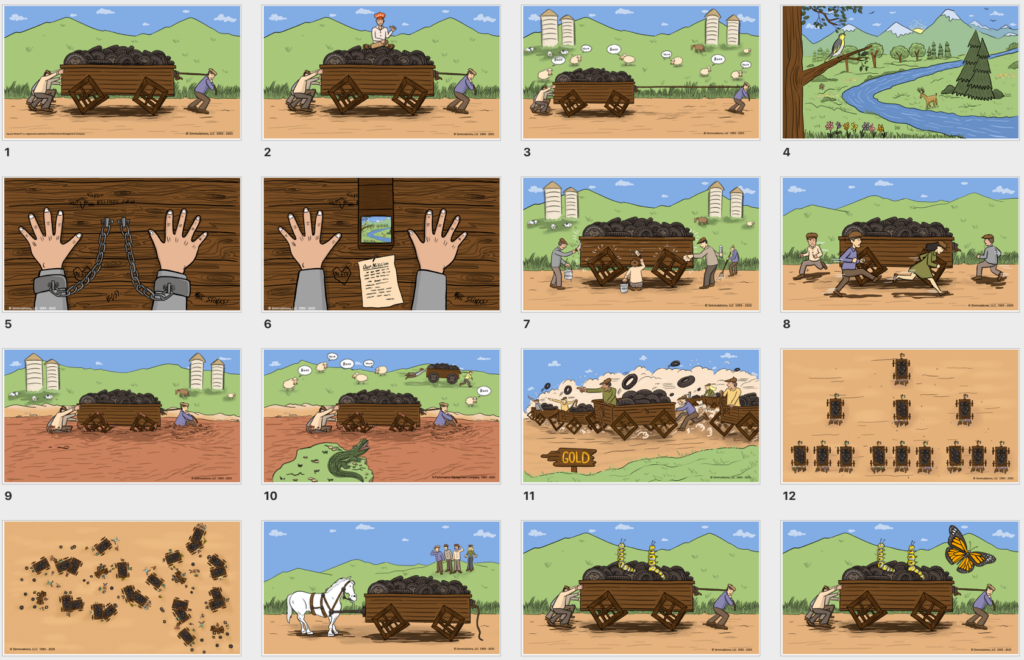
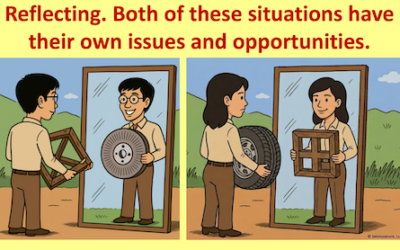
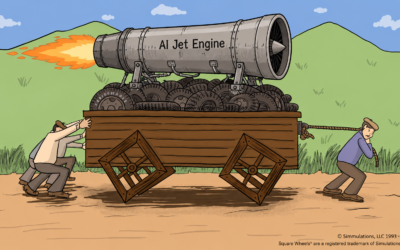
Here is the evolution of the images since 1993… Now with AI support for supervisors.
Notice both how hard their wagon is to move and the possibilities already available.
Structure the Feedback, Then Open the Conversation
Guido Betz’s Black Book Feedback Systems separates two things: designing a good feedback instrument and handling its results well. His central warning is simple. Even a well-designed tool can accomplish little, or even do harm, when people use it poorly. Surveys with no visible action and reports with no real discussion are problems Betz sees again and again.
My performance-feedback checklist covers another essential piece: people need timely, understandable information about meaningful accomplishments. You cannot learn to play the piano when the notes are even delayed 5 seconds — how can we expect people to perform in the workplace when the actual feedback is delayed by weeks or months?
People should be able to see their results, understand the standards, and recognize their progress in a timely and clear way. Good feedback helps build the intrinsic rewards that will help sustain improvement and change. Here is the checklist, with a click-link to the downloadable tools. The full article and details and explanations are here.
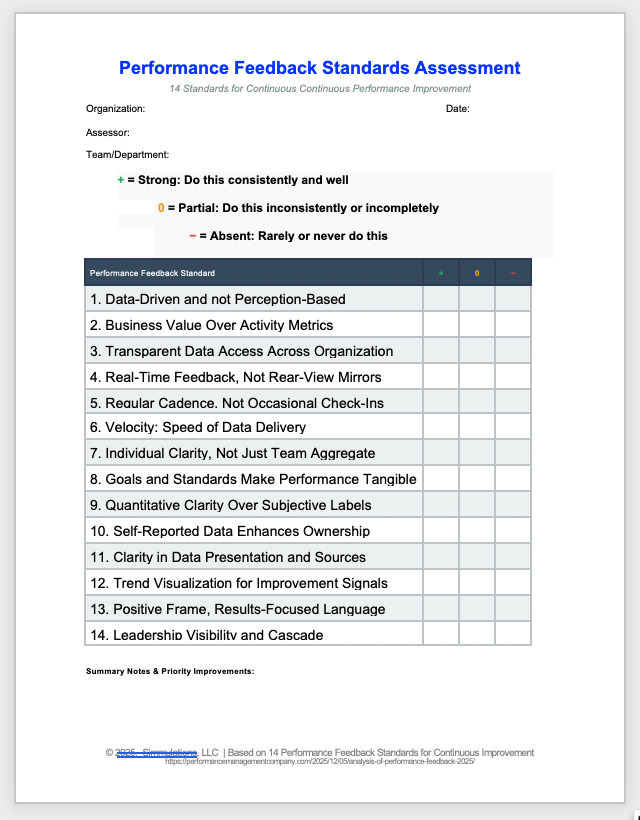
The two approaches complement each other and should be integrated to optimize outcomes, They answer different questions. (I put some sample checklist questions at the bottom.)
| Feedback component | The question it helps answer |
|---|---|
| Performance information | What are we accomplishing, and how does that compare with what’s needed? |
| Employee perspectives | What helps or gets in the way of the work, and what are people experiencing? |
| Facilitated improvement conversations | What could we change, what will we try, and how will we know it helped? |
Performance results and employee perceptions are not the same thing. Betz describes survey and 360-degree feedback as information about perceptions, while my performance management checklist focuses on measured accomplishments and results. Together they give a much stronger starting point for discussion than either one alone. And a key is to put the information in the hands of the supervisor so that the conversations can be regular and real. You cannot really expect this once-a-year review crap to be effective, can you?
Use Square Wheels frameworks to Make the Discussion Practical
Click on this image to download Square Wheels One, FREE
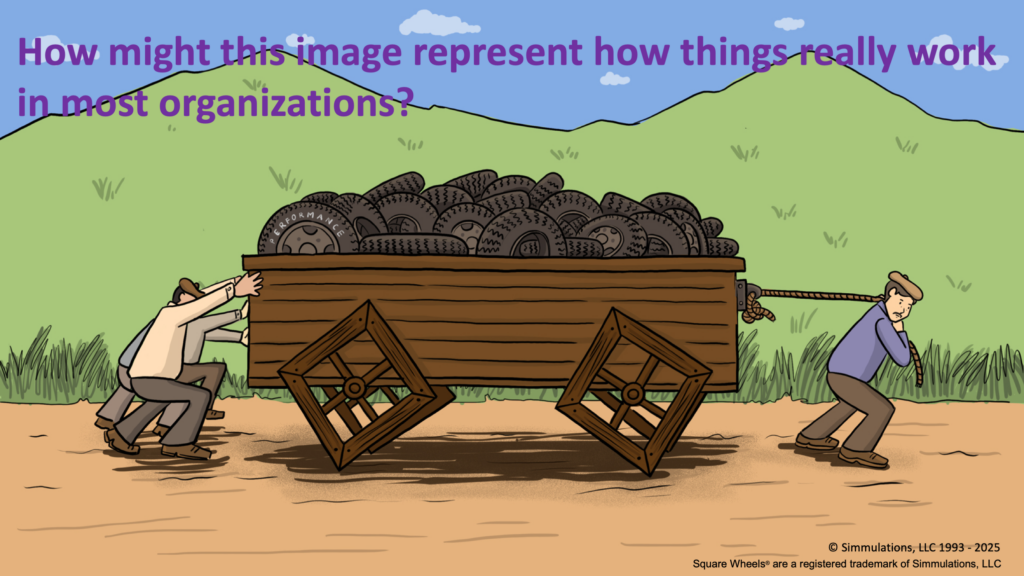
Square Wheels images, like Square Wheels One above, give people shared visual anchors for exploring how work actually gets done. They are projective tools, inkblots, that help people look at things differently and reflect on the ideas of others.
Instead of opening with “Why aren’t you performing better?”, a supervisor using one of the Square Wheels One images can ask:
“What are the Square Wheels making the work difficult, and what round wheels might we already have?”
That shifts the conversation from defending a score to exploring possibilities for improvement.
(And note that we have hundreds of different images focused on so many different aspects of the situation with people and performance in the workplace. We can help you construct a toolkit for the organization.)
We commonly find that your people may already know a better way to do things. Another team may have solved a similar problem. An old procedure may no longer fit the work. The idea that “the round wheels are already in the wagon” fits closely with Betz’s advice to share successful practices across organizational boundaries.
The supervisor doesn’t need to have every answer.
The job is to help people bring their knowledge forward,
look at alternatives, and agree on something worth trying.
No one else is remotely positioned to actually do this!
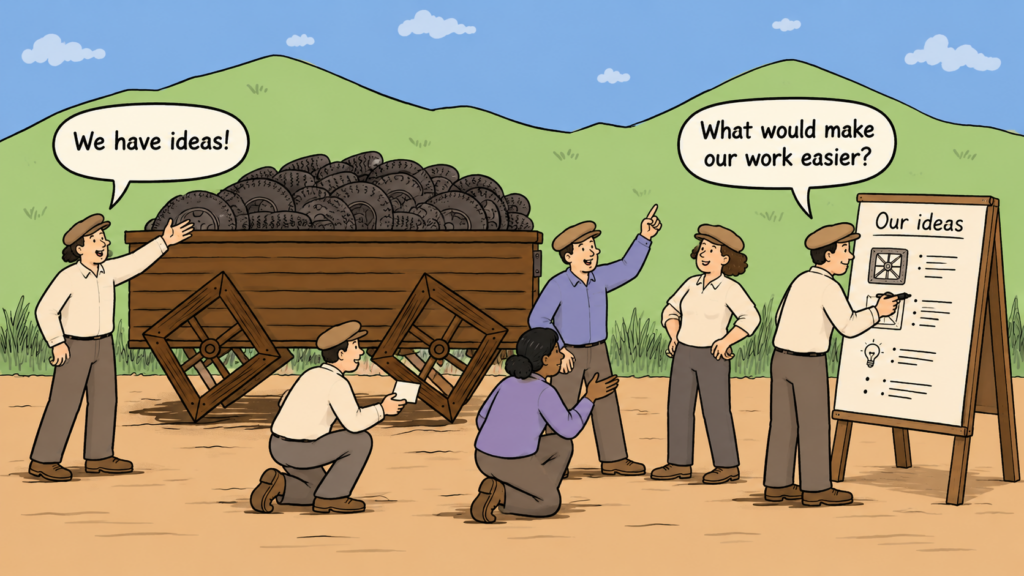
Supervisors Must Enable More Than Reporting
Asking for ideas is not the same as enabling innovation.
A useful next step is to build a simple improvement conversation around the feedback. What is happening? What makes it difficult? What should happen? What could we try? What support do we need? What result would tell us the change helped?
This gives supervisors a role beyond explaining targets or reporting shortfalls. They can remove barriers, coordinate with other departments, support small experiments, and bring people back together to review the results. Collaboration is possible.
Betz puts it neatly: “Feedback is the beginning of a conversation, not a replacement for it.” He also stresses that people need to see what changed because they spoke up.
| Feedback standard | What the supervisor does with it |
|---|---|
| Measured accomplishments, not impressions | Opens with real results, then asks what makes them harder to achieve than need be |
| Clear goals and standards | Makes sure everyone agrees on what “better” looks like before anyone judges a score |
| Timely, current information | Discusses results while people can still act on them |
| Performer ownership | Asks people to read their own data and suggest their own next steps for improvement |
| Visible trends | Shows whether an installed round wheel is still working over time |
| Positive, results-focused language | Recognizes progress without filtering out bad news |
Feedback quality and supervisor behavior go hand in hand. Feedback is a powerful tool for self-improvement. Excellent data that nobody discusses changes very little. A great discussion with no credible data drifts into opinion.
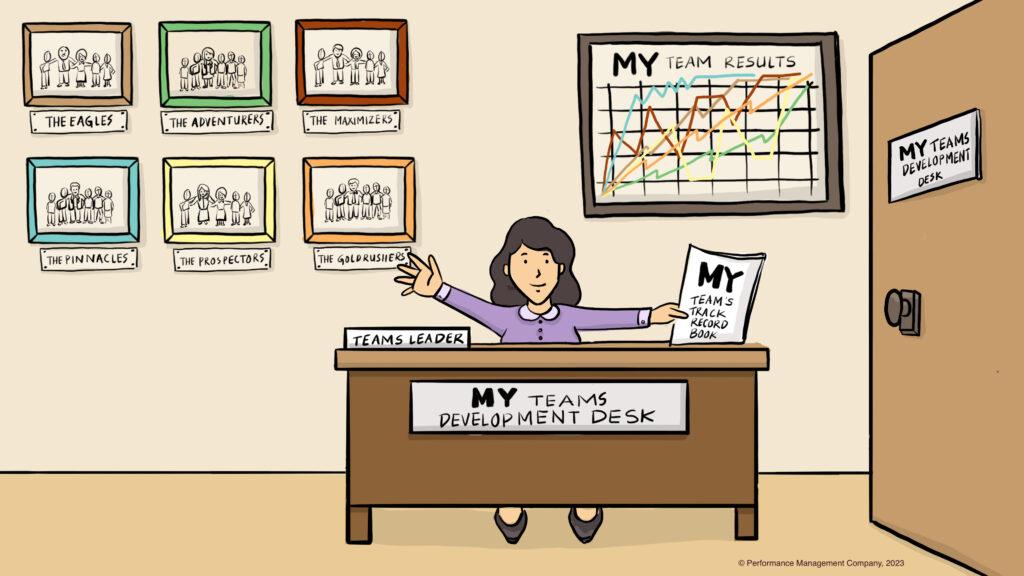
Managers should support collaboration between the teams and share effective performance information and feedback.
Make the Improvements Visible
An improvement idea should lead to more than enthusiasm. Write down what will be tried, who will support it, and when the team will look at the results. Then use good performance information to measure progress, and ask employees whether the work actually got easier or more effective. Embed these ideas into your regular performance reviews with your teams, not the annual one but the weekly ones!
When a suggestion can’t be implemented, explain why. Betz says there are three legitimate responses to feedback: make the change, ask for help making it, or explain a real limitation. The leadership / motivational failure is ignoring the feedback to the players.
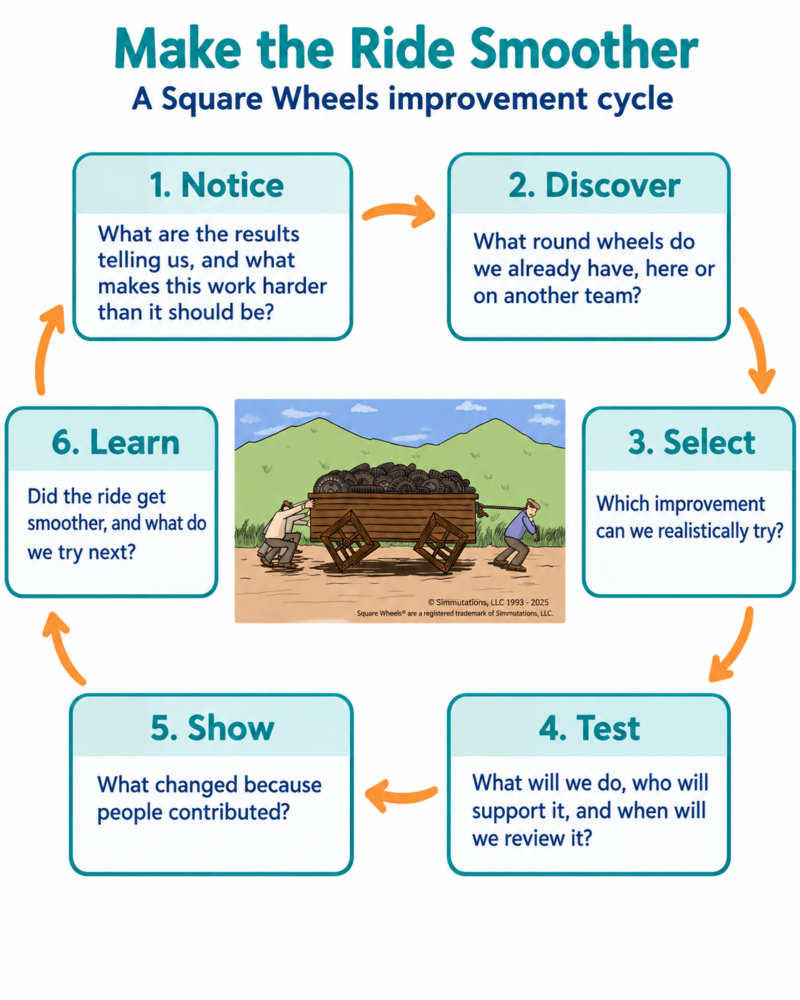
None of this needs a complicated practice. It needs fo feel real and it needs to become part of the overall workplace management practices, not some “program” to do for a week or two. It needs a predictable rhythm and flow to feel natural:
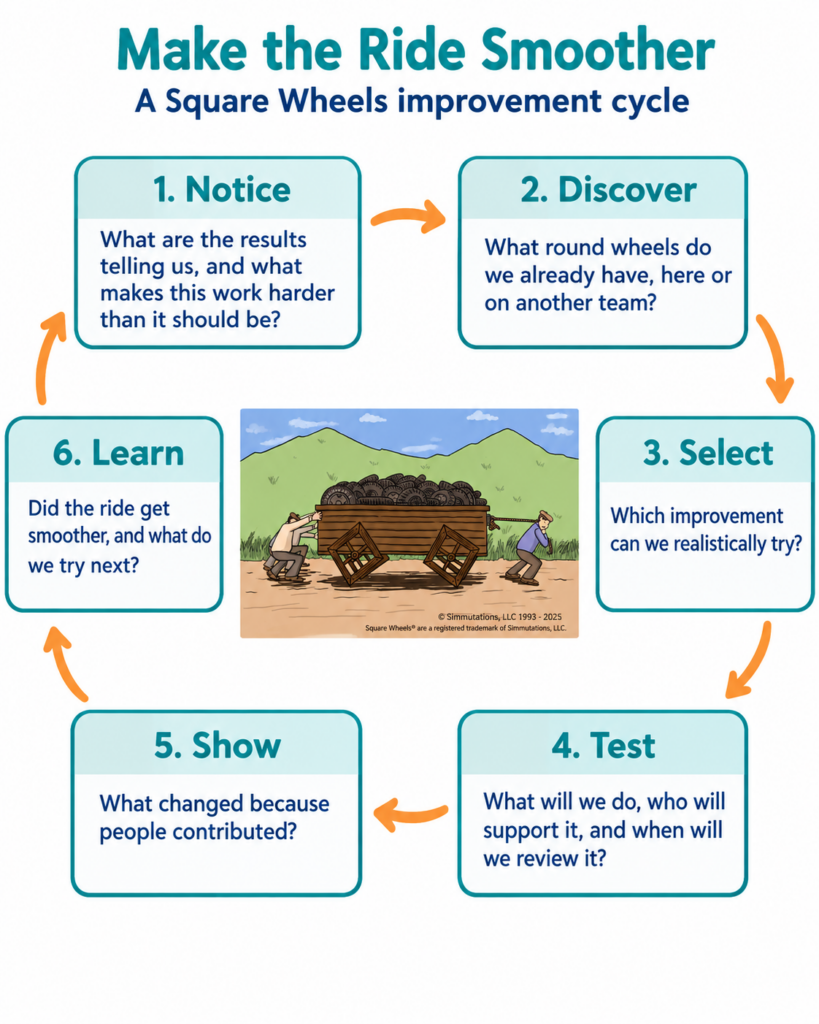
Make this flow a normal part of your results reviews with your people to keep them involved and engaged in continuous continuous improvement.
When teams repeat this cycle, feedback stops being something that happens to people and becomes a normal part of how they get better.
The Bottom Line
Good performance feedback is necessary, but it isn’t enough. Organizations can write better questions, deliver cleaner reports, and measure what really matters, and still get stuck if supervisors treat feedback as the end of the process.
The opportunity is to set up feedback so it leads directly into conversation. Square Wheels gives people a safe, shared way to talk about obstacles and possibilities. Good data shows whether their ideas are working. Supervisors who make room for that conversation, remove barriers, and celebrate the round wheels that get installed turn feedback into innovation.
We don’t need another report confirming that the wagon is hard to move. The round wheels are usually already in the wagon, and the supervisor’s job is to help people find them, put them on, and see how much better the ride can be.
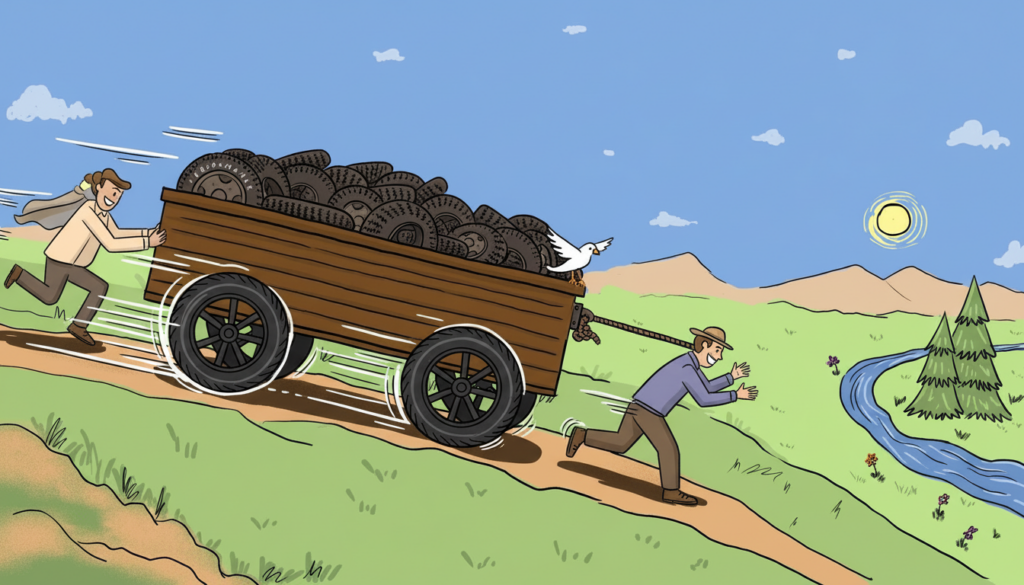
If you’d like a structured way to start these conversations with your supervisors and teams, the Square Wheels tools and my performance-feedback checklist are designed to work together. I’d be glad to talk about how they could fit your organization.
Here are five questions drawn from my performance management checklist, phrased as questions rather than quoted verbatim from the standards in my article. There are 14 in total:
-
Is performance feedback based on actual measured accomplishments rather than guesses, impressions, or subjective opinions?
-
Does the information highlight results that have value to the organization, rather than simply measuring activity or effort?
-
Does performance information routinely reach the people doing the work—not just management?
-
Is feedback timely enough for people to adjust their behavior and improve performance while it still matters?
-
Are results measured against clear goals or standards so people know how their performance compares with expectations?
The Checklist article presents these standards as a discussion tool, not a prescription. For each question, participants can assess their current system as Strong, Partial, or Absent, then identify opportunities for improvement. It generates a conversation about possibilities
—
For the FUN of It!
 Dr. Scott Simmerman is a designer of team building games and organization improvement tools.
Managing Partner of Performance Management Company since 1984, he is an experienced presenter and consultant who is trying to retire!! He now lives in Cuenca, Ecuador.
You can reach Scott at scott@squarewheels.com
Learn more about Scott at his LinkedIn site.
Square Wheels® is a registered trademark of Simmulations, LLC
and images are © Simmulations, LLC 1993 – 2026
Note: Please do not take my images and think about using them. It can generate a whole heap of problems given international copyright law and trademark law. Read this article for more information.
See a detailed overview of my tools, background and experiences by clicking here.
What I’m About:
My Square Wheels blog and website exist to help leaders, trainers, and facilitators make work smoother, more engaging, and more human. I focus on practical tools for process improvement, organizational change, and workplace collaboration that spark insight and deliver measurable results.
And I am convinced, after 30+ years of using Square Wheels®, that it is the best facilitation toolset in the world. One can use it to involve and engage people in designing workplace improvements and building engagement and collaboration. It is a unique metaphorical approach to performance improvement and we can easily license your organization to use these images and approaches.
By blending proven facilitation methods, creative problem-solving, and engaging team activities, my mission is to support organizations in building energized, sustainable cultures of involvement and innovation.
Through accessible — and often free — resources and virtual facilitation tools, I aim to help teams everywhere collaborate more effectively, innovate continuously, and take ownership of their improvement journey.
#SquareWheels #InnovationAtWork #TeamEngagement #FacilitationTools #WorkplaceImprovement #EmployeeEngagement #CreativeProblemSolving #OrganizationalDevelopment #LeadershipTools #collaboration #leadership #motivation #communications #enablement #leadership #CreativeCommons #enablingperformance #teamwork #storytelling #storyasking #enablement #disruptiveengagement #un-dis-engagement #un-dis-empowerment #innovation
© 2026 Simmulations, LLC. Please note that “Square Wheels®” is a registered trademark of Simmulations, LLC. and materials, original wagon line art, text, and visual designs are protected. Original line art by Roy Sabean, used under rights owned by Simmulations, LLC and formerly Performance Management Company, a sole-proprietorship of Dr. Scott J. Simmerman. Original concept and source artwork © Simmulations, LLC; derivative visuals sometimes created with assistance from Perplexity Pro AI.


0 Comments