
Analysis of Feedback: A 2025 Framework for Continuous Continuous Performance Improvement for generating intrinsic motivation
The Timeless Principle of Performance Feedback
It’s difficult to play the piano when you cannot hear the notes or if the notes are muffled or delayed. It is much the same with managing people—getting good feedback is important. But most performance feedback systems remain far from optimal, almost like not being able to hear any notes.
Performance improves itself when good feedback is available and the performance itself becomes rewarding.
Yet, here is the crazy part: MOST performance feedback systems can easily be improved. It is not rocket surgery and we will share some simple ideas below that can begin the improvement process. Basically, ANY improvement will be an improvement.
And performance feedback helps drive engagement and active involvement in so many organizational development opportunities.
Today’s workplace has transformed dramatically. Remote and hybrid work, distributed teams, real-time data systems, and shifting employee expectations demand a reimagined approach to feedback. Yet the fundamental principles underlying human behavior remain unchanged: accuracy, timeliness, specificity, and transparency drive results.
When things look like this:

Do this:
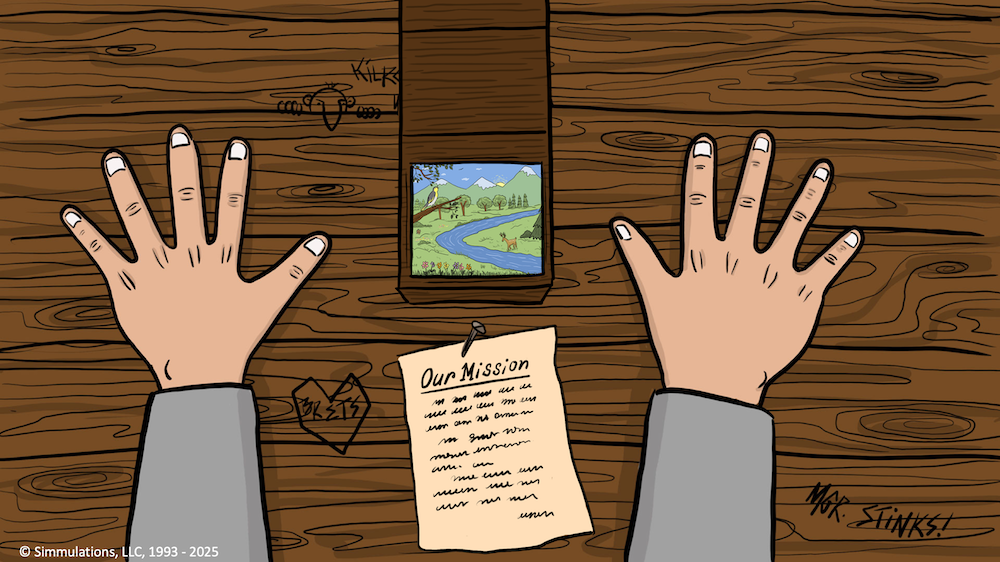
People need to see the vision and also know how they are performing
14 Feedback Effectiveness Standards for the Modern Workplace – Items for a Checklist (with the checklist below)
Assess your current system. Mentally, check those you do well:
-
Data-Driven and not Perception-Based
The Standard: Information on performance is based on actual measured accomplishment and not on guesses, impressions, or subjective opinions about how well people perform.
Why It Matters: In today’s distributed work environment, managers cannot rely on in-office visibility. Some remote workers may respond quickly to Slack but deliver mediocre output. Others work asynchronously and appear “offline” while producing exceptional results. Psychological biases—halo effects, recency bias, affinity bias—distort perception-based feedback. Hard metrics eliminate favoritism and provide objective truth.
Today’s Application: Leverage your existing tools (project management platforms, CRM systems, analytics dashboards, production metrics) to generate performance data automatically. Reduce reliance on manager observation or impression.
-
Business Value Over Activity Metrics
The Standard: Information highlights areas of performance that have quantifiable value to the organization rather than focusing on activity, effort, or general areas of personal preference.
Why It Matters: The distinction between activity and results has never been sharper. A salesperson can make 100 calls while landing zero deals. A software developer can attend all meetings but ship nothing. What matters: revenue generated, bugs fixed, customer satisfaction, retention rates, value delivered. Feedback should be ruthlessly focused on bottom-line impact.
Modern Application: Identify 3-5 leading indicators tied directly to organizational outcomes. Move beyond “effort looks good” to “this metric achieved our target.” Use OKRs (Objectives and Key Results) to align individual feedback with company goals. Avoid measuring busy-ness.
-
Transparent Data Access Across the Organization
The Standard: Performance information routinely goes to the people who do the work, not just to management. Everyone with relevant responsibility has visibility into performance data.
Why It Matters: Information asymmetry breeds disengagement and perception gaps. When only managers possess data, employees assume silence means “acceptable” or worry in the absence of information. Transparency builds trust, enables self-correction, and distributes accountability. Modern workforces expect data access.
Modern Application: Create dashboards, automated reports, or mobile app access that lets individuals pull their own performance data on demand. Share team performance summaries openly. Use internal communication channels to broadcast positive results. Make data accessible 24/7.
-
Real-Time Feedback, Not Rear-View Mirrors
The Standard: Information shows current levels of performance rather than being delayed by weeks or months; timing is immediate enough to enable self-correcting actions in real-time.
Why It Matters: Feedback delayed by a month is nearly or totally worthless. Behavior changes when feedback is proximate to action. This principle has been neuroscience-validated: working memory fades in minutes, and the behavior-feedback connection becomes impossible to reconstruct after delay. Annual reviews are antiques and should simply go away for all the damage they can cause.
Modern Application: Implement continuous feedback systems for continuous continuous improvement. Use monitoring tools where appropriate (not invasive—focus on output, not keystrokes). Send performance alerts same-day or next-day at latest. Create standing cadences: daily standups, weekly check-ins, bi-weekly reviews. Use mobile notifications for milestone achievements.
-
Regular Cadence, Not Occasional Check-Ins
The Standard: Results are reported consistently on a predictable schedule, not on a haphazard or occasional basis. Random additional feedback is certainly encouraged but regular timely feedback is essential.
Why It Matters: Consistent reporting sets organizational culture: “We measure what matters, and we care about improvement.” Irregular feedback signals that performance management is a compliance checkbox, not core to how you operate. Regular cadence enables people to plan adjustments and track progress over time.
Modern Application: Establish feedback frequency that matches role requirements. Knowledge workers might thrive with weekly touchbases; manufacturing roles may need daily or even hourly dashboards. Create standing 1-on-1 schedules. Use calendar reminders. Make regular check-ins non-negotiable, even when results are strong, to sustain performance.
-
Velocity: Speed of Data Delivery
The Standard: Data is available to performers immediately—ideally seconds or minutes after task completion, but realistically within 24 hours at most.
Why It Matters: Learning science confirms: immediate feedback fundamentally changes behavior. It is that piano-thing where even a 30 second delay makes good performance impossible. A sales rep knowing conversion rate in real-time shifts approach mid-call. A customer service representative seeing satisfaction score minutes after interaction adjusts next conversation. Delays destroy feedback efficacy.
Modern Application: Automate data feeds. Use APIs and integrations so performance metrics flow to dashboards automatically. Implement system notifications for key events. Where manual entry is needed, create easy-entry forms accessible on mobile. The goal: feedback appears faster than the performer forgets the action.
-
Individual Clarity, Not Just Team Aggregate
The Standard: Information shows individual performance results, not only group averages or team totals. Peer group performance can be supportive but it alone will not drive individual performance results effectively.
Why It Matters: Top performers can go unrecognized, buried in team metrics. Poor performers hide in averages. Individual clarity enables targeted recognition, targeted support, and fair accountability. People want to know how they performed, not just “the team did okay.” Both are important and teamwork should be encouraged, but not competition. Competition creates LOSERS.
Modern Application: Disaggregate team data into individual components. Create personal performance dashboards. While celebrating team wins publicly, provide individual feedback privately. Use comparison benchmarks (“you’re in the top 20% of the team,” “you’ve improved 15% from last quarter”) to contextualize individual results.
-
Goals and Standards Make Performance Tangible
The Standard: Results are measured against explicit performance goals or standards—whether individual targets, group benchmarks, historical performance comparisons, or industry standards.
Why It Matters: Without context or a target, performance is meaningless. Is 10 sales a month good? Without knowing the goal is 15, the context is missing. Standards provide the psychological challenge Csikszentmihalyi described as “flow”—the sweet spot between boredom (easy) and anxiety (impossible). Clear standards motivate. (See my article on Flow and performance here.)
Modern Application: Cascade organizational goals to team and individual levels using frameworks like OKRs, SMART goals, or MBOs. Make goals visible and updated. Share historical benchmarks so people can see improvement trends. Consider peer comparison (anonymized) for context: “You’re 5% below team average, and here’s the gap. What are some of your ideas?”
-
Quantitative Clarity Over Subjective Labels
The Standard: Performance is measured by precise numbers, not vague subjective evaluations like “good,” “satisfactory,” or “meets expectations.” We need good standards of performance and what gets measured gets done has always been true.
Why It Matters: “You’re performing well” really means nothing. “You completed 47 customer calls this week against a target of 45” is clear. Subjectivity introduces bias. Different managers define “good” differently. Numbers create shared understanding and remove ambiguity. Numbers also hold managers accountable for consistency.
Modern Application: Replace rating scales (“1-5 performance”) with specific metrics. Instead of “leadership is improving,” say “led 3 cross-functional projects this quarter.” Use concrete numbers: calls handled, revenue closed, defects per thousand units, customer satisfaction scores (NPS, CSAT), project delivery dates met.
-
Self-Reported Data Enhances Ownership
The Standard: Performance information is collected and summarized by the performer, not exclusively by someone else (manager, HR, tracking system). They will trust their own data more than that of others they may not trust. Trust is earned.
Why It Matters: Self-collected data increases perceived accuracy (“I did this; I know it’s true”), creates active involvement in the performance system, and deepens understanding of how metrics work. Employee-generated data also surfaces issues with measurement—if performers can’t gather the data easily, the metric might be poorly designed.
Modern Application: Use tiered data collection: automate what you can (system-generated metrics), but have performers also self-report qualitative achievements, obstacles, and context managers can’t see (“we pivoted strategy mid-project which delayed launch but saved costs”). Create simple weekly self-check templates. Employees review their own dashboards and report anomalies.
-
Clarity in Data Presentation and Sources
The Standard: Data is presented in a format that’s easy to understand, with clear sourcing and definitions so people know exactly what they’re looking at.
Why It Matters: Data that isn’t understood is useless. If performers question the source, the calculation, or the meaning, the feedback loses power. Confusion breeds skepticism and disengagement. Simple, clear presentation increases comprehension and acceptance.
Even though excellent in reality, hearing, “your performance i sone standard deviation about the mean” is not effective for motivating most people. Keep feedback simple and clear.
Modern Application: Create data dictionaries explaining metrics if need be. Use dashboards with visual hierarchy: most important metrics first, supporting details second. Include legends, definitions, and data-sourcing notes. Show calculations transparently. Use plain language, not jargon. Test clarity with your least-technical performers—if they understand, everyone will.
-
Trend Visualization for Continuous Improvement Signals
The Standard: Performance trends (positive and negative) are made visually apparent through graphs, charts, and longitudinal comparisons. Information is displayed visibly, either publicly for team environments or in personal dashboards.
Why It Matters: Small improvements, in small increments, characterize real performance improvement. A 2% gain goes unnoticed without trend visualization. When no one sees the improvement, motivation extinguishes. Trend charts signal progress and enable continuous reinforcement. Visual data is processed faster and remembered longer than tables of numbers.
Modern Application: Use sparklines, line graphs, and heatmaps to show performance over time (last 4 weeks, 13 weeks, year-over-year). Create visual alerts for significant changes. Show confidence bands or ranges. Post trend dashboards in team areas (physical or digital) for public recognition. Use color-coding: green for improvement, yellow for plateau, red for concerning declines. Video dashboards work beautifully for this.
-
Positive Frame, Results-Focused Language
The Standard: Data is expressed in positive terms—emphasizing results achieved and accomplishments rather than errors, failures, or complaints.
Why It Matters: Neuroscience shows chronic negative feedback activates threat response (amygdala), reducing cognitive function and motivation. Chronic negativity trains people to minimize risk rather than maximize performance. A feedback system drowning in error reports, complaints, and defects becomes background noise that people learn to ignore. Positive framing doesn’t ignore problems; it frames them as opportunities for improvement, not moral failures.
Modern Application: Reframe deficit-focused metrics. Instead of “errors per month,” use “accuracy rate” or “defects prevented.” Instead of “late deliveries,” report “on-time rate.” When problems exist, present them as opportunities: “We can improve efficiency here from 85% to 90%; here’s what that would enable.” Use recognition and celebration of wins prominently; flag concerns conversationally, not punitively.
-
Leadership Visibility and Cascade
The Standard: Performance information is summarized and reviewed by leadership levels to ensure organizational recognition of achievement and sustained commitment to performance improvement.
Why It Matters: Without senior leadership actively engaging with performance data, feedback systems become compliance exercises. If the CEO doesn’t review performance trends, middle managers disengage. Conversely, when leaders visibly consume, celebrate, and act on performance data, the entire culture shifts. Leadership engagement signals “this matters.”
Modern Application: Build leadership dashboards aggregating performance metrics. Schedule monthly/quarterly leadership reviews of performance data. Publicly celebrate top-performing teams and individuals (especially cross-functionally). Have senior leaders attend team standups or virtual celebrations. When leaders mention performance improvements in all-hands meetings, the message cascades: “We care about this.”
Implementation Notes: The Path Forward
This framework is a discussion tool, not a prescription. Every organization differs. Use it to audit your current system, identify gaps, and prioritize improvements.
Scoring Your System
Rate yourself on each of the 14 standards. If you did not review as a checklist, go back and revisit.
- ☑ Strong: We do this consistently and well
- ◔ Partial: We do this inconsistently or incompletely
- ☐ Absent: We rarely or never do this
Most organizations score 4-5 out of 14. This is normal and fixable. An improvement of +2 standards often produces significant performance gains, so that might be relatively easy to generate and you will immediately see the differences.
LOW scores on the above are normal but consider that as showing you have a clear opportunity to do some things differently and doing those things WILL generate performance improvement. That is a very clear reality when it comes to managing human behavior. Guaranteed.
Note that when you do things differently, that often causes some level of discomfort. But change only occurs where there is some discomfort with the way things are now — that is what helps to motivate change.
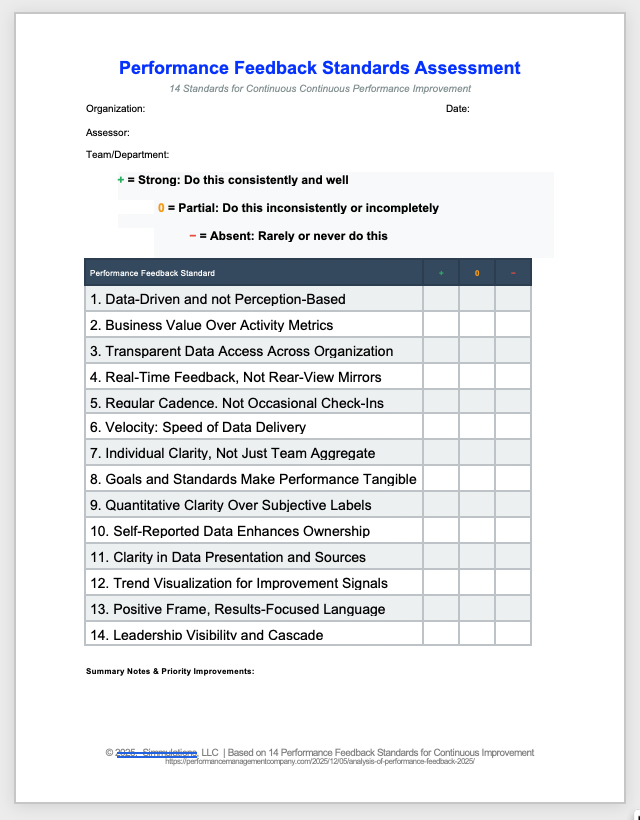
If you want the above pdf file of the Performance Feedback Standards Assessment CHECKLIST, send me an email or message me on LinkedIn. Somehow, I am not able to load this into the blog. Square Wheels are everywhere!!
The Deming Caveat about rewards
Edwards Deming’s warning remains relevant: if you couple feedback tightly with rewards (especially zero-sum individual rewards), people will optimize for the measured metric and ignore unmeasured but critical behaviors. Design your system to reward outcomes, not to game measures. Think systems, not silos.
Starting Small
You cannot implement all 14 standards overnight. Prioritize:
- Identify your highest-impact metric. What single performance indicator moves your business most?
- Make it real-time. Move that metric from monthly review to daily or weekly visibility.
- Share it transparently. Put the metric where performers and their peers can see it.
- Celebrate progress. When that metric improves, make it visible and acknowledge the effort.
- Rinse and repeat with the next metric.
The Psychological Foundation
Feedback works because humans are fundamentally motivational creatures. We want to know how we’re doing. We want to improve. We want recognition. Performance feedback systems that honor these basic drives—by being honest, timely, specific, and celebratory—become virtuous cycles: good feedback → better performance → more positive feedback → sustained improvement.
The piano analogy still holds. Delayed notes don’t produce music. A feedback system with 12-month delays produces noise, not harmony.
Key Shifts from 2013 to 2025
The 14 standards remain timeless and I generated the 2014 list from the one I was using back in the 1980s. These are strongly anchored in the performance management approaches of people like Tom Gilbert. Douglas McGregor and W. Edwards Deming and so many other organizational performance thinkings. But the application and possibilities for delivering effective feedback have evolved:
| Dimension | 2013 Context | 2025 Context |
| Data Availability | Delayed; annual reviews; hidden in spreadsheets | Real-time; dashboards; mobile access; always-on |
| Feedback Cadence | Annual or semi-annual | Continuous; weekly; daily standups; real-time alerts |
| Work Context | Primarily co-located | Remote, hybrid, distributed, asynchronous |
| Technology Role | Supportive, manual | Central; automated; integrated; AI-augmented |
| Employee Expectation | Quarterly or annual updates | Ongoing awareness; transparency; frequent touchpoints |
| Data Transparency | Manager-gatekept | Employee self-service; team dashboards; public celebrations |
| Measurement Tools | Manual tracking; spreadsheets | Automated feeds; APIs; integrated platforms; real-time visualization |
The need for good feedback was urgent in 2013. It’s essential in 2025.
For the Fun of It
Discomfort produces change. Change produces improvement. Improvement often has a bottom-line payoff. And the round wheels are already in the wagon — people already have ideas for improvement and best practices they can share, collaboratively, to improve group and individual performance.
Use this checklist not as judgment, but as invitation to conversation. Put on your coaching hat and ask: What would improve by +2 standards? What’s one change we can make this quarter? What feedback mechanism could we turn on today?
The piano is waiting. Your organization deserves to hear the music.
And look for those round wheels that can be implemented.
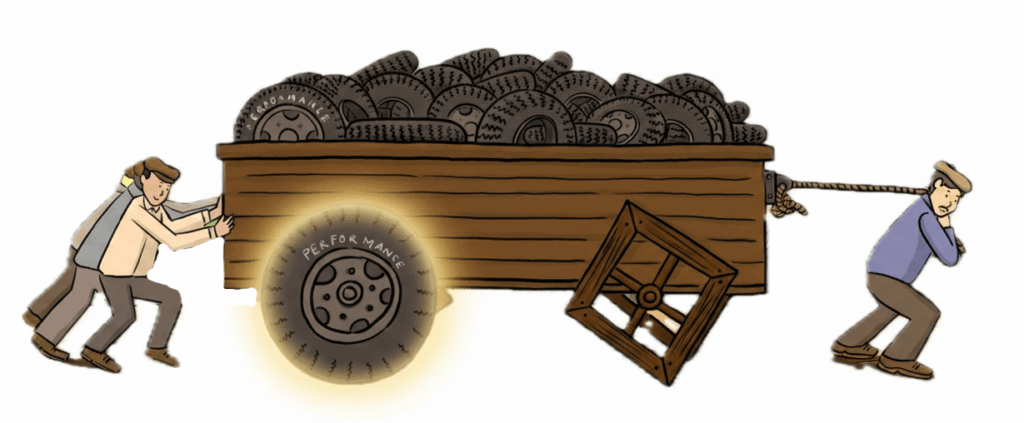
Celebrate the implementation of round wheels
—
For organizations with multiple stuck teams, book a short conversation to design a program using Square Wheels across your organization, We can easily build some really great tools and courses and support systems,
For the FUN of It!
 Dr. Scott Simmerman is a designer of team building games and organization improvement tools.
Managing Partner of Performance Management Company since 1984, he is an experienced presenter and consultant who is trying to retire!! He now lives in Cuenca, Ecuador.
You can reach Scott at scott@squarewheels.com
Learn more about Scott at his LinkedIn site.
Square Wheels® are a registered trademark of Simmulations, LLC
and images have been copyrighted since 1993,
© Simmulations, LLC 1993 – 2025
What I am about:
My Square Wheels blogs and website exist to equip leaders, trainers, and facilitators with practical process improvement tools along with effective organizational change tools. My purpose is to facilitate engagement and active involvement to help make work smoother and more human.
By blending change management facilitation with proven workshop facilitation techniques, team collaboration activities, and creative problem solving activities, my mission is to support organizations in designing employee engagement strategies that are both energizing and sustainable. Through accessible, sometimes free team building resources and virtual facilitation tools, my focus is on helping teams everywhere discover better ways to collaborate together, innovate continuously, and own their path to improvement.
#SquareWheels #InnovationAtWork #TeamEngagement #FacilitationTools #WorkplaceImprovement #EmployeeEngagement #CreativeProblemSolving #OrganizationalDevelopment #LeadershipTools #collaboration #leadership
Original work by Dr. Scott Simmerman, “The Square Wheels Guy”
Modernized for distributed workforces, real-time feedback systems, and continuous performance cultures using Perplexity AI.



0 Comments