
Rolling Toward Workplace Happiness: How Supervisors Turn Square Wheels into a Culture of Progress
Ask any group of employees what makes them happy at work, and you’ll rarely hear them mention salary, perks, or even titles. As Oliver Burkeman in The Guardian recently reminded readers (article), happiness often comes from simple things: a sense of connection, progress, and purpose. It’s not about grand solutions or company-wide initiatives — it’s about the daily experience of doing work that feels worthwhile, supported by people who care.
Happiness comes from simple things:
a sense of connection, progress, and purpose.
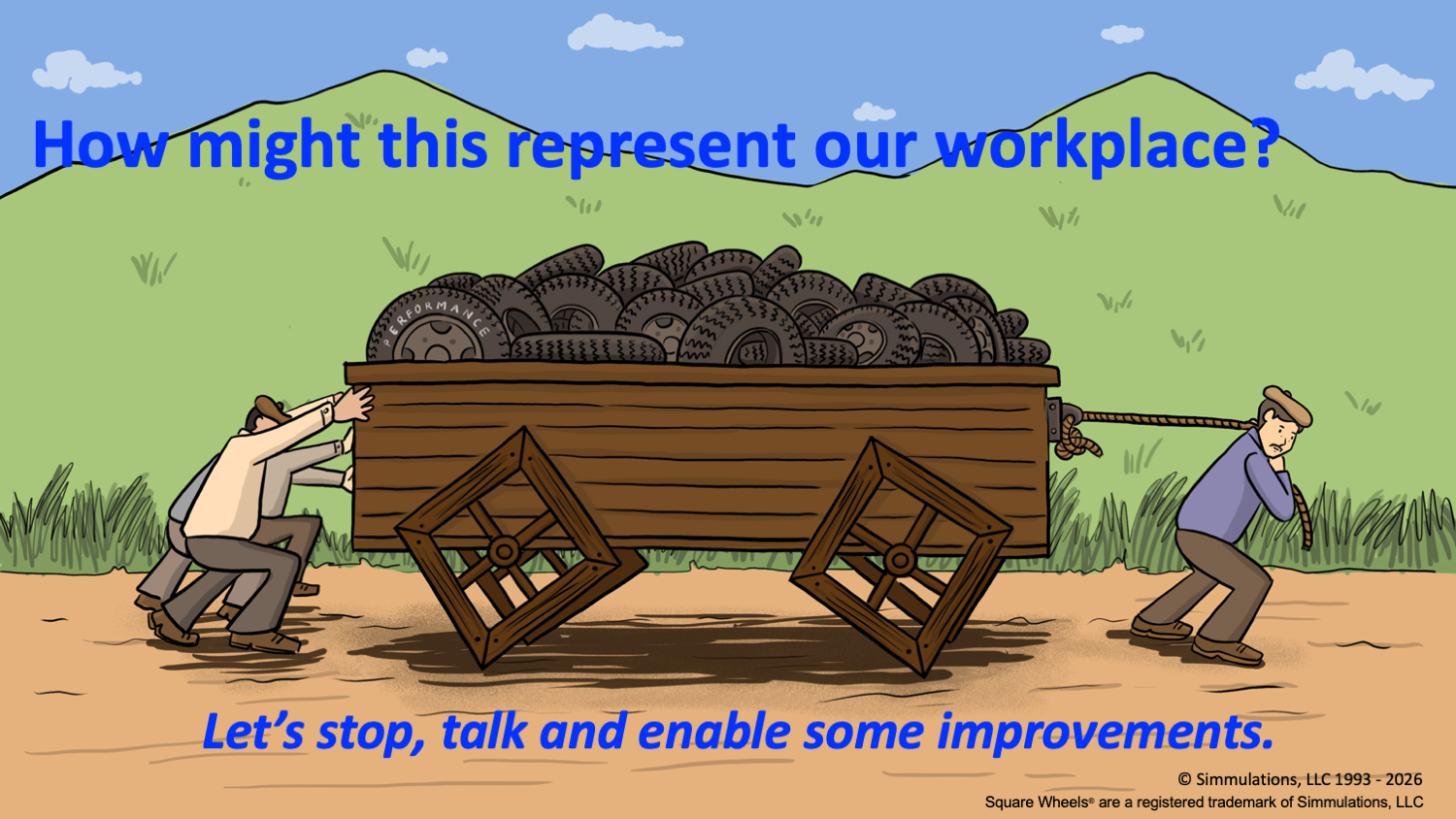
That’s where the role of the supervisor becomes critical. Supervisors sit at the pivot point of culture. They are the lens through which employees experience leadership and the daily environment — and their behaviors determine whether people feel empowered or constrained. Using the Square Wheels metaphor, supervisors can transform the workplace from a bumpy, frustrating ride into one that moves more smoothly toward engagement, fulfillment, and improved performance.
Happiness Starts with the small things
The quest for happiness in organizations often gets framed as a massive undertaking — engagement surveys, culture initiatives, or corporate “wellness programs.” But genuine happiness doesn’t need to be complex. Behavioral science consistently shows that people feel happiest when they experience small wins, autonomy, and meaningful progress. These factors are all within the supervisor’s immediate influence.
People feel happiest when they experience small wins,
autonomy, and meaningful progress.
The workplace, like a wagon rolling along on Square Wheels, has inefficiencies, miscommunications, and outdated practices that make the journey harder than it needs to be. Yet the Round Wheels — better ideas and easier ways of doing things — already exist inside the workgroup. The key is helping people feel safe and motivated to bring those ideas into discussion. An enabling supervisor doesn’t just manage work; they remove friction so work can flow.
The Supervisor’s Lens: Seeing Square Wheels®
Many supervisors are promoted for their technical expertise, not necessarily for their ability to lead people and organizations are not generally offering them training and development opportunities. Once in the role, they often face the immediate pressure to “fix problems quickly.” But the more productive approach is to slow down long enough to truly see what’s slowing the team down. (Read about supervisors and enablement here.)
Square Wheels represent those visible and invisible obstacles that make work feel harder — confusing processes, lack of resources, unclear expectations, or broken communication channels. A thoughtful supervisor asks:
-
“What’s bumpier than it needs to be right now?”
-
“Where are we getting stuck?”
-
“What’s one thing that would make your work easier this week?”
These questions shift the relationship from fault-finding to problem-solving. They build psychological safety — the foundation for any healthy, happy workplace. When people feel heard, they stop hiding problems and start collaborating on better ways forward. And understand that workers can see a lot of things when they look at the image. Repeat: people can see a LOT of things related to their workplace by discussing the image:
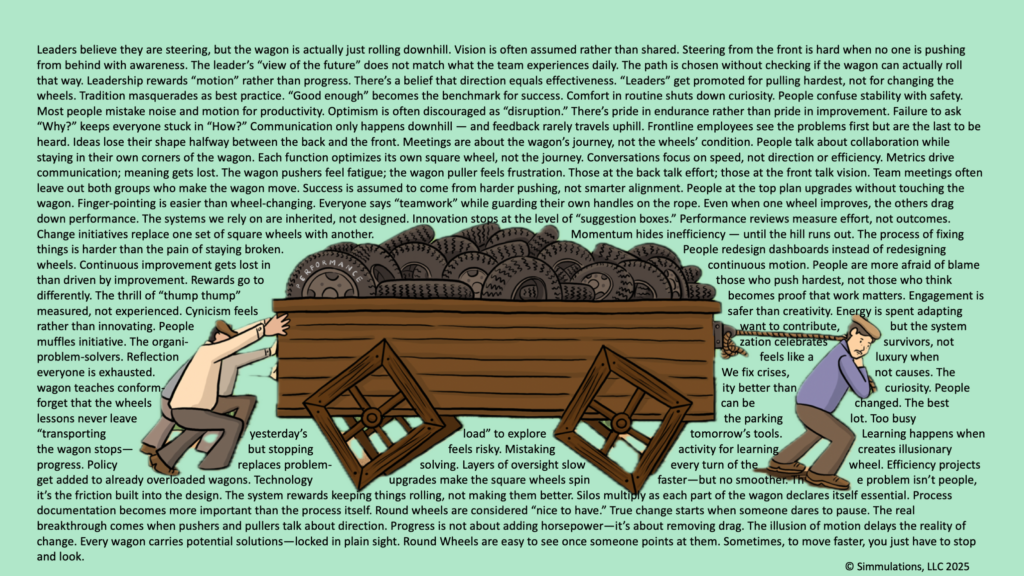
Here are 100+ actual responses to the Square Wheels One image
Encouraging Round Wheel Thinking
The most effective supervisors treat everyone on their team as a potential innovator. They recognize that employees — the hands-on people doing the actual wagon pushing — are closest to the improvement possibilities and therefore have the best perspective on solutions.
Round Wheel Thinking means regularly inviting people to share what’s working, what’s not, and what could be improved. And these do not have to be formal discussions — they certainly appear when managers are doing their MBWA. A few simple practices help nurture this mindset:
-
Begin or end meetings with a short “Round Wheels” moment — one SW idea or a RW improvement idea from the team.
-
Rotate who leads short improvement discussions to distribute ownership and voice.
-
Reward experimentation, not just success — acknowledging effort and creativity encourages participation.
Employees rarely expect their ideas to be perfect; what matters is being asked and valued. And when their ideas become visible and acted upon, a virtuous cycle of engagement begins. Happiness stops being an abstract goal and becomes the energy that propels continuous improvement.
Employees rarely expect their ideas to be perfect;
what matters is being asked and valued.
Progress and Recognition: The Engine of Motivation
The link between progress and happiness isn’t just intuitive — it’s well-documented. Harvard researcher Teresa Amabile found that, “the single most important factor in motivation is making progress in meaningful work.” Progress creates momentum, and momentum creates satisfaction and satisfaction creates progress.
Supervisors are uniquely positioned to recognize that progress, both visibly and verbally. Every small success deserves acknowledgment, not only for results but also for learning and collaboration. Celebrating improvements — whether it’s a simplified workflow, a customer compliment, or fewer errors — creates emotional fuel. It reinforces the belief that the team’s efforts matter and that their work is moving forward.
As these moments accumulate, so does trust. Teams begin to associate their supervisor not with control or evaluation, but with support, recognition, and opportunity.
And understand that this is NOT a training issue. Little if any training is needed for facilitating with Square Wheels images to generate active involvement and engagement.
Creating a Positive Ripple Effect
Culture doesn’t form through slogans or memos and it certainly is not influenced by some speech from a senior manager; it grows organically from consistent leader behaviors. When supervisors replace criticism with curiosity — asking why something is hard rather than who to blame — they model openness and empathy. When they ask for ideas, act on them, and give credit where it’s due, they build credibility and trust. Over time, teams begin to echo those same behaviors with each other.
In a Square Wheels framework, this means the “wagon” begins to move more easily. Communication improves, cooperation strengthens, and people take ownership of both the problems and the progress. The workplace feels lighter not because the load disappears, but because the effort becomes shared — and meaningful.
Rolling Toward a Happier Workplace
Workplace happiness doesn’t need some grand redesign — it needs daily intention. Supervisors have the most immediate and powerful influence over whether employees enjoy their work, trust their environment, and see a path to improvement.
The good news? The tools are simple.
-
Listen actively.
-
Acknowledge the Square Wheels reality.
-
Invite Round Wheel ideas.
-
Recognize progress publicly and authentically.
Do those things consistently, and you’ll have a team that rolls forward together — smoother, faster, and prouder of how far they’ve come.
As The Guardian article suggested, happiness isn’t elusive after all. It’s simpler than we think. It’s about the joy of movement — of progress, purpose, and shared success.
So, supervisors, here’s your week’s reflection:
What’s one Square Wheel you can help
your team roll past starting Monday morning?
—
For the FUN of It!
 Dr. Scott Simmerman is a designer of team building games and organization improvement tools.
Managing Partner of Performance Management Company since 1984, he is an experienced presenter and consultant who is trying to retire!! He now lives in Cuenca, Ecuador.
You can reach Scott at scott@squarewheels.com
Learn more about Scott at his LinkedIn site.
Square Wheels® are a registered trademark of Simmulations, LLC
and images have been copyrighted since 1993,
© Simmulations, LLC 1993 – 2026
What I’m About:
My Square Wheels blog and website exist to help leaders, trainers, and facilitators make work smoother, more engaging, and more human. I focus on practical tools for process improvement, organizational change, and workplace collaboration that spark insight and deliver measurable results.
And I am convinced, after 30+ years of using Square Wheels®, that it is the best facilitation toolset in the world. One can use it to involve and engage people in designing workplace improvements and building engagement and collaboration. It is a unique metaphorical approach to performance improvement and we can easily license your organization to use these images and approaches.
By blending proven facilitation methods, creative problem-solving, and engaging team activities, my mission is to support organizations in building energized, sustainable cultures of involvement and innovation.
Through accessible — and often free — resources and virtual facilitation tools, I aim to help teams everywhere collaborate more effectively, innovate continuously, and take ownership of their improvement journey.
#SquareWheels #InnovationAtWork #TeamEngagement #FacilitationTools #WorkplaceImprovement #EmployeeEngagement #CreativeProblemSolving #OrganizationalDevelopment #LeadershipTools #collaboration #leadership #motivation #communications #enablement #leadership #CreativeCommons #enablingperformance #teamwork




0 Comments