
The Supervisor Hellscape is a reality. Organizations CAN focus on enabling supervisors to perform at much high levels, given 70% are disengaged (Gallup) along with 79% of their people.
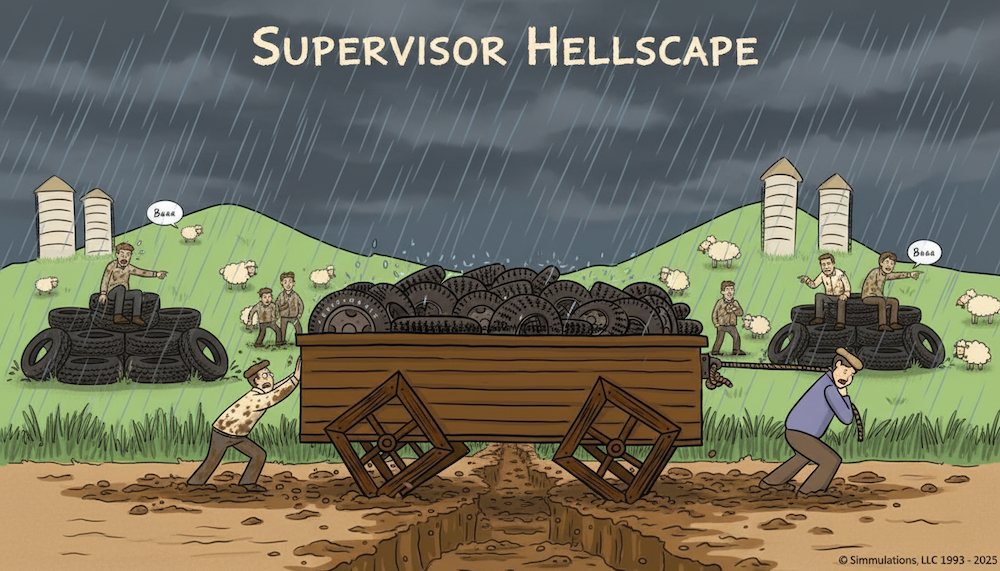
And this is not me trying to sell some consulting or training. This is simply about some things that YOU, the manager, can choose to do differently to improve the performance reality.
Surface Issues:
Supervisors tend to talk about “safe,” surface-level pain points that sit above the real cultural and system issues. Here are 10 that show up consistently in surveys and leadership articles.
-
“People don’t communicate.”
-
Complaints about poor communication, information not flowing, and misunderstandings between shifts or departments. This is both upwards and downwards.
-
-
“There’s too much conflict and drama.”
-
Ongoing interpersonal friction, gossip, and personality clashes that disrupt work but are framed as individual behavior issues.
-
-
“My team isn’t engaged or motivated.”
-
People doing the minimum, low energy in meetings, and lack of initiative, often described as a motivation or attitude problem.
-
-
“Performance is inconsistent.”
-
Some people hit targets while others lag, recurring quality errors, rework, and missed deadlines framed as individual performance gaps.
-
-
“Turnover is killing us.”
-
Constant hiring, training, and backfilling, with supervisors focusing on the churn and vacancies rather than deeper causes.
-
-
“We’re short-staffed, undertrained and overloaded.”
-
Not enough people to cover the workload, frequent overtime, and complaints about burnout and schedule issues.
-
-
“People resist change.”
-
Pushback on new processes, systems, or metrics, described as employees being stubborn or negative about change.
-
-
“They need more training.”
-
Lack of skills, mistakes, and low confidence with new technology or tasks, often summed up as “they just haven’t been trained.” But is this training or motivation? CAN they do it even once?
-
-
“I don’t have enough time for people stuff.”
-
Struggle to balance production demands with coaching, feedback, and one-on-ones; feeling buried in operational tasks. Organizations do NOT focus on the people stuff much at all.
-
-
“HR/leadership doesn’t support us.”
-
Frustration that policies, tools, or senior leaders make the job harder, along with a sense of being caught in the middle. Even with support, there is generally not enough meaningful support. You never hear a complaint about too much support!
-
-
For each surface problem, identify the deeper fear or risk underneath it (e.g., looking incompetent, losing control, missing career opportunities, being blamed for poor performance).
-
For each deeper fear, write 3 short “I know how this feels” statements framed in the Square Wheels metaphor.
Example angle: “You see the wagon with Square Wheels and feel you’re the one pushing, but no one is allowed to say there might be Round Wheels inside.”
So, what is actually happening below the surface and what can you do to help the managers get out of the ditch and up on the road, remembering that there are two kilometers of ditch for every kilometer of road?
Here are simple, Square Wheels–style approaches you can put in a supervisor’s hands immediately, tied to each surface complaint and digging deeper. This is NOT a detailed Certified Training Program; it is just a short plunge into some general ideas about what you might choose to do differently to better enable performance improvement and collaboration in a workgroup.
Some possible actions for the Actual Issues
1. “People don’t communicate”
-
Run a 10‑minute wagon-discussion huddle
Use the main Square Wheels wagon image that you can get for FREE and ask, “Where are our communication Square Wheels right now?” Capture specific examples (missed handoffs, unclear priorities) on a flip chart. Get people talking about issues and opportunities and challenge the beliefs by asking simple questions. -
Co-create one Round Wheel
Ask, “What is one simple wheel we can try this week to smooth information flow?” (e.g., standard 5‑minute shift handoff, simple whiteboard, common chat channel). Agree, test for a week, review. Generating ideas about round wheels to address Square Wheel problems is pretty damn easy!
2. “There’s too much conflict and drama”
-
Make conflict a process issue, not a people issue
Show the wagon and ask, “Which Square Wheels in our process are causing friction between people?” Get them to name policies, workflows, or unclear roles that create collisions. -
Use the image as a neutral mediator
When two people are at odds, sit them down with the picture and ask, “Looking at this, where does the wagon make it hard for both of you?” Then co-create one round wheel idea, rule or checkpoint to reduce repeat conflicts.
3. “My team isn’t engaged or motivated”
-
Shift to “dis‑un‑engagement”
Use Square Wheels to ask the group: “What parts of the wagon make it hard to care?” Let them list frustrations; then ask, “Which one or two could we improve locally in the next two weeks?” By sharing their ideas about doing things differently, you are involving and engaging them — but you MUST take some action to make some changes or remove some roadblocks. -
Turn complaints into improvement experiments
For each demotivator, ask, “What’s a Round Wheel version of this?” Turn their ideas into tiny experiments with owners, dates, and a quick follow-up huddle. Generate some cognitive dissonance around the reality of Square Wheels and the possibilities of using some round ones instead.
4. “Performance is inconsistent”
-
Make the work visible
Draw your team’s wagon with them, “What are the current wheels for training, checklists, tools, and feedback?” Have them circle where the wheels are “square” for some people but not others. Talk about round wheel best practices and ideas for doing things differently. -
Standardize one Round Wheel at a time
Ask, “What’s one Round Wheel practice that our best performers already use that we can all adopt?” Turn that into a shared standard, then repeat for the next Square Wheel.
Don’t allow “Continuous Unimprovement”
to be the operating paradigm in the workgroup.
5. “Turnover is killing us”
-
Explore the “leaving” Square Wheels
In a team discussion, use the wagon to ask, “If someone were thinking of leaving, what Square Wheels here would push them out?” and what round wheels might hold them in. Let them talk; capture themes of improvement without debate. Give them a better sense of ownership involvement and do things with them. -
Build one Retention Round Wheel
Ask, “What’s one improvement that would make it easier to stay?” (e.g., clearer schedules, better cross-training, recognition rituals). Implement one quickly and publicize that it came from the team. Being part of an effective team is one way to generate more active involvement and reduce frustration with the reality of the workplace.
6. “We’re short-staffed and overloaded”
-
Separate real load from Square Wheels
Use the image to distinguish unavoidable load (the wagon contents) from dumb friction (Square Wheels) stuff. Ask, “What part of our overload is caused by bad wheels we can actually change?” Look to minimize or eliminate the petty annoying stuff or add some positive structure to the workplace. -
Remove low-value friction
Have the team identify one or two tasks, reports, or approvals that add little value but consume time and energy. Use the wagon metaphor upward to ask leaders to approve dropping or simplifying them.
7. “People resist change”
-
Normalize resistance as wheel awareness
Show the wagon and say, “When we change routes or loads, the Square Wheels show up more. What wheels feel especially Square with this change?” This frames resistance as useful data. Understand that people resist change done TO them but generally resist less when they are involved in the change — do things WITH them. -
Co-design Round Wheels for the change
Ask, “If this change has to happen, what Round Wheels would make it less painful?” Capture quick wins (better instructions, extra support, temporary workarounds) and implement a few fast.
8. “They need more training”
-
Diagnose the real wheel first
In a huddle, use the picture and ask, “Is this really a skill gap, or is it a Square Wheel in process, tools, or clarity?” Have the team label where the real friction sits before ordering training. -
Use peer Round Wheel teaching
Identify who already has a “rounder wheel” and set up short, on-the-job demos, using the wagon metaphor to show that the team is just sharing better wheels, not fixing broken people. Best practices already exist within any workgroup so get people talking and sharing their ideas.
9. “I don’t have enough time for people stuff”
-
Embed Square Wheels into existing huddles
Instead of adding meetings, ask supervisors to use one image and one question in the meetings they already run: “What’s one Square Wheel we can work on this week?” Ten minutes, then back to work. Followup. Do things differently. -
Make “working on the wagon” a visible priority
Encourage supervisors to track Round Wheel experiments on a simple board so leaders see that time spent on people and process is producing fewer problems and smoother performance.
10. “HR/leadership doesn’t support us”
-
Use the image to speak truth safely upward
Equip supervisors with the wagon and their team’s list of Square Wheels to share with leaders: “Here’s what the wagon looks like from here, and here are three Round Wheels we want to test.” -
Ask for support on specific Round Wheels
Instead of general complaints, frame requests as: “If you can help us implement this one Round Wheel (policy change, tool, headcount tweak), here’s the benefit we expect for output and engagement.”
You can find an overview about the statistics on the Supervisor Hellscape by clicking on the image below
—
For the FUN of It!
 Dr. Scott Simmerman is a designer of team building games and organization improvement tools.
Managing Partner of Performance Management Company since 1984, he is an experienced presenter and consultant who is trying to retire!! He now lives in Cuenca, Ecuador.
You can reach Scott at scott@squarewheels.com
Learn more about Scott at his LinkedIn site.
Square Wheels® are a registered trademark of Simmulations, LLC
and images have been copyrighted since 1993,
© Simmulations, LLC 1993 – 2026
What I’m About:
My Square Wheels blog and website exist to help leaders, trainers, and facilitators make work smoother, more engaging, and more human. I focus on practical tools for process improvement, organizational change, and workplace collaboration that spark insight and deliver measurable results.
And I am convinced, after 30+ years of using Square Wheels®, that it is the best facilitation toolset in the world. One can use it to involve and engage people in designing workplace improvements and building engagement and collaboration. It is a unique metaphorical approach to performance improvement and we can easily license your organization to use these images and approaches.
By blending proven facilitation methods, creative problem-solving, and engaging team activities, my mission is to support organizations in building energized, sustainable cultures of involvement and innovation.
Through accessible — and often free — resources and virtual facilitation tools, I aim to help teams everywhere collaborate more effectively, innovate continuously, and take ownership of their improvement journey.
#SquareWheels #InnovationAtWork #TeamEngagement #FacilitationTools #WorkplaceImprovement #EmployeeEngagement #CreativeProblemSolving #OrganizationalDevelopment #LeadershipTools #collaboration #leadership #motivation #communications #enablement #leadership #CreativeCommons #enablingperformance #teamwork #disruptivethinking #divergentthiniking #supervisor #supervisorhellscape


0 Comments