
This post is about thinking, your brain and round wheels, how we can rethink our Square Wheel realities to impact our performance in the workplace.
Using Square Wheels® as a recurring visual metaphor will train your brain to see reality as constructed rather than fixed, which opens up new pathways for learning, collaboration, and change. The images essentially “hack” predictive processing: they interrupt automatic interpretations and invite teams to consciously reshape the story their brains are telling them about work, obstacles, and possibilities.
I often refer to this as disruptive engagement or disruptive innovation.
This is NOT about expecting change when nothing is changing. The use of the metaphor is intentional, DO change how people are thinking and to get both System One and System Two processes engaged and enabled. And who doesn’t need more personal and organizational innovation and improvement?
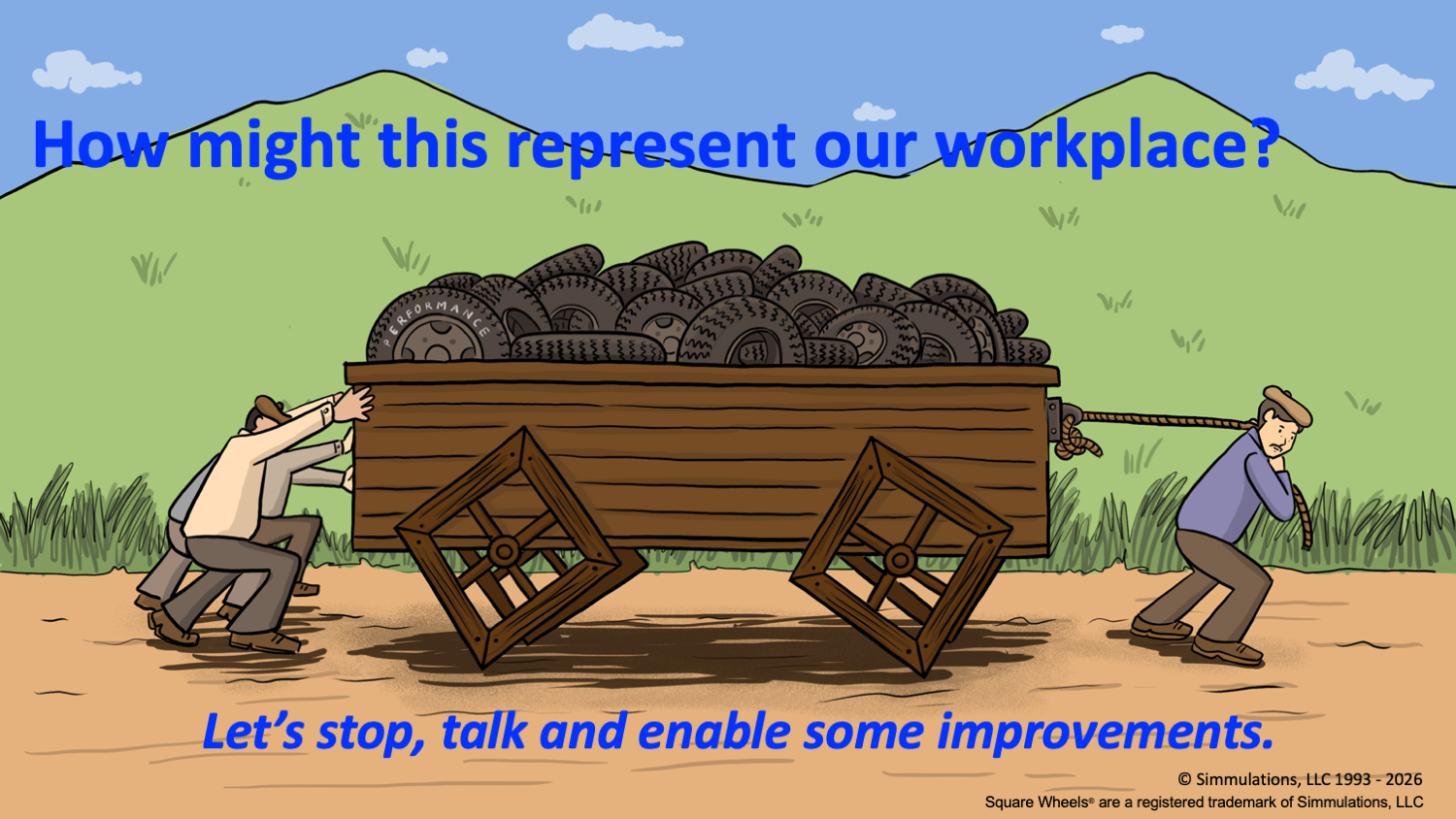
So, I start with this image as The Beginning and ask the question,
“How might this image represent how things
really work in our organization?”
A related comment is,
“Don’t Just DO Something, Stand There!”
Your brain edits your reality. Why not train it to be more open to different ideas?
Modern neuroscience shows that perception is not a camera; it is a construction. And memory is a re-construction. The brain constantly predicts what it expects to see, then fits incoming data into that prediction, filling gaps and filtering out anything that does not match the current model of reality.
This predictive processing is fast, efficient, and usually helpful—but it also locks people into old patterns, blind to better options that sit right in front of them. When people say, “That’s just how things are around here,” they are really describing how their brains have learned to see the workplace, not the workplace itself.
Why Square Wheels disrupt autopilot
The classic Square Wheels One wagon does three things to the nervous system at once.
-
It creates a safe cognitive shock – a Whack on the Side of the Head. People instantly recognize that the wagon “works” but clearly not smoothly, which generates mild cognitive dissonance—enough discomfort to notice, but not enough to trigger threat or defensiveness.
-
It exposes predictive habits. Most viewers initially focus on the obvious problem (the Square Wheels), then “discover” the round wheels in the wagon a moment later. That delay is a live demonstration of how attention and expectation shape what the brain notices first.
-
It externalizes beliefs. Because “it’s just a cartoon,” people project their own experiences, assumptions, and frustrations onto the image. That projection makes invisible mental models visible and discussable without personal attack.
Rewiring perception through metaphor
Repeated use of the Square Wheels One or other related images and related metaphors (mired wagons, mud, silos, alligators, Spectator Sheep) helps teams re-train their brains in how they process workplace reality.
-
It normalizes the idea that every system has Square Wheels that “work but don’t work smoothly,” so noticing friction becomes a habit rather than a criticism.
-
It builds a shared language for mental models: people talk about “the wagon,” “the rope,” “the mud,” and “the round wheels” instead of blaming individuals, which reduces social threat and keeps the prefrontal cortex online for problem solving.
-
It nudges attention toward possibility. The round wheels are always already in the wagon, so the brain starts scanning for existing assets, untapped ideas, and simple shifts rather than defaulting to “we need more resources” or “nothing will change.”
From System One to System Two
In the late Daniel Kahneman’s terms, the first glance at a Square Wheels scene is almost pure System One: fast, intuitive, story-driven, and anchored in old experience. The facilitation process then deliberately moves people into System Two—slower, more deliberate analysis of what else they see and what might be done differently.
-
System One response: “That’s just how it is—we’re busy pushing.” The brain defends the current story because it “fits.”
-
System Two engagement: “What Square Wheels are we living with?” “What round wheels do we already have but are not using?” This step recruits more cortical resources, activates divergent thinking, and lets new patterns of connection form.
-
Integrated collective thinking: Over time, teams learn to have faster, more accurate System One reactions that are informed by their System Two work with the metaphors—intuitive recognition of friction paired with an almost automatic search for round wheels. Group thinking takes it many steps faster forward.
This is how Kahneman might view things:

Practical implications for your writing and facilitation
For a blog post built on that Kahneman’s theme, you can see that Square Wheels One and the other images are not just clever cartoons but practical tools for reshaping how the brain experiences work. You can:
-
Link predictive processing to everyday organizational life (“Your brain edits out the round wheels at work the same way it edits out background noise in a restaurant”).
-
Position Square Wheels as a “pattern interrupt” that softens threat, surfaces hidden assumptions, and gives the brain a new script for dealing with discomfort and opportunity.
-
Emphasize that each image is a micro-experiment in neuroplasticity: every time people step back from the wagon, name the Square Wheels, and invent round ones, they are literally strengthening new neural pathways for problem solving, collaboration, and continuous improvement.
When people play just a little with the main image (which you can get for free use at this landing page), they generate more and more diversity of ideas.
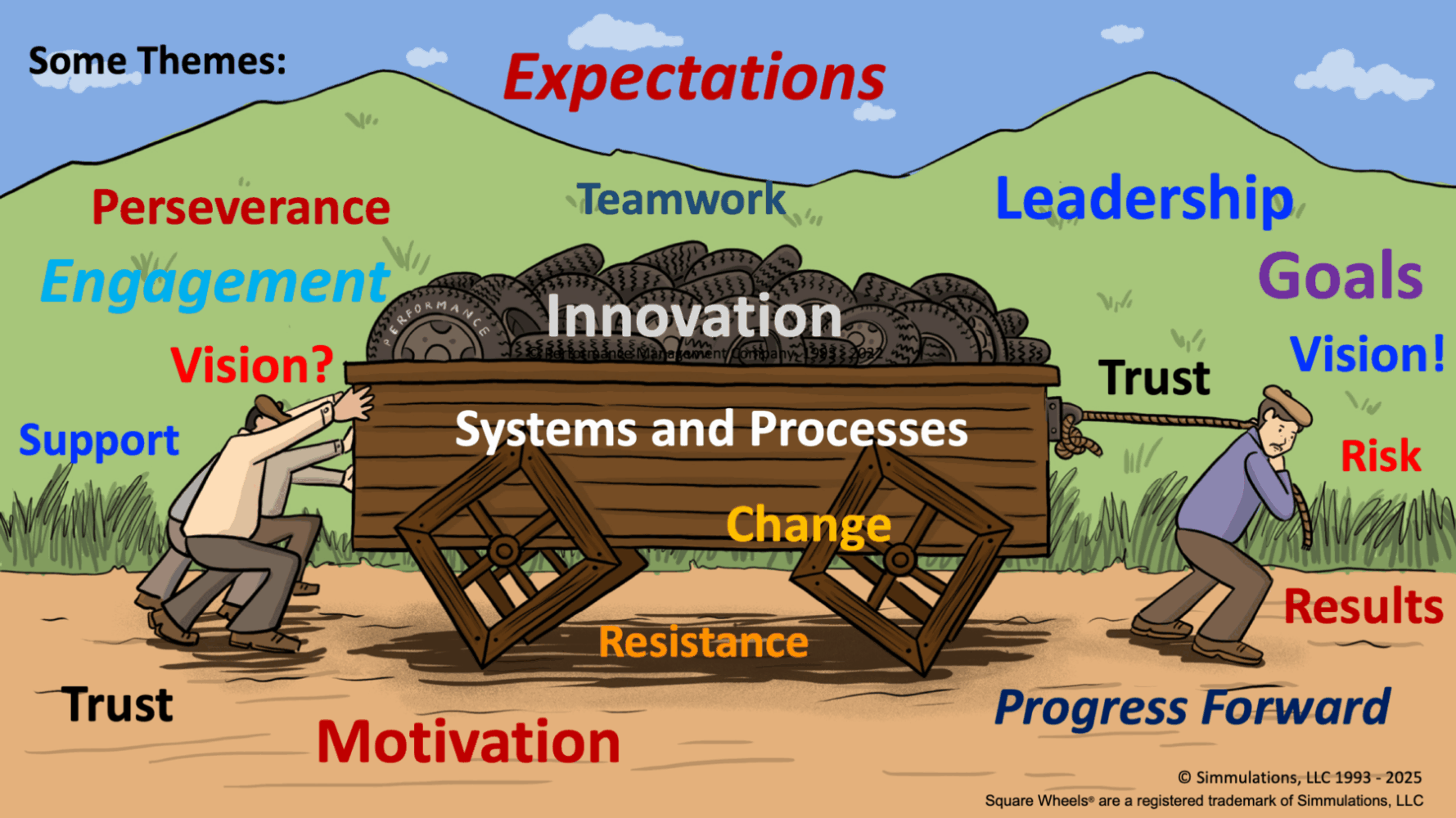
There are many different themes that open for discussion when using Sauare Wheels One
And, once you begin to generate the active involvement, there are many other themes of organizational improvement that you can link to this starting idea to build a better organizational culture of performance improvement and collaboration.
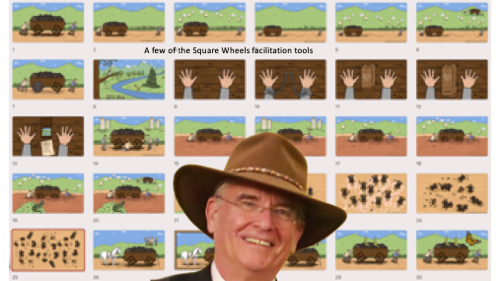
Here’s ME with a few of the many dozens of different Square Wheels images that are available for use.
Square Wheels® are elegantly simple engagement and enablement tools that you can access.
Consider the possibilities,
—
For the FUN of It!
 Dr. Scott Simmerman is a designer of team building games and organization improvement tools.
Managing Partner of Performance Management Company since 1984, he is an experienced presenter and consultant who is trying to retire!! He now lives in Cuenca, Ecuador.
You can reach Scott at scott@squarewheels.com
Learn more about Scott at his LinkedIn site.
Square Wheels® are a registered trademark of Simmulations, LLC
and images have been copyrighted since 1993,
© Simmulations, LLC 1993 – 2026
What I’m About:
My Square Wheels blog and website exist to help leaders, trainers, and facilitators make work smoother, more engaging, and more human. I focus on practical tools for process improvement, organizational change, and workplace collaboration that spark insight and deliver measurable results.
And I am convinced, after 30+ years of using Square Wheels®, that it is the best facilitation toolset in the world. One can use it to involve and engage people in designing workplace improvements and building engagement and collaboration. It is a unique metaphorical approach to performance improvement and we can easily license your organization to use these images and approaches.
By blending proven facilitation methods, creative problem-solving, and engaging team activities, my mission is to support organizations in building energized, sustainable cultures of involvement and innovation.
Through accessible — and often free — resources and virtual facilitation tools, I aim to help teams everywhere collaborate more effectively, innovate continuously, and take ownership of their improvement journey.
#SquareWheels #InnovationAtWork #TeamEngagement #FacilitationTools #WorkplaceImprovement #EmployeeEngagement #CreativeProblemSolving #OrganizationalDevelopment #LeadershipTools #collaboration #leadership #motivation #communications #enablement #leadership #CreativeCommons #enablingperformance #teamwork



0 Comments