
“Anybody Listening?” This post is about Square Wheels, Supervisors, and the courage to really HEAR their people singing in the workplace.
IS there anybody listening?
The lyrics of Queensrÿche‘s “Anybody Listening?” center on personal awakening, rejecting manufactured realities, and the loneliness of trying to live authentically in a conformist world.
You and I both know this feeling as a manager: you roll out another change, send another email, host another town hall, and still wonder, “Is anybody listening?” This Queensrÿche song “Anybody Listening?” captures the deep loneliness and frustration about not being heard, about voices that disappear into the noise. In a lot of workplaces, that’s exactly how front-line people (and even our supervisors) feel when it comes to improvement: they talk, but they don’t feel that anyone with power is truly listening.
LISTEN to the song as you read this. Click here.
The good news is that there is one role in the organization that can change that dynamic faster than anything else: The Supervisor. Not the CEO, not the consultant, certainly not HR and not the posters on the wall. The supervisor is the person who can turn “Is anybody listening?” into “Yes. And what you’re saying matters.” But do we give them the tools? That is one focus of this article.
Note: Square Wheels® gives us a simple way to give them the tools.
Get the FREE image and toolkit here.
The workplace as a Queensrÿche song
Think about some of the lines from “Anybody Listening?”: “Is there anyone that sees what’s going on? Read between the lines… Think for yourself…”
That could be your front-line people and teams talking about the daily frustrations they live with.
-
They see and they feel the Square Wheels: the clunky processes, the dumb rules, the rework that everyone pretends is normal.
-
They hear the “words they’re selling” as the slogans, the campaigns, the glossy slide decks, but they’re not sure anyone actually wants to fix the wagons and improve how things really work.
-
They long “to live like the wind upon the water,” to do work that flows, that feels smooth and meaningful, not jammed up by friction of the mud all day, every day.
In that environmental reality, is “Anybody Listening?” isn’t just a song. It’s a daily workplace question. It is a perceived reality about what might be done differently. And who IS to listen to them?
Core themes of the song also include:
-
Waking up from comfortable lies: Lines about having “spent so long living lies” and “just begun to see the light” frame the song as someone realizing their old life was shaped by false assumptions and expectations.
-
Leaving comfort to chase a dream: The verse about “leaving all I loved behind” and “a life under lights and judging eyes” captures the tension between security and the risk of pursuing a calling, often read as semi‑autobiographical for the band.
-
Questioning what you’re told: The repeated call to “read between the lines, criticize the words they’re selling” is a direct push to interrogate everything: media, authority, and social narratives, instead of passively consuming them as the regular workplace dis-engaging reality.
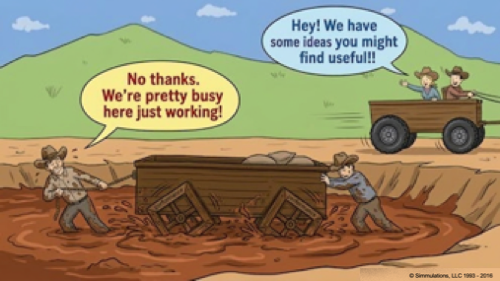
From a performance standpoint, who is to listen to them is lethal: IS Anybody Listening? When people conclude that nobody is really listening, they stop talking. They stop offering ideas. They stop caring about fixing the Square Wheels and just push the wagon. Mud? Normal. So, they push at the level to just get by.
Supervisors: the only ones close enough to hear
Senior leaders speak in strategies and structures. Supervisors live in conversations around constraints. They are close enough to hear the creaks of the wagon and the sighs of the team as they deal with the reality of the mud and the silos.

The heart of “Anybody Listening?” is the call to see what’s going on and to read between the lines. That’s exactly the supervisor’s job when it comes to continuous improvement:
-
Hear what people are actually saying about their perceived and actual Square Wheels, not just what fits the official narrative.
-
Read between the lines when people are polite but disengaged, when they’ve “put on the mask” and stopped bringing their best ideas. (Or even any ideas at all.)
-
Notice where the round wheels already exist, those better ways of doing things that are lying around inside the wagon, unused, because nobody asked and nobody really seemed to care.
Supervisors don’t need a new slogan. They need a new listening posture: curious, humble, and focused on removing friction from work.
Using Square Wheels to answer “Is Anybody Listening?”
One of the reasons I keep coming back to my Square Wheels metaphor is that it gives supervisors an incredibly practical way to listen differently.
Imagine you pull your team together and instead of launching into another PowerPoint, you simply show the Square Wheels One wagon and ask a few questions:
-
“How might this represent how things really work in most organizations?”
-
“Where do you see our Square Wheels in the work we do every day?”
-
“What are some ‘round wheels’—better ideas or tools—that we’re not using yet?”
-
“What could we do, in the next 30 days, to make this wagon roll just a little more smoothly?”
At that moment, you’ve stopped “selling words” and started inviting active ownership involvement. (Click here for my Best Blog on active ownership involvement You’ve moved from broadcasting to real listening.
A few things happen very quickly:
-
You surface the real friction points that have been there all along.
-
People experience that their voice has weight, not just volume.
-
You discover that the knowledge to improve performance is already inside the wagon—you just needed to ask.
And the unspoken question — “Is anybody listening?” — starts to get different answers.
Grab the FREE image of Square Wheels One along with a simple Instructor’s Guide and get rolling.
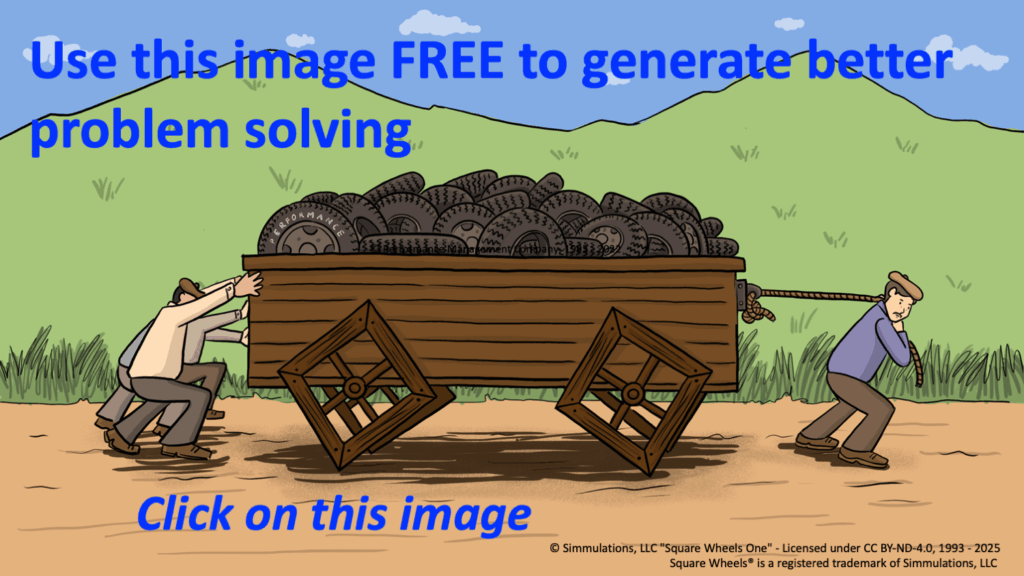
Moving from lonely voices to Shared Ownership
There’s a haunting line of interpretation around, “Anybody Listening?”: feeling disconnected, questioning whether one’s voice and actions have any impact in an indifferent world. That same emotional storyline plays out quietly in a lot of our workplaces. People once had dreams and ideas; over time, they learned that speaking up doesn’t really change anything, so they sit back and conform. They’re IN, but they are really OUT.
Supervisors can rewrite that story for their teams by doing three deceptively simple things:
-
Invite dissent and reality.
Don’t just ask, “Any questions?” Ask, “What’s going to get in the way of this working?” and “What are we pretending is fine that really isn’t?” That’s how you “read between the lines” of the usual meeting politeness. -
Act on at least one idea, fast.
When people raise a Square Wheel, pick one you can do something about and move on it quickly. Visibility of action is how you prove that listening is real, not performative. -
Give credit loudly and specifically.
Name the people and the ideas that led to the change. Connect the round wheel to the person who first pointed to it. This is how you shift the narrative from “applause has died” to “we can dream again.”
That’s the essence of active ownership: people see their fingerprints on the wagon. And Round Wheels implemented are Successes. Pass the word!
A practical Square Wheels conversation you can run next week
If you want to build a blog-ready “how‑to” section that supervisors can actually use, here is a quick, repeatable pattern but note that if you get the FREE download of Square Wheels One, you also get an instructor’s guide with lots of ideas and suggestions.
-
Frame the session (2 minutes).
“We all know there are Square Wheels in how we work—things that slow us down or make the job harder than it needs to be. I want us to name a few and see what round wheels we already have or can invent. I’m going to show you an image of how that appears.” -
Use the image (5–10 minutes).
Show the Square Wheels One image, ask them about how this might represent how things really work, and give people a silent minute to jot down where they see similar Square Wheels in your world. Then do a quick, top of mind “round robin” to capture some on a flip chart or whiteboard. -
Cluster and choose (5 minutes).
Group similar issues together. Ask, “If we fixed one of these in the next month, which would have the biggest impact?” Circle it. -
Generate round wheels (10 minutes).
Ask, “What are some possible round wheels for this one Square Wheel? What have you seen work elsewhere? What small experiment could we run?” Capture at least 5–7 ideas. Ask about some of the implementation issues. -
Commit to action (5 minutes).
Pick one small, concrete step you can take in the next week. Decide who will do what by when, and how you’ll know if it helped. -
Close the loop (next week).
Come back to the group, share what happened, and ask, “What did we learn? What’s the next Square Wheel we should tackle?”
Run that rhythm a few times and something powerful happens: the emotional soundtrack of the team changes. Instead of a quiet, skeptical “Is anybody listening?” you begin to hear, “We can do something about this.” Supervisors become catalysts, not conduits.
From prog‑metal to performance improvement
Queensrÿche asked, “Is there anybody listening? Is there anyone that sees what’s going on?”
In your organization, the answer to that question should be, “Yes, The Supervisors.” They are the ones close enough to see the real work and human enough to hear the real stories.
Square Wheels gives them the language and images to:
-
Make the invisible friction visible.
-
Invite people to think for themselves and challenge the “words they’re selling.”
-
Turn passive complaint into active ownership of better ways to roll.
When supervisors step into that role—when they really listen and then act—teams don’t just push the wagon. They help redesign it. And that’s when performance, engagement, and yes, even hope, start to sound a lot less like a rock ballad and a lot more like everyday work.
Help them to make changes fun, and impactful for them.
Some other songs in this series:
An deep dive into Queensryche’s song, “Someone Else,” and about it’s snapshot of mid‑life identity crisis and professional burnout that most of us can identify with. It is an insightful post about personal identity:
https://performancemanagementcompany.com/2026/03/18/personal-identity-and-crossroads-edge/
And this song, “Silent Lucidity,” is about how one can help create some Lucid Dreaming among people to help them create ideas for improvement. It’s about Guiding the Dreams…
—
For the FUN of It!
 Dr. Scott Simmerman is a designer of team building games and organization improvement tools.
Managing Partner of Performance Management Company since 1984, he is an experienced presenter and consultant who is trying to retire!! He now lives in Cuenca, Ecuador.
You can reach Scott at scott@squarewheels.com
Learn more about Scott at his LinkedIn site.
Note that I often use Perplexity AI to help research and generate ideas for my posts.
Square Wheels® are a registered trademark of Simmulations, LLC
and images have been copyrighted since 1993,
© Simmulations, LLC 1993 – 2026
What I’m About:
My Square Wheels blog and website exist to help leaders, trainers, and facilitators make work smoother, more engaging, and more human. I focus on practical tools for process improvement, organizational change, and workplace collaboration that spark insight and deliver measurable results.
And I am convinced, after 30+ years of using Square Wheels®, that it is the best facilitation toolset in the world. One can use it to involve and engage people in designing workplace improvements and building engagement and collaboration. It is a unique metaphorical approach to performance improvement and we can easily license your organization to use these images and approaches.
By blending proven facilitation methods, creative problem-solving, and engaging team activities, my mission is to support organizations in building energized, sustainable cultures of involvement and innovation.
Through accessible — and often free — resources and virtual facilitation tools, I aim to help teams everywhere collaborate more effectively, innovate continuously, and take ownership of their improvement journey.
#SquareWheels #InnovationAtWork #TeamEngagement #FacilitationTools #WorkplaceImprovement #EmployeeEngagement #CreativeProblemSolving #OrganizationalDevelopment #LeadershipTools #collaboration #leadership #motivation #communications #enablement #leadership #CreativeCommons #enablingperformance #teamwork #storytelling #storyasking #listening



0 Comments