
Change is hard for people and organizations for a very simple reason: the past is rarely past and change is resisted. Here are actionable tools.
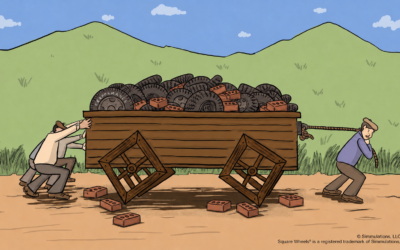
For almost 40 years and in almost 50 countries, the Square Wheels® illustrations and the caterpillar / butterfly metaphor have been used to get people talking about change, coaching, mentoring, engagement, and performance improvement. The reason the image and related metaphors work is that it is simple, playful, and memorable — but it also opens the door to some very serious truths about why people resist change and why organizations struggle to sustain it. And we engage people in discussions to enable them to make different choices.
Using the Square Wheels tools allows us to do things WITH people rather than TO them, decreasing their resistance and generating active ownership involvement. They are the difference between storytelling and storyASKING.
The joke that opens the door to thinking about change
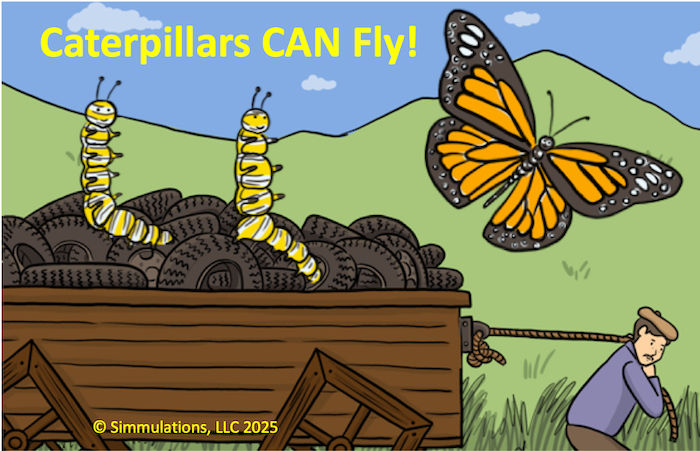
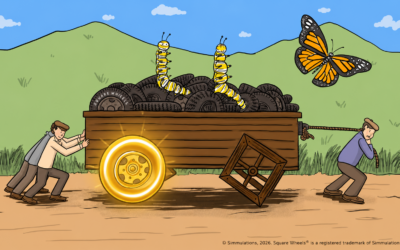
There are two caterpillars sitting on the wagon. A beautiful butterfly floats by and one caterpillar says to the other, “You’ll never get ME up into one of those butterfly things!”
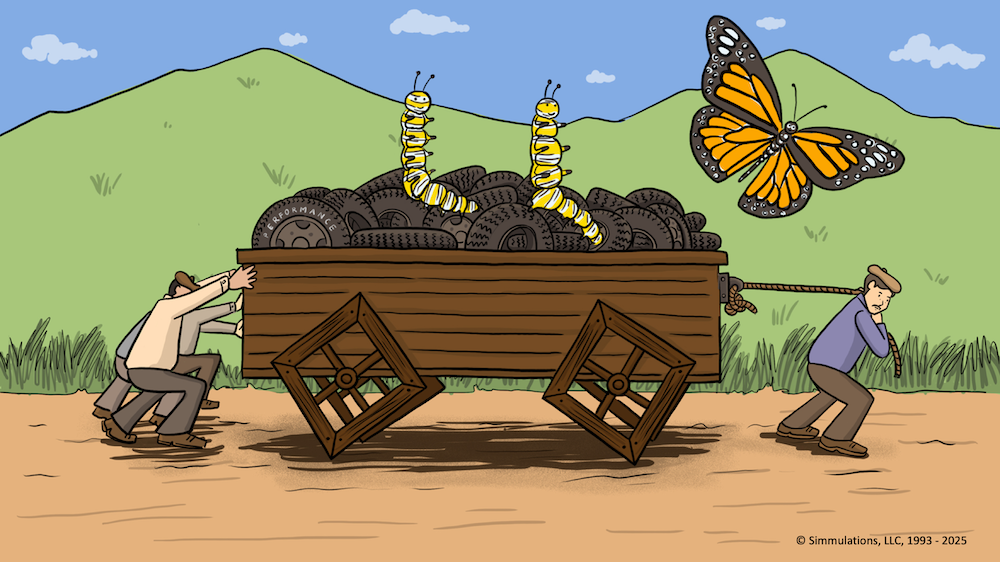
Click on the image to download Square Wheels One for FREE use.
Most people laugh and move on. But that is exactly the problem with most discussions about change: people think they have “gotten the point” and stop thinking. The real value of the story is that there is no single best punchline. It can be about resistance to change, lack of vision, inevitability of change, fear of the unknown, comfort with the familiar, or the simple fact that it is hard to focus on flying when you are busy eating leaves.
More details on delivering the Caterpillar / Butterfly Joke
That is why the metaphor works so well in workshops. It creates discussion, and discussion creates possibility. The moment people stop looking for one right answer, they begin to see how many barriers to change are hiding in plain sight.
Caterpillars can fly, if they just lighten up!
The butterfly still remembers
What makes this metaphor even more powerful is that modern science suggests that some caterpillars may retain learned associations after metamorphosis. In a well-known 2008 study, researchers trained caterpillars to avoid a particular odor by pairing that smell with a mild electric shock. And then learned and remembered.
Even after metamorphosis, many of the adult moths still avoided the same odor, suggesting that some learned responses can persist through a dramatic biological transformation, even though the organism itself looks entirely different.
Now, let us be careful and accurate. The research does not mean every butterfly remembers everything about being a caterpillar, and it does not mean that all species or all forms of memory work the same way. But it does support a fascinating and useful idea: major transformation does not automatically erase prior learning.
That matters, because people are very much like that. They remember “the bad smells.” They retain memories of their past and often those contain negative remembrances around their attempts to change or innovate. These often unconscious memories often underlie their resistance to try something new, especially when it is not their idea but someone else’s.
Why change is so difficult
Organizations often act as if senior managers announcing a new strategy, launching a new initiative, or putting people through a training program will create a fresh start. It very rarely does. People carry memories of prior reorganizations, failed implementations, broken promises, poor leadership, abandoned initiatives, and political scars that make them resistant. Those memories shape how they interpret the next round of “change.”
In other words, the butterfly still remembers the smell.
“And Fear is the mindkiller” when it comes to change. (Dune)
A person who felt punished for taking initiative 10 years ago may nod politely in the kickoff meeting and still avoid the perceived risk of doing something differently. A team that lived through a badly managed reorganization may smile at the new PowerPoint deck and still assume this effort will disappear in six months like all the other ones. An organization that says it wants innovation but remembers how it treated the last innovator should not be surprised when people play it safe.
This is one reason change is so hard to accomplish. The new structure may be different, but the emotional residue remains. The situation changes faster than the beliefs do.
Coaching, mentoring, and the residue of experience
This is where coaching and mentoring matter so much. Too many managers try to push change through logic, structure, deadlines, and announcements. Those things matter, but they are rarely enough. If someone’s past experience tells them that change is dangerous, humiliating, wasteful, or temporary, then no amount of slogans will create commitment or enable change in teams and organizations.
Coaching works because it helps people make sense of their experiences and gives them active involvement in the change process and the visioning of considered alternatives. Mentoring works because it helps people move from fear to possibility. The job is not simply to describe the butterfly. The job is to help the caterpillar deal with everything it remembers about crawling.
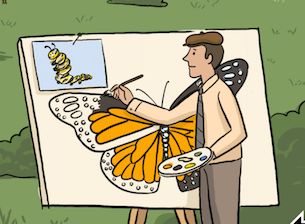
Mentoring and coaching
A good manager or change leader has to understand that resistance is often not irrational. Resistance is memory-based. It is learned. It may be rooted in perfectly reasonable reactions to past events. When leaders ignore that reality, they mistake caution for stubbornness and skepticism for disengagement.
The Square Wheels Connection
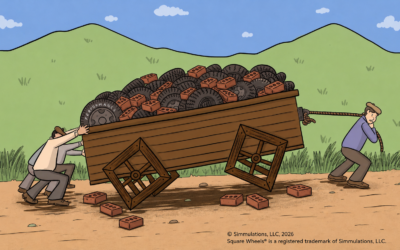
The Square Wheels metaphor has always worked really well because it makes people see both the bumps in the present and the possibilities sitting in the wagon. The round wheels are already there. The potential for change is already present. The issue is not whether better options exist. The issue is whether people are willing to use them.
And willingness is shaped by memory and considered alternatives.
If people have previous success with change, they are more likely to try again. If they have previous failure, embarrassment, or punishment, they are more likely to hesitate, wait, or resist. That is not negativity. That is experience doing what experience does — shaping expectations.
You might see negativity. They likely see danger.
This insight strengthens my simple change model:
-
Discomfort with the way things are now helps create motivation to move.
-
An attractive Vision of the future helps people see why the effort is worthwhile.
-
Previous Success with change makes people more willing to try again, while failure can generate risk avoidance instead of energy.
-
Peer Support makes action more likely because nobody wants to transform alone.

When those four forces are present, change becomes more possible. especially within a work team with a shared interest in generating improvements. When they are absent, the caterpillar stays on the wagon and mocks the butterfly.
What leaders should do differently
If residual memories shape resistance, then leaders need to stop treating change as if it were only a communication problem. Better messaging is useful, but it is not enough. Leaders have to work with the emotional and behavioral leftovers from previous experience. Leaders have to enable people and teams to do things differently.
A few practical ideas:
-
Ask people what this new initiative reminds them of.
-
Surface the stories they carry about past change efforts.
-
Identify where fear of failure or punishment is still alive.
-
Build early wins so people create new memories of success.
-
Use peer support to replace isolation with shared movement.
-
Coach managers to respond to hesitation with curiosity instead of pressure.
The point is not to erase the past. The point is to acknowledge it, learn from it, and create enough positive experiences that people can begin to expect something better.
Teaching the caterpillar to fly
The paradox remains. You cannot really “teach” a caterpillar to fly in any direct, mechanical way you might teach someone to complete a spreadsheet or run a machine. Flight requires transformation. It requires development. It requires conditions, support, perspective and time.
But leaders can create the environment where transformation is more likely. They can reduce unnecessary fear. They can offer support and consistency. They can provide vision. They can make the journey feel possible. And they can remember that the creature entering the cocoon does not emerge as a blank slate.
That may be the most important lesson of all.
When people and organizations change, they do not leave their histories behind. They bring those histories with them. The challenge of leadership is not simply to point toward the sky, but to help people work through the memories that keep pulling them back toward the leaf.
So yes, the butterfly may still remember being a caterpillar. And that is exactly why change, coaching, and mentoring matter so much. Work to enable people to make the changes they see as important.
“Nobody ever washes a rental car!”
—
For the FUN of It!
 Dr. Scott Simmerman is a designer of team building games and organization improvement tools.
Managing Partner of Performance Management Company since 1984, he is an experienced presenter and consultant who is trying to retire!! He now lives in Cuenca, Ecuador.
You can reach Scott at scott@squarewheels.com
Learn more about Scott at his LinkedIn site.
Note that I often use Perplexity AI to help research and generate ideas for my posts.
Square Wheels® are a registered trademark of Simmulations, LLC
and images have been copyrighted since 1993,
© Simmulations, LLC 1993 – 2026
What I’m About:
My Square Wheels blog and website exist to help leaders, trainers, and facilitators make work smoother, more engaging, and more human. I focus on practical tools for process improvement, organizational change, and workplace collaboration that spark insight and deliver measurable results.
And I am convinced, after 30+ years of using Square Wheels®, that it is the best facilitation toolset in the world. One can use it to involve and engage people in designing workplace improvements and building engagement and collaboration. It is a unique metaphorical approach to performance improvement and we can easily license your organization to use these images and approaches.
By blending proven facilitation methods, creative problem-solving, and engaging team activities, my mission is to support organizations in building energized, sustainable cultures of involvement and innovation.
Through accessible — and often free — resources and virtual facilitation tools, I aim to help teams everywhere collaborate more effectively, innovate continuously, and take ownership of their improvement journey.
#SquareWheels #InnovationAtWork #TeamEngagement #FacilitationTools #WorkplaceImprovement #EmployeeEngagement #CreativeProblemSolving #OrganizationalDevelopment #LeadershipTools #collaboration #leadership #motivation #communications #enablement #leadership #CreativeCommons #enablingperformance #teamwork #storytelling #storyasking

0 Comments