
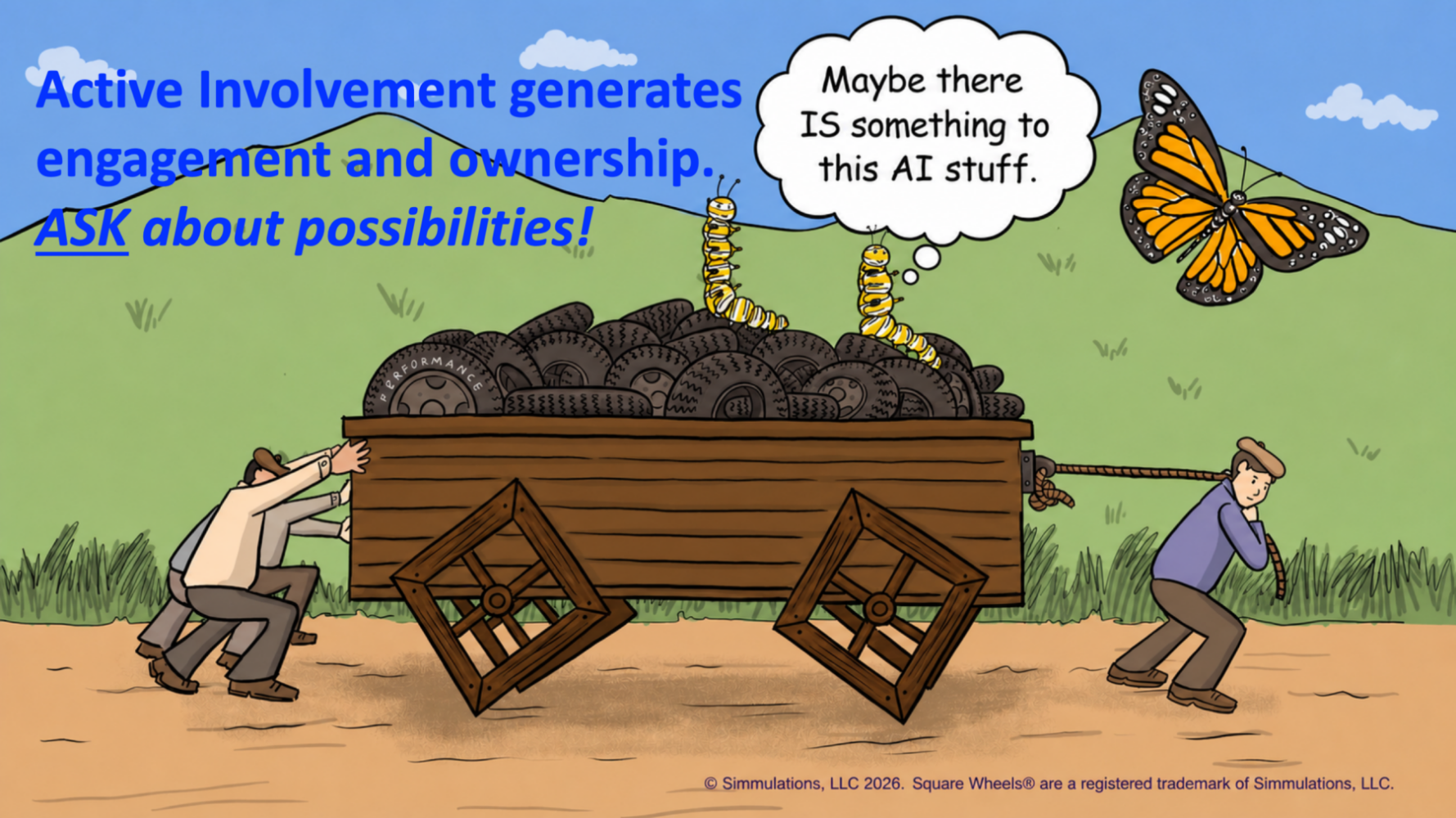
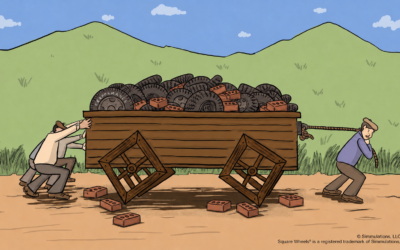
“Rolling Past Resistance” is about using Square Wheels®, a bombproof visual tool for implementing AI, decreasing resistance and impacting workplace innovation.
People generally resist change, especially when they feel it is being done TO them rather than WITH them. When people experience change as top‑down, imposed, or opaque pressure, they naturally protect what they already know, even if the new approach would be better. You can probably recall those painful rollouts where employees were told, “Here’s the new system—use it,” with little explanation, no voice, and zero ownership. In those situations, resistance isn’t irrational; it’s a logical response to feeling excluded, threatened, or devalued.
Today, that pattern is playing out again around AI and other advanced technologies. In many workplaces, workers and even their managers are not just quietly skeptical; they are actively resisting and sometimes even sabotaging the implementation of tools that could dramatically improve quality, speed, and decision‑making.
Managers and workers are worrying about losing control, losing competence, or even losing their jobs, and when those fears are not surfaced and addressed, they harden into obstruction. The tragedy is that these powerful tools are often exactly what teams need to make work safer, smarter, and more sustainable, but without genuine involvement, they are perceived as yet another “square wheel” being bolted on to an already shaky wagon.
How bad is it? How bad IS resistance to implementing AI tools?
Employee resistance to AI is now clearly documented across multiple studies and surveys. AI is being actively resisted. A widely cited 2025 survey by Writer found that 31% of employees admit to “sabotaging” their company’s AI initiatives — by refusing to use mandated tools, ignoring official policies, or relying on unauthorized alternatives — and that figure rises to 41% among Millennial and GenZ workers.
A follow‑up analysis reported that nearly half of GenZ workers in large enterprises admit they are actively undermining AI rollouts, and that about 80% of enterprise workers avoid or quietly reject AI tools provided by their employer. These findings are echoed in coverage from Fast Company, CIO, and LinkedIn News, all highlighting that roughly one in three employees self‑describe as “sabotaging” AI at work.
(You can read more about these statistics and their implications in Fast Company’s article: “31% of employees are actively ‘sabotaging’ AI efforts. Here’s why” (link) Another source is CIO’s “31% of employees are ‘sabotaging’ your gen AI strategy” (link), along with Vectrel’s “The Quiet AI Rebellion” (link).)
Beyond outright sabotage, research has shown a strong perception and trust gap between leaders and employees for decades and AI initiatives are certainly not reducing that. A Harvard Business Review article reports that while 3/4 of executives believe their employees are enthusiastic about adopting AI, only 1/3 of individual contributors say they actually feel enthusiastic.
Lastly, Slack’s Workforce Lab survey of more than 5,000 knowledge workers found distinct AI “personas”: about 30% are “maximalists” who openly embrace AI, but 19% are “rebels” who avoid and distrust it. Ironically, 20% are “undergrounds” who use AI secretly because they worry visible use might make them look replaceable.
Thus, a wide variety of academic work links resistance and low intention to use AI to concerns about job insecurity, fairness, and dehumanization at work. Overall, real evidence shows that resistance to AI is not anecdotal; it is measurable, patterned, and tightly connected to how organizations communicate, involve employees, and design AI‑enabled work. Resistance is not just passive skepticism; it has become active behavior; choices are slowing technology investments meant to improve quality, speed, and decision‑making.
Resistance to AI is not anecdotal; it is measurable, patterned,
and tightly connected to how organizations communicate,
involve employees, and design AI‑enabled work.
Your managers can use Square Wheels images and discussions as a deceptively simple way to flip the brain into “engage, explore, and solve” mode, which is why the metaphor so reliably sparks involvement, motivation, and practical ideas for change.
That same engagement makes Square Wheels a natural on‑ramp for adopting AI tools, because people can visually map their current “wagon,” see where AI represents the round wheels, and co‑design how to implement them.
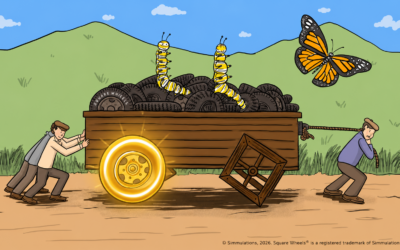
Take a moment to simply consider a discussion around this image:
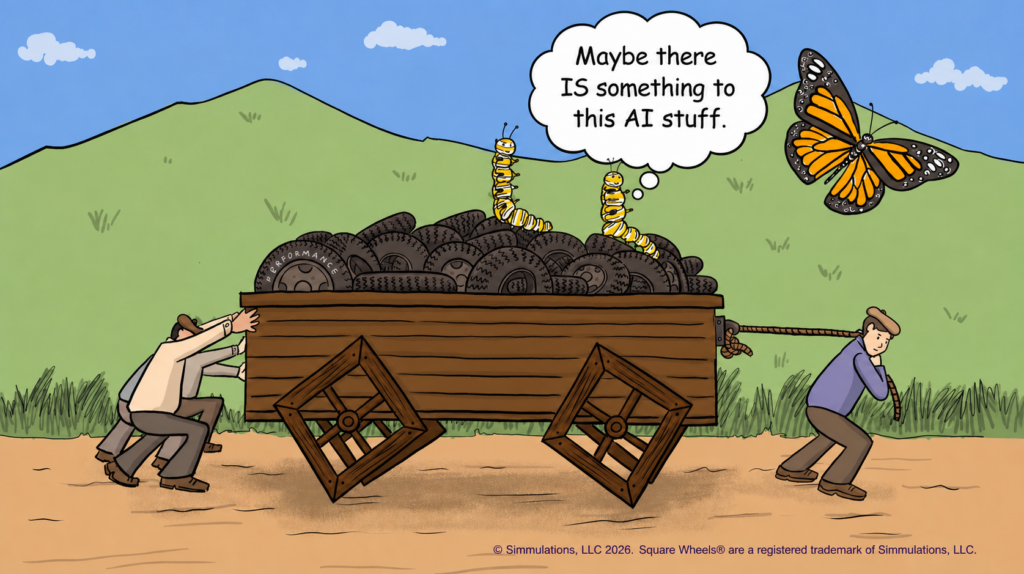
Ask me if you want to try using this image. It is protected intellectual property.
Why Square Wheels Works on the Brain
When people look at the above wagon with its wooden Square Wheels and unused round rubber tires and the different perspectives of the caterpillars and the butterfly, their brain instantly tries to make sense of the scene, lighting up visual, emotional, and problem‑solving networks at the same time. (Note that I have a doctorate in behavioral neurophysiology – the brain and behavior stuff.)
Visual metaphors like this recruit both hemispheres, with image and story on one side, logic and consideration and planning on the other and lots of connections between them. Images and metaphors serve to naturally increase attention, memory, and depth of processing. And collectively, the people will see and imagine many different possible alternatives and possibilities so they can share perspectives and frameworks. And they create their own stories about what is happening based on their beliefs. This generates engagement and internal discussion around possibilities, not resistance and certainly not sabotage.
Rich, ambiguous images act like cognitive “inkblots,” inviting personal interpretation and triggering reward when people spot patterns or improvements. Because images like the above are non‑threatening and slightly playful, they reduce defensiveness so participants can talk about real workplace problems and opportunities without feeling personally attacked.
This image is seen as their workplace as they play with the themes. It is presented as, “How most workplaces really work” and not as an attack on them. They choose to make the switch to talk about how things really seem to work from their own perspectives.
The Power of Visual Metaphor for Change
Over 30 years, I’ve developed a series of over 200 images with related metaphors to engage people’s thinking about workplace issues. The images comprise an organizational development toolkit that can anchor many different issues to opportunities for improvement and growth. The images generate alternative considered possibilities around the choices we make.
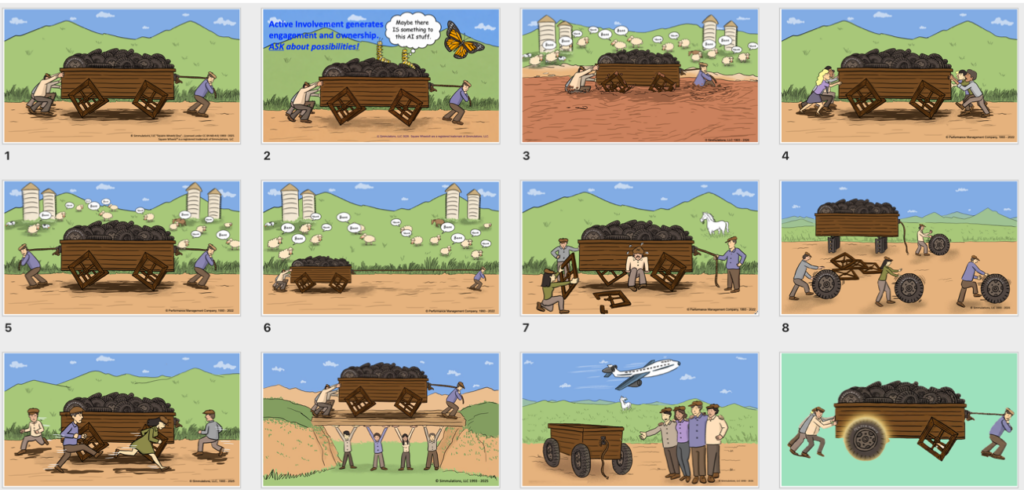
These include themes of change including caterpillars and butterflies, dealing with mud and the difficulties of making progress, the isolation of silos and Spectator Sheep along with images of competition, collaboration and of success and appreciation. These are all tools to generate discussion around disruptive thinking and engagement.
In organizational settings, visual metaphors and interactive discussions help teams zoom out, see the bigger picture, and build a shared language for what is happening and what could be different. Square Wheels are universal — a wagon rolling on Square Wheels that work with round wheel possibilities that already exist — so people in different roles and cultures can instantly link it to “things that work but could roll better” in their own reality.
Experiential learning research explains part of the impact: participants first experience and interpret the image, then reflect on how it matches their world, conceptualize better “round wheel” solutions, and finally plan concrete experiments and actions. That cycle transforms a drawing into a sustained change conversation and makes improvements feel like their own ideas, which increases ownership and follow‑through.
Why are these images So Easy for managers to use
Square Wheels tools are easy to use because managers don’t need facilitation certification; they need only to ask a few good questions and a desired outcome. The image and the process itself does the heavy lifting: people project their beliefs and reality onto it, describe the wagon as “us,” and spontaneously start considering Square Wheels (issues and problems) and round wheels (solutions and possibilities).
A simple, repeatable flow a manager can use in almost any meeting might look like this:
- Show the image (handouts, slide, whiteboard, or digital tool) and ask, “How is this like how we operate?”
- Capture responses about the wagon, the people, the road, and the environment. The caterpillar and the butterfly present the theme of different viewpoints and perspectives (so look around!).
- Ask, “What are our Square Wheels, those things that work but could roll better?”
- Ask, “What round wheels are already available that we’re not using?” “How might different AI tools represent different ways of doing things?”
- Prioritize two or three ideas and agree on next steps and owners. Keep the conversations going because people WILL keep considering how thing work and what might be improved in the workplace (and at home, etc.).
Because the metaphor is non‑specific, it fits topics from production to sales to culture, and managers can adapt it to their style in under ten minutes of preparation. This “low skill, high impact” profile makes it practical to cascade across supervisors so engagement and innovation become everyday behaviors, not one‑off workshops.
Example in practice
A supervisor in operations might show the wagon and hear: “Our reporting process is one Square Wheel—slow and clunky—while automated dashboards are the round wheels sitting in the back.” Or, they might hear that their measurement systems work to generate inferior product (I have an incredible story from my son Jeff about that!). The insights comes from the team, not from a lecture or SME telling them about their reality, which makes them more motivated to implement the new tools they just identified.
There is a HUGE difference between something MINE and something YOURS.
“Nobody ever washes a rental car” is a phrase I have used for decades
to help illustrate this simple point, and that is something my friends
who own rental car agencies INSIST is a reality!
Connecting Square Wheels to Motivation and Engagement
In most organizations, only a minority of employees report feeling actively engaged, which makes simple tools that invite voice and ownership more critical than ever. My article on the Supervisor Hellscape makes this quite clear (link). Square Wheels flips the dynamic from “management telling” to “team discovering,” which boosts autonomy, competence, and relatedness—three core psychological drivers of motivation highlighted in contemporary research.
The image also creates psychological safety: people critique the wagon, not each other, so they can surface issues like bureaucracy, outdated processes, or poor communication without blame. As participants see their ideas captured and acted upon, trust grows, motivation increases, and “dis‑un‑engagement”—removing roadblocks rather than trying to “install engagement”—becomes a practical daily focus for supervisors.
Using Square Wheels to Accelerate AI Adoption
Visual metaphors are amazingly effective in helping organizations understand and accept complex changes such as AI, because they simplify complexity and create a shared narrative. Acceptance of new technologies rises when people can see clear benefits, connect tools to their tasks, and feel involved in designing how those tools will be used.
Managers can combine Square Wheels with AI discussions in several practical ways:
-
Map current workflows as the wagon: Identify where the process “rolls on Square Wheels” such as manual reporting, repetitive data entry, or slow analysis.
-
Frame AI tools as potential round wheels: Show how specific AI applications — summarization, forecasting, knowledge search, image generation — could replace or smooth those Square Wheels.
-
Co‑design implementation: Ask the team, “If this AI tool were a round wheel on our wagon, where would we install it, and what would we need to change to make it roll?” Capture fears, constraints, and support needs as part of the metaphor.
-
Use visual collaboration platforms like Stormz: Combine Square Wheels with digital canvases and facilitation tools so participants can brainstorm, cluster, and prioritize AI use‑cases in a structured, engaging way. You can hire facilitators who can integrate these tools into real change and engagement practices.
By doing things like those suggested above, AI stops being an abstract threat and becomes a practical, co‑created solution aligned with employees’ daily frustrations and aspirations. The same neurophysiology that makes Square Wheels powerful, the visual processing, metaphor, pattern‑spotting, and ownership, helps people integrate AI into their mental model of “how work gets done,” speeding up adaptation and reducing resistance.
If you have any questions about the tools or the approach or the basic ideas around facilitating workplace improvement, ask me.
—
For the FUN of It!
 Dr. Scott Simmerman is a designer of team building games and organization improvement tools.
Managing Partner of Performance Management Company since 1984, he is an experienced presenter and consultant who is trying to retire!! He now lives in Cuenca, Ecuador.
You can reach Scott at scott@squarewheels.com
Learn more about Scott at his LinkedIn site.
Note that I often use Perplexity AI to help research and generate ideas for my posts.
Square Wheels® are a registered trademark of Simmulations, LLC
and images have been copyrighted since 1993,
© Simmulations, LLC 1993 – 2026
Note: Please do not take my images and think about using them. It can generate a whole heap of problems given international copyright law and trademark law. Read this article for more information.
What I’m About:
My Square Wheels blog and website exist to help leaders, trainers, and facilitators make work smoother, more engaging, and more human. I focus on practical tools for process improvement, organizational change, and workplace collaboration that spark insight and deliver measurable results.
And I am convinced, after 30+ years of using Square Wheels®, that it is the best facilitation toolset in the world. One can use it to involve and engage people in designing workplace improvements and building engagement and collaboration. It is a unique metaphorical approach to performance improvement and we can easily license your organization to use these images and approaches.
By blending proven facilitation methods, creative problem-solving, and engaging team activities, my mission is to support organizations in building energized, sustainable cultures of involvement and innovation.
Through accessible — and often free — resources and virtual facilitation tools, I aim to help teams everywhere collaborate more effectively, innovate continuously, and take ownership of their improvement journey.
#SquareWheels #InnovationAtWork #TeamEngagement #FacilitationTools #WorkplaceImprovement #EmployeeEngagement #CreativeProblemSolving #OrganizationalDevelopment #LeadershipTools #collaboration #leadership #motivation #communications #enablement #leadership #CreativeCommons #enablingperformance #teamwork #storytelling #storyasking

0 Comments