
Would You Like to Join the Facilitators’ Guild? I think you would find it of great benefit for whatever kinds of facilitation you do.
WHY? Why should YOU join The Facilitators Guild?
I am interested in The Facilitators’ Guild because I have spent much of my professional life thinking about how supervisors can improve the everyday experience of work. Supervisors occupy a critical position in every organization: close enough to understand what people actually face, and influential enough to shape whether work becomes more engaging, productive, and meaningful—or more frustrating and difficult. When supervisors develop better skills in listening, coaching, asking questions, facilitating conversations, and removing obstacles, they can positively affect not only their own teams but the workplaces of the world.
That is also why the Guild’s emphasis on facilitation is so important to me. I believe supervisors should not be expected simply to push harder, solve every problem themselves, or impose their own answers. They need practical ways to help people think together, identify the Square Wheels that create friction, discover better possibilities, and take ownership of improvement. The Facilitators’ Guild offers a community and a developmental path for people who want to build those capabilities with humility, integrity, inclusion, and a commitment to helping groups—and the people within them—move forward.
Facilitation is one of those practices that can change the quality of a conversation, a meeting, a workshop, a team, or even an entire organization.
A good facilitator helps people think more clearly. They create space for voices that might otherwise go unheard. They ask the questions that move a group beyond familiar answers. They help people see patterns, explore possibilities, make decisions, and turn ideas into action. They can do the disruptive engagement that helps organizations grow and engage.
But facilitation can also be lonely work.
Whether you facilitate workshops, lead organizational change, teach, coach teams, guide community conversations, support research, or help people solve difficult problems, you probably know that the work requires continual learning. Every group is different. Every situation brings new challenges. Every facilitation session teaches us something.
That is why I am inviting interested colleagues to consider joining The Facilitators Guild. (Link to application)
A community for people who guide groups and facilitate change
The Facilitators Guild is a community of practice for people who care about the craft and impact of facilitation.
Our members work in different settings, including companies, academia, government agencies, research, consulting, and community organizations. That diversity is part of the value. We bring different experiences, methods, questions, and perspectives—and we learn from one another.performancemanagementcompany
The Guild exists to support:
-
Mutual learning.
-
The development and exchange of facilitation ideas.
-
Professional community-building.
-
Better group processes and outcomes.
-
More thoughtful, inclusive, and creative ways of bringing people together.
This is not simply a directory of facilitators. It is an opportunity to connect with people who are curious about how groups work and who want to become more intentional about helping groups work better.
Why facilitation matters
Many workplace and community problems are not caused by a lack of intelligence, commitment, or good intentions. They are caused by conversations that never happen, decisions that remain unclear, meetings that produce activity but not progress, and systems that make it difficult for people to contribute their best thinking.
Facilitation helps create the conditions for something different.
It can help a group:
-
Make sense of complex information.
-
Surface assumptions and competing perspectives.
-
Identify obstacles and opportunities.
-
Generate more creative possibilities.
-
Build shared understanding.
-
Navigate disagreement productively.
-
Make decisions with greater clarity.
-
Translate discussion into action.
The facilitator does not need to have all the answers. In many situations, the facilitator’s most important contribution is to help the group discover what it already knows, notice what it has overlooked, and create the next useful step.
The value of learning with others
One of the reasons communities of practice matter is that facilitation is both a discipline and an art. There are frameworks, techniques, tools, models, and research that can help us improve. But there is also judgment. Timing. Presence. Listening. The ability to sense when a group needs more structure—or more freedom. And the more you learn, the more options you have.
Just look at the impacts that AI is having on the art of facilitation and even on things like session design and capturing information to process out the ideas and to actively involve and engage participants in generating ideas for improvement and for producing the report summaries that justify the works to senior decision-makers. There is simply so much happening, only a network of collaborators can help you sort it out.
The best learning often comes from discussing real situations with other practitioners:
-
What happened in the room?
-
What did you notice?
-
What did you try?
-
What might you do differently next time?
-
Which part of the process created energy?
-
Where did the conversation get stuck?
-
How could the experience become more equitable, engaging, or useful?
Those conversations can be difficult to create in isolation. The Facilitation Guild offers a place to share ideas and learn across disciplines.
Facilitation is about creating meaningful moments
The Guild’s “Art & Science of Making Meaningful Moments” series reflects this broader view of facilitation.
The series explores practical and creative approaches to bringing people together, including playful and mindful facilitation, inclusive practice, science facilitation, compassionate community work, organizational culture, and the art of adjourning.
And, that range is important.
Facilitation is not only about running an efficient meeting. It is also about creating the conditions in which people can participate, think, connect, contribute, and leave with a clearer sense of what matters.
- Sometimes the meaningful moment is a breakthrough idea.
- Sometimes it is a person feeling safe enough to speak.
- Sometimes it is a group recognizing a problem honestly for the first time.
- Sometimes it is the decision to try one small improvement instead of waiting for a perfect solution.
A connection to Square Wheels®
In my decades of work with my Square Wheels images and tools, I often ask groups to look at a simple image called Square Wheels One and consider the many possibilities for improvement
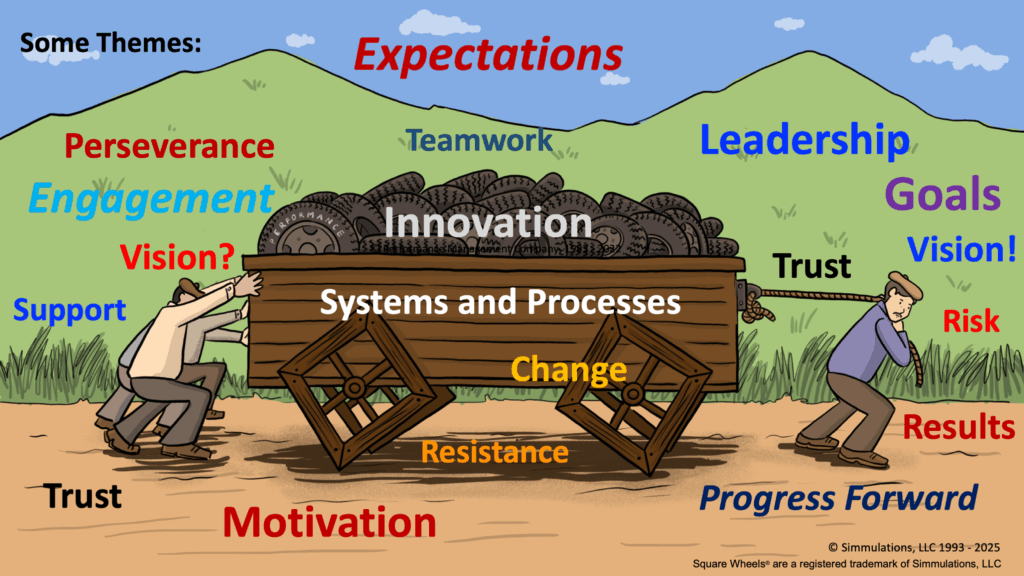
There are many different themes that open for discussion when using Square Wheels One
The image gives people a visual and relatively safe way to talk about workplace friction, unused possibilities, and opportunities for improvement. “Square Wheels” represent the things that are slowing progress or making things difficult, while the “Round Wheels” represent ideas, resources, or practices that could help the group move forward and that are generally already in the wagon.
This approach works because it gives people a shared language. Instead of immediately blaming individuals, the group can examine the system, the process, the habits, and the assumptions that shape everyday performance.
That kind of shared sense-making is central to effective facilitation.
I wrote yesterday about using Square Wheels as a practical coaching technology—connecting research about workplace coaching with simple, visual conversations that help people reflect, identify possibilities, and take action. You can read that article here:
Coaching with Square Wheels: Turning Research into Everyday Performance
You may also find these related resources useful:
-
Square Wheels Tools — an overview of the visual tools and facilitation resources.
-
Square Wheels One — a simple and FREE image for starting conversations about workplace reality and improvement. It is under a Creative Commons BY-ND license for your use!
-
The Stupidly Simple Square Wheels Facilitation Toolkit — a practical resource for supervisors, managers, team leaders, and facilitators.
-
The World’s Best Facilitation Tool — a deeper look at how a simple visual metaphor can support group dialogue and action.
Who should be interested in The Facilitators Guild?
The Facilitation Guild may be especially relevant if you are:
-
A professional facilitator or organizational consultant.
-
A manager or leader who regularly guides group discussions.
-
A coach, trainer, educator, or researcher.
-
Someone who designs workshops or learning experiences.
-
A community engagement practitioner.
-
A change-management or organizational-development professional.
-
A person who wants to develop a more intentional facilitation practice.
-
Someone who believes better conversations can lead to better outcomes.
You do not need to have one specific job title to be interested in facilitation. And personally, I believe it should be a Core Skill of every manager. There is no downside to asking for ideas and generating a sense of active ownership involvement in any change initiative.
Here, you can find ideas for supervisors for reducing resistance to implementing AI.
If you regularly help people think together, work through complexity, make decisions, solve problems, or create something new, you are already practicing some form of facilitation.
What might YOU contribute?
Every member brings something different.
You may have a useful process for opening a difficult conversation. You may have experience facilitating across cultures or disciplines. You may have learned how to help groups work through conflict. You may be experimenting with visual tools, online collaboration, participatory research, inclusive practice, or new ways to design meaningful learning experiences.
You may also simply bring thoughtful questions that change the thinking or help ground a tool to a different reality. (That is what I do, I think, more than anything else.)
Communities become stronger when members share not only polished success stories, but also the uncertainties, experiments, mistakes, and discoveries that shape real practice.
Consider joining us
If facilitation is part of your work—or if you want it to become a more intentional part of your work—I invite you to learn more about The Facilitation Guild.
Visit the Guild’s website: The Facilitation Guild
You can also explore:
-
Meet the Guild — learn more about the people involved.
-
Join the Mailing List — receive Guild updates and information.
-
The Art & Science of Making Meaningful Moments — explore the Guild’s facilitation series.
-
Contact the Guild — connect with Guild members and learn more.
-
Services and Rates — see how Guild members approach customized facilitation work.
And if you are ready to take the next step, please complete the application here:
Apply to Join The Facilitation Guild
I hope you will consider joining us. There are interesting things happening as we support each other in our movement towards the future of Facilitation and the use of new tools.
Facilitation can change the quality of the conversations people have, the decisions they make, and the way they work together.
The more we learn from one another, the better we can help groups move from stuck to engaged, from confused to clear, and from merely talking about improvement to actually creating it.
What are the conversations you are helping make possible?
—
For the FUN of It!
 Dr. Scott Simmerman is a designer of team building games and organization improvement tools.
Managing Partner of Performance Management Company since 1984, he is an experienced presenter and consultant who is trying to retire!! He now lives in Cuenca, Ecuador.
You can reach Scott at scott@squarewheels.com
Learn more about Scott at his LinkedIn site.
Note that I often use Perplexity AI to help research and generate ideas for my posts.
Square Wheels® are a registered trademark of Simmulations, LLC
and images have been copyrighted since 1993,
© Simmulations, LLC 1993 – 2026
Note: Please do not take my images and think about using them. It can generate a whole heap of problems given international copyright law and trademark law. Read this article for more information.
What I’m About:
My Square Wheels blog and website exist to help leaders, trainers, and facilitators make work smoother, more engaging, and more human. I focus on practical tools for process improvement, organizational change, and workplace collaboration that spark insight and deliver measurable results.
And I am convinced, after 30+ years of using Square Wheels®, that it is the best facilitation toolset in the world. One can use it to involve and engage people in designing workplace improvements and building engagement and collaboration. It is a unique metaphorical approach to performance improvement and we can easily license your organization to use these images and approaches.
By blending proven facilitation methods, creative problem-solving, and engaging team activities, my mission is to support organizations in building energized, sustainable cultures of involvement and innovation.
Through accessible — and often free — resources and virtual facilitation tools, I aim to help teams everywhere collaborate more effectively, innovate continuously, and take ownership of their improvement journey.
#SquareWheels #InnovationAtWork #TeamEngagement #FacilitationTools #WorkplaceImprovement #EmployeeEngagement #CreativeProblemSolving #OrganizationalDevelopment #LeadershipTools #collaboration #leadership #motivation #communications #enablement #leadership #CreativeCommons #enablingperformance #teamwork #storytelling #storyasking


0 Comments