
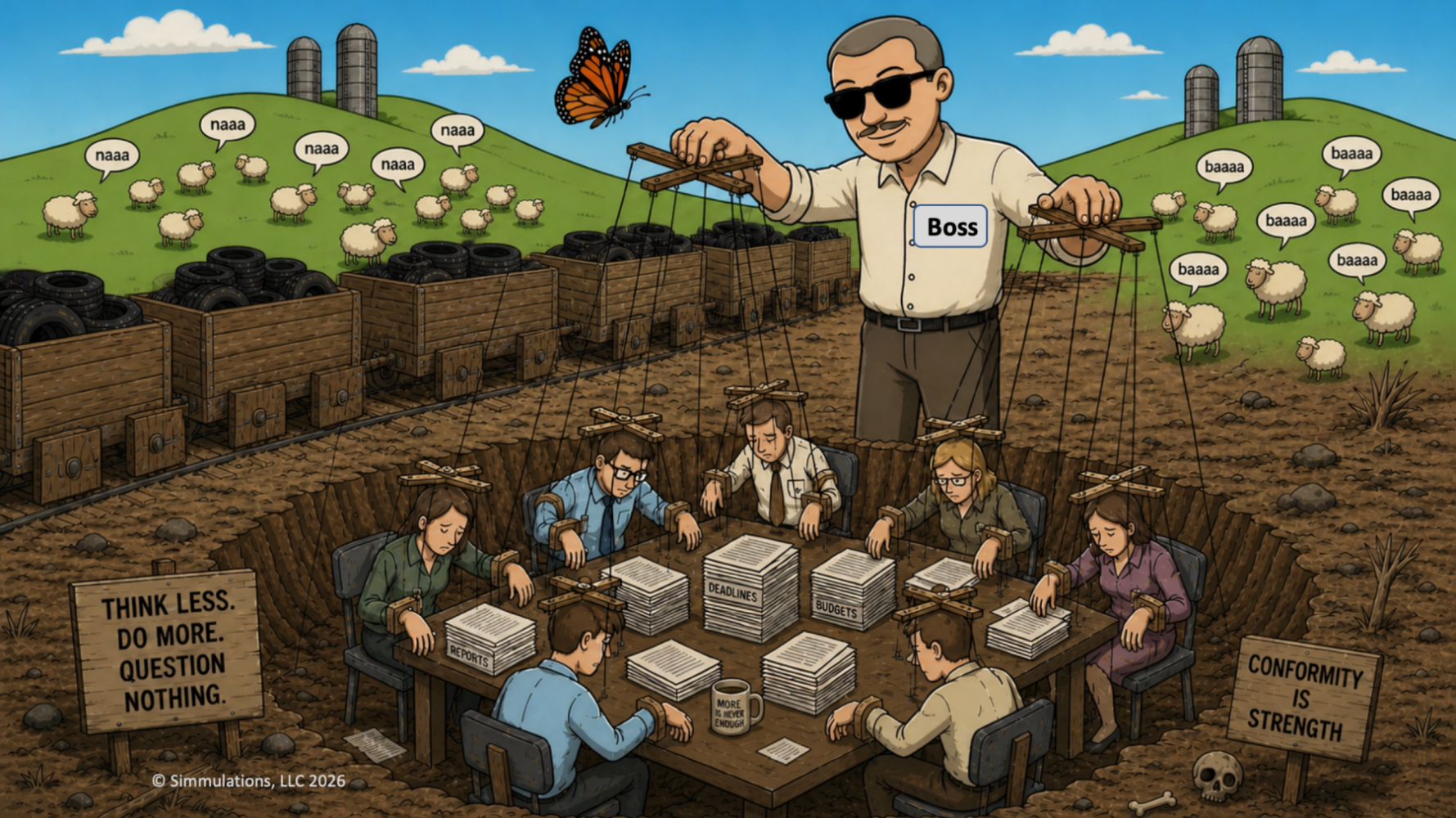
It is predictable that AI will not just change work but will also change how people think and how they are viewed by each other and management.
The real workplace risk of AI is not simply that it will eliminate jobs. I believe that organizations may become faster at producing output while becoming worse at things like developing people, sharing judgment, solving unfamiliar problems, and sustaining the human engagement that makes improvement possible. We may become more mechanical and even less focused on people and performance. And, there are some great risks to that.
AI can be an extraordinary workplace improvement tool. It can help a supervisor prepare for a difficult conversation, summarize customer feedback, draft a proposal, organize data, generate alternatives, and remove frustrating routine work. Used well, it gives everyone more time for customers, collaboration, creative thinking, coaching, and meaningful improvement.
But used carelessly or with malice, it can also remove the very experiences through which employees learn how work actually works and how people actually integrate.
The original article that got me thinking along these lines is here*; it frames AI as a threat to the “reproduction of knowledge.” In my view of a good workplace, there is a much more practical idea: experienced people teaching newer people how to diagnose problems, make sound decisions, challenge assumptions, collaborate across boundaries, and improve the system rather than merely cope with it. It is a supporting culture. But, the article’s central concern is that AI can deliver immediate, context-specific answers while reducing the human effort that creates durable, shared knowledge.
- “Nobel Prize Winner Has Just Proven That AI Is a Ticking Bomb Beneath Our Entire Technological Ecosystem” at https://medium.com/@sergeykleftzov/nobel-prize-winner-has-just-proven-that-ai-is-a-ticking-bomb-beneath-our-entire-technological-2775762dbcfe
The many Workplace Paradoxes of AI
Here is the main paradox leaders and managers need to understand:
AI may improve today’s individual performance while weakening tomorrow’s organizational capability.
When people must work through a problem, consult colleagues, test a solution, explain their reasoning, and learn from mistakes, they build competence and gain confidence in their skills. They also create knowledge that benefits the larger organization. Informal conversations, team huddles, coaching, after-action reviews, problem-solving meetings, and peer-to-peer assistance are not “extra work.” They are the organization’s learning system.
AI can shortcut parts of that developmental process.
An employee faced with a customer complaint, a technical problem, a staffing issue, or a difficult report may ask AI for an answer and receive a polished response in seconds. That can be helpful and look responsive. But if the employee simply accepts the answer, sends it, and moves on, several things may be lost:
-
The employee may not understand the logic behind the recommendation.
-
The manager may never hear about the recurring issue.
-
Co-workers may lose an opportunity to contribute their different perspectives.
-
The underlying process problem may remain invisible.
-
The organization gains a completed task but not a stronger person or a better system.
That distinction matters. Output is not the same as learning. Speed is not the same as capability. And an answer is not the same as judgment.
There is a similar dynamic in professional and technical knowledge communities: AI can make it easier to obtain a quick answer while reducing the incentives and opportunities for people to generate, explain, critique, and preserve general knowledge. In a typical workplace, the equivalent may be a decline in developmental conversations such as:
-
“What are we seeing here?”
-
“Why did this happen?”
-
“What have we tried before?”
-
“Who else has dealt with this?”
-
“What should we change in the process?”
-
“How will we know whether this actually worked?”
Those are the questions from which organizational learning grows. And these can go missing.
What Workers Will Face, the Reality of working
Workers will experience AI not only as a productivity tool, but as a change in the psychological contract of work. The core question will increasingly become: “Am I being helped to do better work, or am I being made more replaceable?” How will they view their work and their workplaces?
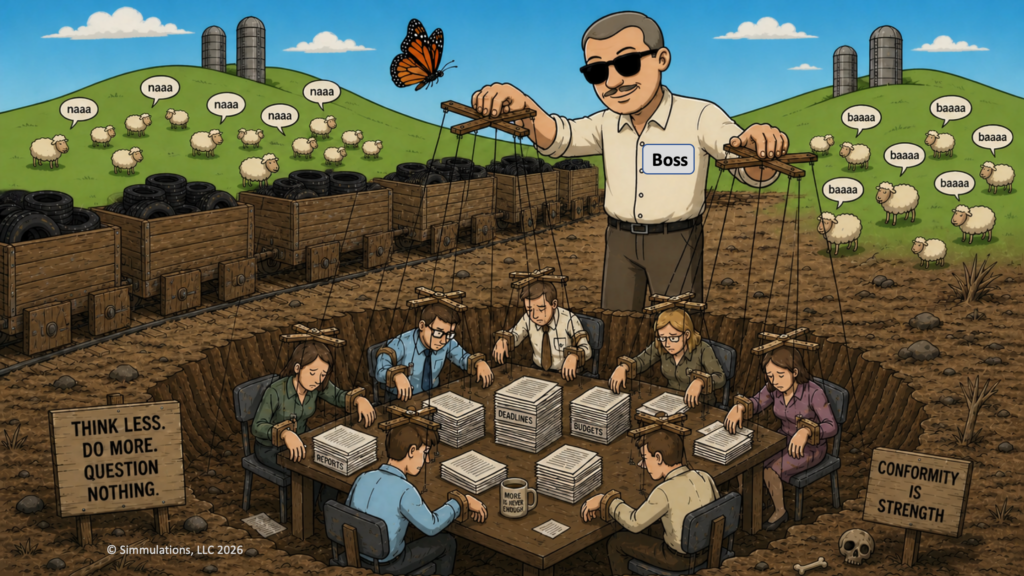
Less routine work — but fewer learning opportunities
For many employees, routine work has historically been the starting point for expertise and the development of the tacit knowledge that makes all things work:

For many employees, routine work has always been the starting point for expertise.
AI may remove or automate the first link in this chain. That is not automatically bad in that few people will mourn the loss of tedious, repetitive tasks. But managers must recognize what routine work often provided:
-
Repetition that built familiarity and pattern recognition.
-
Small decisions that developed confidence.
-
Exposure to real customer, operational, and technical variation.
-
Opportunities to ask experienced colleagues questions.
-
A practical basis for understanding why standards, procedures, and safeguards exist.
If AI drafts the emails, writes the code, analyzes the data, creates the presentations, responds to customers, and resolves the basic cases, newer workers may have fewer chances to build the foundations that let them handle exceptions, ambiguity, conflict, or crisis later. Who among us has not learned how things really work based on the routine things we did in our businesses?
That does not mean “make junior people suffer through busywork so they can learn.” It means organizations must deliberately replace passive learning-through-routine with active learning-through-practice, coaching, simulation, reflection, and increasingly complex assignments.
Anxiety and disengagement from working through problems
AI-related uncertainty can affect engagement long before a job disappears. There is evidence that uncertainty about AI’s future impact may discourage people from entering fields even when demand remains strong. In organizations, a similar effect can appear when employees begin to wonder:
-
“Why should I develop this skill if AI will do it?”
-
“Will my manager invest in me, or just automate my work?”
-
“If I share what I know, am I helping eliminate my position?”
-
“Does the organization value my judgment, or only my output?”
-
“Am I still building a career, or just supervising software?”
The above are engagement questions, not simply technology questions.
When employees do not see a credible future for themselves, motivation drops. They may protect knowledge rather than share it, minimize effort, avoid learning new systems, disengage from improvement activities, or leave. An organization can purchase AI tools and still lose the very discretionary effort, trust, creativity, and problem ownership it needs to use those tools well.
The real risk of “I can use it, but I cannot explain it”
A particularly serious risk is false competence. Employees may be able to produce high-quality-looking work with AI assistance without being able to explain the work, judge its quality, identify errors, or adapt it when the situation changes.
There may be an erosion of professional judgment or “intuition rust”: performance measures can initially improve while people gradually become less able to recognize when AI is wrong, incomplete, biased, or inappropriate. And, while it IS getting better, it is still sometimes wrong, incomplete, biased or inappropriate! And dealing with those systems problems can be very frustrating for people.
In a workplace, “intuition rust” might sound like this:
-
“The AI said this was the right customer response.”
-
“I do not know why the spreadsheet model made that recommendation.”
-
“The report looks professional, so I assumed it was accurate.”
-
“The policy summary seemed right, so I sent it.”
-
“The code worked in testing, but I cannot explain what it does.”
-
“The system scheduled the staff, so I did not question it.”
That is not empowerment. It is dependency. And this will lead to any number of workplace enablement or engagement issues. Do you think the person with the above kinds of reactions will be that highly motivated individual?
Employees should be able to use AI, but they must retain enough working knowledge to question it, improve it, reject it when necessary, and take responsibility for the final decision.
What Managers Will Face in the day to day work
The manager’s job becomes more demanding, not less. AI will make it easier to measure activity and output, but harder to see whether people are learning, collaborating, thinking critically, and building the capability the organization will need next year. They will be less able to grow the business or innovate their workplaces.
The temptation to optimize the present and cost the future
A manager under pressure to reduce cost, meet deadlines, or improve quarterly results may see AI as a reason to reduce entry-level hiring, cut training time, eliminate mentoring, or expect fewer people to do more work. They will see improvement in some of the metrics, for sure and it may create short-term gains. But it will also create a long-term talent and knowledge problems.
The danger comes as organizations “consuming” inherited knowledge without reproducing it. Put plainly: if a company stops bringing in and developing newer employees, who becomes the next generation of experienced problem-solvers, supervisors, technical specialists, salespeople, project leaders, and executives?
Every organization has this kind of knowledge supply chain in operation:
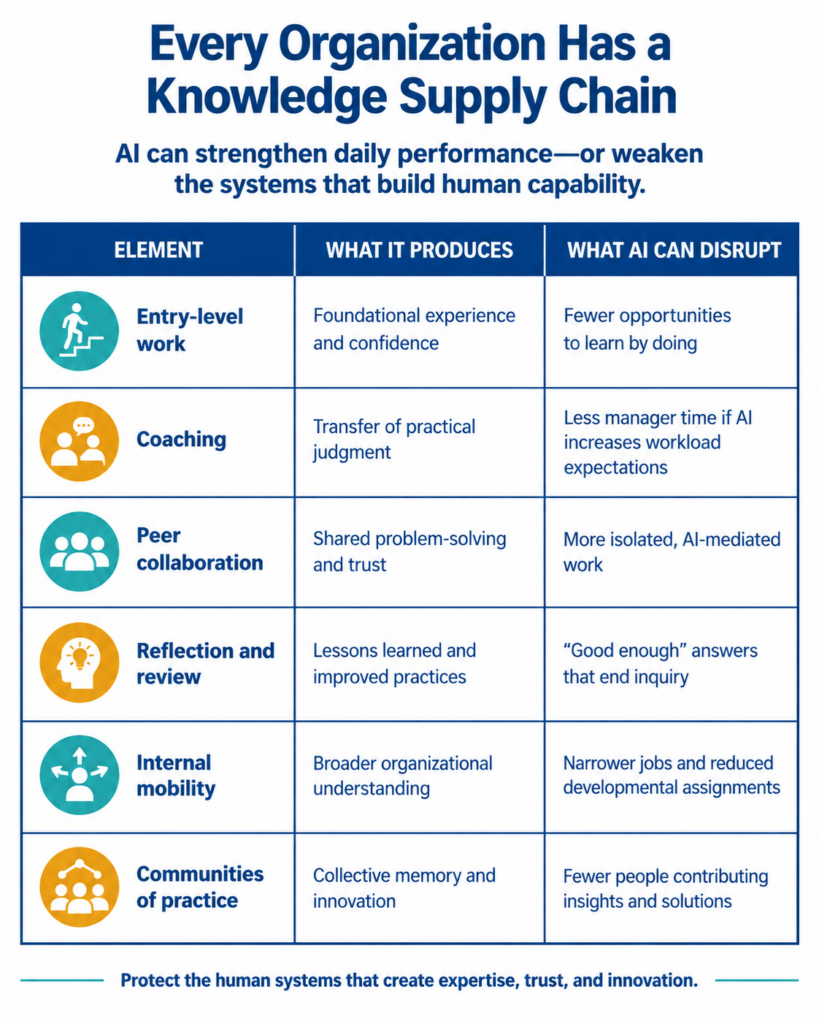
A manager who automates work without redesigning workplace learning may improve the dashboard while weakening the bench strength. So, what do we do and how do we change our perceptions and our behaviors to generate long-term positive impacts?
Decisions will need more and not less human judgment
Managers will need to continue to decide which decisions and operations can be automated, which can be AI-assisted, and which must remain decisively human.
A practical rule is:
-
Use AI for speed, synthesis, drafting, searching, pattern detection, and alternative generation.
-
Use people for purpose, trade-offs, ethics, relationships, accountability, local context, interpretation, and final judgment.
For example, AI can analyze employee-survey comments and identify recurring themes. But it cannot replace a manager listening carefully to employees explain why trust has fallen, why a policy feels unfair, why workload is unsustainable, or why people no longer believe management will act on feedback. This requires human judgment to make human decisions. (Note that the toxic managers may continue to be toxic. I have written about this many times in my blog.)
AI can draft a performance conversation but it cannot create genuine respect, psychological safety, empathy, credibility, or trust. Those are built through the manager’s behavior over time.
Innovation may become more plentiful, but also more shallow
AI will make it easier to generate ideas. A team can produce 50 suggestions, 20 marketing concepts, 10 process improvements, or several alternative project plans in minutes. But innovation is not idea volume. And it will not generate the active human involvement needed to identify the most important necessary changes. Real innovation requires people to do several difficult things:
-
Notice a real problem worth solving.
-
Understand the work well enough to define the problem accurately.
-
Involve the people affected by the change.
-
Test assumptions in the real operating environment.
-
Resolve conflicts among competing goals.
-
Learn from failed experiments.
-
Build commitment to implementation.
AI can accelerate divergence and the generation of possibilities. Ai can help collect and process ideas. But human dialogue is still essential for convergence and improvement: choosing, adapting, implementing, and learning from the right possibilities. People help the process to generate real improvements in how things work and to collaborate across organizational barriers to get things done.
Without that dialogue, organizations may become very good at generating attractive proposals and very poor at implementing meaningful change. AI will not generate the active ownership involvement needed to implement improvements.
Communication and Culture
AI will not only change the content of workplace communication. It will change its texture.
More messages will be drafted by machines. More summaries will be automated. More meetings will be transcribed, analyzed, and condensed. More customer and employee interactions will be routed through chatbots and assistants. More communication will become polished, quick, and standardized. While useful, it can also make communication less human.
The likely Cultural Shifts we can expect
New research is showing that a workplace that relies heavily on AI without clear norms may drift toward several patterns:
-
More polished language but less authentic voice.
-
More information but less shared understanding.
-
Faster responses but weaker relationships.
-
More “answers” but fewer questions.
-
More individual efficiency but less peer learning.
-
More monitoring and measurement but less trust.
-
More content production but less meaningful dialogue.
-
More dependence on tools but less confidence in personal judgment.
Employees can usually tell when a manager is speaking with them versus sending a generic AI-generated message. The issue is not whether AI helped draft it. The issue is whether the message reflects real understanding, specific context, personal accountability, and a willingness to listen.
A manager who says, “I used AI to help organize the options, but I want your experience to tell us what it missed,” is inviting engagement.
A manager who says, “The AI analysis shows this is the answer,” is closing down engagement.
That one difference has major implications for culture.
The Communication Challenges
The central cultural choice is whether AI becomes a substitute for conversation or a prompt for better conversation.
Used poorly, AI can create a workplace where people interact less with one another and more with systems. Employees receive algorithmic recommendations, automated performance feedback, standardized answers, and machine-generated communications. They may comply, but they will not necessarily commit.
Used well, AI can free people from low-value administrative work and make more room for the conversations that produce engagement:
-
Clarifying priorities.
-
Asking employees what gets in the way of good work.
-
Sharing customer feedback.
-
Examining recurring operational problems.
-
Coaching people through unfamiliar decisions.
-
Recognizing contributions specifically and credibly.
-
Inviting people to improve the work they know best.
-
Making decisions transparently, especially difficult ones.
Engagement is not created because people receive more messages. It grows when people believe their work matters, their ideas matter, their manager listens, and they have a real role in improving the organization.
Why Square Wheels® Matter
This is where my Square Wheels approach becomes especially valuable. We offer a simple tool with a variety of different metaphors that can lead to excellent discussions of issues and opportunities. Take a look and see what you might use to generate discussions about your organizational realities:
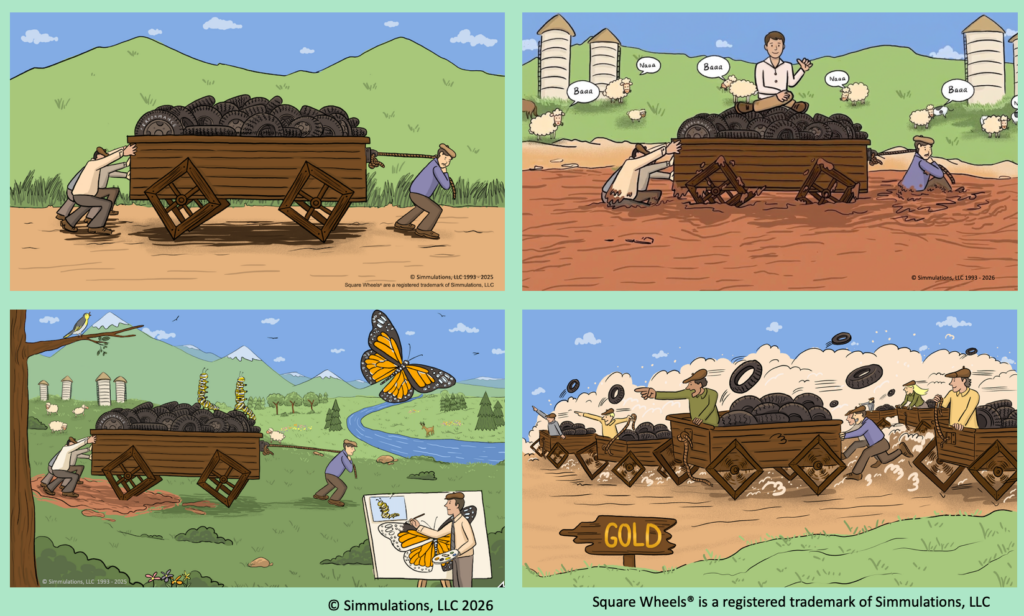
Four illustrations showing some of the Square Wheels metaphors to generate discussions
Square Wheels is not simply a lightweight cartoon exercise. These tools are a real communication technology for human systems. The images and related metaphors for discussion help people see and discuss workplace realities that are often difficult to name directly: frustrating processes, outdated practices, unnecessary barriers, disengagement, leadership blind spots, cross-functional conflict, and ideas that never get heard.
And the images work elegantly to generate active engagement and ownership involvement to thus generate real cognitive dissonance between how things really are and what could be different. This is a core practice in generating the motivation to initiate and sustain change, both personal and organizational.
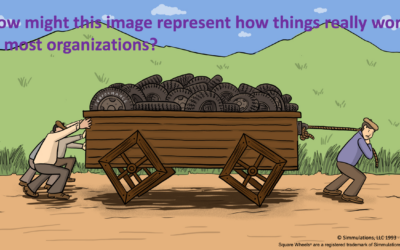
Square Wheels are things that work but do not work smoothly.
Round Wheels are already in the wagon.
Implementation requires stopping. Note that Mud is common.
Facilitating change is not rocket surgery but conversations and listening.
The Mentor sees the butterflies in the caterpillars.
In an AI-enabled workplace, this enablement around improvement ideas works, and value may actually increase.
AI produces language quickly. Square Wheels produce conversation and engagement.
AI can generate a process-improvement plan. Square Wheels can get the people doing the work to say, “Yes, that is exactly what is getting in our way,” and then engage them in identifying what they can choose to do differently to improve.
My classic Square Wheels images and metaphors creates a safe, non-defensive way to talk about organizational frictions:
-
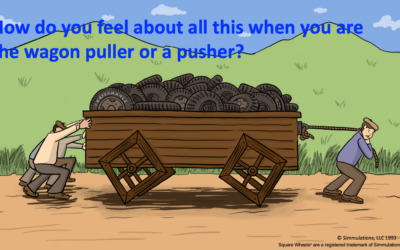
The Square Wheels represent current practices, systems, rules, handoffs, or habits that make work unnecessarily difficult.
-
The round wheels already in the wagon represent overlooked ideas, capabilities, or improvements already available within the organization.
-
The people pushing the wagon represent employees who are working hard inside a system that may not be designed to help them succeed or give them much of a view of where they are going..
-
The puller in the picture represents management’s opportunity—and responsibility—to ask better questions, remove barriers, and use the ideas already present. But that rope isolates them somewhat from the thumping and bumping.
That metaphor is particularly powerful when employees fear that AI is being imposed upon them. Instead of beginning with, “Here is the new AI system,” leaders can begin with:
“Where are the Square Wheels in our work? What is AI helping us improve? What new square wheels might AI create? And what round wheels—ideas, skills, safeguards, and better practices—do we already have but are not using?”
That changes AI adoption from a technology rollout into an engagement process. See this blog for more ideas about dealing with resistance when implementing AI tools. (Rolling past resistance in using AI in the workplace)
A simple “Square Wheels Conversation About AI”
A supervisor could facilitate a team conversation using a Square Wheels One visual and these questions:
-
What Square Wheels slow us down now?
Identify repetitive tasks, poor handoffs, confusing policies, duplicate reporting, information bottlenecks, customer frustrations, or low-value administrative work. -
Where could AI genuinely help?
Focus on work that is tedious, time-consuming, data-heavy, or highly repetitive—not on replacing employee judgment, relationships, or accountability. -
What work must remain human?
Identify decisions involving ethics, customers, employee wellbeing, sensitive conflict, safety, local context, trust, and responsibility. -
What do people need to learn in order to use AI intelligently?
Ask what employees must understand well enough to verify AI output, challenge errors, recognize limitations, and make sound decisions. -
What knowledge must we continue to reproduce?
Identify skills and judgment that newer employees still need to acquire through practice, coaching, mentoring, simulations, rotation, and reflection. -
How will we make AI use visible and discussable?
Encourage people to share how they used AI, what worked, what failed, what had to be corrected, and what new operating practices are needed. -
What round wheels are already available?
Surface employee ideas, existing expertise, informal workarounds, customer insights, process knowledge, and cross-functional resources that can improve implementation.
The supervisor / facilitator’s job is not to convince employees that AI is good. It is to help the group develop shared ownership of how AI will be used responsibly and productively.
The Engagement Opportunity
There is a large difference between these two messages:
“We are deploying AI to increase productivity.”
and:
“We will be using AI to remove unnecessary friction, improve the work, strengthen your capability, and create more time for meaningful contribution.”
The first message often will trigger fear, defensiveness, and compliance. The second has the potential to create involvement, learning, and commitment—but only if management behaves consistently with it.
Employees will evaluate leaders by what actually happens:
-
Are jobs and career paths discussed honestly?
-
Are people trained before being judged on AI-enabled work?
-
Are junior employees still given developmental opportunities?
-
Are managers rewarded for coaching and developing others?
-
Are employees invited to improve the implementation?
-
Is AI output reviewed critically?
-
Are people recognized for catching mistakes and raising concerns?
-
Are efficiency gains reinvested in learning, innovation, customer service, or workload improvement?
If AI simply becomes a tool for doing more with fewer people, engagement will suffer. If AI helps people eliminate waste, build capability, solve better problems, and have more influence over their work, it can strengthen engagement.
The Management Imperative – Getting Actively Involved
The central task is not to prevent AI from changing work. That is neither realistic nor desirable. The task is to ensure that AI augments human capability rather than quietly eroding it.
A healthy AI-enabled workplace will deliberately protect and strengthen five things:
-
Human judgment: Employees must understand enough to question, verify, and improve AI-generated work.
-
Developmental pathways: Newer employees need structured opportunities to learn, practice, make decisions, receive coaching, and build expertise.
-
Collective knowledge: Teams need forums to share lessons, document insight, solve problems together, and retain institutional memory.
-
Authentic communication: Managers need to use AI to prepare better conversations, not to avoid conversations.
-
Employee involvement: People closest to the work must help identify both the square wheels AI can remove and the new square wheels AI may create.
The most dangerous outcome is not an organization that uses AI. It is an organization that uses AI to become more efficient at the expense of becoming less thoughtful, less connected, less capable, and less human. Many workplaces are already pretty inhumane and we can use the implementation of AI tools to change that enablement dynamic.
Square Wheels tools offer a practical antidote because they restores the conversation. They help people name the barriers, see the overlooked possibilities, and participate in improving the system. In a future full of machine-generated answers, organizations will need more, not less, of that kind of human dialogue.
The essential question for every manager is not, “How much work can AI do for us?” The real question is:
“How can we use AI to help our people do better work, learn more deeply, contribute more fully, and improve the system together?”
Note: Much of this information comes from Professor Daron Acemoglu and colleagues at MIT in a paper titled AI, Human Cognition, and Knowledge Collapse.
If my tools can help you in any way, connect with me,
—
For the FUN of It!
 Dr. Scott Simmerman is a designer of team building games and organization improvement tools.
Managing Partner of Performance Management Company since 1984, he is an experienced presenter and consultant who is trying to retire!! He now lives in Cuenca, Ecuador.
You can reach Scott at scott@squarewheels.com
Learn more about Scott at his LinkedIn site.
Note that I often use Perplexity AI to help research and generate ideas for my posts.
Square Wheels® are a registered trademark of Simmulations, LLC
and images have been copyrighted since 1993,
© Simmulations, LLC 1993 – 2026
Note: Please do not take my images and think about using them. It can generate a whole heap of problems given international copyright law and trademark law. Read this article for more information.
What I’m About:
My Square Wheels blog and website exist to help leaders, trainers, and facilitators make work smoother, more engaging, and more human. I focus on practical tools for process improvement, organizational change, and workplace collaboration that spark insight and deliver measurable results.
And I am convinced, after 30+ years of using Square Wheels®, that it is the best facilitation toolset in the world. One can use it to involve and engage people in designing workplace improvements and building engagement and collaboration. It is a unique metaphorical approach to performance improvement and we can easily license your organization to use these images and approaches.
By blending proven facilitation methods, creative problem-solving, and engaging team activities, my mission is to support organizations in building energized, sustainable cultures of involvement and innovation.
Through accessible — and often free — resources and virtual facilitation tools, I aim to help teams everywhere collaborate more effectively, innovate continuously, and take ownership of their improvement journey.
#SquareWheels #InnovationAtWork #TeamEngagement #FacilitationTools #WorkplaceImprovement #EmployeeEngagement #CreativeProblemSolving #OrganizationalDevelopment #LeadershipTools #collaboration #leadership #motivation #communications #enablement #leadership #CreativeCommons #enablingperformance #teamwork #storytelling #storyasking

0 Comments