
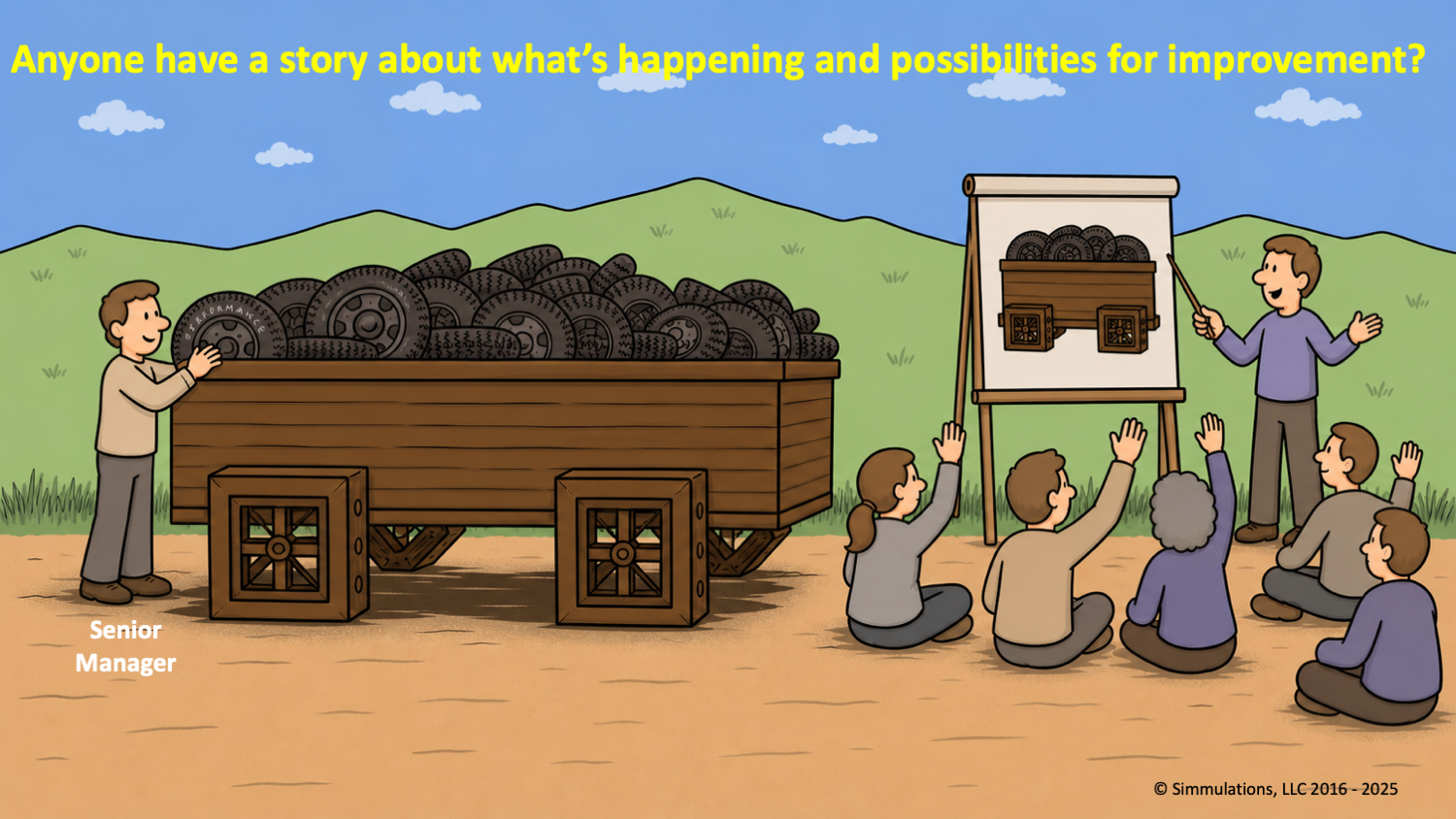
StoryASKING is a practical way to shift ownership to the people and build engagement. A supervisor can make the ownership effects of implementing improvement very explicit.
By asking for stories, you give the psychological ownership of problems to them. And you do not need to have any storytelling skills. Asking is easy if you use a simple visual to anchor the process. And Square Wheels® is that simple tool for making this work seamlessly.
This stuff ain’t rocket surgery, but asking for ideas for improvement is engaging and enabling.
Why StoryASKING Absolutely Beats StoryTelling for Managers.
Storytelling is a skill, and few do it well. And you never know the reactions or thoughts of the people who hear it told. (See my story around the caterpillar / butterfly joke and how I was so wrong in what I thought people understood it to mean — there are many different interpretations!)
When you move from telling stories to asking for them, you quietly shift who owns the narrative of work. Instead of “management’s story about the team,” you elicit “the team’s story about the work and the workplace.” That transfer is what creates ownership involvement. People are no longer passive listeners; they become co‑authors describing where the wagon is stuck and where the round wheels already exist. Once they voice those realities in their own words, they are much more likely to feel responsible for changing them.
Researchers looking at narratives in workplace settings note that who “owns” a story and who has the right to tell it strongly shapes identity, professionalism, and behavior at work. When a supervisor becomes a story asker, they hand the microphone to the people doing the work, which validates their lived experience and reinforces that “this is our process to improve,” not “their process to endure.”
-
People move from recipients of decisions to designers of improvements, because they are the ones naming the square wheels and suggesting round wheels.adp+1
-
Teams develop a shared language and memory of wins to build a culture of performance improvement. “Remember when we said the wagon was overloaded and we rebalanced work?” reinforcing a collective sense of “we did this.” You are building a collective memory of positive failures and important successes.
-
Supervisors gain credibility as partners instead of inspectors, because they are seen listening, capturing ideas, and acting on them.
The Background of asking and improvement – some details and frameworks
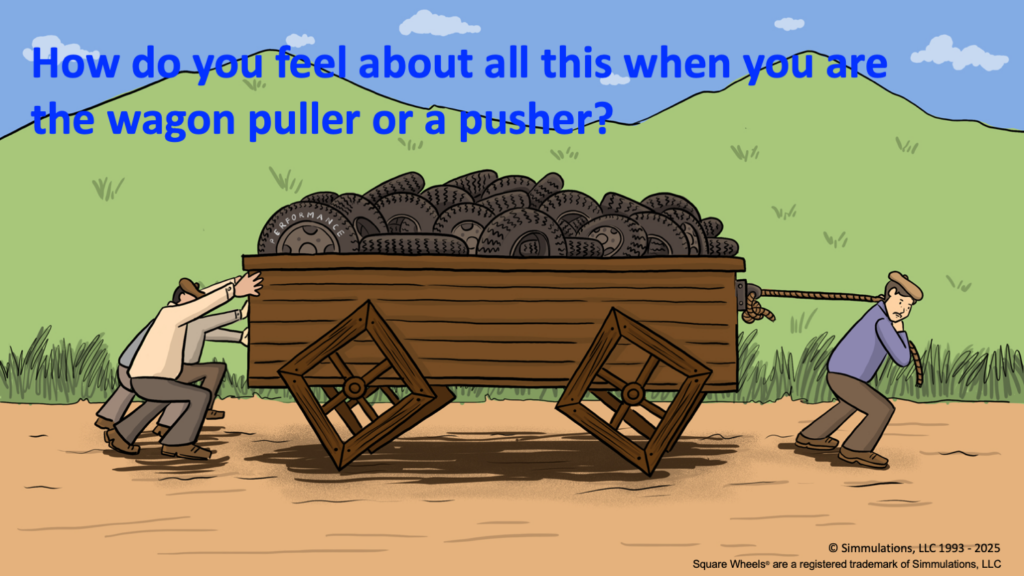
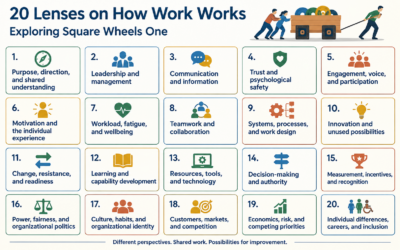
I work from this simple perspective about how things really work in most organizations. It is called Square Wheels One and you can get it for free along with an instructors’ guide and a simple toolkit.
Engagement does not begin with a survey, a motivational speech, or a new corporate initiative. It begins when people believe their day-to-day experience matters and that speaking up may lead to something changing. And for supervisors, that is a powerful opportunity to engage and enable.
Workers are close enough to the work to see the pressure points, the workarounds, the frustrations, and the small wins that middle and senior leaders may never notice. Your team members see them even more clearly. The challenge is creating a regular, safe way for people to share what they see and help improve it.
That is where StoryASKING comes in.
StoryASKING means using questions, images, and curiosity to invite employees to describe their work experience in their own words. Rather than explaining what is happening or telling people how they should feel, you ask them to help make sense of the work together.
It is a simple shift:
-
Less telling people what the story is.
-
More asking people what story they are living.
-
Less “Here is the plan.”
-
More “What are you seeing, and what would make this work better?”
That shift can make everyday team conversations more engaging, more honest, and more useful.
REALITY: Engagement Is Not Just Motivation
People are more likely to engage when they have a chance to contribute, influence decisions that affect their work, and see that their ideas are taken seriously. Engagement is not about keeping everyone cheerful all the time. It is about creating an environment where people can say things like:
-
“I understand what matters.”
-
“My work and perspective count.”
-
“I can raise a problem without being blamed.”
-
“I have some ability to improve how work gets done.”
-
“When I contribute an idea, something may actually happen.”
Supervisors cannot always solve staffing shortages, policy issues, equipment failures, customer demands, or corporate decisions. But they can shape how the team talks about those challenges and whether employees feel like observers or participants.
StoryASKING helps people become participants.
Instead of being asked to simply accept a process, employees are invited to describe where that process helps, where it gets in the way, and what a better version might look like. That conversation creates involvement—and involvement is one of the strongest building blocks of engagement.
What StoryASKING Looks Like
StoryAsking does not require you to be a polished storyteller or facilitator. You do not need a big meeting, special software, or an hour on everyone’s calendar.
It starts with a visual metaphor and a good question.
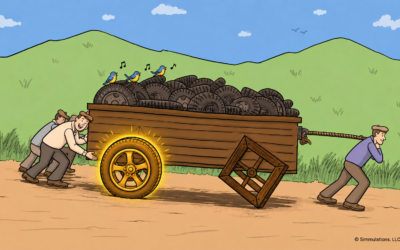
For example, you might use Square Wheels One, above, and just ask what people see happening in the image (and not yet in their workplace). Let them share their thoughts and reactions.
After they play with this for a bit, ask this kind of question and solicit their reactions:
“Where are we in this picture right now?”
Note that the above question is a lot more useful than asking, “What are our problems?” since it gives people a safe, indirect way to say what is really going on.
They may say:
-
“We are pushing hard, but the process is slowing us down.”
-
“We have good tools, but nobody knows who is supposed to use them.”
-
“The wagon is overloaded.”
-
“We keep fixing the same issue instead of preventing it.”
-
“The round wheels are right there, but we do not have time to stop and install them.”
-
“Everyone is helping, but no one is steering.”
Those comments are not just feedback. They are the beginning of a shared understanding of the work and the work processes.
Your role as a storyasker is not to correct the story or immediately explain why things are the way they are. Your role is to listen, capture the team’s language, and help the group identify one useful next step.
Why Projective Images Help People Speak Up
Direct questions can make people cautious or hesitant to speak up. You have all seen that, for sure. If the boss asks, “Why are we failing to meet our production target?” people can rightly worry about blame. If you ask, “What is wrong with our customer-service process?” employees may assume you already have a preferred answer.
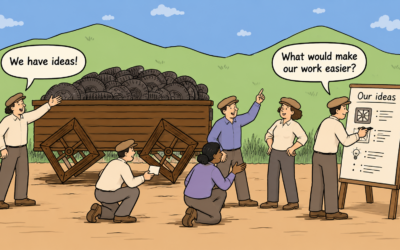
As proof, when I share this image on the left, managers will make 4 negative comments to every positive one, even though the image represents change and possibilities. I then share the other images to make the point that change will not happen in an environment full of blame.

Using images lowers that performance pressure.
People can point to a part of the image instead of pointing at a person. They can say, “That person looks like us,” or “Those Square Wheels are our approval process,” without making the conversation personal. They can point out that there are unused possibilities already in the wagon that can be implemented if we change things.
Images and conversations also help supervisors hear things that do not appear in reports or metrics:
-
Friction between teams or shifts.
-
Confusing handoffs.
-
Rework that has become normal.
-
Missing information at the point of work.
-
Workarounds employees rely on every day.
-
Good ideas that have never been tested.
-
Pride in the team’s ability to keep going under pressure.
Using an image like Square Wheels Onehelps people create a common language of the workplace. Once the team has a phrase such as “the overloaded wagon” or “the round wheel we are ignoring,” you can use it later without reopening the whole issue. They can talk about the mud being grinding paste or cement when it is bogging people down.
That shared language helps teams discuss difficult realities with less defensiveness and more clarity.
How StoryASKING Builds Engagement
StoryAsking improves engagement because it gives people a meaningful role in understanding and improving their own work.
People feel heard. Simple as that.
When employees describe their reality in their own words and you show you are listening, they see evidence that you are listening.
Feeling heard does not mean every request will be granted. It means people can see that their concerns were taken seriously, understood accurately, and given a fair response.
• People help define the real problems; they often have a different reality than management
Supervisors often receive pressure to solve problems quickly. But a fast solution to the wrong problem creates more frustration. StoryAsking slows the conversation down just enough to make sure the team is collectively working on the right issue.
For example, a supervisor might think a team needs to “work faster.” Through StoryAsking, the team may reveal that the real problem is not effort or pace; it is repeated rework caused by unclear specifications at the beginning of the shift.
That changes the response from “work harder” to “improve the handoff.” Employees are more likely to support that solution because they helped uncover it.
• People help choose the solutions and implement the processes
Ownership grows when people have a real voice in deciding what to try.
After the team identifies a Square Wheel, one can ask:
-
“What would a round wheel look like?”
-
“What is already working that we could use more consistently?”
-
“What is one small change we could test this week?”
-
“What can we control within this team?”
-
“What support do we need from outside the team?”
Problem solving can become collectively inventive. Often, one exemplary performer is already using a different approach to the issue and now, they can share it. The goal is not to create a giant list of issues that no one can address. It is to select a practical action on a particular issue that the team can influence.
A small improvement that employees help design and see through to completion often builds more un-dis-engagement than a large initiative imposed from above.
• People realize that speaking up actually matters
The fastest way to damage engagement is to ask for input and then do nothing with it.
The most important part of StoryAsking is not asking the first question. It is returning to the team later and asking what happened. Bring back the same image or the same list of comments and say:
“Last week, we said our biggest Square Wheel was the handoff between shifts. We agreed to test a shared handoff checklist. What did we learn?”
Even if the experiment did not work perfectly, the follow-up matters. It demonstrates that the team’s input led to action, learning, and another decision. That is the reality of how employees begin to trust the process. Trust is the residue of promises fulfilled.
The Supervisor’s StoryAsking Routine
You can use this approach in a 10- to 15-minute huddle, a weekly team meeting, a shift-start conversation, or a one-on-one. You can get the image for free. Or, you can use your own; it is the process of using visuals for engagement that we focus on.
1. Put up an image
Use a picture similar to Square Wheels One that represents a familiar work challenge: a wagon, a road, a bridge, a relay race, a map, a team climbing a hill, or a machine with a visible bottleneck.
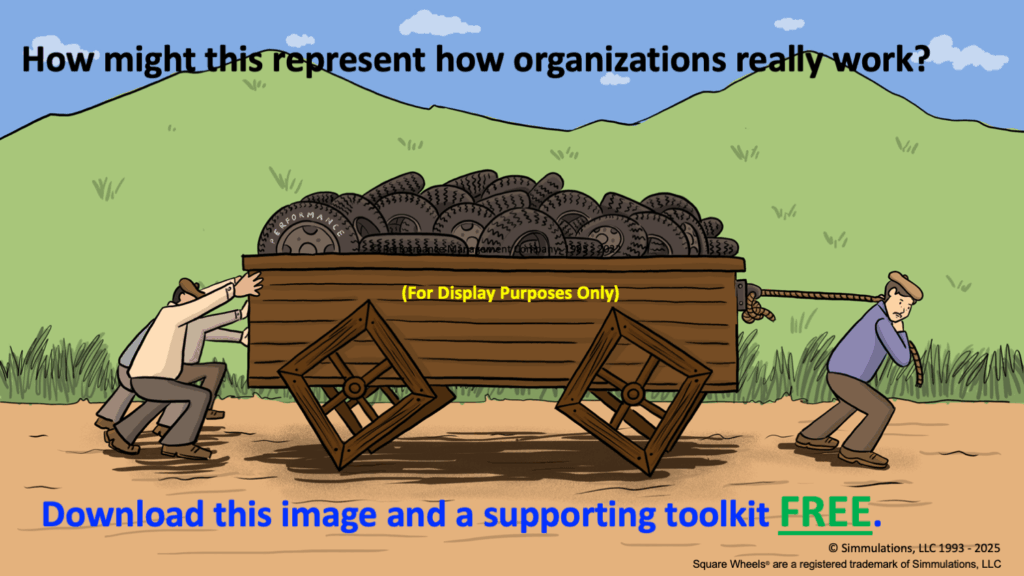
Download the FREE Square Wheels® One image and instructor’s guide under a Creative Commons license
The image you choose should be simple enough that people can interpret it differently. Do not choose an image that gives away the “correct” answer but also try to keep it somewhat work-related.
2. Ask one open question about the story
Choose one question that fits the moment and anchors to the storyasking:
-
“What part of this picture feels most like our work this week?”
-
“Where are we working harder than we need to?”
-
“What is helping us move forward?”
-
“What is getting in the way of good work?”
-
“What round wheel do we already have but are not using?”
-
“What would make this picture look better by next Friday?”
Ask the question, then pause. Give people time to think. Silence can feel uncomfortable for a supervisor, but it often gives employees time to decide whether it is safe to speak.
3. Capture their exact words to show their thoughts are important
Write down the phrases you hear where everyone can see them.
This step matters because it turns a quick conversation into a shared record. It also reduces the chance that employees later feel that management misunderstood or softened their input.
If someone says, “We have three ways to do the same job depending on who is working,” do not reduce it to “inconsistent procedures.” Capture both if needed, but keep the original wording visible.
4. Choose ONE issue for focus and influence – Keep Things Simple
You will usually hear more ideas than you can address. That is normal. Focus things by asking the team:
-
“Which of these would make the biggest difference if we improved it?”
-
“Which one can we influence in the next week?”
-
“Which one should we escalate, and which one can we solve here?”
Keep the focus tight. Choosing one issue does not mean the others do not matter. It means you are protecting the team from another conversation that creates awareness but no progress.
5. Agree on a small experiment
Turn the discussion into a test, not a vague promise.
Instead of saying, “We should communicate better,” agree on something observable:
-
Use a five-minute shift handoff checklist for five days.
-
Assign one person to verify that a required part is stocked before each shift.
-
Hold a two-minute daily review of the most common customer issue.
-
Put the current priority list at the point where work begins.
-
Test a different escalation path for a week.
Define who will do what, when it will start, and how the team will know whether it helped.
6. Close the loop
At the next huddle or meeting, revisit the experiment.
Ask:
-
“What changed?”
-
“What did not change?”
-
“What surprised us?”
-
“Did this help us move the wagon?”
-
“What should we keep, adjust, or stop?”
This is the moment when StoryAsking becomes a habit of continuous improvement rather than a one-time engagement activity. Make things FUNCTIONABLE.
StoryASKING as a Common Supervisor Moment
At the start of a shift, use the image and ask, “What is the one thing most likely to slow us down today?” This helps the team spot risks early and gives employees a chance to share practical knowledge before the pressure of the day takes over.
After a difficult day, If a shift was especially hard, do not start with blame or a lecture. Ask for the story, “Where did the wagon get stuck today?” and let people name the bottleneck, the missing support, the unclear priority, or the recurring problem. Then ask, “What can we do tomorrow that would make the biggest difference?” What we are looking for are possibilities for change.
• During one-on-ones
Use StoryAsking to learn how an individual experiences the work. Ask:
-
“What part of your job is taking the most energy right now?”
-
“Where do you feel like you are pushing a square wheel?”
-
“What is a round wheel you wish we could put into use?”
-
“What would make you feel more successful in this role?”
These questions help you understand engagement at a personal level without turning the conversation into a formal survey.
When a new process, system, schedule, or expectation is coming, ask, “What problem are we trying to solve with this change?” (See parallel thoughts about implementing AI tools here.)
Then ask, “What might make this change hard in real work?”
Employees often identify implementation issues early. Inviting those concerns is not resistance to change; it is practical involvement in making change work over time.
• When performance slips
If quality, service, safety, productivity, or attendance is slipping, avoid assuming that the answer is more pressure. Consider asking, “What is the story behind this result?”
The team may identify a training gap, an unclear standard, a capacity problem, an equipment issue, a workflow obstacle, or a problem that requires escalation. You still need accountability, but better accountability starts with understanding the work as people actually experience it.
What Managers and Supervisors Must Do Differently
StoryASKING works only when employees believe the conversation is genuine. And this will build up over time if the behavior is consistent and real.
That does not mean you must agree with every comment. It means you must show curiosity, fairness, and follow-through.
• Listen without rushing to explain
When someone raises a concern, your first instinct may be to provide the reason, policy, context, or constraint. Resist that urge for a moment.
Try saying:
-
“Tell me more about that.”
-
“Where do you see that showing up?”
-
“What happens next?”
-
“Who else is affected?”
-
“What would better look like?”
You can explain constraints later. Start by understanding the experience.
• Avoid turning it into a complaint session
StoryAsking should make room for real frustrations, but it should not stop there.
A useful transition is:
“That sounds like a real wooden, thumpy Square Wheel. What is one thing within our influence that we could test?”
This acknowledges the issue while moving the individual or group toward agency and action.
• Be honest about what you can control
Do not promise to fix everything. If an issue is outside your authority, say so clearly.
For example:
“I cannot change that policy myself, but I can document the impact, bring it forward, and keep you informed. What can we do in the meantime to reduce the pain point?”
Honesty builds more trust than vague reassurance.
• Give credit to the team
When an improvement works, name where it came from.
Say:
“This was an idea the team surfaced when we talked about our square wheels. You tested it, adjusted it, and made the process better.”
Recognition reinforces the message that speaking up and participating are worthwhile.
A 15-Minute Huddle Example
Imagine a service team that has been receiving more customer complaints about slow response times.
A supervisor opens the huddle with Square Wheels One and asks:
“If this picture represents our service process this week, where is the wagon getting stuck?”
Team members might respond:
-
“Requests come in without enough detail.”
-
“We spend too much time looking for the right person.”
-
“Urgent requests interrupt everything else.”
-
“We do not know which requests are truly urgent.”
The supervisor writes the comments down and asks:
“Which Square Wheel can we influence this week?”
The team chooses unclear urgency. They agree to test a short set of urgency categories at intake and to review results at the end of the week.
The following week, the supervisor asks:
“Did the new urgency categories help move the wagon?”
The team reports fewer interruptions but says some categories are still unclear. They revise the categories and continue testing.
Nothing magical happened. The supervisor did not give a grand speech. But the team identified a real obstacle, chose an action, tested it, learned from it, and improved the work together.
That is engagement in action.
Start Small and Be Consistent
You do not need to transform every meeting into a workshop. Start with one image, one question, one issue, and one small action. You know that,
The key is consistency. Repetition, Repetition, Repetition
When employees see that you regularly ask about the real work, listen to what they say, and come back to the actions the team chose, they begin to expect involvement. They become more willing to share concerns earlier, offer ideas more often, and take responsibility for improvements they help create. Again, trust is the residue of promises fulfilled. Make promises you can keep and keep things rolling forward.
That is the difference between telling people to be engaged and creating a workplace where engagement makes sense and people feel enabled.
As a supervisor, you may not control every decision, resource, or policy. But you do influence the conversations your team has every day. Use those conversations to ask better questions, surface real stories, and help your people move from pushing the wagon to improving how it rolls.
Some FAQs
1. What is StoryAsking in the workplace?
StoryAsking is a facilitation and management practice in which a supervisor uses open questions, curiosity, and often a visual metaphor to invite employees to describe how work actually feels and functions. Instead of telling people what the problem is or giving them management’s interpretation of events, the manager asks employees to share their own observations, experiences, obstacles, workarounds, and improvement ideas.
For example, a supervisor might show a Square Wheels image and ask, “Where are we in this picture right now?” Employees can then describe where the team is working hard, what is slowing progress, and what “round wheels”—existing ideas, resources, or better practices—could make work smoother. The goal is not storytelling for entertainment; it is collective sense-making, problem identification, and practical improvement.
2. How is StoryAsking different from storytelling?
Storytelling is usually leader-led: a manager or presenter frames the situation, tells an illustrative story, and hopes listeners draw a useful conclusion. StoryAsking reverses that direction. The supervisor asks employees to describe the story they are living in their own work, using their own language and examples.
This matters because people are more likely to support an improvement when they have helped name the problem, examine its causes, choose a possible solution, and test the change. StoryAsking shifts employees from recipients of management decisions to co-designers of better work.performancemanagementcompany
3. Why do images such as Square Wheels help employees speak up?
A simple projective image creates a safer, less personal route into conversations about difficult work issues. Rather than saying, “Our approval process is a mess,” someone can point to the image and say, “Those square wheels feel like our approval process,” or “The wagon looks overloaded.” The visual gives people language to discuss friction, ambiguity, rework, poor handoffs, missing information, or unrealized improvement opportunities without immediately blaming a colleague or manager.
Square Wheels also helps a team see that its work is not defined only by problems. The “round wheels” symbolize useful ideas, resources, workarounds, strengths, or practices that may already exist but are not being used consistently. That shared visual language can lower defensiveness, make hidden operational issues easier to surface, and help teams return later to a challenge without reopening a personal argument.performancemanagementcompany
4. How can a supervisor use StoryAsking in a 15-minute team huddle?
A supervisor can use StoryAsking in a short huddle, weekly meeting, shift-start conversation, or one-on-one by following a simple six-step routine:
-
Show a simple image. Use Square Wheels or another neutral visual that represents a familiar work challenge, such as a bottleneck, overloaded wagon, bridge, relay race, or steep hill.
-
Ask one open question. For example: “Where are we working harder than we need to?” “What is slowing us down this week?” or “What round wheel do we already have but are not using?”
-
Capture people’s exact words. Write visible phrases as employees say them, rather than translating them immediately into management language.
-
Choose one issue within the team’s influence. Ask which issue would make the biggest difference and can realistically be improved or tested soon.
-
Agree on one small experiment. Define a specific action, owner, start date, and visible indicator of whether it helped—for example, trialing a five-minute shift-handoff checklist for one week.
-
Close the loop. At the next huddle, ask what changed, what did not, what the team learned, and whether to keep, adapt, or stop the experiment.
The follow-up is essential. Asking for input and then doing nothing erodes trust; returning to the team’s idea, even when a test did not work perfectly, shows that speaking up can lead to action and learning. This positively impacts organizational culture
—
For the FUN of It!
 Dr. Scott Simmerman is a designer of team building games and organization improvement tools.
Managing Partner of Performance Management Company since 1984, he is an experienced presenter and consultant who is trying to retire!! He now lives in Cuenca, Ecuador.
You can reach Scott at scott@squarewheels.com
Learn more about Scott at his LinkedInsite.
Note that I often use Perplexity AI to help research and generate ideas for my posts.
Square Wheels® are a registered trademark of Simmulations, LLC
and images have been copyrighted since 1993,
© Simmulations, LLC 1993 – 2026
Note: Please do not take my images and think about using them. It can generate a whole heap of problems given international copyright law and trademark law. Read this article for more information.
What I’m About:
My Square Wheels blog and website exist to help leaders, trainers, and facilitators make work smoother, more engaging, and more human. I focus on practical tools for process improvement, organizational change, and workplace collaboration that spark insight and deliver measurable results.
And I am convinced, after 30+ years of using Square Wheels®, that it is the best facilitation toolset in the world. One can use it to involve and engage people in designing workplace improvements and building engagement and collaboration. It is a unique metaphorical approach to performance improvement and we can easily license your organization to use these images and approaches.
By blending proven facilitation methods, creative problem-solving, and engaging team activities, my mission is to support organizations in building energized, sustainable cultures of involvement and innovation.
Through accessible — and often free — resources and virtual facilitation tools, I aim to help teams everywhere collaborate more effectively, innovate continuously, and take ownership of their improvement journey.
#SquareWheels#InnovationAtWork#TeamEngagement#FacilitationTools#WorkplaceImprovement#EmployeeEngagement#CreativeProblemSolving#OrganizationalDevelopment#LeadershipTools #collaboration #leadership #motivation #communications #enablement #leadership #CreativeCommons #enablingperformance #teamwork #storytelling #storyasking #organizationalculture

Love the idea of storyasking, I had really thought of it that way before. The concept of providing ownership to a story or event or an organization through the stories one is asked to tell is compelling. As you indicated, what a grea way to motivate employees and encourage them to be actively involved in various areas of the organization.
Thanks, Karl, as your thoughts are always of interest. And the simplicity of the approach speaks to a lot of the issues of engagement. Using the visuals is similar to using a card deck, I suppose. But the business-oriented images are different and probably more effective.