
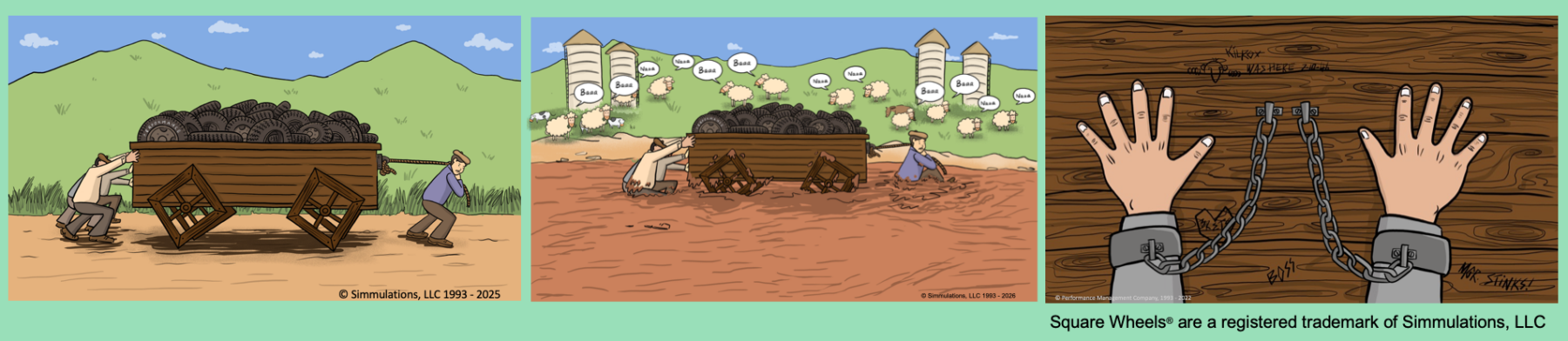
My Square Wheels® approach to workplace conversations makes a simple but often ignored leadership truth very visible: people closest to the work usually feel the friction and see the practical improvements long before senior decision-makers do. We can make better decisions!
When leaders decide before they have really listened, they may gain apparent speed, but they also create the resistance, confusion, workarounds, and slow re-negotiation that make execution expensive and costly to implement.
The familiar Square Wheels image gives teams a safe, concrete way to surface those issues. It shifts the conversation from, “Who made the mistake?” to, “What is making our work harder than it needs to be—and what Round Wheels are already available?”
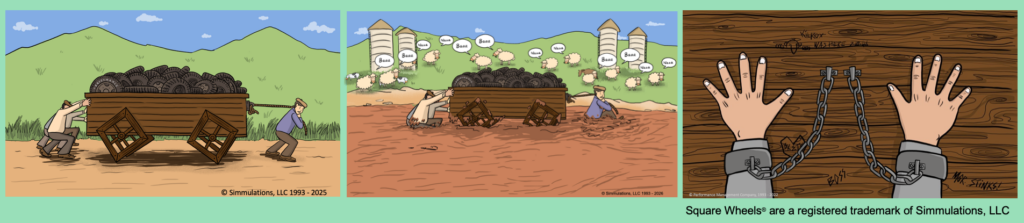
Three of the main Square Wheels® images
The Problems with Fast Decisions
There is a version of decisiveness that looks like leadership strength but functions as a liability. A leader moves quickly, announces a decision, and assumes the organization will now execute.
Sometimes that works, especially in a true emergency when there is little time to consult and the decision is reversible. But (hopefully), most workplace decisions are not emergencies. They involve systems, customers, workload, handoffs, incentives, technology, policies, and the accumulated knowledge of people doing the work every day.
When leaders make the call before their people have had a meaningful chance to contribute, the decision may be fast, but its implementation is usually slow.
The organization often pays later through:
-
Repeated explanations of the decision and stories that can shift over time.
-
Questions that should have been raised before the decision.
-
Resistance from people who see and felt the risks leaders did not attend to.
-
Quiet workarounds created to keep the work moving.
-
Re-litigation in hallway conversations and follow-up meetings.
-
Low ownership, because people feel the decision was done to them rather than developed with them.
-
Lost trust when employees conclude that “asking for input” is merely a ritual.
That is not decisive leadership. It is expensive leadership.
A decision is not truly complete when it is announced. It is complete when people understand it, can execute it, and are willing to make it work.
Using my Square Wheels images make hidden frictions discussable
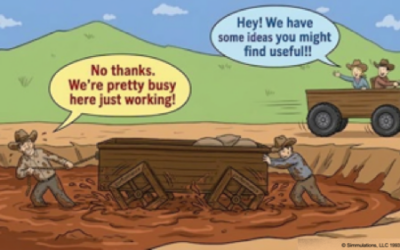
The Square Wheels images and metaphors are powerful because they are immediately understandable. In the Square Wheels One illustration, a group of people strains to pull a wagon rolling on wooden Square Wheels. The journey is rough, exhausting, noisy, and inefficient. Yet round rubber tires, an obvious solution, are the wagon’s cargo.
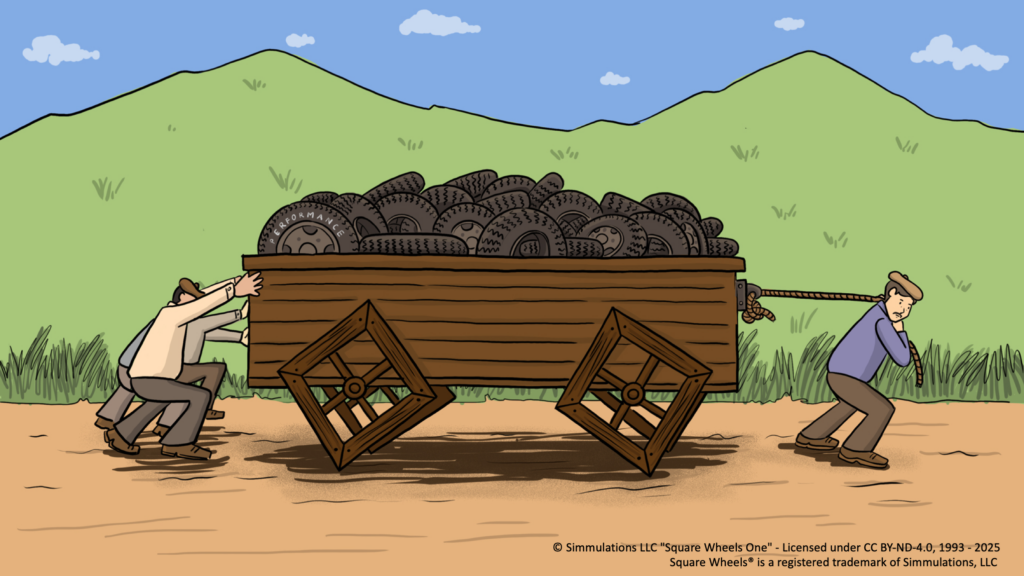
This is called Square Wheels One, from which other images roll…
The image captures a reality that many employees recognize instantly:
We are working hard. We are committed. We are trying to get results. But some of the ways we work are unnecessarily difficult, and useful ideas may already be available but not being used. Obviously. But is management really aware?
That simple discussion is a doorway to a much better leadership conversation.
Rather than beginning with a leader’s proposed answer, a Square Wheels discussion begins with observation and discovery, reflection and assessment in conversations:
-
What are the “Square Wheels” we find in this situation?
-
Where are our people experiencing unnecessary frustration, delay, duplication, or confusion?
-
What gets in the way of better performance?
-
What is already working that we could build on?
-
What “Round Wheels” do we already have, but are not using consistently?
-
What would make it easier for people to do good work?
Those questions invite people to contribute what they know without forcing them immediately into a defensive discussion about personalities, blame, hierarchy, or who is right. Those questions will not get you where you want to go.
Using the visual metaphor above matters. It gives people language for describing difficult realities in a way that is candid but constructive. Saying, “Our approval process is a Square Wheel,” is often safer and more productive than saying, “Management has created another bureaucratic mess.”
The goal is not to complain about the journey. The goal is to improve the way we work. The process is to get out of the ditch and up on the road…

Discovery before Decision
Good leaders do not surrender their responsibility to decide. They improve their ability to decide by making sure they are deciding from a more complete picture.
That is the practical value of a Listen–Position–Listen approach.
A leader may begin with a point of view. That is appropriate. Leaders are paid to notice patterns, make judgments, set direction, and move the organization forward. The problem begins when a leader treats an initial view as a finished conclusion.
A better sequence looks like this:
-
Listen first. Ask people closest to the work what is happening, where the friction is, what customers are experiencing, and what conditions are helping or hurting performance.
-
Share a preliminary position. Be transparent about what you are seeing, what matters most, and what constraints or priorities shape the decision.
-
Listen again. Invite people to test the assumptions, identify unintended consequences, add missing information, and propose better alternatives.
-
Decide and explain. Make the decision, describe the reasoning, clarify what was learned from the discussion, and identify next steps.
The Square Wheels framework supports every part of that process. It gives the group a common visual language for identifying obstacles, recognizing existing strengths, and designing improvements that people can actually implement.
Importantly, it also helps a leader avoid the trap of performative consultation.
People can tell when a leader has already decided. They hear it in the questions that have only one acceptable answer. They see it when concerns are dismissed, when the same few voices dominate, or when the meeting ends with a decision that bears no relationship to what was said. And once employees conclude that consultation is theater, they stop investing in it. They withhold information, avoid raising concerns, and wait for the next change initiative to pass. The organization loses the practical intelligence it needs most.
Square Wheels activities counter that pattern because they make active participation visible. Everyone can identify Square Wheels. Everyone can name potential Round Wheels. Everyone can help distinguish between a problem that is merely irritating and one that truly blocks performance.
That is not consensus-based paralysis. It is disciplined discovery.
Discussion is not delay
Many leaders resist meaningful discussion because they assume it slows down action. Certainly, poorly facilitated meetings can waste time. Open-ended conversation without a purpose, time boundaries, or a decision process can become frustrating and unproductive.
But that is not an argument against discussion. It is an argument for facilitating discussion well.
A structured Square Wheels conversation can be brief, focused, and highly productive. A leader does not need a three-hour retreat to improve the quality of a decision. Even 20 or 30 minutes of honest, well-framed discussion can reveal critical information that would otherwise emerge later as resistance, failure, rework, or disengagement.
Consider the contrast:
The first approach feels faster because the decision is announced quickly. The second approach is faster where it counts: in execution.
People who have had a genuine opportunity to contribute do not necessarily get everything they want. They do not need to agree with every decision. Their total expectations may not be met. But they are far more likely to support a decision when they understand the reasoning, see that their concerns were considered, and believe the leader genuinely listened.
That is the difference between compliance and commitment.
What Square Wheels add to leadership and management discovery
The Square Wheels approach is more than a clever image. It is a practical method for building the conditions that better decision-making requires.
It makes issues visible and discussable.
Many operational problems remain vague: “Communication is poor,” “People are resistant,” or “We need more accountability.” Those labels are often too broad to solve.
Communicating with a visual metaphor like Square Wheels encourages teams to identify specific obstacles:
-
Where does the work get stuck?
-
Which handoffs create confusion?
-
What information arrives too late?
-
What approvals add delay without adding value?
-
What expectations conflict?
-
Which tools, practices, or habits make work harder than necessary?
Once the Square Wheels are visible and in discussion and accepted as a reality, teams can address them. Why?
It reduces blame and defensiveness
An image directs attention toward the work system rather than toward individual fault. People can discuss broken processes, confusing policies, unhelpful routines, interdepartmental conflict, and poor handoffs without turning the session into a complaint about a particular person.
That does not mean individual accountability disappears. It means teams first understand the conditions in which people are operating. Often, what appears to be a people problem is actually a process, clarity, capacity, or communication problem.
It surfaces existing solutions
One of the most hopeful elements of the Square Wheels metaphor is that the round wheels are often already present. Teams frequently possess useful practices, capable people, successful workarounds, customer insights, and tested ideas. The challenge is not always inventing something new. It is noticing, sharing, adapting, and consistently using what already works.
That is especially valuable for leaders under pressure. Instead of assuming that every problem requires a major redesign, external consultant, or new technology platform, they can ask:
What are we already doing somewhere in this organization that could help us solve this problem?
It builds Active Ownership Involvement
People support what they help create. That does not mean leaders must give up authority or seek unanimous agreement. It means they invite employees to help diagnose the problem, identify options, anticipate risks, and improve implementation. When people can see their experience reflected in the eventual decision, they are more likely to treat execution as their responsibility rather than management’s latest demand.
It strengthens trust over time
Psychological safety is not built by declaring, “We want honest feedback.” It is built when people offer candid input and see evidence that it mattered.
Leaders build trust when they:
-
Ask questions to learn rather than to confirm their own answer.
-
Make room for differing viewpoints.
-
Acknowledge concerns without becoming defensive.
-
Explain what they heard.
-
Show how input affected the decision, or explain clearly why it did not.
-
Follow through on the commitments made during the discussion.
Square Wheels sessions create repeated opportunities for leaders to demonstrate these behaviors in a practical, visible way.
A simple facilitation structure
A leader can use the Square Wheels image and approach in a staff meeting, project review, planning session, supervisor workshop, or change initiative. The process does not have to be complicated.
1. First, frame the purpose
Start with a specific question, such as:
“Before we decide how to improve this process, let’s identify what is making the work harder than it needs to be and what solutions may already be available to us.”
Make clear what is open for input, what constraints exist, and when a decision will be made.
2. Ask people to identify the Square Wheels
Invite people to name the frustrations, barriers, inefficiencies, recurring problems, and unnecessary sources of effort, basically anything they feel get in the way of good performance. And do not be surprised when these ideas come from many different and diverse perspectives.
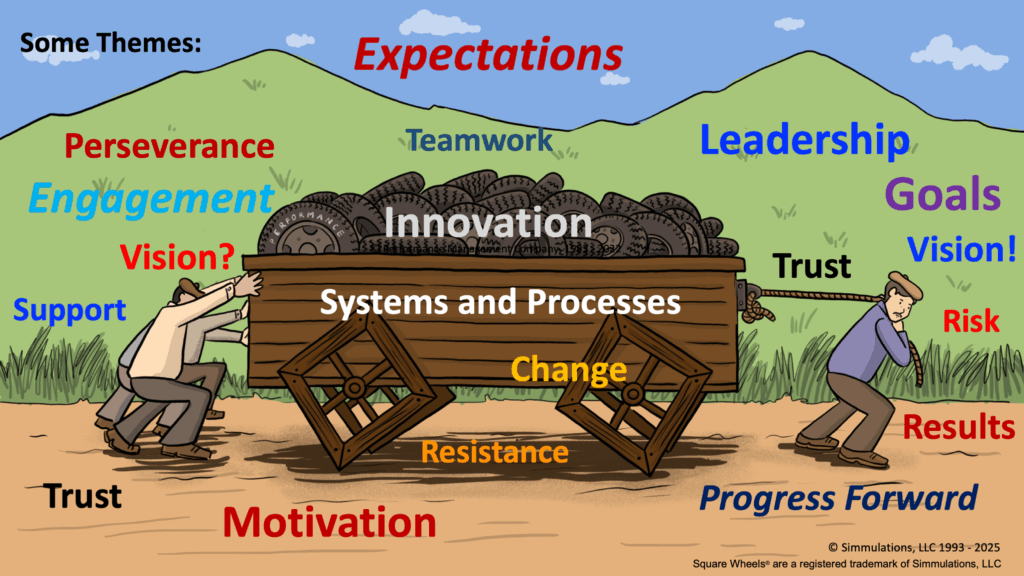
There are many different themes that open for discussion when using Square Wheels One
Keep the conversation focused on observable work realities rather than generalized criticism. These can represent real ideas for new real solutions.
3. Identify the Round Wheels
Ask the group what is already working, where similar problems have been solved, what resources are underused, and what small changes could make a meaningful difference.
This is where a problem-focused conversation becomes an improvement-focused one.
And understand that the Round Wheels of Today
will become the Square Wheels of Tomorrow.
Innovation is about continuous continuous improvement.
4. Prioritize together
Not every Square Wheel can be fixed at once. Ask the group to identify the issues with the greatest impact on customers, quality, safety, time, cost, morale, or performance.
A leader can then distinguish among:
-
Issues the team can solve immediately.
-
Issues that require cross-functional coordination.
-
Issues requiring a management decision or additional resources.
-
Issues that are real but not currently a priority.
5. Decide, communicate, and then ACT
The leader makes the decision, explains the rationale, assigns next steps, and establishes a way to review progress. Most importantly, the leader closes the loop and gets the commitment to change:
“Here is what we heard. Here is what we are going to do now. Here is what we cannot change immediately. Here is why. And here is when we will revisit the remaining issues.”
That follow-through turns listening into credibility.
The leadership discipline to get things done
The best leaders are not necessarily the leaders who decide fastest. They are the leaders whose decisions stick. Decisions stick when people understand the problem, believe the relevant information was considered, see the logic behind the choice, and know what role they have in making it work. They stick when leaders are willing to hold an initial position loosely enough to learn from the people doing the work.
The Square Wheels image reminds us that people are often already working hard. They do not need another speech about trying harder. They need leaders who are willing to notice the rough journey, invite honest conversation about why things are thumping and bumping, and help the group discover and use the round wheels that can make performance better.
A short, well-facilitated discovery conversation before a decision is usually far less costly than the weeks of resistance, confusion, and rework that follow a decision made too soon.
Build discussion into the process.
Surface the Square Wheels.
Find some Round Wheels.
Then make the decision with the confidence that comes from knowing the room was genuinely heard.
Interested in more? Here are my best three blog posts that support different key aspects of the above ideas:
—
For the FUN of It!
 Dr. Scott Simmerman is a designer of team building games and organization improvement tools.
Managing Partner of Performance Management Company since 1984, he is an experienced presenter and consultant who is trying to retire!! He now lives in Cuenca, Ecuador.
You can reach Scott at scott@squarewheels.com
Learn more about Scott at his LinkedIn site.
Note that I often use Perplexity AI to help research and generate ideas for my posts.
Square Wheels® are a registered trademark of Simmulations, LLC
and images have been copyrighted since 1993,
© Simmulations, LLC 1993 – 2026
Note: Please do not take my images and think about using them. It can generate a whole heap of problems given international copyright law and trademark law. Read this article for more information.
See a detailed overview of my tools, background and experiences here.
What I’m About:
My Square Wheels blog and website exist to help leaders, trainers, and facilitators make work smoother, more engaging, and more human. I focus on practical tools for process improvement, organizational change, and workplace collaboration that spark insight and deliver measurable results.
And I am convinced, after 30+ years of using Square Wheels®, that it is the best facilitation toolset in the world. One can use it to involve and engage people in designing workplace improvements and building engagement and collaboration. It is a unique metaphorical approach to performance improvement and we can easily license your organization to use these images and approaches.
By blending proven facilitation methods, creative problem-solving, and engaging team activities, my mission is to support organizations in building energized, sustainable cultures of involvement and innovation.
Through accessible — and often free — resources and virtual facilitation tools, I aim to help teams everywhere collaborate more effectively, innovate continuously, and take ownership of their improvement journey.
#SquareWheels #InnovationAtWork #TeamEngagement #FacilitationTools #WorkplaceImprovement #EmployeeEngagement #CreativeProblemSolving #OrganizationalDevelopment #LeadershipTools #collaboration #leadership #motivation #communications #enablement #leadership #CreativeCommons #enablingperformance #teamwork #storytelling #storyasking #enablement #disruptiveengagement #un-dis-engagement #un-dis-empowerment #innovation


0 Comments