
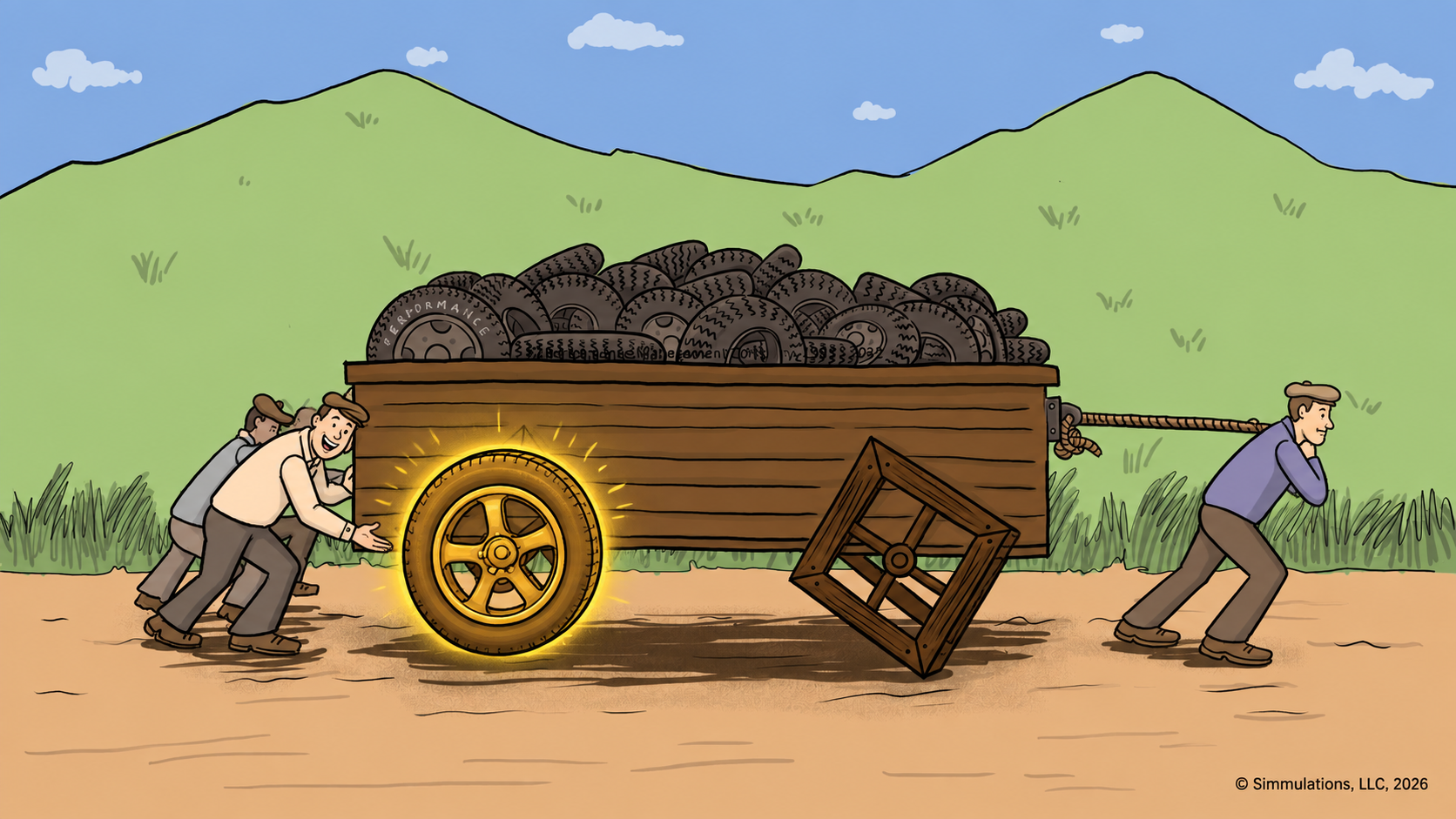
We need to stop asking supervisors to “drive engagement” because we can so easily teach them to facilitate improvement and motivate people.
This is an updated look at how my simple Square Wheels® tools can help
supervisors turn employee observations into team-owned action.
A supervisor can sit through an engagement presentation, receive the survey results, and still walk into their Monday team meeting without a good way to start the conversation or generate any change.
“Your scores need to improve” is not much of an opening. Neither is “Does anyone have ideas?” when people have learned that raising a problem may earn them more work, or generate no response at all.
I wrote about this problem in 2017 and many times earlier. My concern then was that organizations were discussing engagement at the executive level while overlooking the people who could help teams change their daily experience of work: supervisors. I still think that is the right place to focus. But I would put the challenge more plainly today because of all the changes we are trying to drive because of AI:
We must teach supervisors to facilitate improvement, not just hold them accountable for engagement scores. And if we are using AI, we need to improve how our people are engaging others in using those tools.
The supervisor really matters, and they need support now, more than ever.
Gallup’s 2026 State of the Global Workplace report again found that 20% of employees worldwide were engaged in 2025. Engagement among managers fell from 31% in 2022 to 22% in 2025. Gallup also reports that managers account for 70% of the variance in team engagement. That does not mean a supervisor can fix every policy, workload, or organizational problem. It does mean that what supervisors do with their teams matters enormously and that we should be developing and supporting them, not simply giving them another metric to carry.
And there is a LOT more information and research out there about this same problem.
I have called this The Supervisor Hellscape in the past and I need to redo and update
this 2025 post with newer data.
In my direct experiences, employees always have observations about where work is harder than it needs to be. They see the rework, confusing handoffs, missing information, and well-intended procedures that create friction. The difficulty comes in creating a conversation in which those observations can be expressed, understood, and acted upon. (There are a dozen blogs on this website around this.)
Enablement takes a lot more than a supervisor saying, “My door is always open.”
It takes useful questions, a willingness to hear an uncomfortable answer, and a process for deciding what happens next. It takes an engaging environment and a team, and we can influence all of these through the use of some effective visual imagery and a series of good questions to generate involvement. Some supervisors, the ones you remember, do this seamlessly and naturally; most do not and benefit from having the tools and a process.
Let this image open the conversation
Engagement is why I have spent so many years working with Square Wheels®. My main image, below and called Square Wheels One, gives a team a shared metaphor for consideration and discussion: a wagon is moving forward, but its Square Wheels make the journey harder than it needs to be. Round wheels, those many possible improvements, are generally already existing in the wagon. New solutions generally do NOT need to be deveioped in part because the exemplary employees are often already doing things differently than the others.
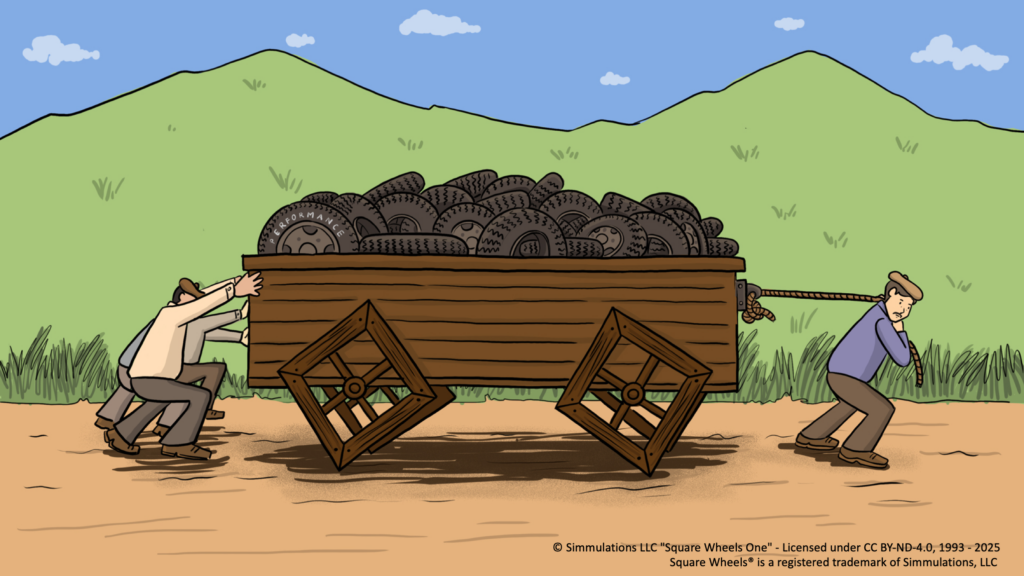
And, the image does not TELL anyone what is wrong with their workplace; it gives them room to say what they see and to share their perceptions and realities. Often, they can also more motivated to choose to act to make improvements with their ideas.
A supervisor can begin with a simple question and share the above Square Wheels One (free) image:
“How does this image represent the way work gets done around here?”
At first, people may talk about the wagon, the wheels, or the people pushing it. That is fine. And as the discussion continues, many other themes will also appear about things like trust and missions and visions and similar. The supervisor can then ask, “What might some of our Square Wheels be?” and give people time to name the frictions in their own work and the workplace in general.
This is not a trick to get employees to agree with some solution
management has already chosen. The supervisor’s job is
to make it possible for people to describe their perceived reality,
hear from one another, and identify a useful next step.
The image is the conversation tool; facilitation is the
supervisor’s skill and active engagement
is the outcome that helps generate change.
A meeting a supervisor should lead next week
Here is a practical way to try it in a regular team meeting. The aim is not to redesign the whole organization in half an hour. It is to identify one problem worth addressing and agree on what the team will do next.
-
Set the purpose. Say, “I’d like us to find one thing that makes our work harder than it needs to be—and one improvement we could test.” Make clear what the team can change, what needs another person’s approval, and what you cannot promise to fix.
-
Show a Square Wheels image. Ask, “What do you notice?” Let people describe it before asking them to connect it to work. Give everyone a moment to think or write before opening discussion.
-
Invite workplace examples. Ask, “Where do we experience Square Wheels in our work?” Listen for specific processes or handoffs rather than rushing toward a judgment about who is at fault. If the first answer comes quickly, ask, “What else?”
-
Choose one issue. Ask which problem creates significant friction and is realistic to address. Check that quieter team members have had an opportunity to speak. Do not assume that the supervisor’s preferred issue is the team’s priority.
-
Find a Round Wheel to test. Ask, “What could we try differently?” Agree on a small action or actions, who will take it, what support they need, and how the team will know whether it helped.
-
Come back to it. At the next meeting, ask what happened. Keep the change, adjust it, or explain why it could not proceed. If an issue needs action elsewhere, tell the team who will raise it and when they can expect an update.
That last step is essential. Asking for ideas and then disappearing can make the next conversation harder. People need to see what became of what they shared, even when the answer is “We cannot change this yet, and here is why.”
Facilitation in the workplace is a simple skill, not a script
A meeting outline helps, but it cannot make every decision for the supervisor as they converse about issues and opportunities with their people What happens when someone names a problem the supervisor helped create? What if one person dominates, or the team disagrees sharply about the cause? What if the best idea needs cooperation from another department?
Those moments reveal the real facilitation work. The supervisor has to stay curious and expect problems but also make space for different perspectives, clarify what is known, and avoid defending the status quo before the team has even finished describing it. This is a guided discussion around what people can choose to do differently. Will everyone agree? NO. But because they were involved in the discussions, they are unlikely to protest if some people want to move things forward. We can benefit from the peer pressure supporting the ideas.
Remember, we are doing things WITH people rather than TO them!
And while basic skills are important, learning more skills is certainly possible. And I am not selling anything but a practical and free approach to skills development and networking here. And here is another resource:
The Facilitators Guild.
This is one reason I am interested in The Facilitators Guild. It offers me a broader professional context for examining the skills behind a useful group process. Rather than evaluating a session by whether people liked the image or enjoyed the discussion, I want to ask more demanding questions: Who participated? What did the facilitator do when a difficult issue surfaced? Was the decision clear? Did anyone follow through?performancemanagementcompany
Experienced facilitators can help supervisors build those skills through practice, observation, and specific feedback. A peer watching a Square Wheels conversation might notice that the supervisor asked an excellent opening question but answered too quickly for the group—or that the team generated several ideas but never chose one to test. That kind of feedback is more useful than “Good meeting.”
I am not suggesting that every supervisor must become a professional workshop facilitator. I am suggesting that every supervisor could benefit from learning to guide a short, honest, productive conversation about work. These skills are important as well as useful ones for generating consensus on change.
Lastly, move from scores to smoother work
An engagement survey can tell leaders that something needs attention. It cannot, by itself, show a team how to fix a frustrating handoff on Tuesday afternoon. For that, people need an opportunity to talk about what they experience and a supervisor willing to help turn the conversation into action.
My invitation to supervisors is simple: bring your team an image, ask what they see, and resist the urge to explain it for them. Find one Square Wheel together. Test one Round Wheel. Then return and tell people what happened.
My invitation to facilitators—and to fellow members of The Facilitators Guild—is to help supervisors get better at that work. We can share tools, certainly. More importantly, we can help them strengthen the inquiry, inclusion, judgment, and follow-through that make those tools useful.
What is one Square Wheel your team could put on the table
and what would it take to test a better way?
Four related recent posts
Enabling Front Line Supervisors with Square Wheels tools — January 30, 2026. Reframes the supervisor’s job from personally motivating everyone to helping the team identify obstacles and try improvements. It offers a Square Wheels conversation that can fit into a 10-minute huddle.performancemanagementcompany
From “Supervisor Hellscape” to Flow: Facilitation Tools — February 10, 2026. Makes the case for teaching overloaded supervisors practical facilitation skills instead of simply asking them to “drive change.” It outlines short, focused sessions that end with Round Wheel actions and observable results.performancemanagementcompany
Supervisors: Turn Workplace Information Into Better Conversations, Better Ideas, and Better Management— September 7, 2026. Shows how a supervisor can use performance information to start a non-blaming team conversation, identify a specific Square Wheel, test an improvement, and report back on what happened.performancemanagementcompany
How StoryAsking Shifts Ownership more than Storytelling — September 17, 2026. Explains how asking employees to describe their work—and involving them in choosing and testing a change—shifts ownership from the supervisor to the team. Its 10- to 15-minute huddle routine makes the engagement-through-improvement theme concrete.
—
For the FUN of It!
 Dr. Scott Simmerman is a designer of team building games and organization improvement tools.
Managing Partner of Performance Management Company since 1984, he is an experienced presenter and consultant who is trying to retire!! He now lives in Cuenca, Ecuador.
You can reach Scott at scott@squarewheels.com
Learn more about Scott at his LinkedIn site.
Note that I often use Perplexity AI to help research and generate ideas for my posts.
Square Wheels® are a registered trademark of Simmulations, LLC
and images have been copyrighted since 1993,
© Simmulations, LLC 1993 – 2026
Note: Please do not take my images and think about using them. It can generate a whole heap of problems given international copyright law and trademark law. Read this article for more information.
See a detailed overview of my tools, background and experiences here.
What I’m About:
My Square Wheels blog and website exist to help leaders, trainers, and facilitators make work smoother, more engaging, and more human. I focus on practical tools for process improvement, organizational change, and workplace collaboration that spark insight and deliver measurable results.
And I am convinced, after 30+ years of using Square Wheels®, that it is the best facilitation toolset in the world. One can use it to involve and engage people in designing workplace improvements and building engagement and collaboration. It is a unique metaphorical approach to performance improvement and we can easily license your organization to use these images and approaches.
By blending proven facilitation methods, creative problem-solving, and engaging team activities, my mission is to support organizations in building energized, sustainable cultures of involvement and innovation.
Through accessible — and often free — resources and virtual facilitation tools, I aim to help teams everywhere collaborate more effectively, innovate continuously, and take ownership of their improvement journey.
#SquareWheels #InnovationAtWork #TeamEngagement #FacilitationTools #WorkplaceImprovement #EmployeeEngagement #CreativeProblemSolving #OrganizationalDevelopment #LeadershipTools #collaboration #leadership #motivation #communications #enablement #leadership #CreativeCommons #enablingperformance #teamwork #storytelling #storyasking #enablement #disruptiveengagement #un-dis-engagement #un-dis-empowerment #innovation


0 Comments