
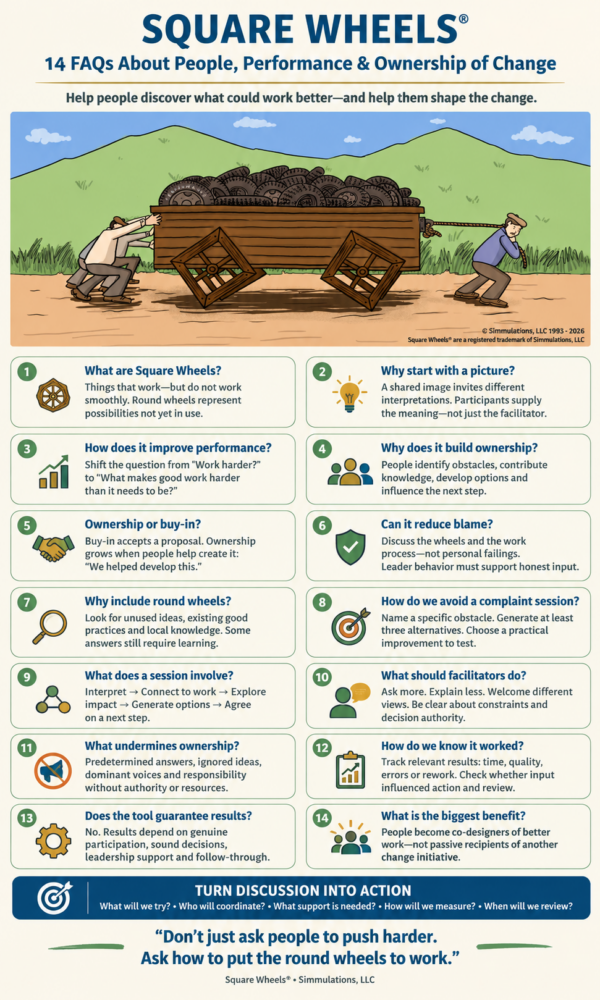
Square Wheels® FAQs: Why a Simple Image of How Things Really Work Can Generate Active Ownership for Organizational Improvement and Change.
People can work very hard and still struggle to get good results. Sometimes the problem is not their motivation, commitment, or willingness to contribute. It is the way the work is organized and how they are involved or not involved. Active ownership involvement is a key theme, as is developing the cognitive dissonance needed to drive enablement and change.
A main belief is:
“Nobody ever washes a rental car.”
That is the starting point for Square Wheels: a wagon rolling on Square Wheels, people pushing and pulling, and round wheels already sitting inside the wagon. The work gets done, but not nearly as smoothly as it could or should. The image opens conversations about the gap between how things work and how they might work better. People will add their beliefs onto the visual and the discussions.
The real power, however, is not simply in recognizing the problem. It is in generating active ownership involvement around the possibilities for change.
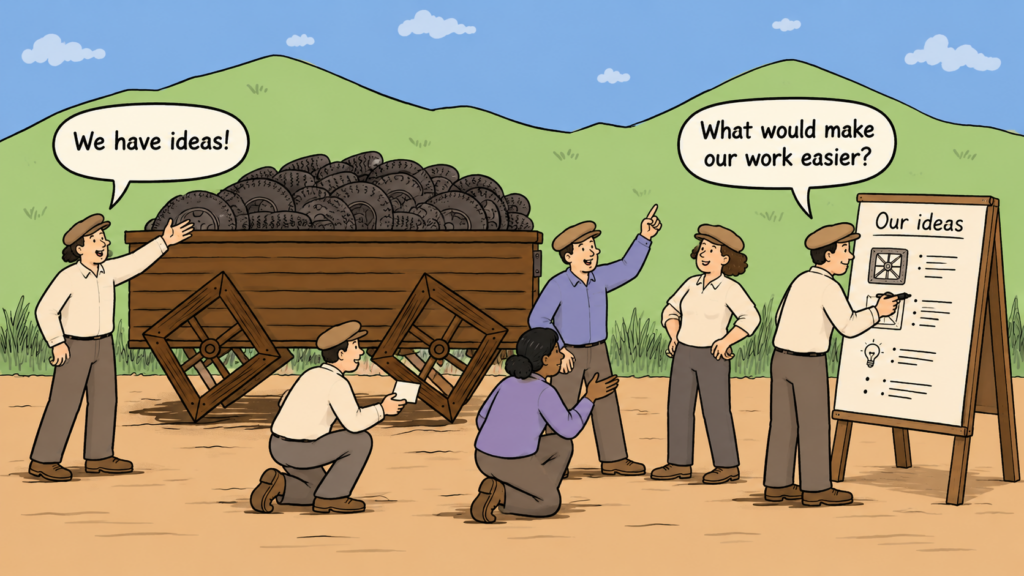
Instead of asking people to accept someone else’s improvement program, Square Wheels invites them to identify what needs attention, develop alternatives, and help shape what happens next. That makes it a particularly useful approach to connecting people, performance, and change.
The purpose of this post is to answer some FAQs about the images as tools for supervisors and facilitators and why you should take the time to consider how their use might benefit your people or your client organizations.
What are Square Wheels?
They are NOT just cute little images. Not at all. They are unique and powerful visual metaphors and facilitation tools for exploring how organizations really work. There are few other tools that are even similar.
In the central illustration, called Square Wheels One:
-
The wagon represents the organization, team, or work process.
-
The wooden Square Wheels represent practices, procedures, habits, and systems that work — but do not work smoothly.
-
The people pushing and pulling provide the effort that keeps everything moving.
-
The round wheels represent possibilities for improvement that exist but are not yet being used.performancemanagementcompany
The important distinction is that Square Wheels are not necessarily broken. They work but they do not work smoothly and the team will paradoxically meet or sometimes exceed their performance and quality goals because these goals are based on this operation). People have often become very good at working around problems and they do get things done.
An awkward approval process can still produce approvals. A confusing handoff can still deliver a finished product. An outdated reporting requirement can still generate a report. People are good at adapting.
But “we get it done” is not the same as “we have a good way of doing it.” And that is what we can accomplish with our discussions.
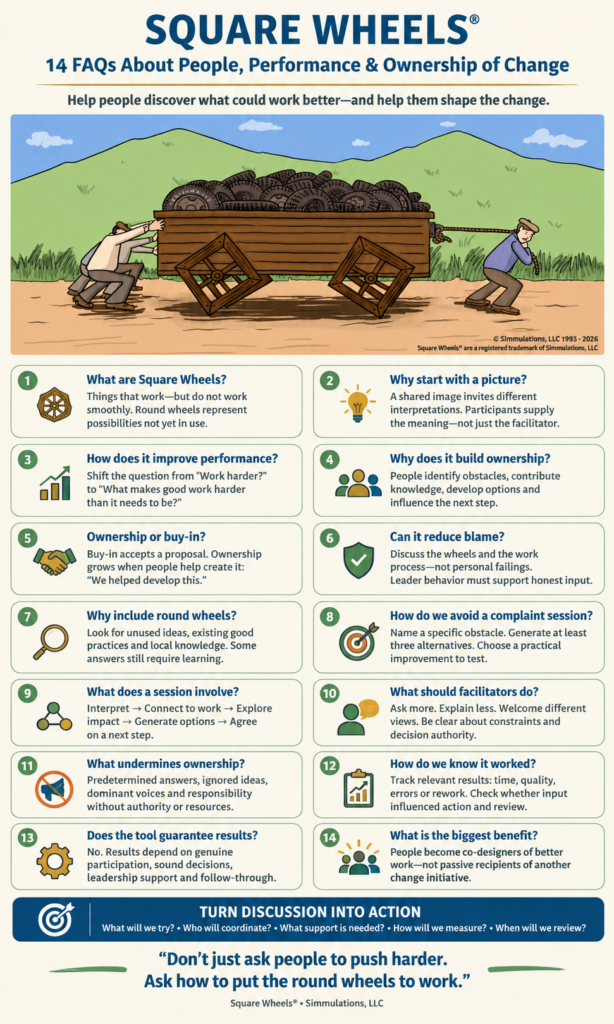
Why are images such useful starting points?
Because they give people something to interpret
before asking them to defend a position.
Start a meeting with “What is wrong with this department?” and the conversation can quickly become negative and personal. Start with “How might this picture represent how things work in organizations?” and participants can explore the situation through the metaphor.
Square Wheels are deliberately open to interpretation. People bring their own experiences to the image, noticing issues involving leadership, communication, teamwork, workload, innovation, or unused ideas. The facilitator does not need to supply every insight. The participants supply the meaning.
That creates a valuable shift:
The facilitator provides the visuals. The participants provide the relevance.
The picture is not a diagnosis or a psychological test. It is a discussion prompt, a projective tool that helps people make their experiences visible.
Why do Square Wheels connect people and performance so effectively?
Because they invites a different performance question.
Instead of asking only, “How do we get people to work harder?” it asks:
“What makes good performance harder than it needs to be—and what could we change?”
That moves the discussion toward enablement: removing obstacles, improving work processes, and putting useful ideas into practice. It also gives supervisors a constructive role beyond urging people to push harder. They can help the team identify the Square Wheels and support the installation of better ones. The round wheels are already in the wagon. What we do is create a pause, an opportunity for reflection.
Don’t Just DO Something, Stand There
Consider an illustrative example: a team repeatedly misses deadlines because routine decisions require several approvals. More reminders about accountability may add pressure without removing the delay. A Square Wheels-focused discussion can help the group examine the approval process itself and probably generate some workable alternatives.
The point is not that people never need training or clearer expectations. It is that improving performance also requires examining the conditions under which people work.
Why is this such a strong approach to generating ownership for change?
Because people have an opportunity to help create changes—not merely receive an explanation of it.
Research on psychological ownership identifies three important routes through which something begins to feel like “mine” or “ours”:
- – Control: having meaningful influence over it.
- – Knowledge: coming to understand it deeply.
- – Investment of self: putting personal time, energy, ideas, and effort into it.sbs.ox.ac
A well-facilitated Square Wheels process can create opportunities for all three:
— People use their knowledge of the work to identify obstacles.
— They invest their thinking in developing possible improvements.
— They exercise influence when they help select, design, and test the next steps.
This is why participation matters more than simply presenting a persuasive case. A review of employee involvement in organizational change identifies turning affected employees into active co-creators as a central purpose of participation.emerald
The distinction is straightforward:
“Here is the change we want you to support” is different from “Here is the improvement we helped develop.”
The second statement gives people a different relationship with the outcome.
How is active ownership involvement different from buy-in?
For practical purposes, buy-in is often about accepting a proposal. Ownership goes further: people see themselves as contributors to the proposal and responsible participants in making it work. They are involved in the buy-in bot enabled and engaged in the latter.
A team can agree that management’s plan sounds reasonable
without feeling much personal connection to it.
Square Wheels creates an opportunity to build real connection earlier—while defining the problem and considering alternatives, rather than after the decisions have already been made. Its facilitation process moves from interpreting the image to identifying workplace issues and developing possible solutions.
That does not mean every employee must make every decision. It means the opportunity to influence the work must be genuine. Will they ALL buy-in? No. But will more of them be actively involved? Certainly.
Research on participation during change also cautions that not all “participation” offers the same degree of influence. Being invited to comment is not necessarily the same as having a meaningful say.journals.
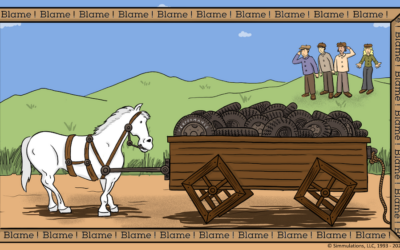
Does Square Wheels help reduce defensiveness and blame?
It can help, because the conversation can begin with the wagon and its wheels rather than with accusations about individuals.
“What are the square wheels in this process?” offers a different starting point from “Who keeps causing these problems?” The metaphor provides shared language for discussing workplace obstacles and possible improvements without making personal blame the organizing theme.performancemanagementcompany+1
But a cartoon cannot guarantee psychological safety. It can help, though.
If a manager punishes disagreement, dismisses inconvenient observations, or demands to know who made a critical comment, the image will not overcome that behavior. Facilitation must make room for honest contributions, and leaders must demonstrate that raising a concern will receive fair consideration.
The tool opens the door. Leadership behavior determines whether people feel able to walk through it.
What do the round wheels add to the discussion?
They keep the conversation from stopping at frustration.
The round wheels suggest that the organization may already possess useful knowledge, workable alternatives, or practices that have not spread. Someone may have solved a similar problem elsewhere. A frontline employee may understand a recurring obstacle better than the people designing the procedure.
That is a hopeful message: improvement does not always require inventing something entirely new.
It is also important not to take the metaphor too literally. Not every solution is already known, and not every employee suggestion will be feasible. Some problems require new expertise, investment, experimentation, or decisions across organizational boundaries.
The useful question is:
“What possibilities do we already have—and what do we still need to learn?”
How do you keep a session from becoming a complaint meeting?
Make identifying the Square Wheels
the beginning of the work, not the end.
The established Square Wheels approach moves from general observations to specific workplace issues, then to alternative solutions and implementation considerations. One suggested practice is to have each group select a relevant square wheel and generate at least three round-wheel possibilities rather than settle immediately on the first idea.
A practical discussion sequence is:
-
Describe the obstacle specifically.
-
Identify who experiences it and how it affects the work.
-
Generate several possible improvements.
-
Compare the alternatives against real constraints.
-
Select a manageable next step.
-
Decide how to evaluate what happens.
For example, “Communication is terrible” is difficult to act on. “The evening shift receives schedule changes after work has already been assigned” gives the group something concrete to investigate.
The aim is not to suppress frustration. It is to turn experience into usable information and a testable improvement. And, we have a lot of different images and metaphors to help a supervisor work with their people to generate other workplace improvement options or help explain different themes around workplace improvement issues.
What does a useful Square Wheels session look like?
Here is a practical format adapted from the approach’s sequence of individual reflection, small-group discussion, identification of workplace issues, and development of alternatives.performancemanagementcompany+1
1 – Invite interpretation
Show the illustration and ask:
“How might this represent how things really work in organizations?”
Allow individual thinking before group discussion. Avoid explaining every part of the picture in advance.
2 – Connect it to the actual workplace. the reality
After the basic themes are established and the conversation is rolling, ask:
“What are some things here that work, but do not work smoothly?”
Encourage specific examples rather than labels about people.
3 – Explore performance consequences
Ask:
“What does this cost us in time, effort, quality, customer experience, or frustration?”
Distinguish what the group knows from what it needs to verify.
4 – Generate alternatives and make them into considered alternatives
Ask:
“What are at least three possible round wheels?”
Include existing good practices, small experiments, and options requiring broader support. Then, work with the group to make some of the ideas into considered alternatives by discussing them in some detail and defining positive and negative realities, issues and opportunities. Discuss how they might be implemented.
5 – Agree on a next step, and make it real
For the selected improvement, record:
-
What the team will try.
-
Who will coordinate it.
-
What authority or support is needed.
-
How progress will be assessed.
-
When the group will review the results.
The objective is not a room full of interesting observations. It is a credible connection between discussion and action.
What should the manager or facilitator do differently?
Ask more than you explain. Give them active involvement and the time to kick the tires. Let them lead. Let them discuss and explain and consider. Build the framework into your existing team structures if that makes sense. Find those team leaders willing to lead, those who see the bigger picture and the opportunities for improvement.
The Square Wheels process is not some dogma and there is not some rigid structure — it is designed to elicit supervisor’s normal engagement processes and the participants’ interpretations and ideas. Explaining the “correct meaning” too early takes that work away from them. The real key is to make this theirs.
Useful facilitation prompts include:
-
“What else do you notice?”
-
“Who experiences this differently?”
-
“What makes that difficult?”
-
“Where is this already working better?”
-
“What would we need to test that idea?”
-
“What concern have we not considered?”
Supervisors and managers also need to be clear about boundaries. If a regulation cannot change, say so. If the team can redesign a handoff but cannot authorize new equipment, make that distinction explicit. But do what you can to help them work around roadblocks so that they can take action.
Genuine participation does not require unlimited authority. It requires honest information about where influence is possible.
What can undermine ownership?
The biggest danger is inviting participation without allowing it to matter.
A session, and what probably becomes a series of sessions, becomes an exercise in compliance when leaders have already selected the answer but want employees to feel they discovered it. Research on change participation highlights the tensions that arise when implementers invite involvement while also trying to control how employees contribute.journals.
Other practical pitfalls include:
-
Collecting ideas without responding to them.
-
Allowing a few voices to dominate.
-
Treating disagreement as disloyalty.
-
Choosing improvements without considering the people affected.
-
Assigning responsibility without providing authority or resources.
-
Failing to explain why an idea cannot proceed.
An idea does not have to be implemented to deserve a thoughtful response.
A clear explanation preserves the credibility of the process better than silence.
How should we judge whether Square Wheels worked?
Look beyond whether people enjoyed the discussion. This is about generating the cognitive dissonance between the actual things that do not work and some of their ideas that can be supported to generate improvement. The goal is to create some gaps where they have active ownership involvement to support their efforts to implement change. And the supervisor needs to be all in to generate improvements.
For each improvement, choose measures that match the issue. Examples might include turnaround time, rework, handoff errors, unnecessary approvals, customer complaints, or time spent locating information.
Then assess participation as well:
-
Did people contribute information that was previously missing?
-
Did their contributions influence the decision?
-
Did the team test an improvement?
-
Did leadership remove an obstacle?
-
Did the group review the outcome and adjust?
These are proposed evaluation questions, not claims of guaranteed results.
The sources describing Square Wheels explain its process and intended benefits; the broader research supports the relevance of participation and psychological ownership. Those are not the same as independent evidence that Square Wheels always outperforms other facilitation methods. Its effectiveness still depends on the quality of the conversation, the decision process, and the follow-through.
What is the most important reason for a SUPERVISOR to use Square Wheels?
It makes organizational improvement something people can help shape.
We are looking to enable people to choose involvement.
The image acknowledges effort without assuming that greater effort is the answer and it is easy to use and pretty bombproof. It makes room for different perspectives, gives people a shared language for obstacles, and points toward alternatives. Most importantly, the process invites employees to become co-designers of better work rather than passive recipients of another change initiative.
That is the ownership opportunity.
Do not simply ask people to push the wagons harder.
Ask them what they see and feel, what could work better,
and how they can help put the round wheels to work.
—
For the FUN of It!
 Dr. Scott Simmerman is a designer of team building games and organization improvement tools.
Managing Partner of Performance Management Company since 1984, he is an experienced presenter and consultant who is trying to retire!! He now lives in Cuenca, Ecuador.
You can reach Scott at scott@squarewheels.com
Learn more about Scott at his LinkedIn site.
Square Wheels® is a registered trademark of Simmulations, LLC
and images are © Simmulations, LLC 1993 – 2026
Note: Please do not take my images and think about using them. It can generate a whole heap of problems given international copyright law and trademark law. Read this article for more information.
See a detailed overview of my tools, background and experiences by clicking here.
What I’m About:
My Square Wheels blog and website exist to help leaders, trainers, and facilitators make work smoother, more engaging, and more human. I focus on practical tools for process improvement, organizational change, and workplace collaboration that spark insight and deliver measurable results.
And I am convinced, after 30+ years of using Square Wheels®, that it is the best facilitation toolset in the world. One can use it to involve and engage people in designing workplace improvements and building engagement and collaboration. It is a unique metaphorical approach to performance improvement and we can easily license your organization to use these images and approaches.
By blending proven facilitation methods, creative problem-solving, and engaging team activities, my mission is to support organizations in building energized, sustainable cultures of involvement and innovation.
Through accessible — and often free — resources and virtual facilitation tools, I aim to help teams everywhere collaborate more effectively, innovate continuously, and take ownership of their improvement journey.
#SquareWheels #InnovationAtWork #TeamEngagement #FacilitationTools #WorkplaceImprovement #EmployeeEngagement #CreativeProblemSolving #OrganizationalDevelopment #LeadershipTools #collaboration #leadership #motivation #communications #enablement #leadership #CreativeCommons #enablingperformance #teamwork #storytelling #storyasking #enablement #disruptiveengagement #un-dis-engagement #un-dis-empowerment #innovation
© 2026 Simmulations, LLC. Please note that “Square Wheels®” is a registered trademark of Simmulations, LLC. and materials, original wagon line art, text, and visual designs are protected. Original line art by Roy Sabean, used under rights owned by Simmulations, LLC and formerly Performance Management Company, a sole-proprietorship of Dr. Scott J. Simmerman. Original concept and source artwork © Simmulations, LLC; derivative visuals sometimes created with assistance from Perplexity Pro AI.



0 Comments