
AI Resistance and the Supervisor Hellscape: Stop telling people to push harder and start ASKING them how AI can benefit the team and the workplace.
Artificial intelligence is arriving in workplaces already overloaded with competing priorities, fragmented communication, and supervisors who are expected to make everything work without enough time, authority, or support. And, now we are handing those same supervisors another assignment: implement AI, overcome resistance, improve productivity, and keep everyone engaged.
As I shared in “The Supervisor Hellscape Is Getting Worse and Supervisors Cannot Fix It Alone,” implementation is an organizational design problem, not simply a supervisor-development problem. Front-line leaders are held accountable for outcomes while the conditions needed to produce those outcomes remain outside their control. Adding AI to that arrangement does not automatically improve the workplace. It can simply add another load or more loads to the wagon, along with more resistance to change.
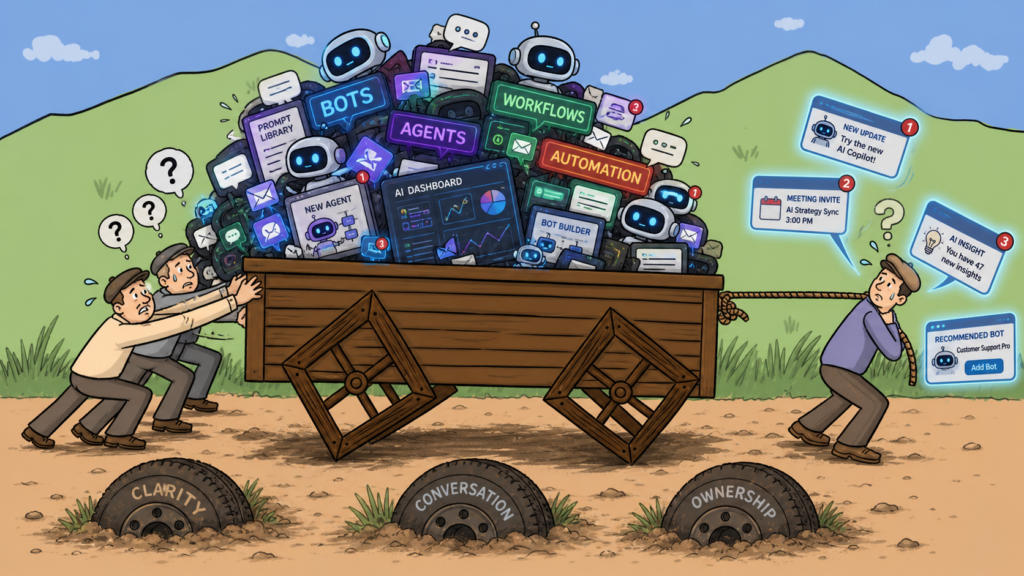
The improvement opportunity is real, but it requires a different approach. Instead of expecting supervisors to sell a technology decision already made somewhere else, organizations need to enable them to involve their people in determining how that technology should improve the work.
The key word is enablement!
Resistance Is Information, Not Just an Obstacle
Before labeling people resistant to AI, we should consider what they might reasonably be resisting. Is it the technology itself, or the possibility of losing their jobs? Are they worried about making mistakes, having their expertise discounted, or being expected to produce more without receiving additional support? Changes are seldom readily accepted by experienced people doing the work of the organization.
And, “Fear is the Mindkiller.” (Dune)
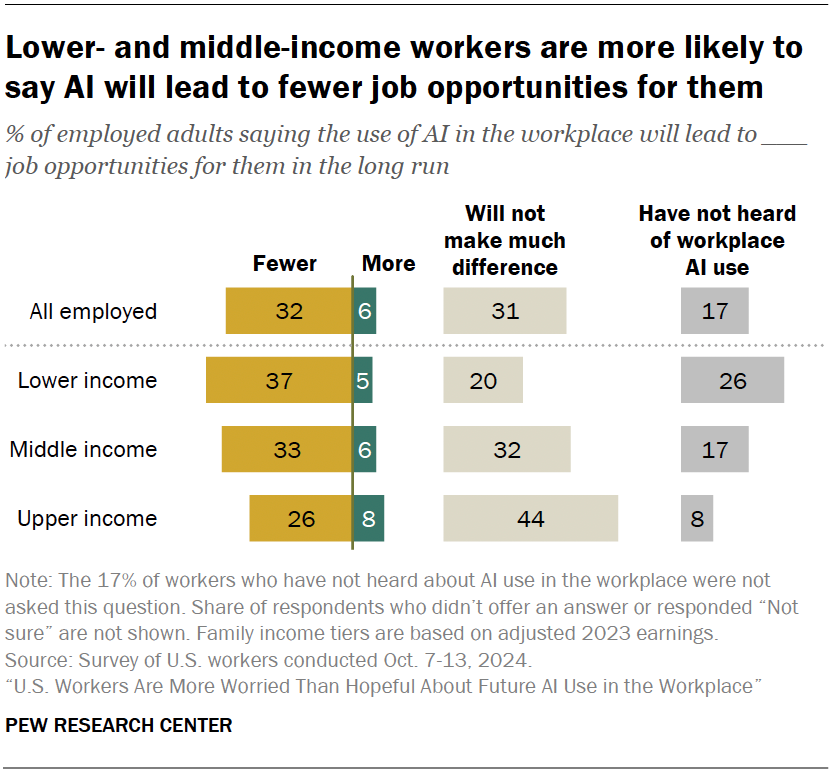
Pew Research Center’s February 2025 report, based on a survey of 5,273 employed U.S. adults conducted in October 2024, found that 52% were worried about AI’s future use in the workplace, compared with 36% who felt hopeful. Nearly one-third, 32%, believed AI would lead to fewer job opportunities for them. These findings measure attitudes rather than actual resistance behaviors, but they make one point clear: supervisors are not introducing AI into an emotionally neutral environment.
So, a cheerful presentation about efficiency will probably not answer those negative feelings and real concerns. Neither will telling people that change is inevitable. A more useful starting point is to ask, “What concerns you about using this here, and what would make it genuinely helpful?”
That changes the supervisor’s role from persuader to facilitator. The goal is not to win an argument about using AI. It is to understand the conditions under which people can use it confidently, responsibly, and productively.
Involvement Is More Than a Nice Leadership Behavior
For supervisors already caught between rising expectations and limited resources, AI can become one more layer of the hellscape: another change to implement, explain, monitor, and somehow turn into better performance. Yet the OECD’s 2025 review of experimental research suggests that AI’s benefits depend on the task, the user’s experience, and how people work with the technology. Buying the tool is not the same thing as improving the work and perceptions and beliefs are important.
There are real opportunities, though. In a late-2024 survey of more than 5,000 small and medium-sized businesses across seven countries, the OECD found that 31% used generative AI. Businesses reported performance improvements and help addressing skill gaps. But twice as many said AI increased their need for highly skilled workers as said it reduced that need — 20% versus 9%. This is not simply a story of software replacing people; it is also a story of changing what people need to know and do.
That changes how we might interpret “resistance.” Before labeling a supervisor resistant, ask: What new responsibilities are being added? What training is available? What existing work will disappear to make room? The OECD’s 2026 skills report emphasizes the importance of digital and data skills alongside problem-solving, creativity, and managerial capabilities. From that perspective, reluctance may be a question about readiness and support and not merely an unwillingness to change.
And we should distinguish changing work from demonstrated economic results. A Danish study linking AI-adoption surveys to employment records found changes in tasks and reported productivity benefits, but no statistically significant average effects on earnings or recorded working hours during the first two years after ChatGPT’s launch. For the supervisor, the new demands may arrive well before the promised payoff becomes measurable.nber
Original sources for the above:
-
OECD, The Effects of Generative AI on Productivity, Innovation and Entrepreneurship (2025):
https://www.oecd.org/en/publications/the-effects-of-generative-ai-on-productivity-innovation-and-entrepreneurship_b21df222-en.html -
OECD, Generative AI and the SME Workforce (2025):
https://www.oecd.org/en/publications/generative-ai-and-the-sme-workforce_2d08b99d-en.html -
OECD, AI and Skills: What We Know So Far (2026):
https://www.oecd.org/en/publications/ai-and-skills_f843b352-en/full-report.html -
Humlum and Vestergaard, Still Waters, Rapid Currents: Early Labor Market Transformation under Generative AI(2025; revised March 2026), NBER working paper:
https://www.nber.org/papers/w33777
A supervisor cannot create meaningful involvement
if every important decision has already been locked down.
Start with the Square Wheels, Not the Software
Let’s begin here with a model of how things really work. This is called Square Wheels One and you can download it for free by clicking on the image.
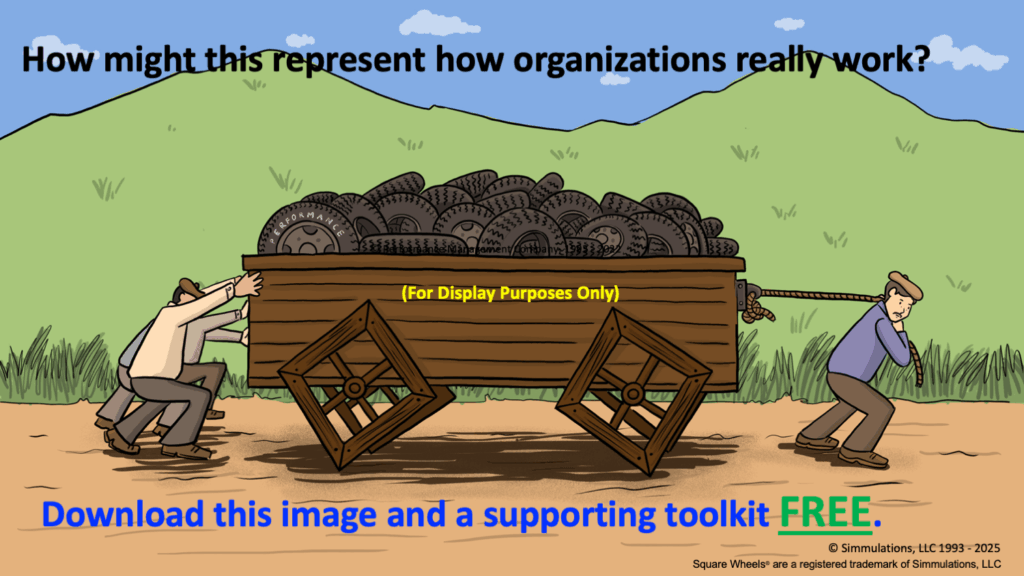
Download the FREE Square Wheels® One image and instructor’s guide under a Creative Commons license
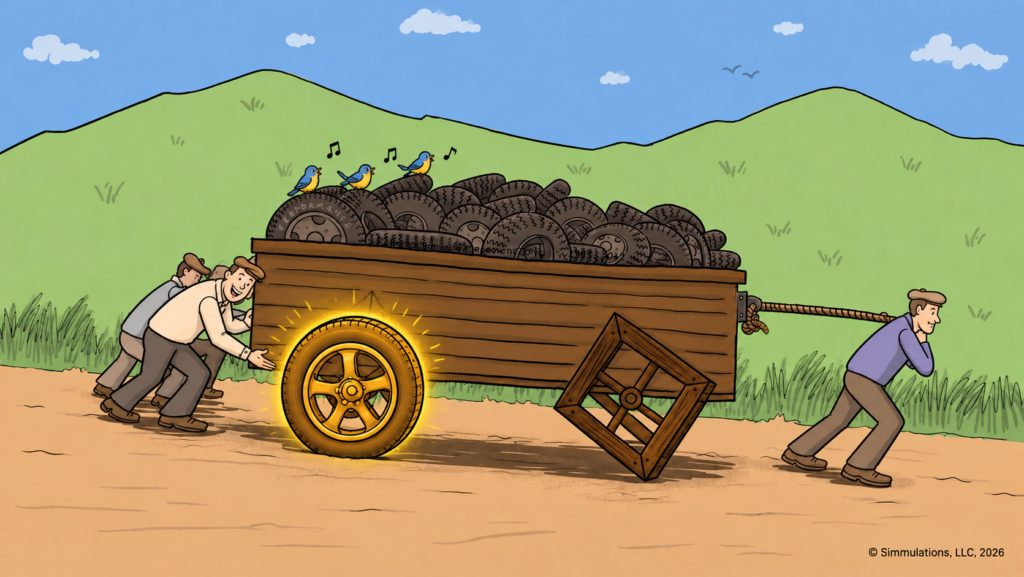
This is where the Square Wheels® approach offers a practical starting point. In the original Supervisor Hellscape article, the Square Wheels represent the processes, policies, habits, and handoffs that create friction and do not work smoothly. The unused round rubber tires represent possibilities for improvement that may already exist but have not been discussed, tested, or supported. The image gives people something to examine together rather than someone to blame.
For AI implementation, I would begin with the same conversation: “Where are the thumps and bumps in our work?” and “How might we use some AI tools to help us address those issues?” Note that we are asking with the goal of involving, doing things With people rather than TO them.
Perhaps people repeatedly search for the same information, rewrite similar documents, or struggle with incomplete handoffs. Perhaps the real problem is an approval rule or contradictory priorities that no AI tool will fix. Starting with the enablement of work allows the team to distinguish a useful application from a technological distraction.
Only then should the supervisor ask, “Could an approved AI tool help us fit a Round Wheel here?”
That sequence matters. It invites employees to identify a problem worth solving before asking them to embrace a proposed solution. It also creates room for an entirely legitimate answer: this particular wheel needs a policy change, not an algorithm.
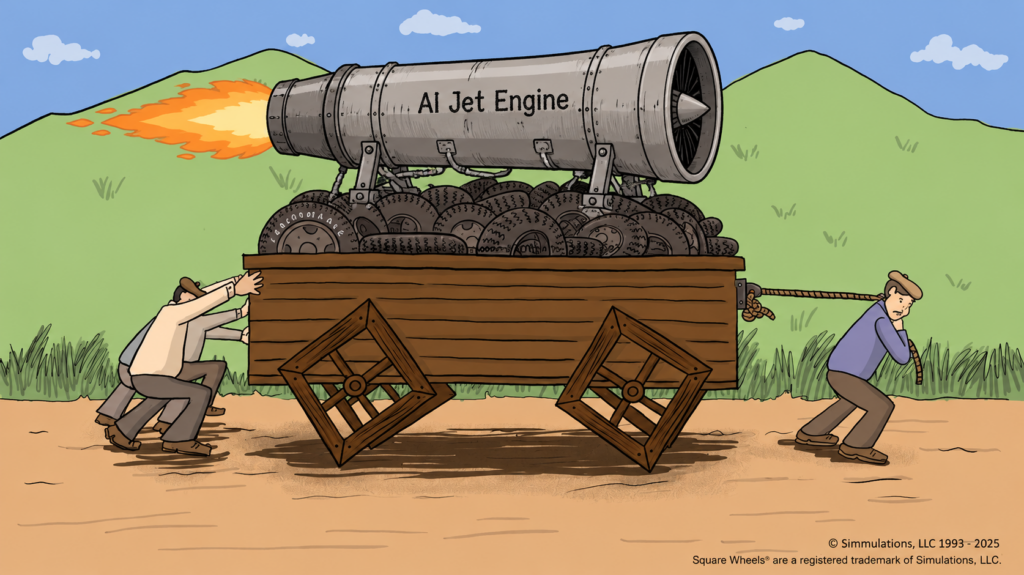
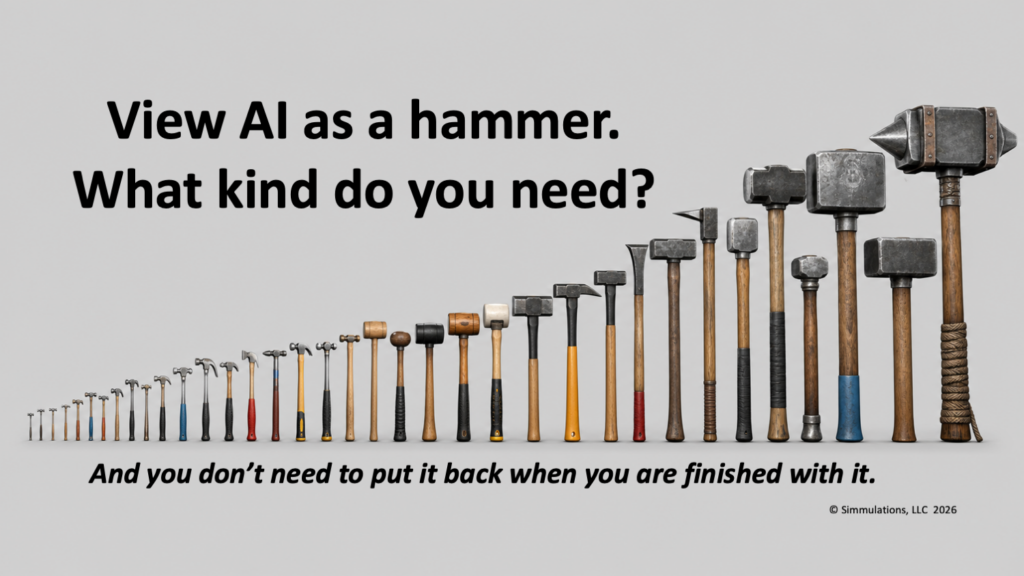
AI is not some rocket engine. AI is much more like a number of hammers that we can use to make things.
Enable Supervisors to Run Small, Shared Experiments
Rather than making supervisors responsible for a vague mandate to “drive adoption,” give them permission and resources to facilitate bounded experiments. A team might select one recurring task, agree on how an approved AI tool could assist, establish what information must not be entered, and decide who will check the output.
For example, a team could test AI-assisted drafting of a routine internal summary using non-sensitive information. Before starting, employees and their supervisor would agree on what improvement means: less preparation time, fewer omissions, clearer communication, or some combination. Afterward, they would examine the checking and correction work as well as the time apparently saved. Their involvement would help craft better solutions. Or, HR could just do it, right?
The useful question is not, “Did people use AI?” It is, “Did the work improve, and what did we learn?” The quality of our decision-making can improve with AI and with the active involvement of people actually involved in the work.
These experiments should include permission to conclude that an application is not useful. Otherwise, the exercise becomes a demonstration with some predetermined verdict. Invite experienced employees to identify exceptions and weaknesses, while giving less-confident colleagues supported practice. Treat questions and discovered errors as contributions to implementation, not evidence of a bad attitude.
Supervisors also need help communicating honestly. They should be able to explain what is known about role changes, what remains undecided, and where employees can influence the outcome. They should not be expected to promise job security they cannot guarantee or defend decisions they have not been allowed to understand.
Senior Leaders Must Change Their Side of the System
None of this works if involvement is simply another responsibility piled onto an already overloaded supervisor.
My original article distinguishes what supervisors can influence locally from what organizations must enable or repair. A supervisor can invite input, clarify expectations, and facilitate an experiment. Senior leaders control staffing, competing priorities, decision authority, and whether escalated problems receive an answer.
For AI implementation, that means providing protected learning time, accessible technical support, clear rules for approved tools and data use, and a timely route for resolving questions. If supervisors are expected to lead experimentation, leaders should specify which existing work will be reduced to make room.
They should also explain how productivity gains will be handled. Will saved time support better service, learning, and reduced backlog, or will every improvement immediately produce a higher quota?
Those OECD case studies describe both improvements in working environments and concerns about increased work intensity and stress. Employees therefore have reasonable grounds to ask not just whether AI works, but whose experience it improves.
A useful leadership review would ask the supervisor: “What did your people identify? What have you tested? What improved? What obstacle now requires a decision from us?” The supervisor is the only one that can get good answers to these issues. And, it must come as credible information from the workforce — a survey will not generate this result.
That last question above keeps employee involvement from becoming a suggestion scheme with no organizational response:
“What obstacle now requires a decision from us?”
We can act on this information.
Better Implementation Begins with Different Conversations
We do not need supervisors who are merely more enthusiastic about AI. We need supervisors who are equipped to facilitate useful conversations, support learning, test improvements, and carry operational evidence back to decision-makers. Asking for ideas and asking about issues is the only way we will involve and engage them and decrease their resistance to change.
That means replacing “How do we overcome their resistance?” kind of thinking with a more productive question: “What do our people know, fear, and need that our implementation plan has not yet addressed?”
Stop the wagon long enough to listen. Let the people doing the work identify the Square Wheels. Give them a meaningful role in testing the alternatives, and give their supervisors the authority and support to act on what they learn.
AI should become an opportunity to improve the work with people
and not another reason to demand that they push harder.
We need their engagement and active participation.
—
For the FUN of It!
 Dr. Scott Simmerman is a designer of team building games and organization improvement tools.
Managing Partner of Performance Management Company since 1984, he is an experienced presenter and consultant who is trying to retire!! He now lives in Cuenca, Ecuador.
You can reach Scott at scott@squarewheels.com
Learn more about Scott at his LinkedIn site.
Square Wheels® is a registered trademark of Simmulations, LLC
and images are © Simmulations, LLC 1993 – 2026
Note: Please do not take my images and think about using them. It can generate a whole heap of problems given international copyright law and trademark law. Read this article for more information.
See a detailed overview of my tools, background and experiences by clicking here.
What I’m About:
My Square Wheels blog and website exist to help leaders, trainers, and facilitators make work smoother, more engaging, and more human. I focus on practical tools for process improvement, organizational change, and workplace collaboration that spark insight and deliver measurable results.
And I am convinced, after 30+ years of using Square Wheels®, that it is the best facilitation toolset in the world. One can use it to involve and engage people in designing workplace improvements and building engagement and collaboration. It is a unique metaphorical approach to performance improvement and we can easily license your organization to use these images and approaches.
By blending proven facilitation methods, creative problem-solving, and engaging team activities, my mission is to support organizations in building energized, sustainable cultures of involvement and innovation.
Through accessible — and often free — resources and virtual facilitation tools, I aim to help teams everywhere collaborate more effectively, innovate continuously, and take ownership of their improvement journey.
#SquareWheels #InnovationAtWork #TeamEngagement #FacilitationTools #WorkplaceImprovement #EmployeeEngagement #CreativeProblemSolving #OrganizationalDevelopment #LeadershipTools #collaboration #leadership #motivation #communications #enablement #leadership #CreativeCommons #enablingperformance #teamwork #storytelling #storyasking #enablement #disruptiveengagement #un-dis-engagement #un-dis-empowerment #innovation
© 2026 Simmulations, LLC. Please note that “Square Wheels®” is a registered trademark of Simmulations, LLC. and materials, original wagon line art, text, and visual designs are protected. Original line art by Roy Sabean, used under rights owned by Simmulations, LLC and formerly Performance Management Company, a sole-proprietorship of Dr. Scott J. Simmerman. Original concept and source artwork © Simmulations, LLC; derivative visuals sometimes created with assistance from Perplexity Pro AI.


0 Comments