
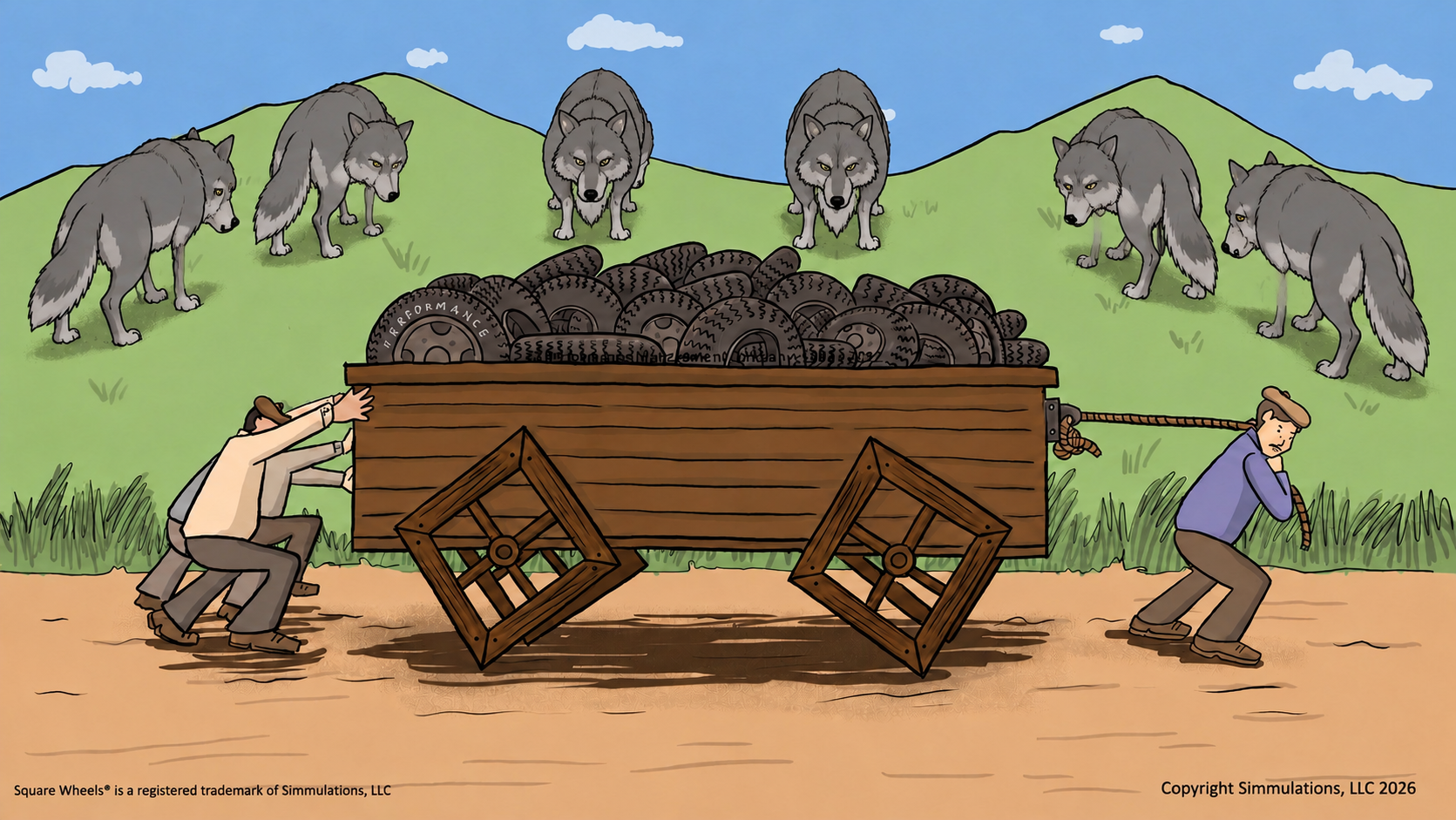
Talking with another game designer about Spectator Sheep and there being many objective, distanced viewpoints of a Square Wheels One reality, I had the idea of something different: Spectator Wolves.
Since I write so much about the Square Wheels® metaphor around, “How organizations really work” and because I have often used the idea of Spectator Sheep in many of my posts, Perplexity AI handles my inquiries pretty seamlessly and helps me test out ideas.
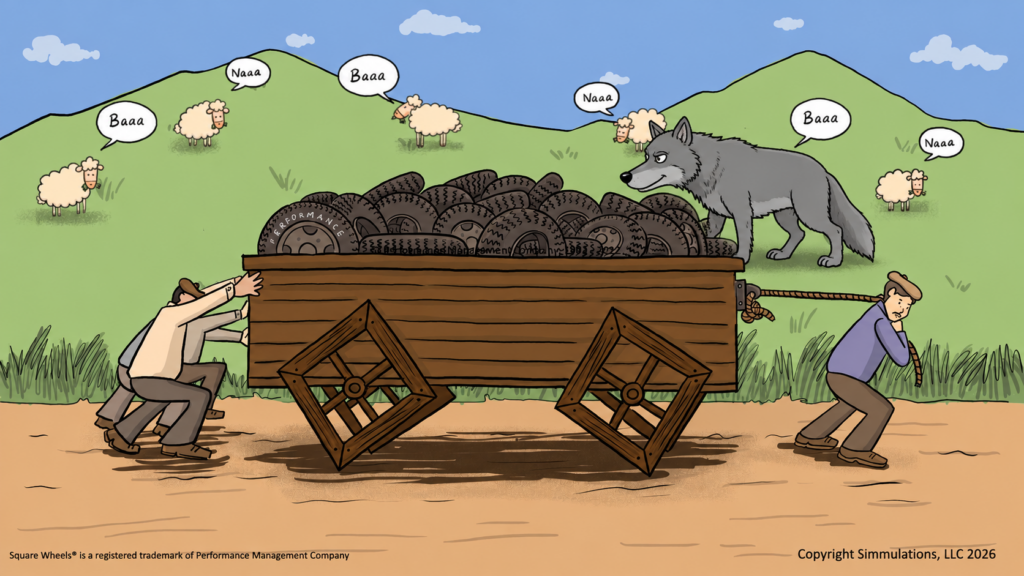
Simply speaking to the reader, Spectator Sheep (shown below) are (in my mind) not actively involved in the journey and they see things differently. That is how I have been using the metaphor for a couple of decades.

The sheep stand around, uninvolved, voicing their opinions of things: Naaaaaaaa Baaaaaaaa
Perplexity and its LLM has really good depth of “understanding” — so much so that I challenge you to ask it a question about how you might use the images and metaphors in some kind of collaboration with me to impact your organization or business. Try it!! Put something like this into your AI platform and let’s kick around the output!
“How can I use Scott’s Square Wheels images
and tools to: (your question or idea here)?”
Here is a slightly edited version of the original Perplexity output generated when I asked about my idea of Spectator Wolves. I feel like I have to give the AI credit for its “thinking” since it is much broader and deeper than what I would have generated on my own. Really. I still have some pretty good mental capability at 78 but AI “remembers everything!”
Below is the third iteration of the Wolves image and the content / contextual thinking around the metaphor:
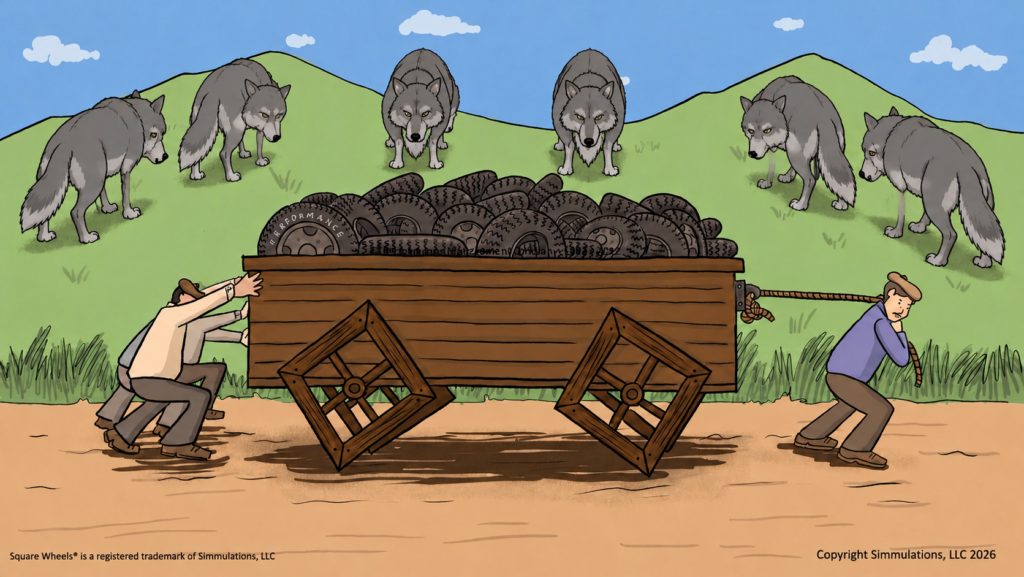
What Perplexity generated:
Scott, I think adding Spectator Wolves has real potential—particularly if you leave their intentions open to interpretation rather than making them the villains. Sheep and wolves can watch exactly the same Square Wheels wagons and see entirely different situations: one might see familiar routines, another an opportunity, another a vulnerability, and another a problem worth helping solve.
The most interesting question may be: “They are all watching the same wagon — but what is each hoping happens next?”
That gives you a way to move beyond participation and disengagement into discussions of interests, power, competition, risk, and whose perspective gets heard.
What Spectator Wolves could add to the picture
Perplexity said: I would explore several possible interpretations, not prescribe one definitive meaning. Organizational-metaphor scholarship supports using multiple images as alternative lenses rather than treating any one metaphor as a literal account of organizational reality. Each interpretation can reveal something while obscuring something else.
Here are some possibilities I would test with groups:
| Possible interpretation | What the wolf might be thinking | Organizational discussion it opens |
|---|---|---|
| The competitor | “While they struggle with those wheels, we can get ahead.” | Competitive vulnerability and the cost of slow improvement |
| The independent thinker | “Why does everyone accept that this is how wagons work?” | Assumptions, conformity, and useful dissent |
| The opportunist | “Their difficulty could work to my advantage.” | Conflicting incentives, internal politics, and who benefits from dysfunction |
| The experienced observer | “I have seen this happen before. Will they listen?” | Expertise outside the working group and ignored warnings |
| The potential ally | “I could help—but would they let me near the wagon?” | Trust, boundaries, and assumptions about outsiders |
| The perceived threat | “They assume I am dangerous, although I have done nothing.” | Stereotyping, attribution, and how groups construct enemies |
These are proposed uses of your Wolves image, not established meanings of wolves or any claims that one kind of person behaves this way.
The especially productive distinction is that spectatorship by either sheep or wolves does not necessarily tell us anything about the reality of agreement, competence, motivation, or intent. In your illustration, two observers could stand in the same place for completely different reasons and generate very divergent ideas.
A very strong twist: Who benefits from the Square Wheels?
Your wolves could open a sharper discussion than simply, “Why haven’t we changed the wheels?” I would try: “We assume everyone wants this wagon to work better. What in the picture supports that assumption? Then:
-
Who benefits from keeping the Square Wheels rolling?
-
Who would lose status, control, income, or importance if the wagon improved?
-
Who sees the problems but has no authority to intervene?
-
Who is waiting for an invitation—and who is waiting for a breakdown?
-
Is everyone using the same definition of “better”?
This is where I see the most distinctive value. We can use “wolves” to explore the possibility that an improvement is technically obvious but socially or politically complicated.
In a hypothetical workplace discussion, changing the wheels might reduce dependence on the person celebrated for repairing them. That does not automatically make that person malicious; it gives the group an incentive problem to examine rather than a personality to condemn.
Let the wolves challenge the sheep—and vice versa
I would avoid making this a simple contrast between passive sheep and insightful wolves. That risks replacing one narrow interpretation with another. Instead, give each perspective both something to contribute and something to question:
-
The sheep might understand the history, relationships, and practical constraints. They have been hanging around for a long time.
-
The wolf might notice an opportunity the group has stopped seeing. They are new to the situation.
-
The sheep might mistake familiarity for safety.
-
The wolf might underestimate the consequences of its proposed change as it really affects the local environment.
-
Either might be helpful, mistaken, self-interested, or simply poorly informed. None are actively involved in the action or the progress.
A useful exercise would be to ask participants to make the strongest case for each observer before deciding which perspective they personally favor. That approach fits research-informed guidance on team discussion: explicitly frame differences as potential sources of value, and begin with information sharing rather than immediate evaluation of who is right.hbs
One question I particularly like is:
“What might the wolf understand that the sheep do not—and what might the sheep understand that the wolf does not?”
The main risk: Turning a discussion tool into a labeling tool
My biggest concern is not the wolf itself. It is the possibility that someone says, “We all know who the wolves are around here.” At that point, the illustration could become a way to accuse colleagues indirectly rather than examine the work.
I would establish a simple boundary: “We are exploring perspectives, behaviors, and conditions—not assigning animal identities to people.”
That matters because candid discussion depends partly on whether people expect to be embarrassed, rejected, or punished for contributing. Research on psychological safety links that climate to speaking up, collaboration, and experimentation. An image can invite a conversation, but the facilitator’s framing and response to participants still matter.academic.
I would also ask, “What have we actually observed, and what story are we adding?” A participant’s assumption that the wolf intends harm could itself become useful discussion material—without the facilitator declaring that interpretation correct. There is no reality when using images of wolves and sheep and a wooden wagon rolling on wooden wheels!
How I would introduce the image to a work group
I would use a short reveal-and-reframe sequence, noting that this might follow a session focused on a more normal discussion of Square Wheels One or that it might be a separate and independent session standing on its own.
1 — Show the wagon and sheep first.
Ask, “What is happening here? What might the observers be thinking?”
2 — Reveal an otherwise identical image with a wolf added.
Ask, “What changed in your interpretation—even though nothing about the wagon changed?”
3 — Collect several explanations before discussing them.
Have people write privately first, then compare in pairs. Ask for a helpful wolf, a threatening wolf, and a misunderstood wolf.
4 — Separate perspective from intention.
“What can this observer see?” is different from “What does this observer want?”
5 — Connect the picture to work.
Ask, “Which perspectives are missing from our improvement discussions? Whose motives have we assumed rather than explored?”
6 — End with a specific action.
Identify one overlooked stakeholder to consult, one assumption to test, or one incentive that needs closer examination.
I would present that as a facilitation experiment worth testing, not as a validated new intervention. The supporting principle is sound: frame the work as a learning challenge, invite contributions through genuine questions, and respond productively to what people raise.
Perplexity’s thoughts on the visual design
For the first version, I would draw a watchful, fairly neutral wolf—not snarling, stalking, or licking its lips. That is a design judgment: obvious menace would answer the question before participants have a chance to interpret it. I would also start with just one wolf. A single new observer lets you ask what changed without overwhelming the familiar wagon scene.
Later, you could develop variations:
-
A wolf beside the sheep: Does proximity imply shared interests?
-
A wolf looking at the Round Wheels rather than the workers: What opportunity has it noticed?
-
A wolf offering help: What would make the offer credible?
-
Sheep watching a wolf help repair the wagon: Who is now the spectator, and why?
-
A wolf and sheep exchanging observations: What becomes possible when perspectives connect?
My favorite starting point is the simplest: the same Square Wheels One wagon, the same struggle, and one additional kind of observer whose intentions are unknown.
The creative opportunity is not merely to add a more dangerous animal. It is to introduce a different reading of the same situation—and let the group discover how quickly it assigns motives, overlooks useful information, or assumes everyone wants the same outcome.
Addendum: Asking the same question to Gemini:
I also asked Gemini, which I am learning to use and I do not use nearly as much as Perplexity just to see what that platform could find about my tools and this idea. I used the same prompt:
What do you think of my idea of adding Spectator Wolves to my images around Square Wheels wagons and Spectator Sheep. Wolves have a different perspective. Share some thoughts on this idea as it relates to facilitating work groups and talking about organizational issues.
Gemini’s Response: Adding Spectator Wolves alongside the Sheep on the hillside introduces a sharp, provocative layer of tension that fundamentally shifts the psychological dynamic of a Square Wheels facilitation.
The classic Square Wheels One wagon scene relies on cognitive dissonance: the wagon pushers and pullers are sweating bullets on their wooden Square Wheels while the round wheels sit idle in the wagon. Spectator Sheep represent the passive majority—safe on the hill, bleating commentary, cynical or detached, observing the struggle without skin in the game.
Dropping Wolves into that audience changes the metaphor from apathy vs. effort to vulnerability vs. consequence.
1. Who Are the Wolves in an Organization?
In the wild, wolves aren’t just spectators; they are seen as predators sizing up weakness, inefficiency, and stragglers. In an organizational metaphor, they might represent entities watching the struggling wagon with an appetite:
- Disruptive Competitors: Watching legacy companies drag square wheels through mud, waiting for margins to drop or delivery times to slip so they can seize market share.
- Aggressive Activist Investors or Corporate Restructurers: Taking notes on inefficiency, calculating headcounts, and planning where to cut or break up assets.
- Internal Political Operators: Colleagues or departments waiting for a project or leader to fail so budget, territory, or influence gets redistributed.
- Churning Customers: Clients tired of the slow crawl who are quietly vetting alternatives.
2. The Narrative Shift: Why Wolves Matter for Facilitation
When participants only see the Sheep, the conversation naturally gravitates toward internal complacency, team disengagement, or fear of speaking up.
When you introduce the Wolves watching both the Wagon and the Sheep, the stakes escalate immediately:
- Urgency Over Comfort: A team dragging square wheels can laugh off sheep saying “Baaa, they’ve always done it that way.” They cannot laugh off wolves saying “Keep pushing like that for two more quarters, and you won’t have a wagon left to pull.” It converts humorous recognition into a burning platform for change.
- The Sheep’s False Security: The Sheep think they are safe sitting on the hillside watching the fools work. But in nature, wolves don’t hunt wagons; they hunt sheep. Facilitators can ask: “If the wagon stops moving or collapses, who do the wolves turn to next?” It forces disengaged bystanders to realize their safety is an illusion.
- Differentiating Intent: Spectators aren’t all uniform. Some watch out of apathy (Sheep), but others watch with predatory intent or calculated opportunism (Wolves). It helps groups distinguish between harmless organizational cynicism and real external/strategic threats.
3. Facilitation Questions to Spark Discussion
In a workshop setting, a visual featuring both Sheep and Wolves provides an immediate springboard for high-impact debriefs:
1 — Identifying the Pack: “Who are the wolves watching our wagon right now? Are they competitors, shifting market forces, new technologies, or internal dynamics?”
2 — Diagnosing the Vulnerability: “What specific inefficiencies on our wagon make us look like easy prey?”
3 — Challenging the Observers: “Are our spectator sheep aware of the wolves behind them, or are they too busy critiquing the wagon crew to notice the real danger?”
4 — Strategic Action: “How does adopting the round wheels (our available solutions) change the behavior of the wolves?” (A fast, well-oiled wagon is hard to hunt; predators move on to easier targets.)
Design & Metaphor Nuance to Keep in Mind
The genius of Square Wheels has always been its balance of humor, accessible self-deprecation, and non-defensive inquiry.
To keep the Wolves from making the drawing feel purely threatening or paralyzing:
- Give them character: Let them look calm, sharp-eyed, and analytical—perhaps holding clipboards, binoculars, or napkins—rather than snarling monsters. They should look like they are simply waiting for natural consequences to unfold.
- Positioning: Placing them slightly behind or above the sheep creates an immediate visual hierarchy: the wagon crew is oblivious, the sheep are distracted, and the wolves see the entire food chain.
It turns the visual from a diagnosis of operational frustration into an unmistakable prompt for strategic survival.
I hope you liked this. It was quite interesting to do and also interesting to see the different outputs of Perplexity and Gemini, both adding to the richness of using visual metaphors for business improvement,
—
For the FUN of It!
 Dr. Scott Simmerman is a designer of team building games and organization improvement tools.
Managing Partner of Performance Management Company since 1984, he is an experienced presenter and consultant who is trying to retire!! He now lives in Cuenca, Ecuador.
You can reach Scott at scott@squarewheels.com
Learn more about Scott at his LinkedIn site.
Square Wheels® is a registered trademark of Simmulations, LLC
and images are © Simmulations, LLC 1993 – 2026
Note: Please do not take my images and think about using them. It can generate a whole heap of problems given international copyright law and trademark law. Read this article for more information.
See a detailed overview of my tools, background and experiences by clicking here.
What I’m About:
My Square Wheels blog and website exist to help leaders, trainers, and facilitators make work smoother, more engaging, and more human. I focus on practical tools for process improvement, organizational change, and workplace collaboration that spark insight and deliver measurable results.
And I am convinced, after 30+ years of using Square Wheels®, that it is the best facilitation toolset in the world. One can use it to involve and engage people in designing workplace improvements and building engagement and collaboration. It is a unique metaphorical approach to performance improvement and we can easily license your organization to use these images and approaches.
By blending proven facilitation methods, creative problem-solving, and engaging team activities, my mission is to support organizations in building energized, sustainable cultures of involvement and innovation.
Through accessible — and often free — resources and virtual facilitation tools, I aim to help teams everywhere collaborate more effectively, innovate continuously, and take ownership of their improvement journey.
#SquareWheels #InnovationAtWork #TeamEngagement #FacilitationTools #WorkplaceImprovement #EmployeeEngagement #CreativeProblemSolving #OrganizationalDevelopment #LeadershipTools #collaboration #leadership #motivation #communications #enablement #leadership #CreativeCommons #enablingperformance #teamwork #storytelling #storyasking #enablement #disruptiveengagement #un-dis-engagement #un-dis-empowerment #innovation
© 2026 Simmulations, LLC. Please note that “Square Wheels®” is a registered trademark of Simmulations, LLC. and materials, original wagon line art, text, and visual designs are protected. Original line art by Roy Sabean, used under rights owned by Simmulations, LLC and formerly Performance Management Company, a sole-proprietorship of Dr. Scott J. Simmerman. Original concept and source artwork © Simmulations, LLC; derivative visuals sometimes created with assistance from Perplexity Pro AI.


0 Comments