
The pressure on supervisors these days is intense and immense: hit the numbers, keep people engaged, drive change, and somehow “motivate” everyone. The problem is, motivation is fickle. It shows up late, leaves early, and never seems to be there when you really need it.
Progress, on the other hand, is reliable. When people see real, tangible progress in their work, their energy and motivation tend to follow. That’s where Square Wheels comes in: a simple, visual way for supervisors to communicate about work, uncover issues and opportunities, and focus everyone on practical, doable improvements.
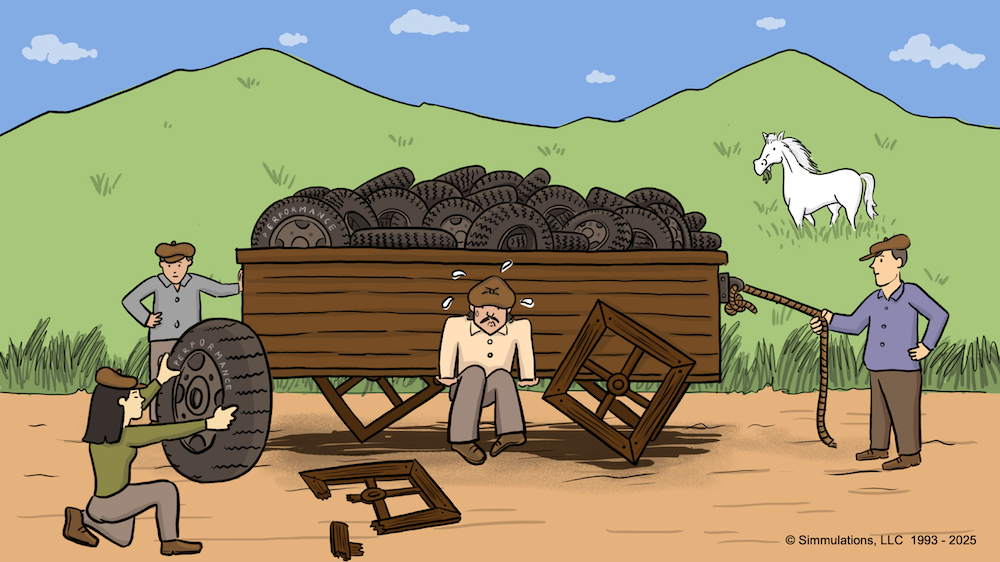
Progress is hard work but also motivating
In this post, I’ll connect a set of practical mindset shifts about progress with how a supervisor can use the Square Wheels metaphor and tools to impact both people and performance in the workplace.
From “Motivating People” to “Improving the Wagon”
Most supervisors are conditioned to talk about effort: “We need to work harder, push more, give 110%.” But if the wagon is loaded down and rolling on Square Wheels, asking people to push harder is not leadership. It’s noise.
Square Wheels offers a different conversation:
-
The wagon is the work, the system and processes and other realities.
-
The square wheels are the current processes, policies, and practices that make work slow, frustrating, or risky.
-
The round wheels are the ideas, improvements, and better ways of doing things that already exist but aren’t being used yet.
Instead of talking about “trying harder,” the supervisor can talk about “using better wheels.” That reframes performance from personal effort to shared improvement. Progress becomes visible, concrete and discussable. It can generate continuous continuous improvement and the goal of making things work better for everyone.
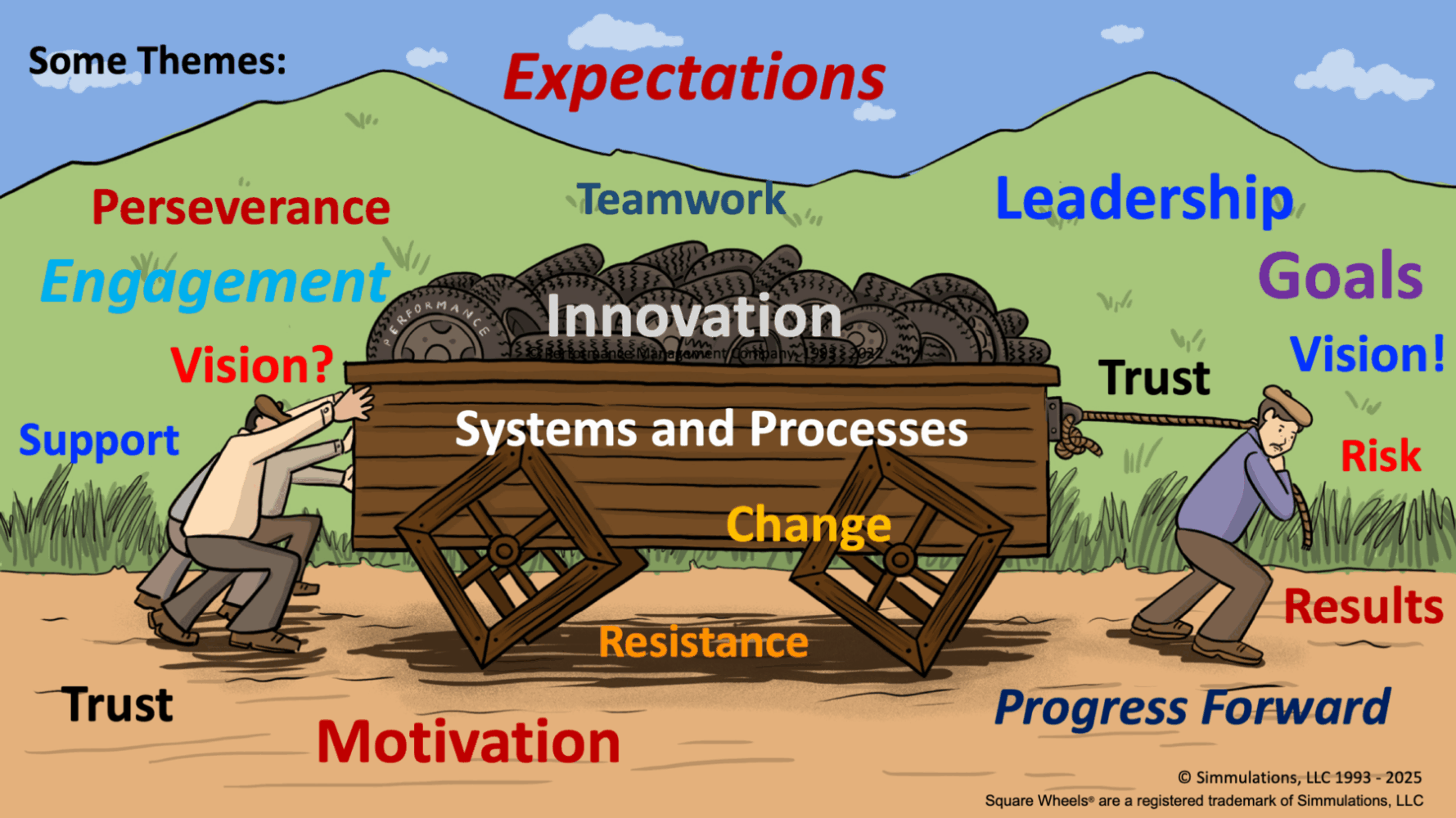
There are many different themes that open up for discussion when using Square Wheels One that open up so many possibilities
Mindset Shift 1: There Is Always a New Wheel
One powerful mindset shift is this: in almost every situation, there is a next move. You may not have the perfect solution, but you can always find a useful step forward.
Square Wheels makes that visible. When you show the illustration of the wagon rolling along on square wheels while a couple of round wheels sit unused in the back, you’re sending a simple message: we don’t have to invent the perfect future; we just have to find one better way to roll.
Note: The round wheels of today will
become the Square Wheels of Tomorrow.
As a supervisor, you might ask:
-
“Looking at our wagon, what’s one Square Wheel we’re pushing right now?”
-
“What’s one small, practical round wheel we could try this week that would make this ride a little smoother?”
You’re not demanding a strategic transformation. You’re asking for a next move, one that is less threatening, more actionable, and far more likely to generate real change and active involvement.
Mindset Shift 2: Action Before Perfect Clarity
Another mindset shift: clarity often comes from action, not before it. We learn by doing, testing, and adjusting. Sitting in a room trying to design the perfect process rarely works.
Using Square Wheels tools allows you to turn improvement into an experiment rather than a project. There are just so many different possibilities…
Use the image in a team meeting and say:
-
“We don’t need the whole future mapped out. Let’s pick one Square Wheel and run a two-week experiment with a new round one.”
-
“What could we change in a small way to see if our wagons roll better—fewer steps, a simpler form, a checklist that actually matches reality. Something that is different and is a possible improvement.”
By framing improvements as “try it and learn,” you lower the risk for people. They don’t have to bet their credibility on a big, perfect solution. They just need to help test a better wheel, see what happens, and adjust. That kind of action leads to the clarity everyone says they’re waiting for. This is not about training to improve some skill; this is about feeling that some things need to be changed.
Mindset Shift 3: There’s More Than One Right Path
Supervisors and teams often get stuck because they assume there’s one “right way” to solve a problem. If they can’t agree on that one solution, they do nothing and even waste energy.
The Square Wheels metaphor breaks that gridlock neatly and nicely. When you use the image or images in a session, you’ll get multiple interpretations and dozens of different “round wheel” ideas. That’s the point.
The Round Wheels already exist in the wagon. Always.
You can say:
-
“This picture proves something: there isn’t just one right answer.”
-
“Let’s capture every round wheel idea that might improve this wagon. We can sort and test later; right now, let’s generate options.”
Instead of debating which path is perfect, the supervisor helps the team see that multiple paths can lead to better performance. That reduces fear of “being wrong” and encourages people to propose improvements that fit their own work realities.
Mindset Shift 4: Progress Beats Motivation
The old model says: get people motivated, and then they will produce results. The more useful model is: help people make visible progress, and they will feel more motivated. By playing with the wheels, they generate considered alternatives that make using the old Square Wheel cognitively impossible.
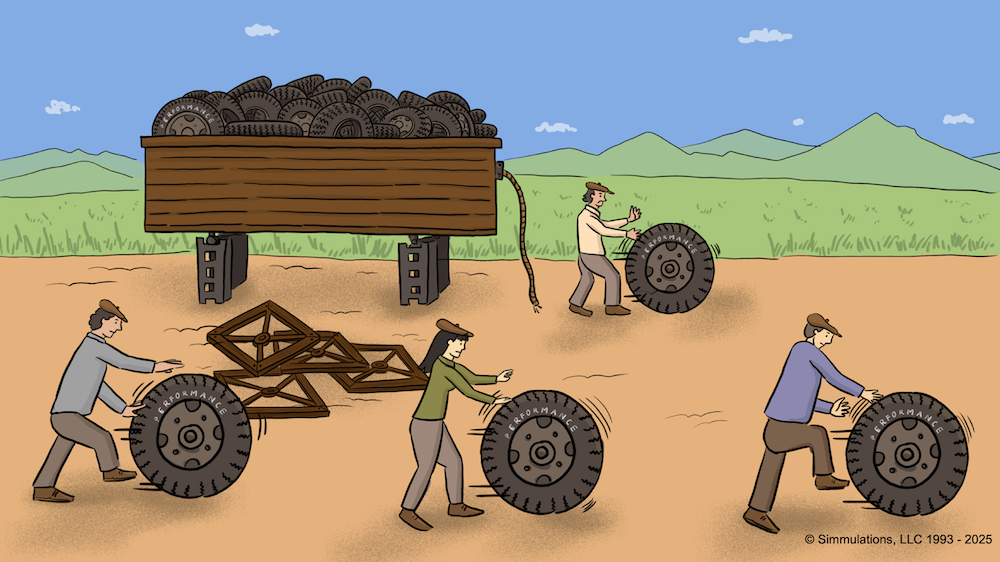
Playing with Round Wheel Ideas creates lots of cognitive dissonance about the Square Wheels
Square Wheels is ideal for showing that progress. Getting people to play with the ideas for improvement is a great way to generated considered alternatives and a shared, collaborative sense of purpose.
Here’s one simple practice – there are many different approaches, so find one that works for you:
-
In week one, use the Square Wheels image to identify one specific “Square Wheel” that everyone agrees is painful or clunky. Label it clearly and explain it in sufficient detail that everyone understands what it is, even your boss!
-
Ask the group to define one small, doable “round wheel” action to reduce that pain over the next week or two. It does NOT have to be the perfect answer, just something workable that probably improves things.
-
In the next meeting, bring back the same idea and update it—circle the wheel you addressed, add a note, or draw a new wheel on the wagon. Celebrate some success and note other things that can be done.
Now the team is not just talking; they’re seeing progress. It becomes a visual story:
-
“Last month, we were tripping over this Square Wheel: the approval process.”
-
“We tried a new round wheel: a simplified decision rule and clear authority.”
-
“Today, the wagon still isn’t perfect, but the ride is smoother. We can all feel the difference.”
That narrative beats any motivational poster or pep talk. People can literally point to what changed. Progress creates its own energy. Continuous continuous improvement is the long-term goal.
And the above are simply ideas; do your own thing that feels most comfortable to you and matched your perceived needs for communicating.
Mindset Shift 5: Redefine Success as Better Wheels, Not Harder Pushing
Another critical shift: success should be defined in terms of better wheels, not harder pushing.

Supervisors often reward visible effort: staying late, answering emails at all hours, “going the extra mile.” But if people are pushing a badly designed wagon, all that energy may produce little value and a lot of burnout.
The Square Wheels image helps you reframe success:
-
Success is fewer bumps, fewer breakdowns, less rework.
-
Success is smoother workflows, smarter tools, better collaboration. Better ideas and innovation are real improvements.
-
Success is people using their time and talent on value-creating work, not wrestling with Square Wheels.
In performance discussions, you can ask:
-
“If we judged success by how smooth the journey feels rather than how hard we push, what would we change first?”
-
“What’s one Square Wheel we could remove this quarter that would make your job significantly easier or more productive?”
- What is one thing we might do to improve customer service? (Note that the customer rides on the top of the wagon and can feel every bump without knowing the causes.)
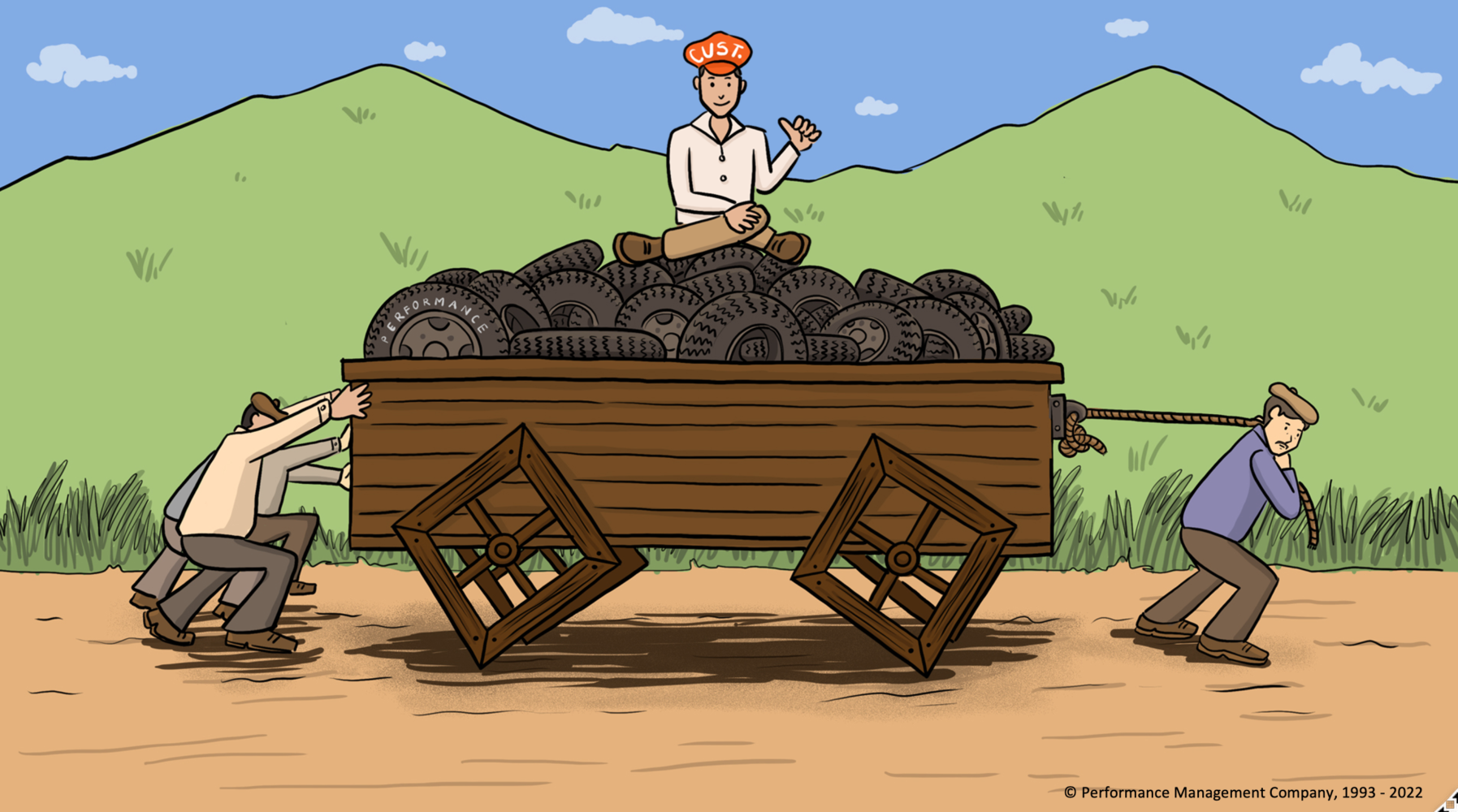
Shift the conversation and attention from individual heroics to system improvements. It signals that the supervisor values intelligent progress over unsustainable effort.
Using Square Wheels® as a Communication Tool
At its core, Square Wheels is about communication. It gives supervisors a simple, safe, visual way to talk about real problems without blaming people. The wagon is the issue, not the pushers or the puller.
Here are some practical ways to use it:
-
Team meetings
Start a monthly “wagon review.” Put up the image and ask:-
“What square wheels are we pushing right now?”
-
“Where are the round wheels we’re not using?”
Capture ideas visibly so everyone sees their input.
-
-
One-on-ones
Use the metaphor to talk about individual workloads and frustrations.-
“What feels like a square wheel in your job right now?”
-
“What round wheel ideas do you have that we haven’t tried yet?”
-
-
Project kickoffs
Before launching a new initiative, show the wagon and ask:-
“What square wheels do we want to avoid building into this project from day one?”
-
“What round wheels do we want to design in from the start?”
-
-
Recognition
When someone suggests or implements an improvement, tie your praise to the metaphor:-
“Thanks for that idea; that’s a great round wheel for our wagon.”
Over time, people start to use that language themselves.
-
The image lowers defenses, creates a shared language, and makes it easier to talk about friction, waste, and obstacles in a constructive and engaging way.
Impact on People and Performance
When supervisors consistently use Square Wheels to communicate, several things tend to happen:
-
People feel safer speaking up. The conversation is about “our wagon” instead of “your mistake.” That encourages more candor and better ideas.
-
Engagement improves because people see that their insights can become round wheels that actually get used. They feel ownership of the wagon, not just responsibility for pushing it. They become more enabled to move forward.
-
Performance improves as the team systematically removes friction from their work. Small changes compound over time, and the ride gets measurably smoother and people get more focused on results.
You don’t need to be a motivational speaker to lead well. You need to help people see the wagon, talk about the wheels, and make real progress together.
Square Wheels gives you a simple, powerful and effective tool to make better progress,
—
For the FUN of It!
 Dr. Scott Simmerman is a designer of team building games and organization improvement tools.
Managing Partner of Performance Management Company since 1984, he is an experienced presenter and consultant who is trying to retire!! He now lives in Cuenca, Ecuador.
You can reach Scott at scott@squarewheels.com
Learn more about Scott at his LinkedIn site.
Square Wheels® are a registered trademark of Simmulations, LLC
and images have been copyrighted since 1993,
© Simmulations, LLC 1993 – 2026
What I’m About:
My Square Wheels blog and website exist to help leaders, trainers, and facilitators make work smoother, more engaging, and more human. I focus on practical tools for process improvement, organizational change, and workplace collaboration that spark insight and deliver measurable results.
And I am convinced, after 30+ years of using Square Wheels®, that it is the best facilitation toolset in the world. One can use it to involve and engage people in designing workplace improvements and building engagement and collaboration. It is a unique metaphorical approach to performance improvement and we can easily license your organization to use these images and approaches.
By blending proven facilitation methods, creative problem-solving, and engaging team activities, my mission is to support organizations in building energized, sustainable cultures of involvement and innovation.
Through accessible — and often free — resources and virtual facilitation tools, I aim to help teams everywhere collaborate more effectively, innovate continuously, and take ownership of their improvement journey.
#SquareWheels #InnovationAtWork #TeamEngagement #FacilitationTools #WorkplaceImprovement #EmployeeEngagement #CreativeProblemSolving #OrganizationalDevelopment #LeadershipTools #collaboration #leadership #motivation #communications #enablement #leadership #CreativeCommons #enablingperformance #teamwork




0 Comments