
Engagement just fell to its lowest level since 2020, with only 1 in 5 employees engaged and making Square Wheels® tools more relevant than ever.
Our new engagement crisis
Gallup’s 2026 “State of the Global Workplace” report shows that global employee engagement dropped again in 2025, down to 20%, the second straight yearly decline and the lowest level since the pandemic year of 2020. No region improved, South Asia saw the steepest fall, and Gallup estimates that each one‑point drop represents about 21 million fewer engaged employees worldwide.
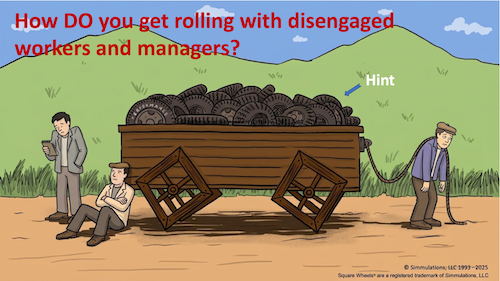
Gallup links this decline to real economic impacts: low engagement is now costing the global economy roughly $10 trillion in lost productivity, about 9% of worldwide GDP. Leaders are trying to cope with AI disruption, rapid change, and talent shortages while simultaneously watching manager engagement fall sharply, from roughly one‑third engaged a few years ago to barely over one‑fifth today.
Manager engagement was about 22% in 2025, a nine-point fall!
In simple terms: most people are not being energized by their work, many are quietly quitting, and managers themselves are rolling on more and more Square Wheels®.
Why a “simple picture” beats another survey or slogan: Interactivity!
Thirty years of leading innovation, alignment, and problem-solving workshops convince me that Square Wheels® remains one of the world’s best engagement tools because the images and metaphors do something most HR processes do not: it gets people talking honestly with each other about how work really works and what they want to improve. They already know most of what needs to be changed to make the workplace better for them. (And the many many many surveys and reports show that nobody is really listening to them, thus the disengagement.)
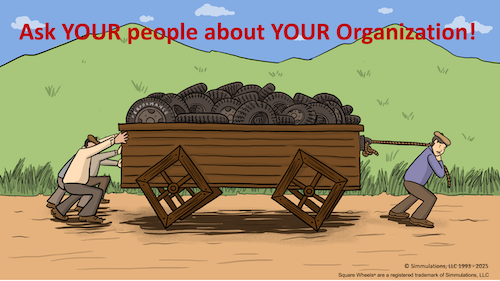
Asking your people for their reactions will help them discuss the round wheels already in the wagon.
Research on learning and memory shows that visual information can dramatically improve retention compared to words alone; some studies suggest gains of up to roughly two‑thirds in recall when visuals are added to spoken information. In practice, that means a single, memorable image can anchor a crucial conversation about friction, frustration, and possibilities in a way that a slide deck of bullet points never will. The simplicity and directness are what make these conversations work.
In my workshops across 49 countries, these images always pull more than 90% of participants into the conversation, generating dozens of specific observations and improvement ideas within minutes. The metaphors are simple, safe, and scalable: people project their reality onto the wagon, the Square Wheels, and the obvious unused round ones, and suddenly they are talking about culture, processes, leadership, and collaboration without feeling blamed or defensive.
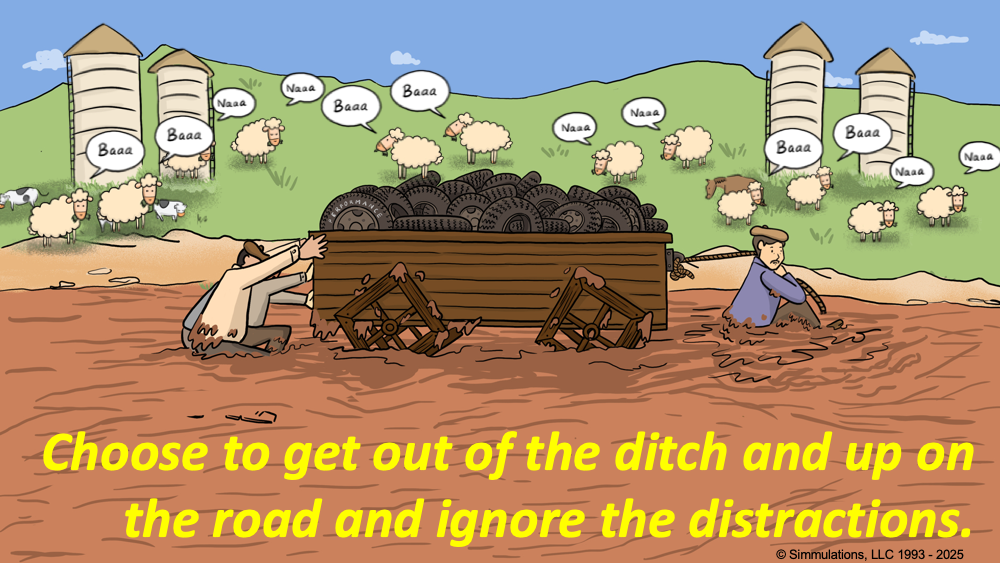
It opens everyone up to discussing the perceived issues and problems, the many potential ideas for improvement, the mud that makes progress difficult, the silos, the Spectator Sheep and so many other realities in any organization. It anchors to the view of the future and the realities of the present. And, being led by their managers, it opens eyes and generates real talk about real solutions to everyday opportunities for improvement. The tools help everyone make batter choices!
How this communications tool works in today’s workplaces
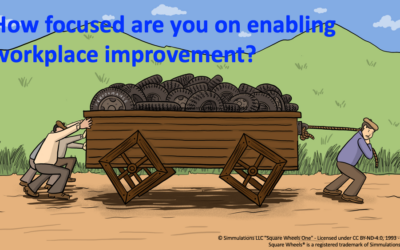
The classic Square Wheels One illustration shows a wagon rolling on Square Wheels, with round wheels already available but not yet in use. That simple image lets you quickly surface and structure the core engagement conversation:
-
Square Wheels = things that work but are clunky, frustrating, or slow — the everyday friction people tolerate because things do not work smoothly.
-
Round Wheels = ideas, tools, possibilities and behaviors that already exist (or could exist soon) but are not yet being used and could be implemented.
The facilitation flow is straightforward:
-
Individuals silently reflect on the picture and write down, “How might this represent how things really work in most organizations?” This gets them projecting ideas about their actual workplace without generating defensiveness.
-
Small groups compare notes, expand their list of “Square Wheels” in the real workplace, and expand the list, often dramatically as this first stage.
-
We generally ask the small groups to select ONE Square Wheel they would like to deal with and then brainstorm at least three “Round Wheel” ideas for each. This pushes the divergent thinking needed to creatively solve problems.
-
The room builds a shared, non‑political language for acting on issues and opportunities. “That policy is a Square Wheel” and for action solutions: “This is one Round Wheel we can test next week”.
You are NOT fixing every problem in the moment; you are creating a language of performance improvement, creating cognitive dissonance to motivate the act of implementation and generating a sense of active ownership. You are supporting their ideas about what can be done differently and generating “acceptance of action” rather than “resistance to change.”
Because the issues are spoken about through a metaphor, the politics and personal blame are generally stripped away; you are not attacking a person or a department, you are simply naming a Square Wheel that everyone can see and feel. That is classic cognitive dissonance at work: once people see the gap between the way things are and the available ideas for improvement, they feel a natural push to narrow that gap.
The same simple image can be used in many ways: embedded in facilitation skills training, integrated into remote collaboration tools, or even built in LEGO for teams to create short stop‑motion videos about their daily realities and desired improvements.
You are creating a language around continuous improvement
and shared goals around possible improvements.
From survey fatigue and resistance to shared ownership enablement
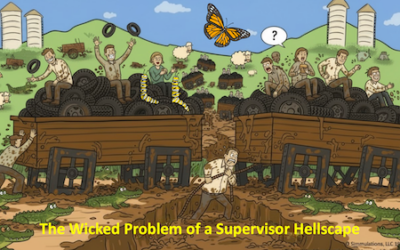
Gallup’s data makes it clear that engagement is no longer just an HR metric; it is a strategic risk indicator. When 80% of the global workforce is not engaged, and managers themselves are burning out, it is unrealistic to expect another top‑down initiative or annual survey to fix the problem. And your organization’s productivity and innovation are more seriously challenged. It is a Supervisor Hellscape out there!
What actually shifts engagement is local: the quality of team conversations, clarity of expectations, recognition, and the sense that “my ideas matter.” That is exactly where the Square Wheels tools excel:
-
They give every employee a voice in defining perceived current reality.
-
They make it normal to challenge the status quo by labeling friction as a fixable Square Wheel.
-
They link naturally to best practices, peer coaching, and experimentation with Round Wheels.
-
They build ownership: people are far more willing to push the wagon if they helped design the new wheels.
One of my favorite metaphors here is still, “Nobody ever washes a rental car.” When people are only passengers in someone else’s change program, they disengage; when they co‑create and implement Round Wheels, they act like owners.
Putting Square Wheels to work with the new Gallup data
If you are a leader, manager, or consultant reading the latest Gallup report and wondering what to do next, you can use the data as your burning platform and the Square Wheels images as your practical ignition switch for change:
-
Start a team meeting by briefly sharing the key Gallup numbers that matter to your business (for example, “Only about 20% of employees globally are engaged; that’s one in five. Engagement has now fallen two years in a row.”.
-
Show the Square Wheels image and ask, “Where are we rolling on Square Wheels, and where are our hidden Round Wheels?”
-
Capture every idea, cluster them, and then ask, “What is one Round Wheel we will install in the next 30 days?”
-
Revisit the image regularly to check progress, celebrate improvements, and surface new friction.
Over time, the image becomes a shorthand across the organization: leaders can simply ask, “What Square Wheels are we still accepting?” and “Who has a round wheel we should try?” That kind of disciplined, visual, collective and participative conversation is exactly the kind of manager behavior Gallup’s research links to higher engagement and better performance.
Note:
We are not some solution looking for a problem and I cannot tell you precisely how to use the above ideas to change your organization. I am not that smart and there are too many variables. BUT, using the tools, you will see what works and what might be done differently. If you are a supervisor, there are things you can immediately do to generate improvement and enable more active engagement. If you are a senior manager, you can show acceptance of the ideas and encourage your people to find ways to do things differently.
I have the tools. You have the answers. And I have generated dozens of blog posts that discuss so many various issues and opportunities to impact people and performance. Use your AI to ask your own questions around my many blogs.
Do things your way, but DO THINGS that will have the positive impacts on your people and their performance. Let my images help you tell the story you want to tell and define the help you need.
Briefly summarizing:
The Gallup State of the Global Workplace 2026 report
Global employee engagement fell again in 2025, driven largely by declining manager engagement, and is now at its lowest level since 2020, with enormous economic costs in lost productivity.
Core engagement findings
-
Global engagement has declined for the second consecutive year, dropping to about 20% in 2025 after peaking at 23% in 2022–2023.
-
This is the first time Gallup has ever recorded two back‑to‑back annual declines in global engagement since tracking began, signaling a structural, not cyclical, problem.
-
No region of the world saw an increase in engagement in the past year; South Asia recorded the steepest drop, at about five percentage points.
Economic and organizational impact
-
Each percentage point drop in engagement represents roughly 21 million fewer engaged employees worldwide. We are talking REAL numbers of people here.
-
Gallup estimates that low engagement cost the global economy about $10 trillion in lost productivity in the last year, roughly 9% of global GDP.
-
Lower engagement is linked to weaker productivity, profitability and growth at the business-unit level, which then aggregates into slower economic performance.
Managers are the tipping point
-
The sharpest engagement decline is among managers, whose engagement is now converging toward the lower levels seen in the employees they lead, eroding the traditional “manager engagement premium.”
-
In South Asia, manager engagement fell by about eight points in 2025, far more than in any other region.
-
Organizational “flattening” and increasing spans of control are likely factors, as cutting management roles and enlarging teams tends to depress manager engagement.
Gallup’s takeaways for leaders
-
Declining global engagement means employees are more psychologically detached from their employers, which weakens resilience in the face of disruption, including AI‑driven change.
-
With job markets relatively robust in many regions, low engagement increases turnover risk: disengaged employees are more likely to leave when they perceive better options.
-
Gallup stresses that trends are not destiny; some organizations engage managers at four times the global average, showing that focused selection, training and ongoing support for managers can reverse the decline.
—
Have FUN out there!
 Dr. Scott Simmerman is a designer of team building games and organization improvement tools.
Managing Partner of Performance Management Company since 1984, he is an experienced presenter and consultant who is trying to retire!! He now lives in Cuenca, Ecuador.
You can reach Scott at scott@squarewheels.com
Learn more about Scott at his LinkedIn site.
Note that I often use Perplexity AI to help research and generate ideas for my posts.
Square Wheels® are a registered trademark of Simmulations, LLC
and images have been copyrighted since 1993,
© Simmulations, LLC 1993 – 2026
What I’m About:
My Square Wheels blog and website exist to help leaders, trainers, and facilitators make work smoother, more engaging, and more human. I focus on practical tools for process improvement, organizational change, and workplace collaboration that spark insight and deliver measurable results.
And I am convinced, after 30+ years of using Square Wheels®, that it is the best facilitation toolset in the world. One can use it to involve and engage people in designing workplace improvements and building engagement and collaboration. It is a unique metaphorical approach to performance improvement and we can easily license your organization to use these images and approaches.
By blending proven facilitation methods, creative problem-solving, and engaging team activities, my mission is to support organizations in building energized, sustainable cultures of involvement and innovation.
Through accessible — and often free — resources and virtual facilitation tools, I aim to help teams everywhere collaborate more effectively, innovate continuously, and take ownership of their improvement journey.
#SquareWheels #InnovationAtWork #TeamEngagement #FacilitationTools #WorkplaceImprovement #EmployeeEngagement #CreativeProblemSolving #OrganizationalDevelopment #LeadershipTools #collaboration #leadership #motivation #communications #enablement #leadership #CreativeCommons #enablingperformance #teamwork #storytelling #storyasking

0 Comments