
I wanted to share some Square Wheels images of the Supervisor Hellscape found in most organizations to address motivation, performance and burnout.
I’ve been concerned about impacting the workplaces of our supervisors for a long time. Front-line managers do not get much training and have lots of task interference. They tend to be up to their axles in mud and dealing with their disengaged Spectator Sheep (often their managers but certainly some of their people) and the isolated silos of other departments.
You can see what you want in the images, they are “projective tools” designed to generate discussions about issues and opportunities and they wrap around my basic Square Wheels metaphors.
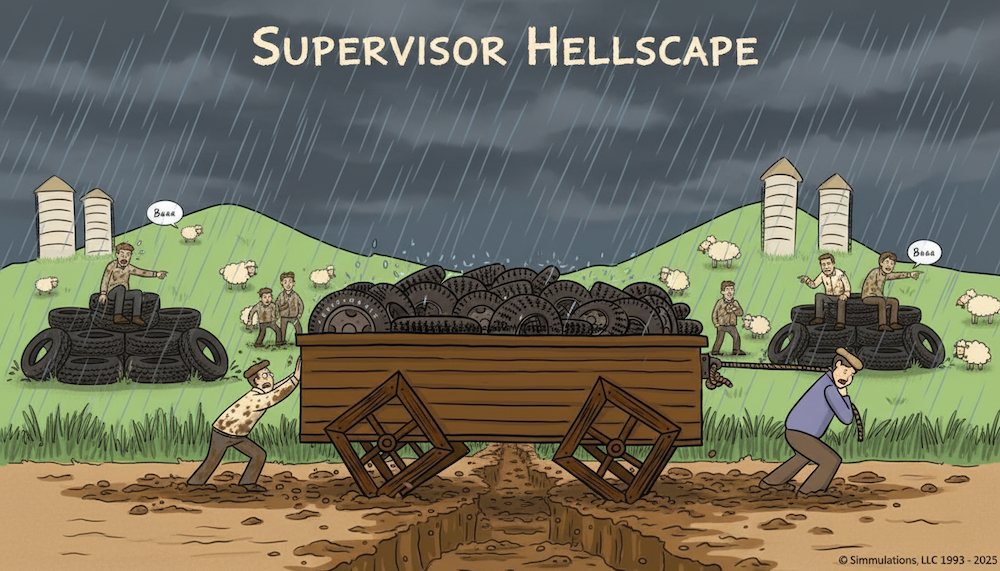
Here is my newest one
Some of my blogs that are loaded with statistics about how bad things are:
1. “It’s about your Supervisors, stupid!” (Jan 27, 2026)
2. “Supervisors Struggle Facilitating Engagement” (Jan 5, 2026)
3. “The Measurable Impacts of Great Supervisors” (Jan 28, 2026)
4. “Enablement of Supervisors and Performance” (Dec 27, 2025)
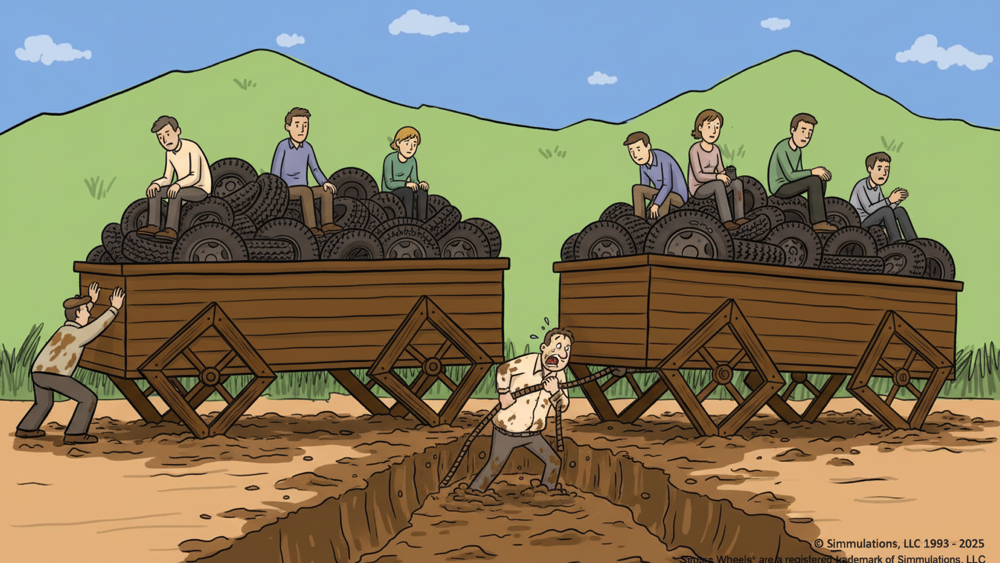
Not so bad, but the data say that 79% of workers are disengaged (Gallup, 2025)

Here, we add the disengaged Spectator Sheel to the disengaged employees and also the silos representing even more isolation.
A simple summary chart of the issues that I recently put together and added to the post. I leave it big because of the fine print:
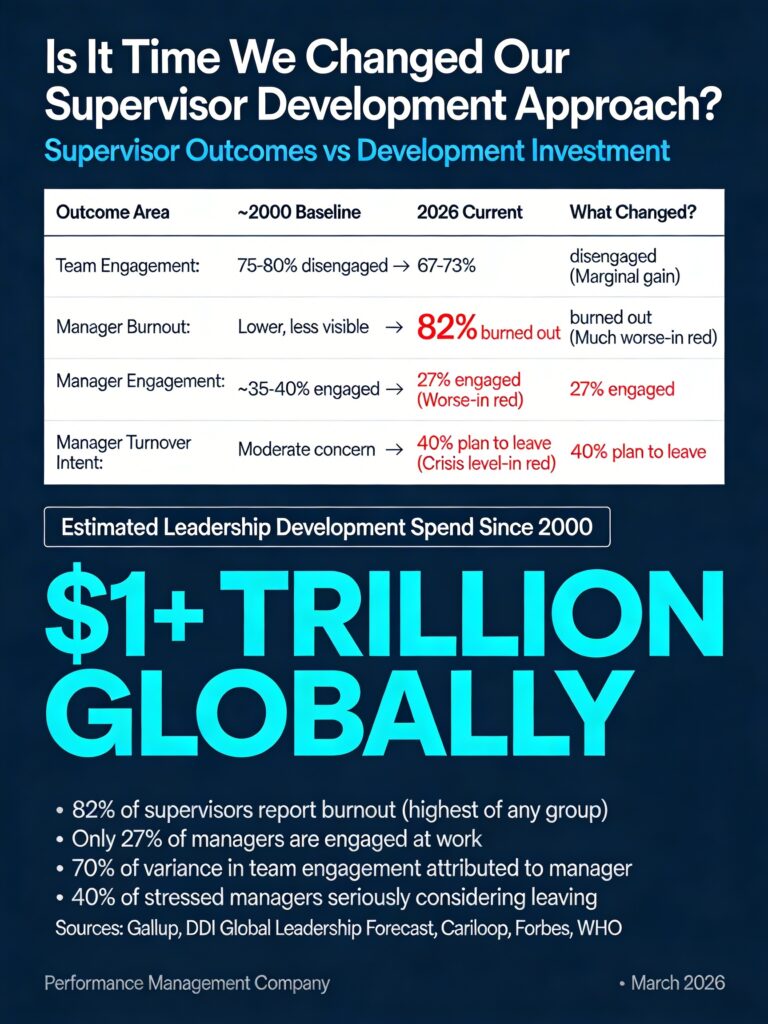
And here is an overview of some of the key points, with links to the data found in the above blogs, for the most part.
Core power-of-the-supervisor stats
-
Managers account for about 70% of the variance in team engagement scores, meaning the quality of the supervisor is the single biggest predictor of whether a team is engaged or disengaged.
-
Gallup’s decades of data show that engagement at the business‑unit level links strongly to higher profitability, productivity, customer ratings, quality, and lower turnover, absenteeism, safety incidents, and shrinkage.
-
In many organizations, only around one in three employees is engaged, leaving roughly two‑thirds partially or fully disengaged even before you look at the added risk of weak supervision.
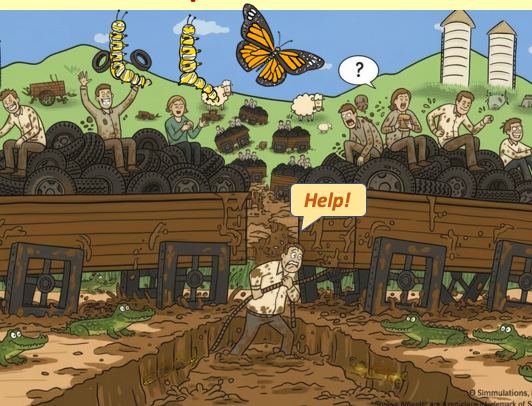
Here we add the call for help, along with some caterpillars and a butterfly. People say the butterfly represents either “Corporate Strategy” or the simple idea of Hope! It is just a cartoon…
Training and the “accidental manager” problem
-
Around 60% of new managers receive no formal leadership training and are left to “figure it out on the job,” often by repeating the same people‑management mistakes.
-
In a large UK study, 82% of leaders described themselves as “accidental managers” with no formal management training, and 28% of employees said they had left a job because of a negative relationship with their manager.
-
Related global studies echo that roughly 8 in 10 bosses are accidental managers, and a third of employees have quit at least one role due to poor management.
Engagement, culture, and risks created by supervisors
-
Employees working for untrained managers are 56% more likely to be disengaged, turning manager skill gaps into team‑level performance and retention problems.
-
Poor management is directly tied to lower motivation: in the UK study, 33% of employees said ineffective management made them less motivated to do their work.
-
Only about 10% of people placed into manager roles have strong natural talent for leading others, meaning most supervisor roles require real development, not just promotion.
Burnout and well-being in the supervisor layer
-
Managers are about 36% more likely to report burnout than individual contributors, and 24% more likely to say they are considering leaving their roles in the next six months.
-
Surveys show two‑thirds of managers say they struggle with heavy workloads, often spending up to three‑quarters of their day in meetings, leaving little time for coaching, problem‑solving, or engagement.
-
Effective managers can increase psychological safety by up to 42%, which is now recognized as a key buffer against stress, burnout, and turnover.
Your Higher‑Impact talking points
In your discussions about improving the Supervisor Hellscape, you can attribute these as your “framing lines,” backed by the stats above:
-
“Roughly 70% of the difference between a highly engaged and enabled team and a miserable one comes down to one thing: the person they report to.”
-
“We have built a world of accidental managers: more than 8 out of 10 bosses step into the role without formal training, and their teams pay the price in disengagement, low motivation and turnover.”
-
“Being a supervisor is now a health‑risk job category; managers are 36% more likely to burn out than the people they manage, and many are actively planning their exit.”
-
“If you want to move your engagement numbers, stop chasing perks and start enabling supervisors; they are the 70% lever hiding in plain sight.”
I wish people would USE the above realities about the Supervisor Hellscape to actually make improvements. It is about enabling them, for the most part. This is not about Big Training but about small engagements.
While we are playing with images, I had Perplexity generate this one about senior managers using the above image structure. Note that Oracle produced research that suggested that 70% of senior managers would prefer robots make their decisions. I have read that CEO resignations are at an all time high and even all the money is not sufficient to keep them contributing. They can also benefit with more support.
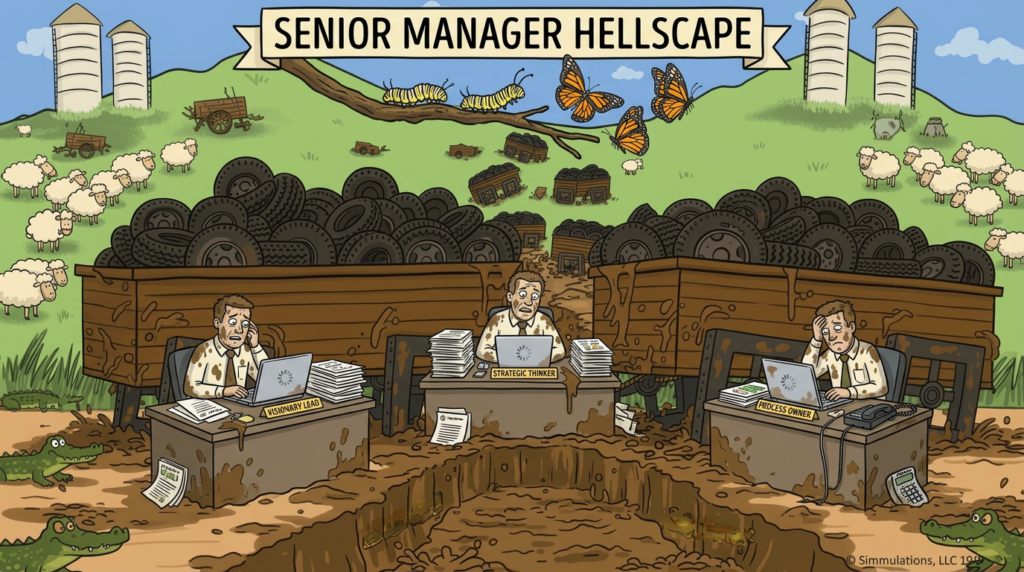
Senior managers also find themselves in a “Performance Improvement Hellscape,” even with all the training and support they get.
—
For the FUN of It!
 Dr. Scott Simmerman is a designer of team building games and organization improvement tools.
Managing Partner of Performance Management Company since 1984, he is an experienced presenter and consultant who is trying to retire!! He now lives in Cuenca, Ecuador.
You can reach Scott at scott@squarewheels.com
Learn more about Scott at his LinkedIn site.
Square Wheels® are a registered trademark of Simmulations, LLC
and images have been copyrighted since 1993,
© Simmulations, LLC 1993 – 2026
What I’m About:
My Square Wheels blog and website exist to help leaders, trainers, and facilitators make work smoother, more engaging, and more human. I focus on practical tools for process improvement, organizational change, and workplace collaboration that spark insight and deliver measurable results.
And I am convinced, after 30+ years of using Square Wheels®, that it is the best facilitation toolset in the world. One can use it to involve and engage people in designing workplace improvements and building engagement and collaboration. It is a unique metaphorical approach to performance improvement and we can easily license your organization to use these images and approaches.
By blending proven facilitation methods, creative problem-solving, and engaging team activities, my mission is to support organizations in building energized, sustainable cultures of involvement and innovation.
Through accessible — and often free — resources and virtual facilitation tools, I aim to help teams everywhere collaborate more effectively, innovate continuously, and take ownership of their improvement journey.
#SquareWheels #InnovationAtWork #TeamEngagement #FacilitationTools #WorkplaceImprovement #EmployeeEngagement #CreativeProblemSolving #OrganizationalDevelopment #LeadershipTools #collaboration #leadership #motivation #communications #enablement #leadership #CreativeCommons #enablingperformance #teamwork #supervisorhellscape #statisticsonworkplaces

0 Comments