
“Square Wheels, Round Wheels, and Real Commitment: Why Accountability and Contribution Are the Only Metrics That Matter” is the basic framework for these ideas herein.
The work of Greg Hawks is the basic framework for my ideas, from his article here:) Accountability and contribution are the visible “Square Wheels” of real commitment: if you can’t see people stepping up and adding value, you don’t actually have commitment; you only have compliance lip‑service with the expected non-result.
Square Wheels, Round Wheels, and the Myth of “Commitment”
Most organizations say they want buy-in. They run engagement surveys, launch culture campaigns, and plaster values on the walls. Yet performance is still uneven at best, collaboration is fragile, and people often do “just enough” when someone is watching.
And the Gallup (2025) data showing 79% worker disengagement can be really mind-numbing and frustrating, disconfirming all the efforts.
And even worse is the 70% supervisor disengagement — these highly influential people on your management team don’t care any more. Supervisors represent about one out of every 16 people in most organizations. Your disengaged supervisors are shaping the experience of everyone else.
In my Square Wheels® frame, leaders are pulling a heavy wagon with Square Wheels representing inefficient processes, fuzzy expectations, and inconsistent follow‑through while the round wheels of accountability and contribution are already in the wagon, unused. We do not have a commitment problem; we have a visibility and engagement problem. We are not focused on the right wheels.
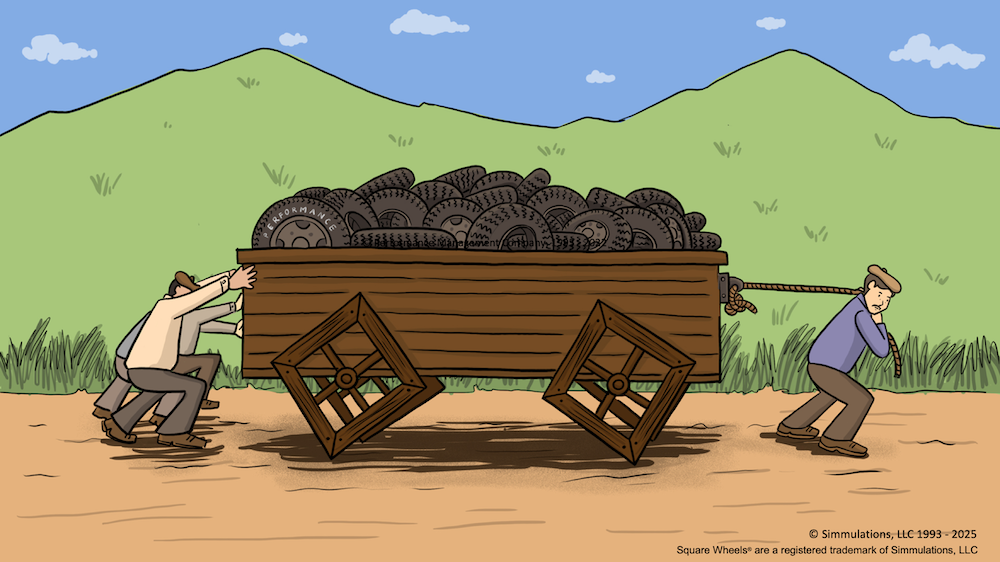
Commitment You Can See: Accountability and Contribution
Commitment is not a feeling; it is a pattern of behavior that shows up as consistent accountability and meaningful contribution to the team’s shared results.
You can “hear” commitment in a meeting, but you only measure it by what happens between meetings:
-
Do people do what they said they would do, by when they said they would do it?
-
Do they proactively surface problems and renegotiate commitments before a deadline, instead of after a miss?
-
Do they look for ways to add value beyond their job description, especially when nobody is watching?
- Do they work to get their people actively involved with helping to address the problem and discover opportunities for improvement?
Those behaviors are the Round Wheels. They are the metrics of commitment. No matter what people say, if accountability and contribution are missing, commitment is missing.
The Classic Square Wheels of “Accountability”
The word “accountability” triggers anxiety for a lot of employees because it has been misused as code for punishment. That misuse or people is one of the biggest Square Wheels in most organizations.
Here are three common Square Wheels around accountability:
-
Punitive focus. Accountability is framed as “Who messed up?” instead of “What did we learn and what will we do next?”
-
Leadership exemption. Senior people talk about accountability but do not model it themselves; they are not the ones reporting openly on missed commitments.
-
Vague expectations. People are “held accountable” for commitments that were never clearly defined in terms of outcomes, timeframes, and success metrics.
When accountability is experienced as surveillance and fear, you get compliance, not commitment. People will push the wagon as long as the boss is watching, then coast. That is a very expensive way to move a wagon.
A favorite story is the CEO who is sharing bullets for a new mission statement. One item for inclusion was, “We manage with uncompromising integrity.” Sharing these bullets with managers, one reframed the reality as, “We manipulate with inflexible righteousness.” Passing that up, that bullet was NOT included. And you can believe this story, because I was there when the comment was made. These gaps often exist and do you think this does not affect commitment?
Flipping the Wagon: From Compliance to Ownership
In a healthy Square Wheels conversation, we ask the wagon‑pushers and pullers a simple question: “What is getting in the way of making this wagon roll more smoothly?” Then we shut up and listen. Let them play with ideas.
When you do that around accountability and contribution, people will describe very specific round wheels they need:
-
Clear, shared commitments with explicit “who does what by when” and how we’ll know it’s done.
-
Regular, low‑drama progress check‑ins that surface problems early, focused on support rather than blame.
-
Reciprocal accountability—leaders report on their own commitments and invite challenge from the team.
-
Visible measures that show how each person’s work ties into team and organizational outcomes.
This flips the dynamic. Instead of leaders “holding people accountable,” teams begin to seek accountability because it helps them win. The wagon still has Square Wheels, but now everyone feels ownership for finding and installing the Round Wheels. Let people play with potential wheels for improvement and you will see change, but it will take time.
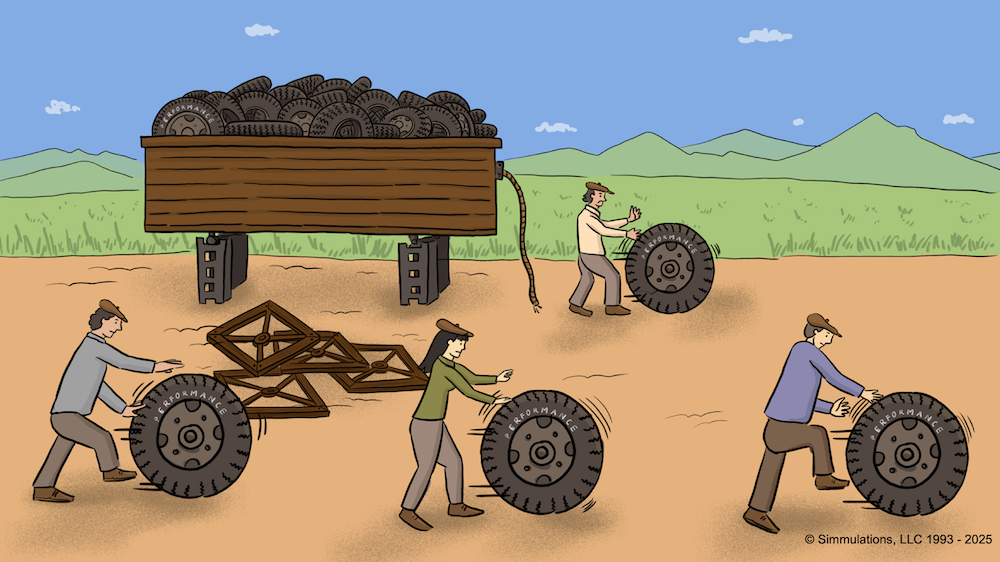
Playing with Round Wheel Ideas creates lots of cognitive dissonance about the Square Wheels
Making Accountability and Contribution your Real Metrics
You can start small, make some practical changes and make a big shift in how commitment shows up:
-
Redefine accountability in the team. In a meeting, ask: “When we say ‘accountable’ here, what do we actually mean?” Capture a short, behavior‑based definition that includes clarity of commitments, follow‑through, and honest explanation when things go off‑track.
-
Make commitments actionable and visible. End key meetings with a simple list: who, what, by when, and how we’ll measure success. Share it with the team so everyone sees the same wagon and the same wheels. Insure they have input to the list, and a feeling of active ownership involvement.
-
Normalize mid‑course corrections. Put a standard half‑way check‑in on critical commitments—not to micromanage, but to remove obstacles while there is still time to fix them. Treat early bad news as a contribution, not a failure.
-
Measure contribution, not just compliance. In 1‑1s and reviews, ask, “Where have you gone beyond your basic role to help the team succeed?” and “Where did you make it easier for someone else’s wagon to roll?”
-
Model it as a leader. Publicly track your own commitments and invite your team to ask you, “Did you do what you said you would do?” Wall the Talk. Nothing accelerates cultural change faster than visible, humble accountability to build engagement and trust over time.
When you consistently look at accountability and contribution as your primary metrics of commitment, the conversation around engagement changes. People feel less inspected and more involved. The energy shifts from “How do we get people to care?” to “How do we remove the Square Wheels so people can contribute at the level they already want to?” “How do we implement improvements?”

Bringing It Back to Square Wheels / round wheels
Every team, everywhere in the world, is pushing and pulling some version of a Square Wheels wagon. The irony is that the round wheels of accountability and contribution are almost always already in the wagon.

Your job as a leader is not to install commitment into people. Your job is to:
-
Make accountability safe, specific, and mutual.
-
Make contribution visible, valued, and tied to real outcomes.
-
Use simple, shared images and conversations to help people discover and install their own round wheels.
When you do these kinds of things, you do not have to wonder who is “really committed.” You can see it, measure it, and build on it—one smoother‑rolling wagon at a time. Things will rock and roll and the culture will feel very different,
—
For the FUN of It!
 Dr. Scott Simmerman is a designer of team building games and organization improvement tools.
Managing Partner of Performance Management Company since 1984, he is an experienced presenter and consultant who is trying to retire!! He now lives in Cuenca, Ecuador.
You can reach Scott at scott@squarewheels.com
Learn more about Scott at his LinkedIn site.
Square Wheels® are a registered trademark of Simmulations, LLC
and images have been copyrighted since 1993,
© Simmulations, LLC 1993 – 2026
What I’m About:
My Square Wheels blog and website exist to help leaders, trainers, and facilitators make work smoother, more engaging, and more human. I focus on practical tools for process improvement, organizational change, and workplace collaboration that spark insight and deliver measurable results.
And I am convinced, after 30+ years of using Square Wheels®, that it is the best facilitation toolset in the world. One can use it to involve and engage people in designing workplace improvements and building engagement and collaboration. It is a unique metaphorical approach to performance improvement and we can easily license your organization to use these images and approaches.
By blending proven facilitation methods, creative problem-solving, and engaging team activities, my mission is to support organizations in building energized, sustainable cultures of involvement and innovation.
Through accessible — and often free — resources and virtual facilitation tools, I aim to help teams everywhere collaborate more effectively, innovate continuously, and take ownership of their improvement journey.
#SquareWheels #InnovationAtWork #TeamEngagement #FacilitationTools #WorkplaceImprovement #EmployeeEngagement #CreativeProblemSolving #OrganizationalDevelopment #LeadershipTools #collaboration #leadership #motivation #communications #enablement #leadership #CreativeCommons #enablingperformance #teamwork




0 Comments