
Engagement is at its lowest level in years, but Gallup also recognizes that some companies are doing engagement much better. What are they doing differently? And what are the impacts?
Gallup signals who the high‑engagement outliers are through its separate Gallup Exceptional Workplace Award (GEWA) list and through its descriptions of what these organizations do differently. These organizations PROVE that leadership can do things to align and actively involve their people in their performance initiatives. Needless to say, engaged employees are HIGHLY profitable in the moves to generate short-term and long-term performance.
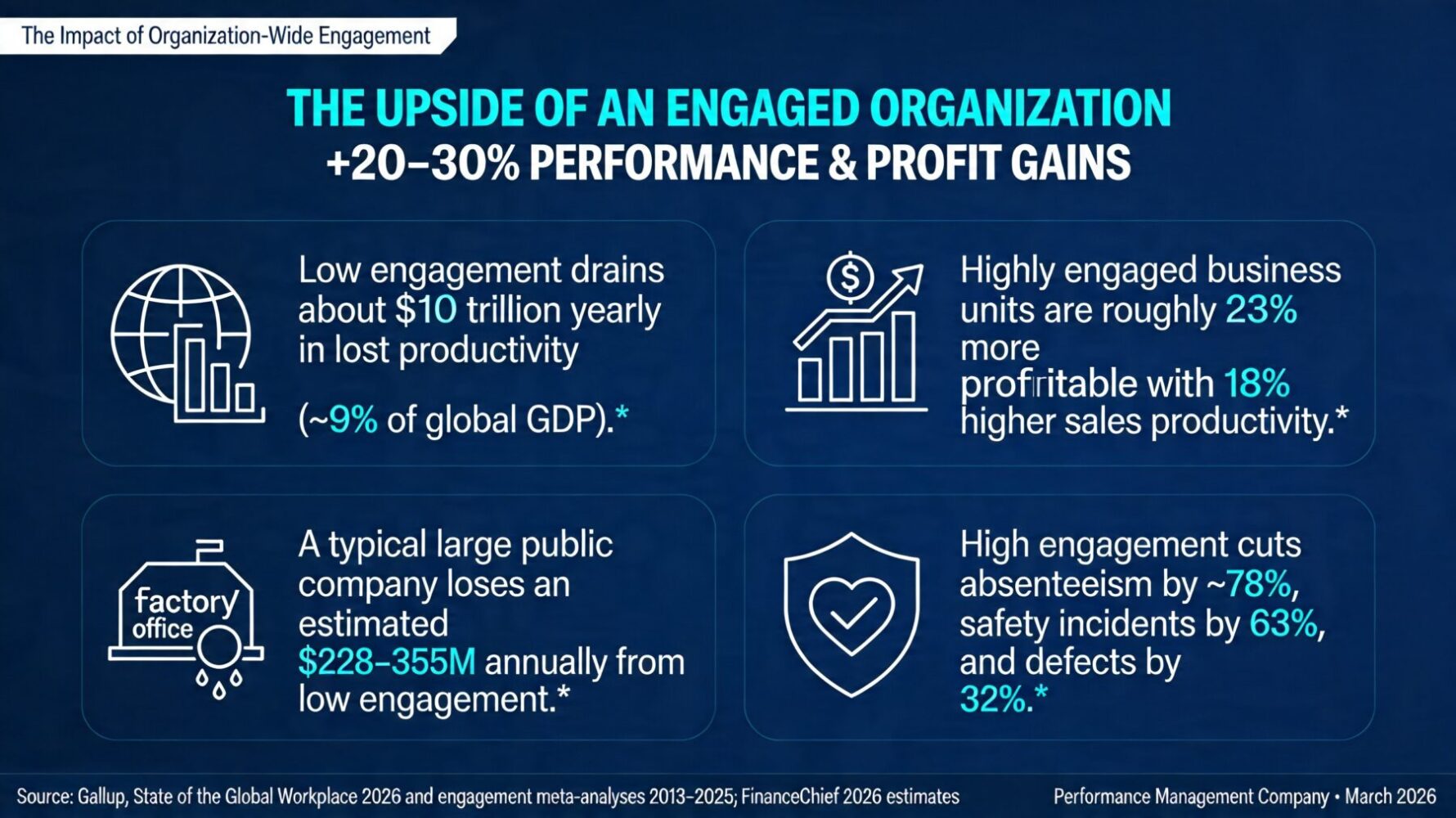
I’ll leave the deep analysis of the impacts to others, or maybe another blog, but below is an overview and these are nothing new; we have measured these metrics for decades.
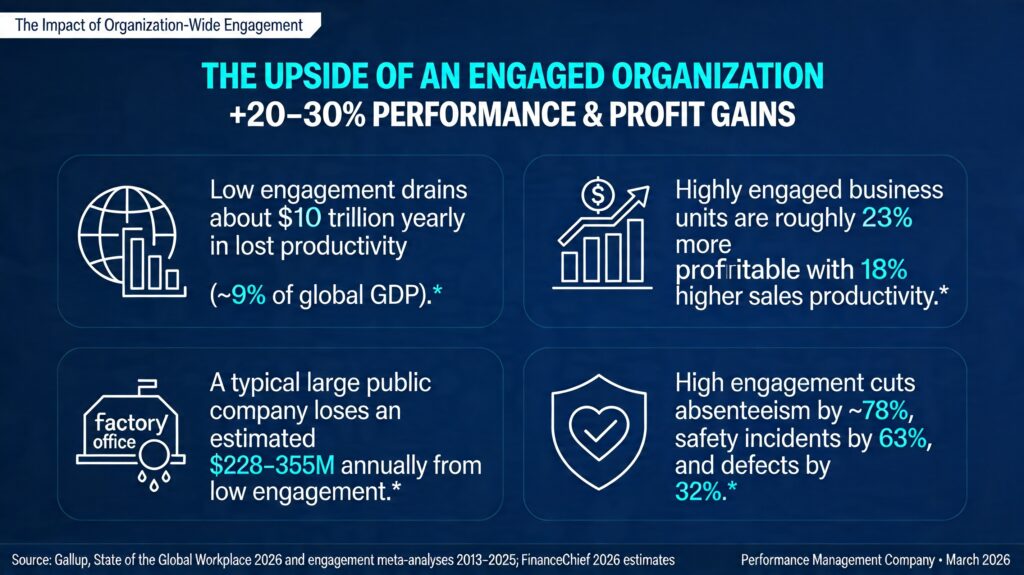
Who doesn’t want more profitability or performance improvement with less absenteeism and employee turnover? Who can’t improve active involvement in the workplace?
Who are the “good engagement” companies?
Gallup does not publish engagement scores for firms in its State of the Global Workplace report, but it does publicly name organizations winning the 2026 Gallup Exceptional Workplace Award, which is its benchmark group for consistently high engagement. The 2026 press release says there are 93 winning organizations worldwide (78 for engagement, 21 for strengths development, 5 with special distinction)..
From the public announcement, the main facts are:
-
93 organizations worldwide received the 2026 Gallup Exceptional Workplace Award.
-
78 of these are explicitly recognized for exceptional employee engagement (top‑quartile business units over time).
-
These companies span multiple regions and industries and are used as the “positive deviance” comparison group in Gallup’s meta‑analysis of engagement and performance.
- The five with Special Distinction have performed at this high level for a minimum of 3 years and often with more.
What these high‑engagement organizations are doing differently
Even though the 2026 detailed workplace article is about the decline since last year, it repeatedly contrasts the global slump with what the best organizations and teams do differently. Across the 2026 report and Gallup’s current guidance, high‑engagement firms differ on five practical fronts:
-
They treat engagement as a manager‑led, team‑level discipline.
-
Gallup emphasizes that engagement is built “where it matters most” – in the relationship between managers and their teams, not in one‑off corporate programs or other normal fluff. It is about commitment.
-
In 2026, the decline is sharpest among managers; Gallup notes that some organizations still manage to engage their managers at “four times the global average,” and those organizations are the ones sustaining high engagement and performance.
- Globally, it is a Supervisor Hellscape, which I elaborate more on here.
-
-
They select, train, and support managers deliberately.
-
The article’s primary prescription to counter the slump is to “prioritize manager selection, training and support,” framing managers as the critical leverage point for both engagement and AI adoption. Understand that the supervisors manage the workers who are doing all of the actual work of the organization.
-
Separate Gallup guidance for 2026 highlights three manager behaviors most correlated with engagement: clarifying expectations, ongoing coaching conversations, and regular recognition. These are really not all that difficult to accomplish if one is focused on them, organizationally.
-
-
They create clear expectations and meaningful work.
-
Gallup notes that in its 2025 data “less than half of employees (47%) strongly agree they know what is expected of them at work,” positioning clear expectations as a foundational element that top organizations get right.
-
High‑engagement teams show much higher rates of people who strongly agree they can do what they do best every day and that their work connects to the organization’s mission. They operate in alignment with those goals and expectations. And so do their front-line managers.
-
-
They build cultures that buffer disruption (including AI).
-
Gallup’s 2026 commentary stresses that high‑engagement organizations are better able to “weather disruption and change, such as with AI,” and that in AI‑implementing firms, manager behavior is the strongest predictor of employee AI use.
-
In sectors like finance, insurance and technology, roughly a third of employees see it as somewhat or very likely their jobs could be eliminated by AI in five years; organizations with strong engagement are using managers and communication to address this anxiety and channel AI into productivity, not fear.
-
-
They systematize engagement and strengths as business levers.
-
The GEWA description notes that winners “prioritize employee engagement and strengths development,” investing in their people to enhance performance, growth and the employee experience.
-
Gallup’s latest meta‑analysis (which draws heavily on these high‑engagement units) shows that top‑quartile teams have substantially better outcomes: higher profitability and productivity, lower absenteeism, turnover, safety incidents, defects, and shrinkage.
-
Here is a very compact way you might articulate this in your own performance improvement efforts:
-
Most companies are talking about engagement; the top few percent are running it as a core operating system at the team level – through who they promote to manager, how they coach, how clearly they set expectations, how they enable their people to make decisions and how consistently they connect daily work to purpose and performance.
Here are the 2026 Engagement Winners:
44 of the organizations are U.S.-based companies or institutions.
Here is the thing: If these organizations can generate high levels of engagement, ask yourself why you cannot involve and engage YOUR people to strive to improve your workplaces? Doesn’t this sound like a high impact and achievable goal?
Sidebar: I remember the good old days of the Quality Improvement Initiatives and where Milliken & Company, a textile manufacturer right up the road from me in Spartanburg SC won the first, 1989 Baldrige Award. Man, their people were incredibly proud of that accomplishment and it supported the reality that Roger Milliken was doing what he talked about doing for decades: he cared for his people and his company. I had friends there and we did some tours and they all said that they were NOT perfect, but everyone really strived to do things right. I attended a couple of their staff meetings. Milliken was formally and internationally recognized for transforming quality into a strategic, company‑wide system rather than a narrow inspection program. Ethisphere has named Milliken one of the “World’s Most Ethical Companies” every year since the list began in 2007, reaching 20 consecutive years in 2026; only a handful of firms have matched that run.
Why doesn’t YOUR organization make some kind of commitment to doing employee engagement and enablement right?
—
For the FUN of It!
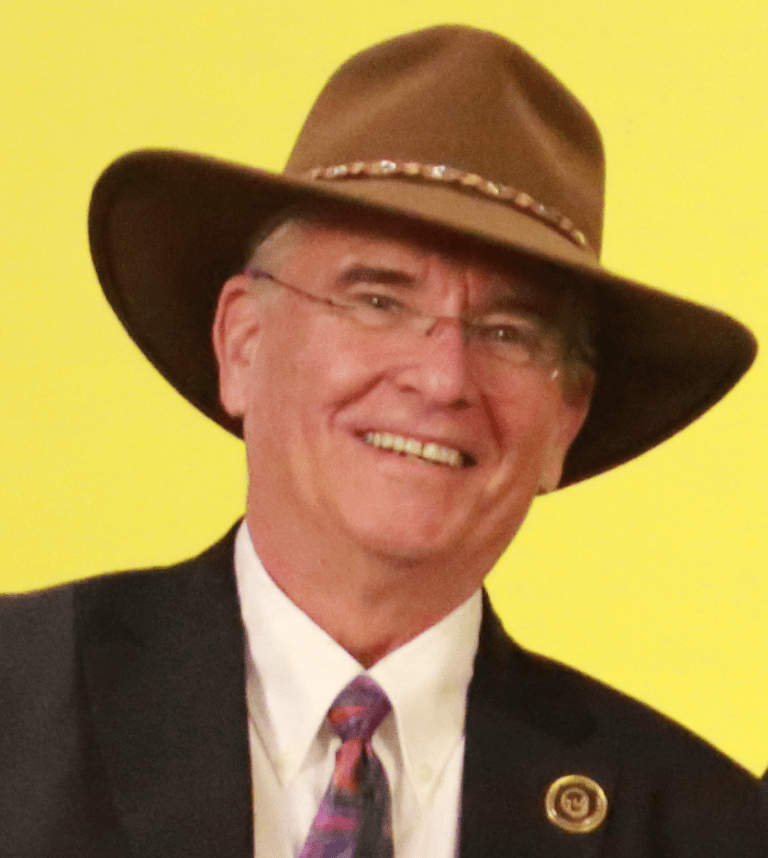 Dr. Scott Simmerman is a designer of team building games and organization improvement tools.
Managing Partner of Performance Management Company since 1984, he is an experienced presenter and consultant who is trying to retire!! He now lives in Cuenca, Ecuador.
You can reach Scott at scott@squarewheels.com
Learn more about Scott at his LinkedIn site.
Note that I often use Perplexity AI to help research and generate ideas for my posts.
Square Wheels® are a registered trademark of Simmulations, LLC
and images have been copyrighted since 1993,
© Simmulations, LLC 1993 – 2026
What I’m About:
My Square Wheels blog and website exist to help leaders, trainers, and facilitators make work smoother, more engaging, and more human. I focus on practical tools for process improvement, organizational change, and workplace collaboration that spark insight and deliver measurable results.
And I am convinced, after 30+ years of using Square Wheels®, that it is the best facilitation toolset in the world. One can use it to involve and engage people in designing workplace improvements and building engagement and collaboration. It is a unique metaphorical approach to performance improvement and we can easily license your organization to use these images and approaches.
By blending proven facilitation methods, creative problem-solving, and engaging team activities, my mission is to support organizations in building energized, sustainable cultures of involvement and innovation.
Through accessible — and often free — resources and virtual facilitation tools, I aim to help teams everywhere collaborate more effectively, innovate continuously, and take ownership of their improvement journey.
#SquareWheels #InnovationAtWork #TeamEngagement #FacilitationTools #WorkplaceImprovement #EmployeeEngagement #CreativeProblemSolving #OrganizationalDevelopment #LeadershipTools #collaboration #leadership #motivation #communications #enablement #leadership #CreativeCommons #enablingperformance #teamwork #storytelling #storyasking



0 Comments