
Moving from Square Wheels to Smart Wheels: Using AI to rebuild your organization to impact operations and enable people and performance.
Organizations have been rolling forward for two thousand years on some version of the same wagon: hierarchy as the information‑routing and control mechanism.
In that time, we changed uniforms, industries, buzzwords and technologies and have renamed so many things, but the core design of how we manage people and performance barely moved. The Roman contubernium, the Prussian General Staff, the railroad org chart, the functional pyramid, the matrix organization; each was an incremental adjustment to the same Square Wheel wagon we have been using: humans in layers pushing information up and down the chain of command.
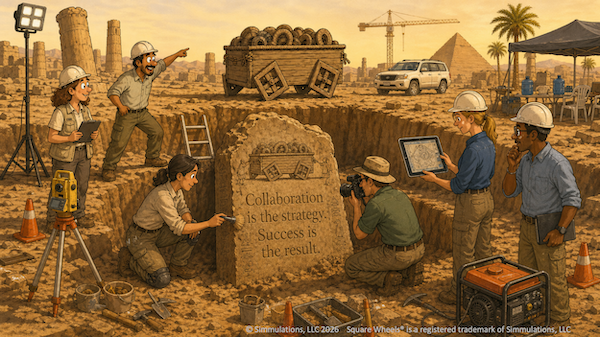
For thousands of years, we have managed things the same way. Ai offers us some new tools for change. Doing things the same way will not help us improve.
AI gives us the first serious alternative to that basic design around how things work.
And that is also where my Square Wheels images and metaphors about people and performance can become a practical bridge to improving communications and engaging people, not just a metaphor. Used in discussions, Square Wheels themes can help everyone see the limitations of their current wagon, imagine new “round wheels” built on AI and data, and engage and enable their people in co‑creating smarter, faster, more humane organizations.
That old wagon: hierarchy as protocol
In their excellent post about what is happening with AI and the Block company, Jack Dorsey and Roelof Botha describe hierarchy as an “information routing protocol” born from a simple human constraint: a leader can effectively manage only a small number of people. Over centuries, we turned that into nested layers—spans of control of 5 to 8 people, line management and staff support functions, operational silos, global management matrices and so on.
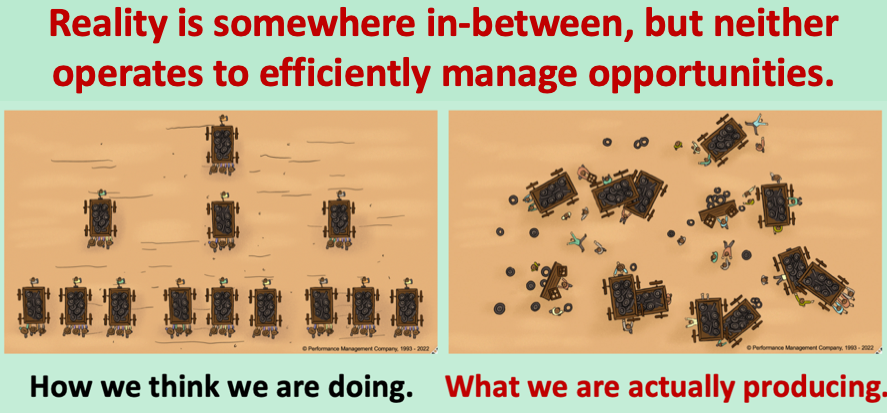
That protocol works, but slowly and with great overall cost. Each added layer adds friction, distortion, and delay. By the time a customer issue, production problem, or market signal gets from the edge to the center and back, some opportunity has often evaporated. We have been slowly rolling forward, but on Square Wheels and often in the mud and uphill with so many impacts on actual performance and innovation and quality.
The job of middle management has largely been to collect information from below, filter it, pass it up, get decisions, and push them back down with little actual value being added. AI will change that dynamic.
Improving communications around business practices can change. Ai can give us very effective tools tor focusing on transactions and opportunities. It can do data analysis so much faster and disseminate actionable information much more rapidly to enable better responsiveness throughout the organization. Things can happen quickly.
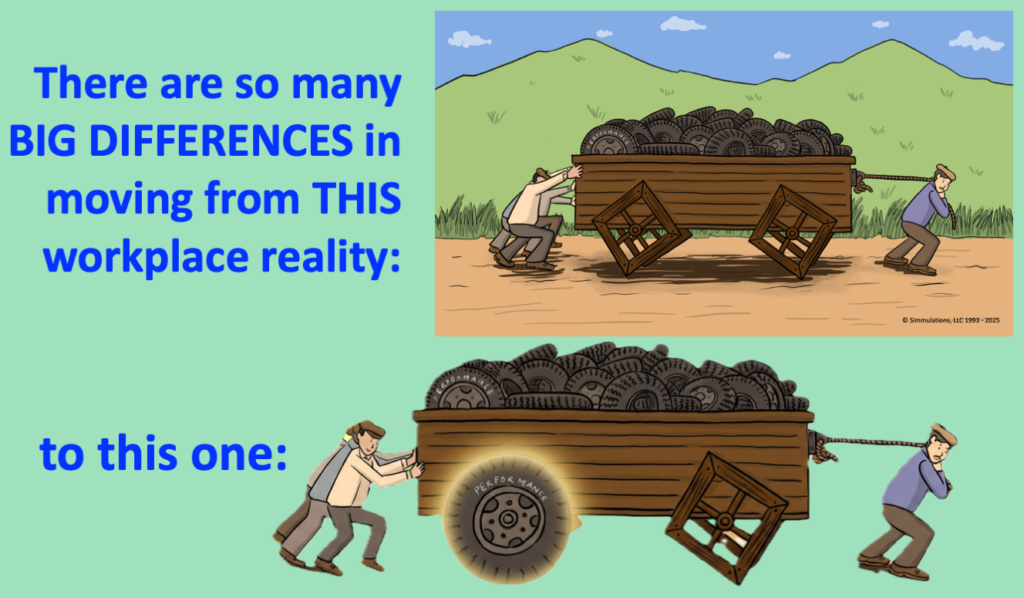
Square Wheels® tools and metaphors capture this reality beautifully: a wagon rolling on Square Wheels being pushed and pulled by people who are working hard but not working smart. They are too busy pushing to stop and improve the wagon. The round wheels, those existing better processes, tools and structures are literally “already in the wagon,” but they are not in use. People tolerate the thump‑thump‑thump of the roll because “that’s how it has always been” and “that is how we expect things to work.”

Continuous unimprovement, and customers can feel every thump and bump in their journey without understanding the functioning of the systems and processes.
The Block article reframes this improvement opportunity: the thumping is not just bad process; it is the noise of an obsolete information‑routing system. The real opportunity is not marginally smoother Square Wheels in operation, but looking at a fundamentally different way to coordinate work differently. AI offers us that alternative..
From hierarchy to intelligence: AI as the new round wheel
What is different now is not just that AI can summarize documents or write code. It is that AI can maintain a continuously updated model of the whole business and its transactions and use this data to coordinate work in ways that used to require multiple layers of managers.
AI can maintain a continuously updating model of the whole business and use that data to coordinate work in ways that used to require multiple layers of managers.
Think of this as installing round wheels on the wagons and having a stream engine pulling things faster forward, instead of throwing more people at the back to push harder.
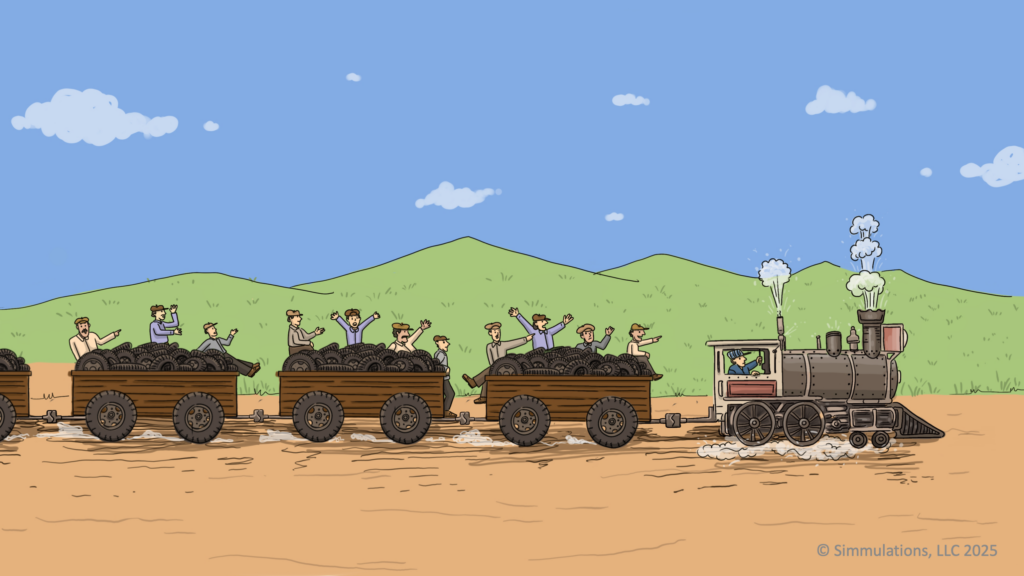
AI is the engine of making real progress, freeing up people to do more valuable things.
Jack Dorsey and Roelof Botha’s framing of the workplace is helpful here:
-
A company-world model that knows what’s being built, what’s blocked, where resources are deployed, and how work is progressing. The round wheels are everywhere and there are many thousands of wagons that need improvement. There are multiple project management tools available to more people.
-
A customer-world model built from real transactions, a truthful, continuously evolving picture of how customers and merchants actually behave, not what they say on surveys or interviews. We capture and act on actual transactions quickly and seamlessly.
-
An intelligence layer that composes the many different solutions from capabilities (payments, lending, payroll, etc.) and other tools and which delivers them at exactly the right time, through various interfaces.
In this setup, the system carries much of the coordination load than those middle managers. People at the edge (individual contributors, directly responsible individuals, player‑coaches) see the same rich context and can act without waiting weeks for decisions to percolate through a hierarchy. And change, innovation and improvement almost always comes from the edges of organizations. Plus, we gain momentum to implement new ideas and generate real change.
In other words, AI and data become the new round wheels for information flow and decision-making. They make it possible to move away from hierarchy‑as‑protocol organizational designs while still maintaining alignment, speed, and control.
Where Square Wheels® tools fit: the human gateway to AI
Most organizations are not ready to “flip a switch” and operate as a mini‑AGI. The technology is racing ahead; the culture and leadership practices are not. This is where Square Wheels is uniquely powerful.
The images are not about technology; they are about “stepping back from the wagon. Improvement is about three human capabilities that are prerequisites for any AI‑enabled transformation:
Seeing reality clearly.
People need a safe way to talk about what is not working—the square wheels—without blame and defensiveness. The cartoons and metaphors give them that language.
Owning improvement.
The core idea is that “the round wheels are already in the wagon.” People closest to the work know where the data lives, what tools exist, and which ideas never get implemented. Square Wheels sessions surface this local knowledge.
Designing better ways to roll.
The magic is not just in identifying problems. It is in having participants generate, prioritize, and test better ways of working together, which is exactly the mindset needed to co‑design new AI‑supported workflows.
If you want AI to actually change how work gets done, rather than just add some dashboards and copilots on top of the same old hierarchy, you need people to think differently about the journey. Square Wheels gives you an accessible, visual and clear way to start that conversation before you ever mention algorithms or models.
Practical uses: Square Wheels as a vehicle for AI
Here are some concrete ways to connect the metaphor to implementation. Note that the images and metaphors embedded in the tools are simply communications devices designed to involve and engage people in any change initiative, something useful in getting our new processes and procedures to be better accepted. Active involvement and ownership greatly reduce resistance to change. Doing thing with people is very measurably better than the perception we are doing things TO them.
1. Map the current “information wagon” and how things really work
In a session, ask groups to draw or annotate their own version of the Square Wheels wagon, but specifically focused on information flow and decision‑making. This is obviously something you will customize to your own situation. A suggested flow might look like this:
-
Who are the wagon pushers shoveling data into reports and systems?
-
Who is at the front of things, trying to steer and direct, but with limited visibility?
-
Where do reports, approvals, and escalations thump along on Square Wheels?
Then ask: “If AI and better data infrastructure were our new round wheels, where would we most want to smooth the ride?”
This immediately ties abstract AI talk to very concrete pain points: status reporting, forecasting, resourcing, customer response times, compliance, and so on. Work this data and process this information so that everyone can see the issues and opportunities.
2. Identify the round wheels already in the wagon
Most organizations already have:
-
Large volumes of digital work artifacts (tickets, emails, chats, documents).
-
Operational and customer data spread across systems.
-
Existing analytics tools, bots, and rule engines nobody fully uses.
3. Use the Square Wheels images and framework to ask:
-
Which of these tools and datasets are our potential “round wheels” for a company world model?
-
What would it take to connect them so we actually see the whole wagon?
-
Where are the cultural or structural square wheels (silos, turf wars, lack of trust) that keep us from using them?
- How would we feel if we were able to generate successes that generated improvements?
This positions AI not as something new you buy, but as a way to finally use the good ideas and capabilities you already have. Use the AI to identify the Square Wheels and identify the round wheels and to impact the reality of how things work in the workplaces. Focus on continuous continuous improvement and rapid problem identification and action.
4. Redesign roles at the edges because that is where the action is

Use the classic Square Wheels image of the View from The Front and the View from The Back to share the communications issues of how the people at the back can’t see the front, and the person at the front can’t see what’s happening behind. Then introduce the Block‑style roles:
-
Individual contributors as deep specialists who now see the same world model as their leaders.
-
Directly Responsible Individuals who take temporary ownership of cross‑cutting problems (e.g., “reduce onboarding friction by 30% in this segment over 90 days”) and can pull resources from anywhere.
-
Player‑coaches who spend more time building and coaching, and less time in status meetings. Help them to focus on performance improvement and generating ideas for innovation and service quality improvement, among other frameworks.
Ask: “If an AI‑driven world model could give everyone shared context, how would we redraw our wagon? Who should own which problems? What could we stop doing?” This narrows the gap between the metaphor and org design. And we will note that the old structures may not be the optimal ones. Make AI seem more like a tool for improvement than some hammer of negativity.
5. Build an experiment / innovation backlog from failure signals
In the Block model, when the intelligence layer can’t compose a solution because a capability is missing, that gap becomes the roadmap. Similarly, in your workplaces:
-
Capture every “we can’t do X today because…” as a potential AI or data opportunity.
-
Cluster these into experiments: where could a model, a workflow automation, or a better interface eliminate a specific Square Wheel we have identified? “What other Square Wheels are now more obvious?”
-
Prioritize by impact on speed, quality, and people’s daily frustration.
This turns the Square Wheels conversation into a living backlog of AI‑enabled process improvement and role experiments that we choose to attempt and that are always positive in their intention.
Keeping people and performance at the center of things
The risk with any technology wave is that organizations use it mainly to cut cost. “AI as headcount reduction” is the cheapest common narrative and the least strategic. It also generates real fear among the employees because of possible negative impacts on employment. It is detrimental to innovation and engagement and can generate any number of negative side effects or even sabotage.
Square Wheels wrapped around using AI for organizational improvement offers a different real storyline:
-
The goal is not fewer people; it is fewer Square Wheels and a more responsive organization. We focus on systems and process that need improvement without the blame often tied to individuals.
-
The aim is to move intelligence from scattered, siloed, and slow patterns filtered by middle management into shared, visible, and fast patterns so that more people are more able to do more higher‑value work.
-
AI becomes the mechanism for better information flow and smarter coordination, while humans stay accountable for judgment, ethics, trust, and culture.
In our story above, AI does not replace leaders;
it just forces them to lead differently.
Leaders must step away from the wagon, look at the whole system, and invite their people into the redesign of how work happens. They must champion psychological safety so that people can talk honestly about the many things that do not work smoothly. And everyone must be willing to let go of the comforting noise of hierarchy in favor of the quieter hum of intelligence and action.

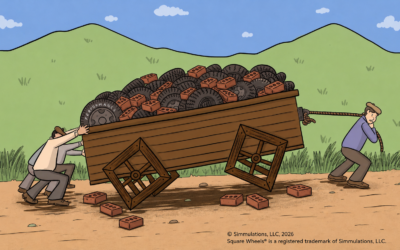
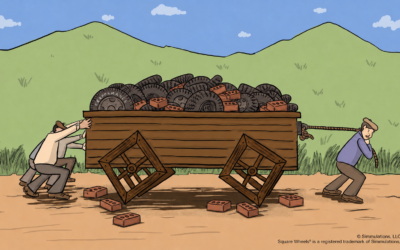
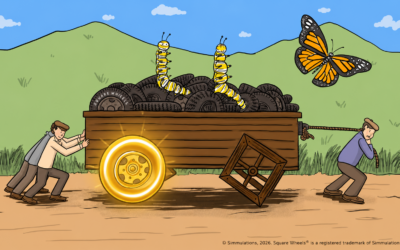
Here is the evolution of the images since 1993…
For me, Square Wheels started as one simple cartoon about a wagon and some thumpy bumpy wheels with the visual potential for improvement. In the age of AI, it is fast evolving to become something more: a shared language and process for helping individuals and organizations move from hierarchy to intelligence and doing this deliberately, humanely, and with a relentless focus on people and performance.
Addendum
I used Perplexity to help me create this other image, remembering that AI is a useful tool:
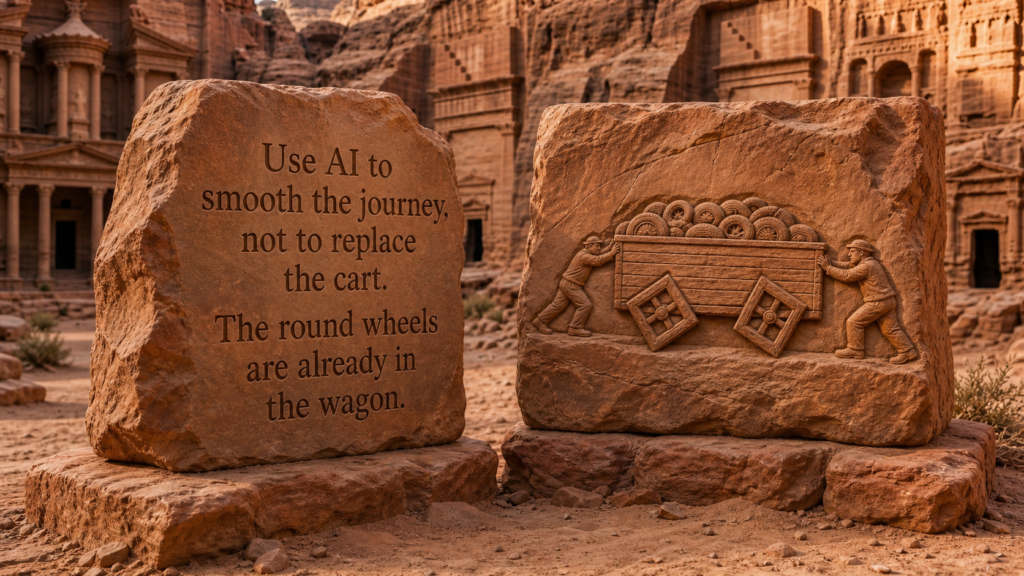
This is a good message, right? AI is a tool we can use for improvement.
Read a related article on generating workplace flow here.
—
For the FUN of It!
 Dr. Scott Simmerman is a designer of team building games and organization improvement tools.
Managing Partner of Performance Management Company since 1984, he is an experienced presenter and consultant who is trying to retire!! He now lives in Cuenca, Ecuador.
You can reach Scott at scott@squarewheels.com
Learn more about Scott at his LinkedIn site.
Note that I often use Perplexity AI to help research and generate ideas for my posts.
Square Wheels® are a registered trademark of Simmulations, LLC
and images have been copyrighted since 1993,
© Simmulations, LLC 1993 – 2026
What I’m About:
My Square Wheels blog and website exist to help leaders, trainers, and facilitators make work smoother, more engaging, and more human. I focus on practical tools for process improvement, organizational change, and workplace collaboration that spark insight and deliver measurable results.
And I am convinced, after 30+ years of using Square Wheels®, that it is the best facilitation toolset in the world. One can use it to involve and engage people in designing workplace improvements and building engagement and collaboration. It is a unique metaphorical approach to performance improvement and we can easily license your organization to use these images and approaches.
By blending proven facilitation methods, creative problem-solving, and engaging team activities, my mission is to support organizations in building energized, sustainable cultures of involvement and innovation.
Through accessible — and often free — resources and virtual facilitation tools, I aim to help teams everywhere collaborate more effectively, innovate continuously, and take ownership of their improvement journey.
#SquareWheels #InnovationAtWork #TeamEngagement #FacilitationTools #WorkplaceImprovement #EmployeeEngagement #CreativeProblemSolving #OrganizationalDevelopment #LeadershipTools #collaboration #leadership #motivation #communications #enablement #leadership #CreativeCommons #enablingperformance #teamwork #storytelling #storyasking

0 Comments