
Coaching with Square Wheels: turning research into everyday performance improvement with some simple tools and engaging facilitation.
Coaching has certainly gone mainstream, but in many organizations it still feels fuzzy, slow, or disconnected from day‑to‑day work. Managers and supervisors are told to “coach more,” some are sent to coaching training programs, and HR builds coaching frameworks into its performance appraisal systems but the actual impact on performance and engagement can be hit or miss (and looking at workplace statistics, mostly miss). There are good studies showing that there are impacts, though. So, DO IT!
Over the past decade, the research has gotten much clearer: well‑designed workplace coaching reliably improves skills, well‑being, and work attitudes, with moderate, meaningful effect sizes across multiple outcome categories. That means coached people don’t just “feel heard”; they actually perform better, cope better, and stay more engaged.
The question here is: how do we make that science around people and performance simple, visual, and actionable for the average manager and team?
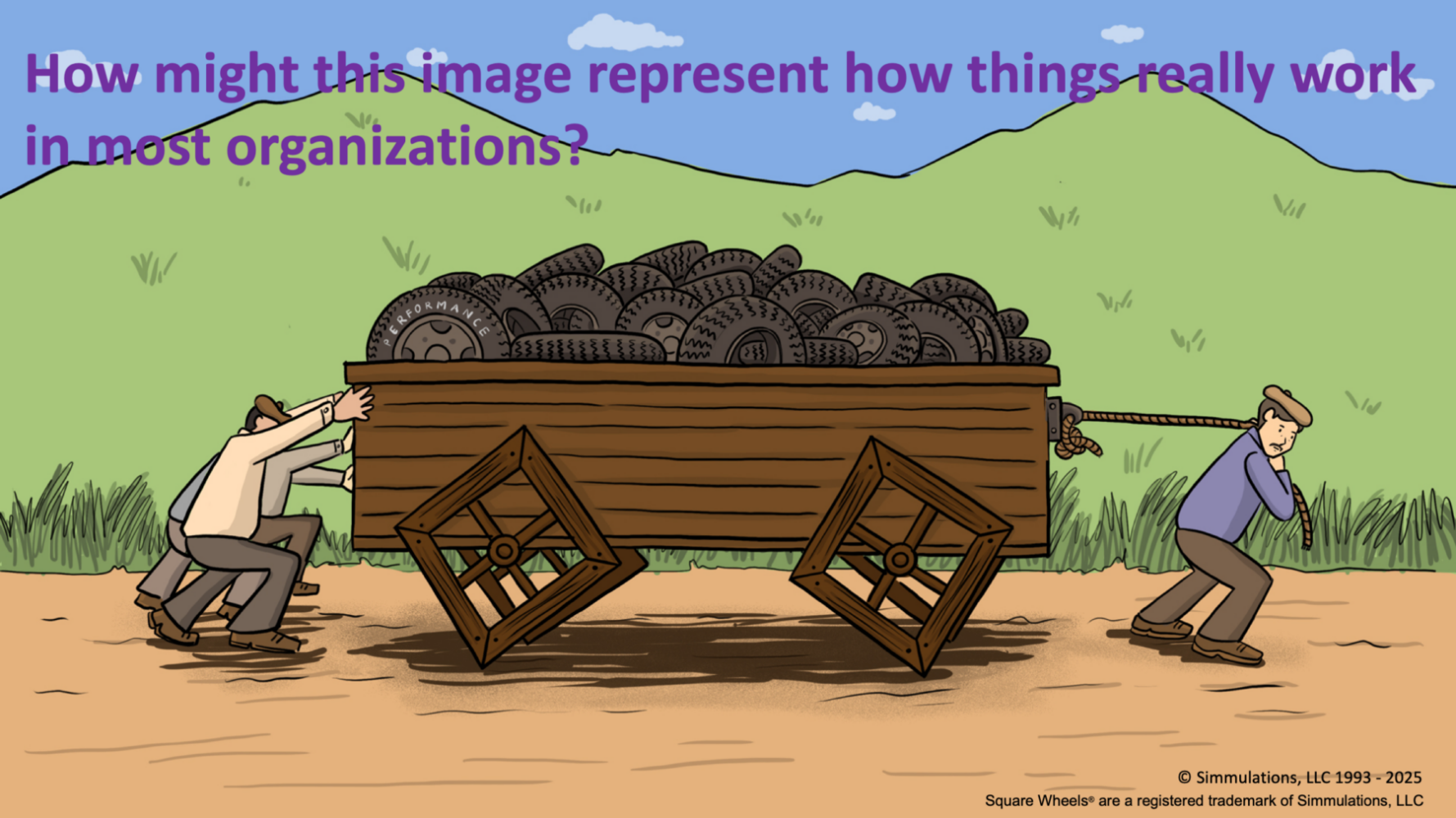
That’s where the Square Wheels® metaphor rolls in so nicely.
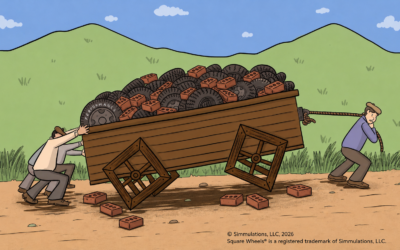
If you’re not familiar with Square Wheels® One, here you go. And note that you can get the image for your use for FREE!!!
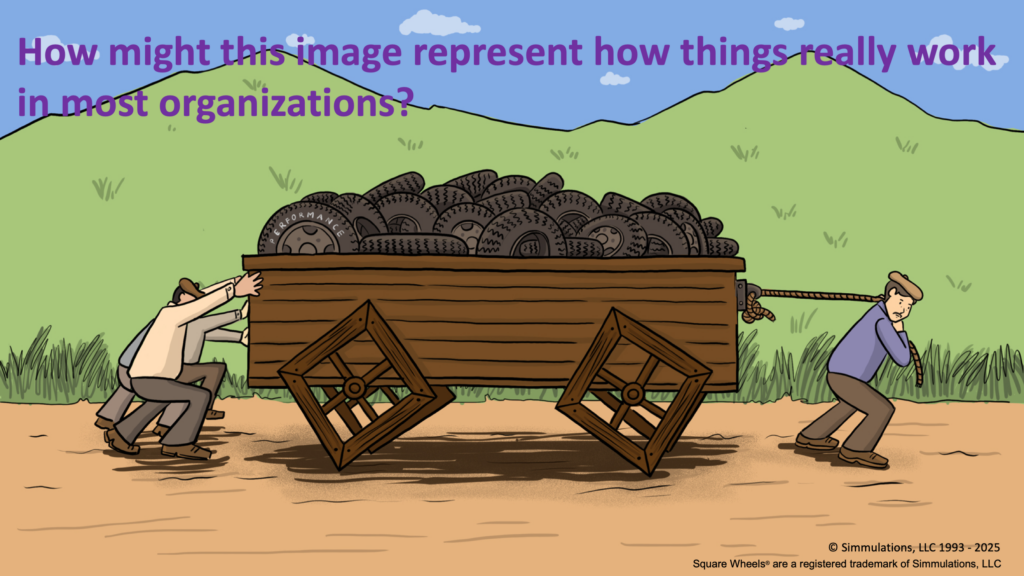
DO take a moment to actually look and consider the image above and to consider the question.
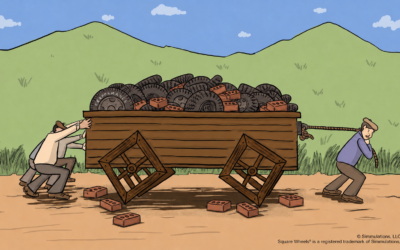
But since most people won’t just read on. Picture this: a wagon loaded with round rubber tires being pulled and pushed, but rolling along on wooden Square Wheels. It’s a funny little image—until people start talking about it. Then it becomes a mirror, a way to easily reflect on the reality of the workplace, the isolation of the wagon puller and the wagon pushers and the reality that everyone (even the readers!) are too busy pushing and pulling to do something differently.
In this post, I’ll connect what some recent coaching research says works with how you can use a simple Square Wheels image to coach individuals, teams, and even whole organizations toward better performance and higher engagement.
What the research says coaching actually does
The last decade of workplace coaching research has moved beyond “coaching is good” to “here’s how, where, and for whom coaching works best.”
Across multiple meta‑analyses and reviews, a consistent picture emerges:
-
Coaching produces moderate positive effects on individual outcomes—big enough to matter in practice, not just statistically. Coached employees outperform a solid majority of their non‑coached peers across performance, well‑being, coping, and work attitudes.
-
The strongest and most reliable gains tend to appear in skills (people actually get better at doing things) and affective outcomes (engagement, confidence, self‑efficacy), which are the engine of sustained behavior change.
-
Coaching works through two broad mechanism sets:
-
Process/facilitation mechanisms, where the focus is on reflection, insight, psychological safety, and meaning‑making.
-
Outcome/goal‑setting mechanisms, where the emphasis is on clarity of goals, action planning, self‑regulation, and accountability.
-
-
Interestingly, neither approach clearly “wins”. Effective coaching blends both: it opens up thinking and emotions and then channels that insight into specific, accountable action.
In other words: good coaching helps people see their situation differently and then behave differently. That sounds exactly like what the Square Wheels image is designed to do.
The Square Wheels image as a coaching technology
Most people see Square Wheels as a fun teambuilding cartoon. I’d argue it’s better understood as a coaching technology—a deceptively simple tool that structures the very mechanisms research tells us matter most.
Look at what happens when people engage with the image:
-
They project their own reality onto it. The wagon becomes their team, their department, their day. It is a powerful projective instrument, in reality, and better than a Rorschach Test.
-
They name the Square Wheels, the clunky processes, dumb rules, broken systems, and workarounds that make life harder than it needs to be. They name theirs and others’.
-
They notice the Round Wheels, tools they don’t use, ideas they haven’t implemented, relationships they haven’t tapped.
-
They do all of this in a way that feels safe, because they’re talking about a cartoon, not criticizing their boss or the company directly.
That’s coaching in action: reflection, insight, psychological safety, and ownership—before you’ve done any formal “process.”
And then, if you steer the conversation just a bit, you can flip seamlessly into goal‑setting and self‑regulation. You can ask, “Which wheel could we make less square in the next 30 days, and what exactly are we going to do?” Now you’re in outcome‑based coaching territory.
What the research says we should be doing, the picture naturally pulls out of people.
The key is to use the image deliberately—not as an icebreaker, but as a repeatable coaching framework.
Coaching individuals with Square Wheels Images
Let’s start at the 1:1 level, where most coaching research has been done and where leaders can make an immediate difference. And note that we are sharing only one of the hundreds of variations that we have to keep things simple.
Imagine you’re a manager, and you want a more coaching‑oriented one‑on‑one with a direct report, but you don’t want it to feel like therapy. You can use the Square Wheels image to structure the conversation in four stages.
1. Elicit their story (process mode)
Show the picture and ask simple questions:
-
“In your current role, what feels like the Square Wheels—the stuff that makes work harder than it should be?”
-
“What are some Round Wheels—skills, tools, relationships, or ideas—that you see lying around but aren’t fully using?”
-
“Where do you feel the most friction in a typical week?”
Let them talk so that you can see how they see things. Your job here is not to solve anything yet; it’s to listen, reflect, and help them articulate their experience and viewpoint. You’re working the affective side of the equation to help them feel seen, safe, and capable of change.
2. Reframe around strengths and agency
Next, shift the focus just slightly:
-
“When you’ve successfully rounded a wheel in the past, what did you do? What strengths did you use?”
-
“If we assume you already have some of the Round Wheels you need, which ones could you roll out more deliberately?”
This ties directly into strengths‑based and positive‑psychology approaches in coaching. You’re reinforcing self‑efficacy (“I can do this”) instead of deficit thinking (“I am the problem”).
3. Convert metaphors into one concrete goal (outcome mode)
Now, bring in the outcome mechanisms. Ask:
-
“If you picked just one Square Wheel to make less square over the next 30 days, which would have the biggest impact?”
-
“What exactly will you do differently, starting this week, to begin rounding that wheel?”
-
“How will we know it’s working—what will you see, hear, or measure?”
You’ve moved from stories to a specific behavioral experiment. That’s the bridge from affect and insight to skills and performance. And the above is NOT a script but some guidelines as to how to flow the conversation…
4. Anchor and revisit
Finally, use the image as a simple self‑regulation tool:
-
Give them a copy (digital or physical) and ask them to jot the chosen wheel and a one‑line commitment somewhere on it.
-
In your next one‑on‑one, start by pointing to the image: “So, how did that wheel move?”
You’ve now embedded visual, memorable accountability into your coaching, without adding any complex forms or systems.
Multiply this across a team, and you’re not just coaching individuals; you’re building a coaching culture grounded in a shared metaphor.
Coaching teams: building a shared language for improvement
Consider this:
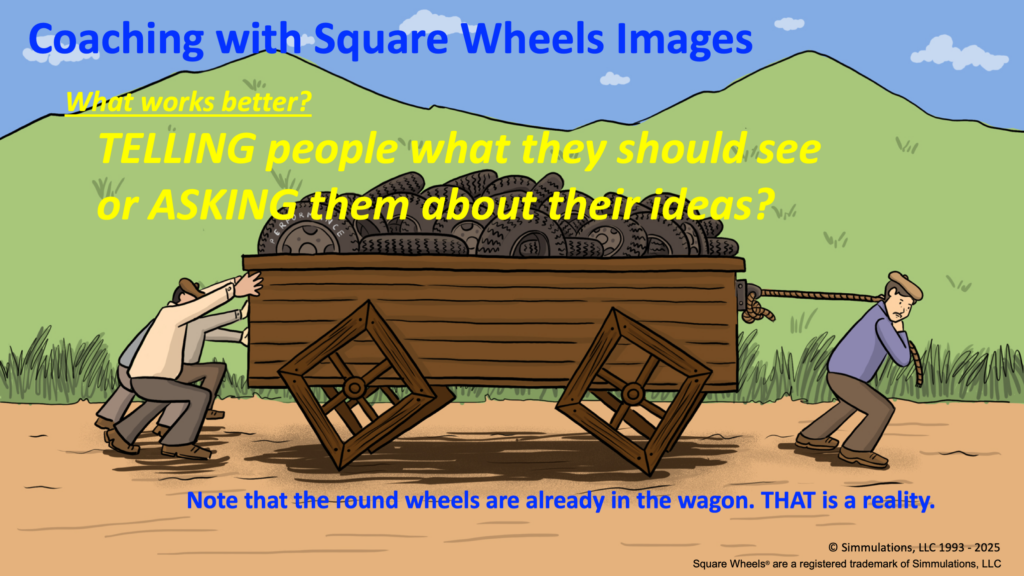
The research base on team‑level coaching is thinner than for individuals, but the mechanisms are essentially the same: reflection, psychological safety, role clarity, and shared action. And asking for ideas gives them active ownership involvement, with them rather than to them.
Square Wheels makes those mechanisms also tangible for intact groups. Here’s a simple team session design that you can run in 60–90 minutes and repeat quarterly.
Step 1: Collective diagnosis
Put the image up in front of the team and ask them, in small groups, to brainstorm:
-
“What are our Square Wheels—the things that slow us down, create rework, or frustrate customers?”
-
“What Round Wheels are we not yet using—process tweaks, tools, partnerships, or ideas we’ve talked about but not implemented?”
Capture everything on flip charts or a shared digital board. Encourage specificity: instead of “communication,” push for “we don’t have a clear handoff checklist between Sales and Operations.”
As the facilitator, coach the conversation quality: make sure everyone’s voice is heard, disagreements are handled constructively, and critique stays focused on systems and processes, not people. That’s live, in‑the‑moment team coaching.
Step 2: Prioritize and assign ownership
Next, ask the team to prioritize:
-
Give each person a small number of votes for the most impactful Square Wheels.
-
Identify the top two or three “big rocks” that are both important and changeable.
Then, explicitly assign ownership:
-
“Who owns this wheel?” (Not to fix it alone, but to convene the right people.)
-
“Who needs to be involved for this wagon to move?”
The act of assigning ownership turns a vague complaint into a coaching goal.
Step 3: Design micro‑experiments
Now you bring in the outcome side again:
-
For each priority Square Wheel, design a small experiment the team can run in the next 2–4 weeks.
-
Define what will change, what data you’ll watch, and when you’ll review.
For example:
-
“Square Wheel: Weekly status meeting is 90 minutes of updates and no decisions. Round Wheel experiment: Move updates to a shared doc, make the meeting 30 minutes, decisions‑only, for one month; track time saved and perceived value.”
You’re building skills in problem‑solving, experimentation, and collaborative execution—not through a lecture, but through doing.
Step 4: Embed in routines
Finally, embed a tiny Square Wheels ritual into team life:
-
Add a one‑question check‑in to your regular meeting: “What’s one Square Wheel we noticed this week, and do we have a quick Round Wheel idea?”
-
Use the image in retrospectives and project kick‑offs to accelerate honest, systemic conversation.
Over time, “Square Wheels” becomes shorthand in the culture: “That’s a square wheel; who wants to help round it?” That’s how coaching effects—better affect, skills, and engagement—scale beyond formal sessions.
Coaching the organization: a visual backbone for a coaching culture
At the organizational level, coaching is often fragmented: executive coaching here, front‑line “coaching skills” training there, engagement initiatives somewhere else. The research keeps calling for clearer theory and better integration.
Square Wheels gives you a simple backbone to connect those pieces.
Here’s how you can use it at scale:
1. Make the metaphor universal
Introduce Square Wheels in leadership programs, supervisor training, and strategy workshops. Use the exact same image and language everywhere.
Executives talk about “Square Wheels in our strategy.” Front‑line supervisors ask, “What Square Wheels are in your day?” HR uses it when looking at engagement survey comments. Everyone knows what the phrase means.
That shared metaphor does two big things:
-
It reduces the conceptual fuzziness around “coaching” by giving people a common mental model.
-
It helps people talk about problems safely and constructively, which is a prerequisite for any culture of continuous improvement.
2. Connect to measurement
Don’t let the picture live in isolation; tie it directly to your dashboards.
For example:
-
If engagement survey scores show low marks for “I have the tools and resources I need,” you ask each manager to run a Square Wheels session focused on tools and processes.
-
If customer complaints spike in a region, you convene a local cross‑functional group to map the Square Wheels in that specific customer journey.
Track both the conversations and the outcomes. Over time, you’ll see which parts of the business routinely identify and round Square Wheels—and whether they also outperform on performance and engagement metrics.
That’s how you move from “coaching is good” to “coaching, done in this specific way, moves the numbers.”
3. Build internal coaching capability
The research suggests that internal coaches and managers can be just as effective as expensive external coaches when they have a clear approach and some skill. That’s where Square Wheels shines.
You can:
-
Train managers to use the image in 1:1s and team meetings as a coaching script, not a one‑off exercise.
-
Certify internal coaches on a simple “Square Wheels coaching conversation” that blends process questions (insight, reflection) with outcome questions (goals, experiments).
Because the tool is visual and intuitive, managers don’t have to remember a complex model. They can literally point to the picture and ask, “Where’s it square? What round wheels do we have?” The model is on the page.
4. Leverage hybrid and virtual formats
Research also shows that coaching doesn’t lose its effectiveness just because it’s online. That’s good news, because Square Wheels works beautifully in virtual settings.
You can:
-
Use the image in online whiteboards and breakouts.
-
Run “virtual wagon‑pulling” conversations where remote teams identify and vote on Square Wheels in real time.
-
Capture and share screenshots of the annotated image as living documentation of the coaching work.
That makes coaching scalable, not just in person, but across geographies and time zones.
Keeping it practical: a simple template you can use tomorrow
To close, here’s a template you can adapt directly into your own practice—whether you’re writing a coaching program, designing a workshop, or simply wanting better conversations as a leader.
For any individual, team, or unit, walk through these four questions with the Square Wheels image:
-
What are our Square Wheels?
What is clunky, frustrating, or harder than it needs to be in your work today? -
What Round Wheels do we already have?
What tools, skills, ideas, or relationships are available but under‑used? -
Which one Square Wheel will we round first?
If we only focused on one thing in the next 30 days, what would have the biggest positive impact? -
What exactly will we do, by when, and how will we know?
Define the small experiment, the owner, and the indicators of progress. Revisit in your next meeting.
That’s it. Four questions, one image, and a decade of coaching research sitting quietly in the background, doing its work.
If you’d like, I can now help you tailor this into a specific blog post for a particular audience—front‑line supervisors, HR leaders, or external coaches—so the language and examples resonate even more precisely. Which audience do you most want this piece to target first?
—
For the FUN of It!
 Dr. Scott Simmerman is a designer of team building games and organization improvement tools.
Managing Partner of Performance Management Company since 1984, he is an experienced presenter and consultant who is trying to retire!! He now lives in Cuenca, Ecuador.
You can reach Scott at scott@squarewheels.com
Learn more about Scott at his LinkedIn site.
Note that I often use Perplexity AI to help research and generate ideas for my posts.
Square Wheels® are a registered trademark of Simmulations, LLC
and images have been copyrighted since 1993,
© Simmulations, LLC 1993 – 2026
What I’m About:
My Square Wheels blog and website exist to help leaders, trainers, and facilitators make work smoother, more engaging, and more human. I focus on practical tools for process improvement, organizational change, and workplace collaboration that spark insight and deliver measurable results.
And I am convinced, after 30+ years of using Square Wheels®, that it is the best facilitation toolset in the world. One can use it to involve and engage people in designing workplace improvements and building engagement and collaboration. It is a unique metaphorical approach to performance improvement and we can easily license your organization to use these images and approaches.
By blending proven facilitation methods, creative problem-solving, and engaging team activities, my mission is to support organizations in building energized, sustainable cultures of involvement and innovation.
Through accessible — and often free — resources and virtual facilitation tools, I aim to help teams everywhere collaborate more effectively, innovate continuously, and take ownership of their improvement journey.
#SquareWheels #InnovationAtWork #TeamEngagement #FacilitationTools #WorkplaceImprovement #EmployeeEngagement #CreativeProblemSolving #OrganizationalDevelopment #LeadershipTools #collaboration #leadership #motivation #communications #enablement #leadership #CreativeCommons #enablingperformance #teamwork #storytelling #storyasking

0 Comments