
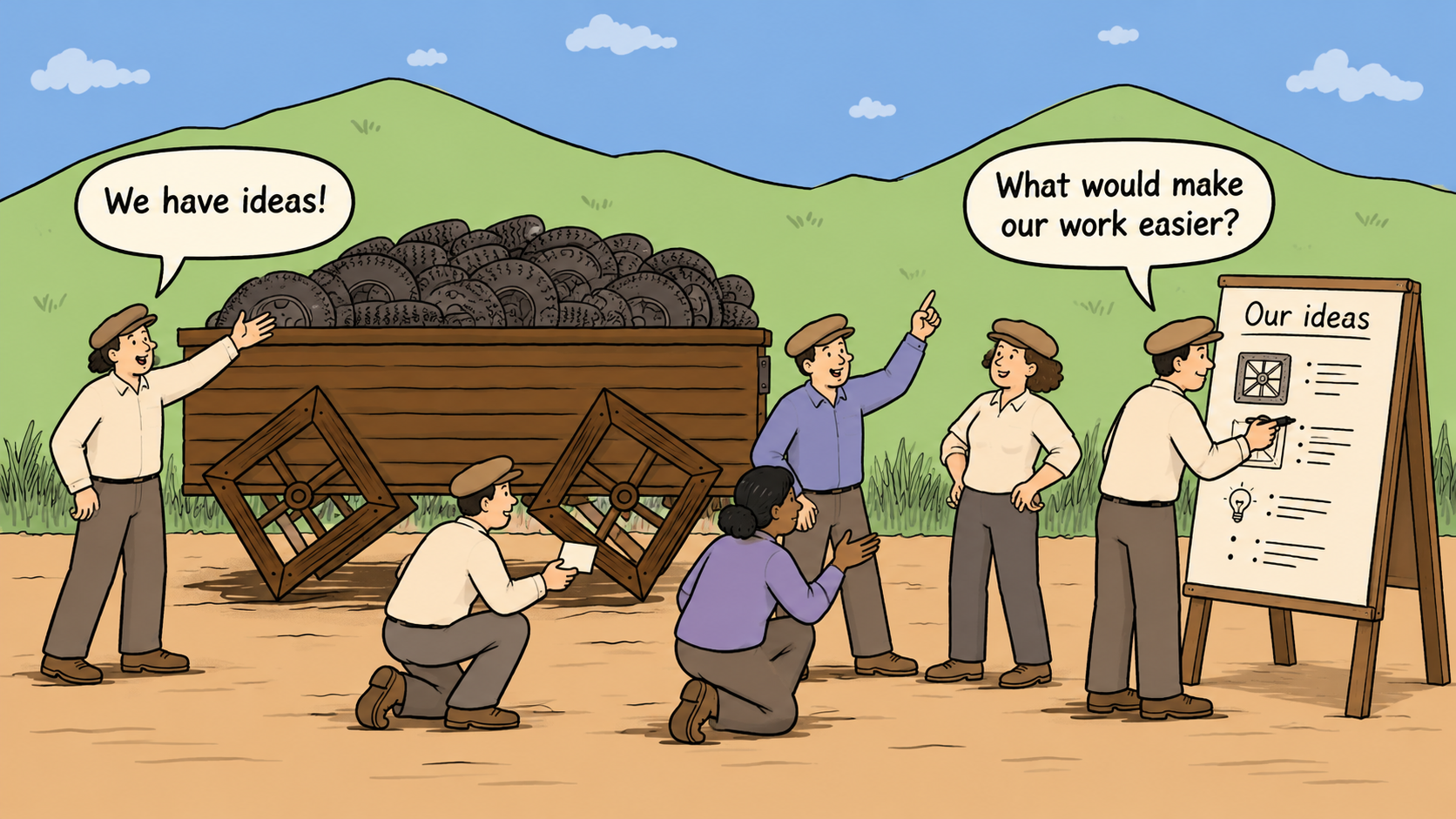
Turning Participation Into Workplace Innovation using Praxis Live. What our short program for The Facilitators Guild demonstrated about visual metaphors, live brainstorming, and a process supervisors can use.
Workplace innovation does not always need to begin with a big initiative. Sometimes, it can begin with a picture and a good question and delivered effectively by supervisors and front-line managers for maximum effect and impact.
On October 7, 2026, Mike Martin and I delivered a short Square Wheels® demonstration program for The Facilitators Guild, using his Praxis Live to help participants explore the images, share interpretations, generate ideas, and identify useful applications. Thirteen people attended, and all thirteen participated in at least one activity. That is 100% participation across the session; it is not a claim that everyone answered every question, but a useful indication that everyone found a way into the process.
Our purpose was practical: demonstrate how a visual metaphor and a structured brainstorming process could work together, and how a supervisor could use a designed module to invite innovation and support enablement in their workplace.
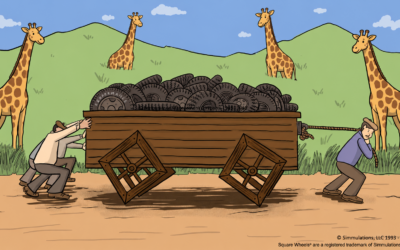
A Picture Opens the conversation and we began with an intentionally open-ended question: “How might this image represent how things really work in most organizations?”
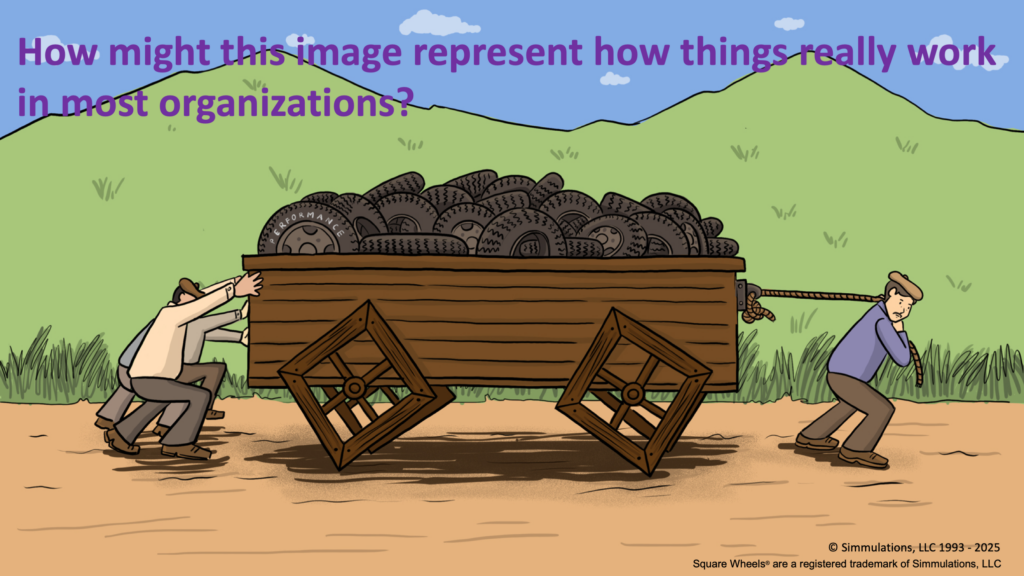
Click on this image to download Square Wheels One for your use
Seven participants responded on their phones. Their interpretations included “Clunky,” “Broken,” “Change is bad,” “Wasted Energy,” “Harder than it has to be,” and “The way we’ve always done it.” Other responses went directly to issues of organizational awareness: “Not seeing assets that are available,” “Missing Vital Data,” and “There are problems that some can see but not others.”
These were not answers we needed to supply to the participants about common workplace issues, these were their projections. They came from participants looking at the image and making different functional connections. And we did not deep dive into these actionable ideas because we only wanted to demonstrate how the image generates perceptions of reality and how the Praxis Live system worked to so easily capture the information.
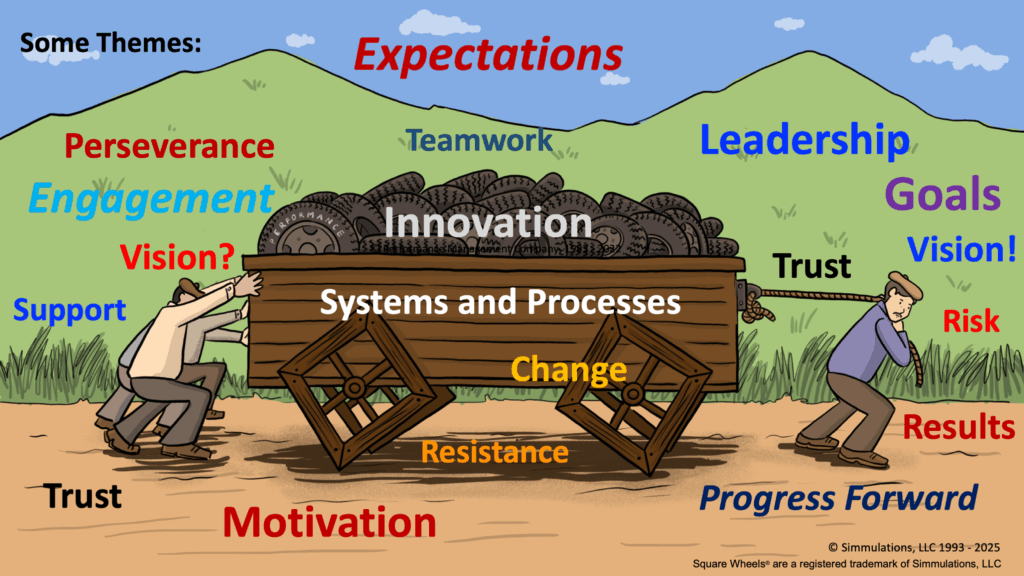
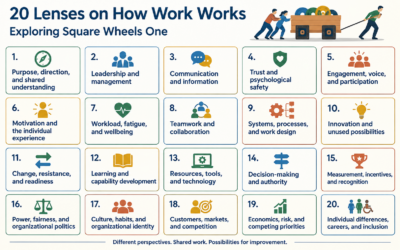
There are many different themes that open for discussion when using Square Wheels One. Here are some general classes of them.
That is the starting point we wanted to demonstrate.
Instead of telling people what is wrong with their workplace, we can give them something to look at and ask what they see.
Their interpretations provide the material for the next conversation.
“Harder than it has to be” could lead to a discussion about a cumbersome process. “Not seeing assets that are available” could open a conversation about overlooked skills, tools, or ideas. “There are problems that some can see but not others” provides a starting point for comparing perspectives across roles.
Those are possible follow-up directions—not outcomes established by the session. But they illustrate how a short visual activity can become a focused workplace discussion and engagement for the process of implementation. We let participants define the issues and opportunities, and that is a powerful way to generate engagement.
Why Images Help People Participate
We also asked participants to reflect on the use of an image or metaphor as a tool for involvement. Ten of the thirteen attendees answered that question. The report’s synthesis identified two recurring themes, each appearing in five different wordings: images make it easier to contribute, and images help build shared understanding.Leadership-report-Praxis-Live.pdf
The report captured the first theme with a memorable phrase from one of the participants:
“An image lowers the price of speaking.”
People do not have to arrive with a polished explanation. They can begin with an observation, a connection, or a different interpretation. The report described this as allowing people to respond without having to be “precise, articulate, or right.”
The second theme was equally useful: images create shared ground while making differences visible. Participants saw applications in opening a day, facilitating team meetings, supporting divergent conversations, and helping people make meaning after an experience. One participant wrote:
“I am thinking it could assist in holding a divergent conversation instead of yellow stickies.”
There was also an important qualification. The report identified three responses emphasizing that the image must fit the audience and that the conversation must be handled with care. A visual metaphor is an invitation to discussion, not a guarantee of agreement.
Moving From Square Wheels to Round-Wheel Ideas
The next step was to move beyond identifying difficulties and toward possibilities:
“What is one round wheel idea that would benefit your clients? What’s most helpful?”
Seven participants answered. Among the ideas receiving votes were:
-
“Build curiosity as a competency” — 5 votes, or 31% of votes cast.
-
“It is ok to disagree” — 4 votes, or 25%.
-
“Question your assumptions” — 2 votes, or 13%.
These percentages describe the distribution of votes, not the percentage of all attendees endorsing each idea.
What I find useful about these responses is their emphasis on how people think and interact. The ideas were not limited to fixing a procedure. They included developing curiosity, making room for disagreement, and examining assumptions.
Those ideas suggest a valuable direction for a supervisor-led module: do not ask only, “What should we change?” Also ask, “What do we need to explore, question, or discuss differently?”
The session did not establish that these ideas improved workplace performance. It demonstrated that participants could move from interpreting an image to identifying potentially useful practices.
Praxis Live Helped Carry the Conversation Beyond the Moment
We then asked:
“How can these tools impact your facilitation?”
Nine people answered. In the prioritization activity, eight participants allocated 62 dots across 12 ideas. The highest dot totals shown in the report were:
The report’s narrative describes the first two ideas as coming out level, but its numerical listing shows 11 and 9 dots. The figures above follow that numerical listing.
For our purposes, the important connection is between capturing ideas and using them afterward. Participants saw potential not only for generating discussion, but also for retaining insights and supporting follow-up.
The PDF itself illustrates that possibility. It brings together prompts, responses, themes, priorities, and a closing feedback activity. The report states that it was assembled from the room’s answers, reviewed and approved by the facilitator, and shared with responses kept anonymous.
That gives the facilitator something concrete to revisit rather than relying solely on memories of a lively conversation. Having the report with comments is a great tool to use in any of the follow. It is also the information that can be collected and summarized if one is doing a number of workplace improvement sessions with different groups to collect overall thoughts on issues and opportunities. It is a powerful tool for understanding the culture of the workplaces.
A Designed Module a Supervisor Could Facilitate
The Guild session offers a practical model for a short supervisor-led discussion. The following is a proposed workplace adaptation—not a claim that we tested this exact sequence with a supervisor’s team.
The supervisor’s job would be to guide the questions, invite contributions, and help the group identify a feasible next step.
1. Invite Interpretation
Show the Square Wheels One image and ask:
“What do you see, and how might this connect to our work?”
Give people a moment to think before inviting responses. Begin with their observations rather than explaining what the image is supposed to mean. Note that you can later share other Square Wheels images to make different key learning points and to drive more of the focused engagement you want around specific issues and round wheel opportunities.
2. Identify a Workplace Square Wheel that should be addressed
Ask:
“What is something in our work that is harder than it needs to be?”
Use the brainstorming process to gather perspectives from all of the participants. For a first module, keep the discussion focused on an area the team can influence rather than attempting to address every organizational problem. Find an issue that they can address and allow them to discuss it sufficiently that everyone is in agreement that this is a problem and that it is worth solving
3. Generate Round-Wheel Possibilities
Ask:
“What could make this work more smoothly?”
Dive in on the issue to generate agreement as to what it actually is and that it is worth fixing. Do not go with the first solution but look at it from different perspectives. Look at it from all sides. Follow with questions such as:
-
What resources or ideas might we be overlooking?
-
What assumptions should we question?
-
Where would a different perspective help?
-
What could we try on a small scale?
These suggested prompts build on the session’s actual themes: overlooked assets, curiosity, disagreement, and questioning assumptions.
4. Select a Useful Experiment
Review the ideas and use a prioritization activity to identify a starting point.
Then ask:
“Which idea can we realistically test, and what would we learn by trying it?”
Treat the vote as input to the decision, not as a substitute for checking feasibility, responsibilities, or constraints.
5. Make Enablement Explicit
Before closing, agree on:
-
What the team will try.
-
Who will take responsibility.
-
What support, time, resources, or permission are needed.
-
When the team will review what happened.
This is the proposed bridge from participation to action. Asking for ideas is one part of the module. Helping people act on a selected idea is the other.
What the Demonstration Tells Us—and What It Does Not
The closing feedback and discussions were encouraging, given this was only my second facilitation with the Praxis Live tool. Five participants answered the final feeling question: four selected “Very positive,” and one selected “Positive.” Those results describe the five respondents, not all thirteen attendees.
This was a small demonstration, not a controlled study or evidence of sustained workplace change. And it was only my second time in using the Praxis Live tool. We should not turn positive reactions into claims about productivity, motivation, or implementation that we have not measured.
What we can say is that every attendee participated in at least one activity; participants generated organizational interpretations and round-wheel ideas; and they identified potential applications for follow-up, larger-group facilitation, and taking insights beyond the room.
That is a useful foundation for the next step: applying a designed module in a real workplace and following through on what the team chooses to try.
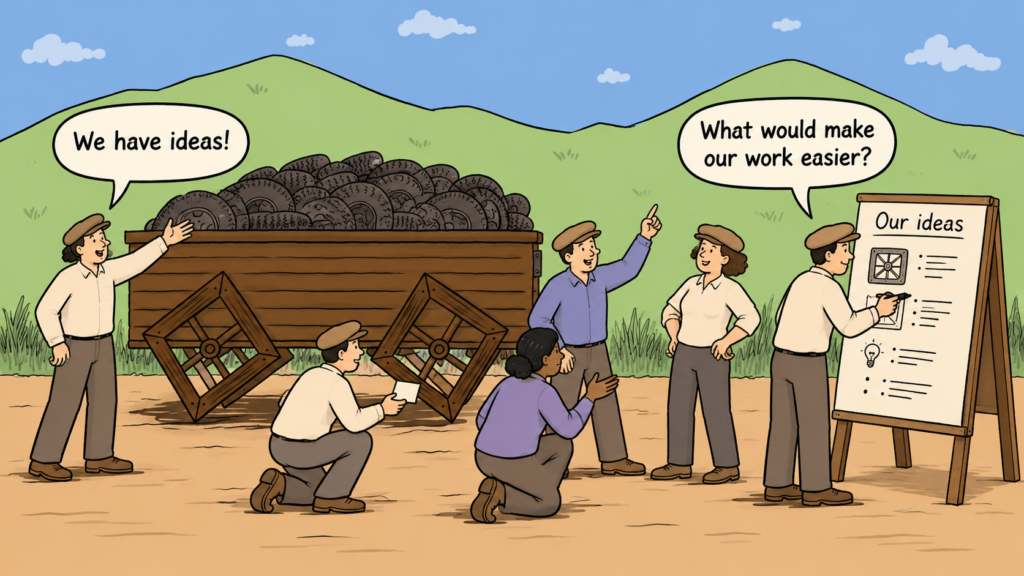
My testimonial on Praxis, both the Live interactive tool and the Journey social media post-program platform:
“Like many of you, I have seen a variety of different brainstorming tools designed to actively involve and engage people in generating peer-supported workplace improvement. Instead of an often-boring powerpoint presentation that is “show and tell” and not engaging, Praxis Live is an easy to use and very flexible platform on which one can upload a presentation and then add the interactive tools, the card-sorting and dot-voting and idea solicitation tools that generate shared ownership involvement around issues and opportunities. There are lots of tools out there but we are committed to using this tool with our hundreds of Square Wheels images and our developing interactive presentation modules.”
The Supervisor Does Not Have to Supply Every Answer
Our Facilitators Guild program demonstrated a straightforward combination: Square Wheels provided the visual starting point, while Praxis Live provided a process for gathering contributions and identifying priorities. The resulting report preserved the conversation for review and follow-up.
And a real outcome from the session is the understanding that we can really build simple to use Modules that anyone can access and use to better involve and engage their people in workplace improvement initiatives. For me, a supervisor can use that structure to shift the conversation from “Here is what I think you should do” kinds of discussions toward:
“What do you see? What could work better? What should we try—and what do you need from me to make that possible?”
That is POWERFUL!!! The aim is not simply to collect more ideas. It is to give people a meaningful opportunity to contribute, then help them put a useful idea to work, and something that can directly involve the supervisor in the workplace.
—
For the FUN of It!
 Dr. Scott Simmerman is a designer of team building games and organization improvement tools.
Managing Partner of Performance Management Company since 1984, he is an experienced presenter and consultant who is trying to retire!! He now lives in Cuenca, Ecuador.
You can reach Scott at scott@squarewheels.com
Learn more about Scott at his LinkedIn site.
Note that I often use Perplexity AI to help research and generate ideas for my posts.
Square Wheels® are a registered trademark of Simmulations, LLC
and images have been copyrighted since 1993,
© Simmulations, LLC 1993 – 2026
Note: Please do not take my images and think about using them. It can generate a whole heap of problems given international copyright law and trademark law. Read this article for more information.
See a detailed overview of my tools, background and experiences here.
What I’m About:
My Square Wheels blog and website exist to help leaders, trainers, and facilitators make work smoother, more engaging, and more human. I focus on practical tools for process improvement, organizational change, and workplace collaboration that spark insight and deliver measurable results.
And I am convinced, after 30+ years of using Square Wheels®, that it is the best facilitation toolset in the world. One can use it to involve and engage people in designing workplace improvements and building engagement and collaboration. It is a unique metaphorical approach to performance improvement and we can easily license your organization to use these images and approaches.
By blending proven facilitation methods, creative problem-solving, and engaging team activities, my mission is to support organizations in building energized, sustainable cultures of involvement and innovation.
Through accessible — and often free — resources and virtual facilitation tools, I aim to help teams everywhere collaborate more effectively, innovate continuously, and take ownership of their improvement journey.
#SquareWheels #InnovationAtWork #TeamEngagement #FacilitationTools #WorkplaceImprovement #EmployeeEngagement #CreativeProblemSolving #OrganizationalDevelopment #LeadershipTools #collaboration #leadership #motivation #communications #enablement #leadership #CreativeCommons #enablingperformance #teamwork #storytelling #storyasking #enablement #disruptiveengagement #un-dis-engagement #un-dis-empowerment #innovation
© 2026 Simmulations, LLC. Please note that “Square Wheels®” is a registered trademark of Simmulations, LLC. and materials, original wagon line art, text, and visual designs are protected. Original line art by Roy Sabean, used under rights owned by Simmulations, LLC and formerly Performance Management Company, a sole-proprietorship of Dr. Scott J. Simmerman. Original concept and source artwork © Simmulations, LLC; derivative visuals sometimes created with assistance from Perplexity Pro AI.

0 Comments