
I am All IN on the idea of SIMPLE. And I have been in a “reduce to the ridiculous” mentality for decades when it comes to impacting performance.

It all starts when you implement ONE round wheel.
Einstein’s hierarchy of thinking, Peter Kaufman’s “go positive and go first,” and the Square Wheels® metaphor all converge on one powerful point: the right kind of simple changes how people think, feel, and perform at work.
When leaders make simplicity more visible and actionable, they reduce blind spots, increase trust, and unlock compounding improvements in culture and results. And leadership should be around performance improvement and enablement, right?
1 – Simple ranks ABOVE Genius
Albert Einstein described five ascending levels of thinking: smart, intelligent, brilliant, genius—and at the very top, SIMPLE. Simple sits above genius in his view because people can understand simple, remember simple, and act on simple consistently.
-
Kaufman’s entire multidisciplinary talk lands on a single, graspable rule: “Go positive and go first, and be constant in doing it.”
-
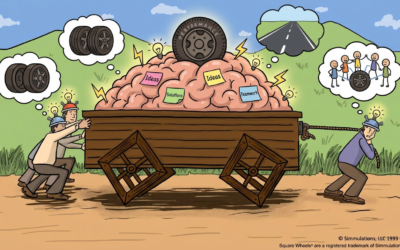
The Square Wheels image does the same for organizational life: everyone can see that the wagon rolls on square wheels while better round wheels already exist nearby.
The right kind of simple is not a dumbing down of reality; it is a distillation that removes noise while preserving the essential signal about how things really work. The conversion of Square Wheels to round ones meets the definition. Identify an issue and generate possibilities.
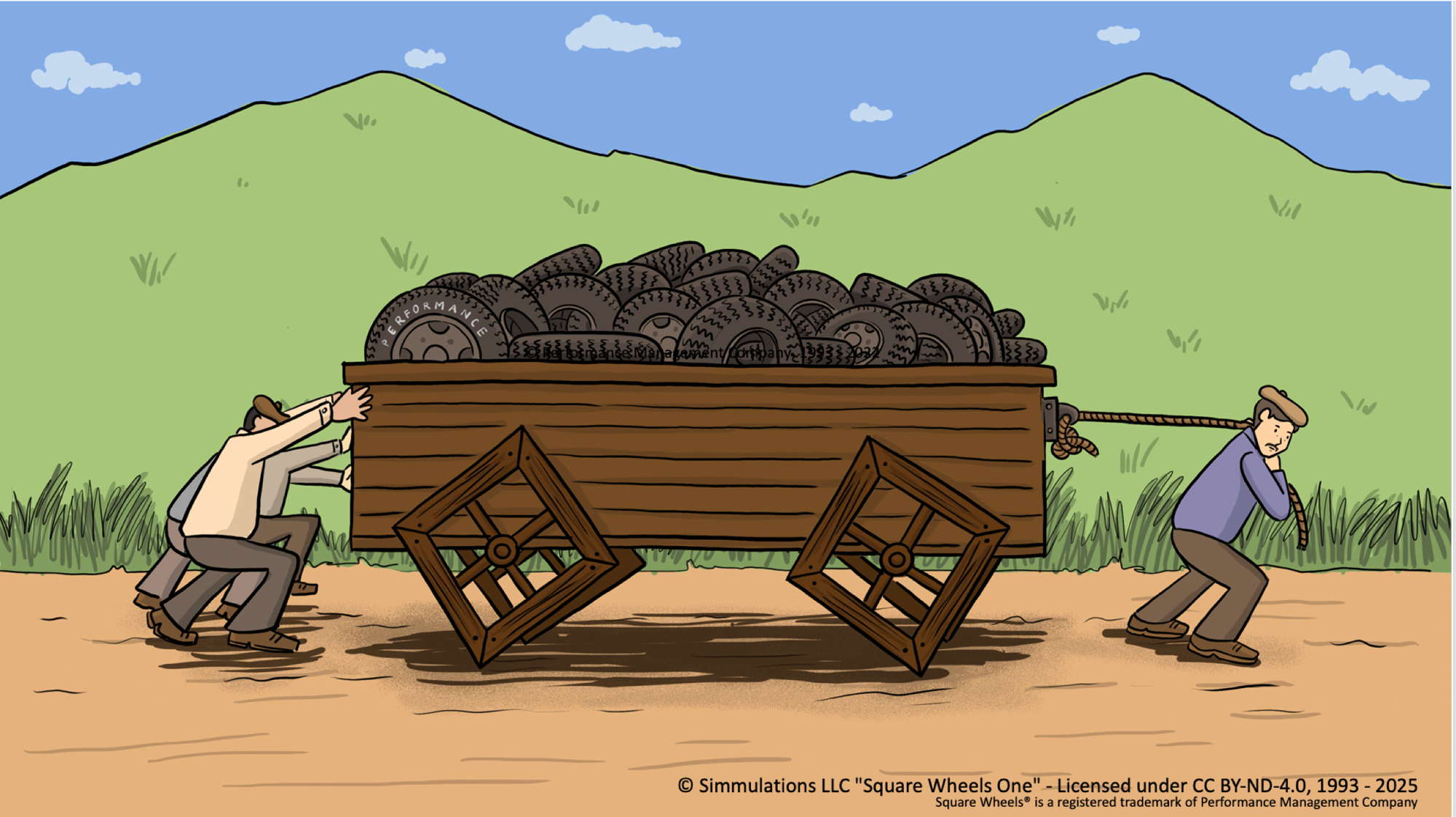
Square Wheels One: A simple model for how things really work in most organizations, for generating discussions
2 – Mirrored Reciprocation and the Wagon
Kaufman’s first big idea, mirrored reciprocation, says that every interaction tends to send back whatever you put into it, whether that is a smile in an elevator or a scowl in a meeting. In workplaces, that “equal and opposite reaction” shows up as enablement or resistance, trust or defensiveness, depending on how leaders show up first.2
Square Wheels roll to make this visible:
-
When leaders pull the wagon from the front and never look back, they literally cannot see the people thumping along on square wheels behind them, nor the round wheels already available.
-
When leaders stop, step back, and ask people to describe the bumps and suggest round wheels, they go positive and go first—inviting mirrored reciprocation in the form of ideas, ownership, and discretionary effort.
The image turns an abstract principle into something people can point to: “We’re feeling that elevator scowl” or “We’re finally getting elevator smiles from the front of the wagon.” It creates a simple language of improvement. The round wheels are already in the wagon, ready to be discussed.

The round wheels already exist
3 – Compound Interest and Continuous Improvement
Kaufman’s second big idea is compound interest, which he reframes as “dogged, incremental, constant progress over a very long time frame.” He shows that this same pattern runs through physics, evolution, and human achievement, making constancy the most powerful and most underused force available to us.
Square Wheels already encodes that logic:
-
Every time a team names one Square Wheel and replaces it with a round wheel, it lowers friction and slightly improves flow, safety, or quality.
-
When this small change behavior is constant with more and more round wheels implemented over time we have continuous improvements every week instead of big-bang initiatives every few years. Your culture experiences a compounding effect in trust, engagement, and performance.
Organizations usually fail not because they lack great ideas, but because ideas are intermittent and often resisted. Sisyphus pushing the wagon halfway up the hill, then letting it roll back down is an organizational reality. The keys to improvement are perspective and choices.
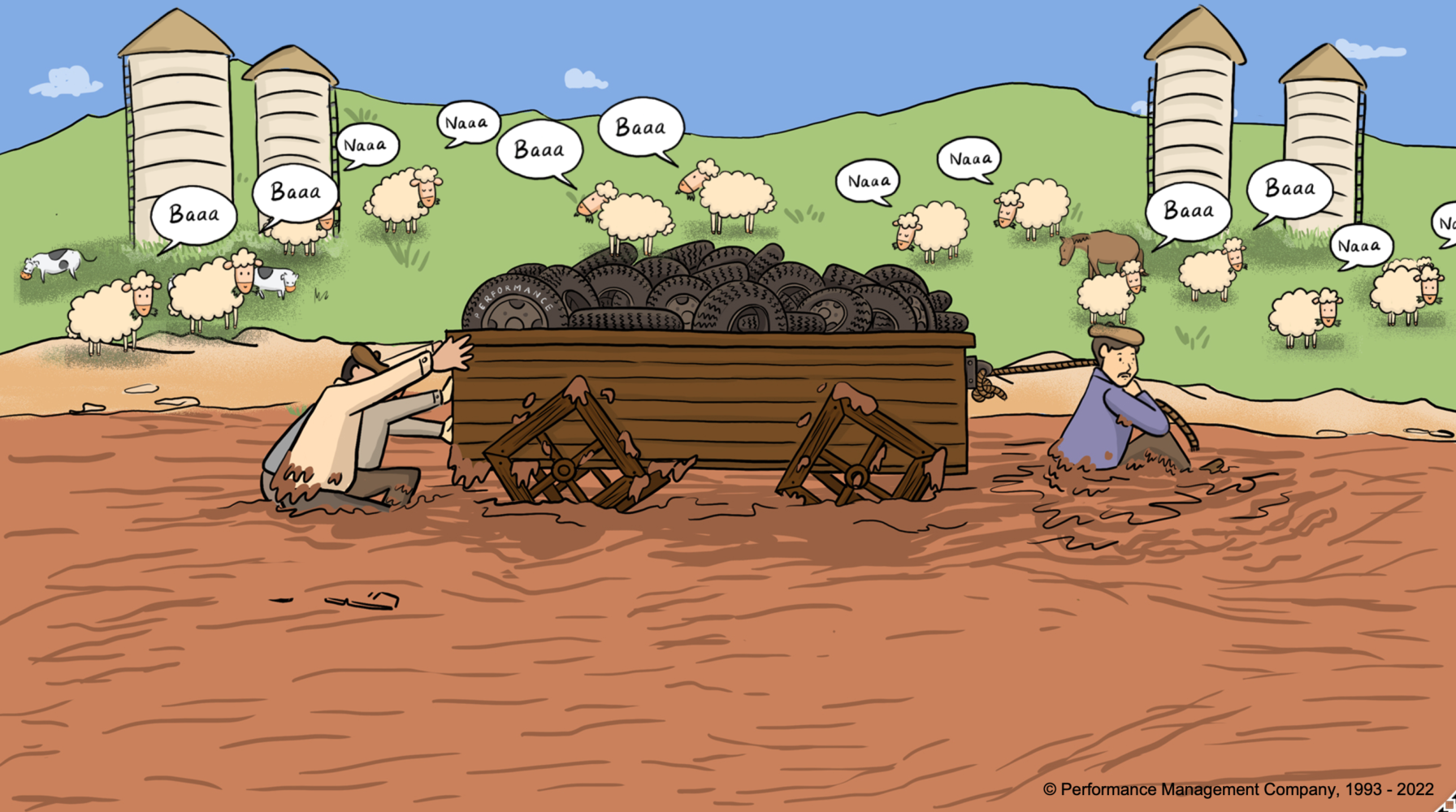
Note that you can easily lead a discussion around what ideas people have for getting out of the ditch and up on the road and dealing better with the environment of mud, or you can focus on how to engage more of the Spectator Sheep or what approaches you can take to deal with the existing silos within the organization. None of these are E-A-S-Y but all of these are straightforward to generate considered alternatives.
Simple visuals and metaphors and simple rules make
constancy of improvement efforts easier to sustain.
4 – A SIMPLE Formula for Culture
Blend Einstein, Kaufman, and Square Wheels, and you get a practical acronym for leaders who want to change culture without drowning people in complexity: SIMPLE. (Perplexity helped me with this one!)
-
S – See the wagon together. Use the Square Wheels One image to surface current realities, allowing people to name the thumps, the issues, and the unused round wheels they see. (Get it FREE)
-
I – Invite mirrored reciprocation. Go positive and go first: ask for ideas, listen carefully, and respond constructively so people experience the “elevator smile effect” at work. The round wheels are already in the wagon.
-
M – Make small, constant changes. Treat every identified Square Wheel as a candidate for a tiny, testable improvement that can be implemented quickly rather than parked on a wish list. DO things.
-
P – Practice over time. Shift attention from one-off events to weekly rituals that can be short debriefs, “round wheel” huddles, or flow checks. Progress compounds. Make small changes continuously and big ones will happen.
-
L – Look through six sets of eyes. Kaufman’s six counterparties – customers, suppliers, employees, owners, regulators, communities – become a simple lens for seeing the wagon from multiple perspectives and avoiding blind spots. Customers sit on top of the wheels; they should not be UNDER them!
-
E – Enable win‑win. Use the shared language of Square Wheels and the “be the list” leadership model (trustworthy, principled, courageous, kind, etc.) to design solutions that reduce friction for everyone involved, not just the top of the org chart.
SIMPLE is not theoretical; it ties each day’s small behaviors—what leaders say, what they notice, what they reinforce—to the compounding trajectory of the culture. This continuous focus on the challenges, with some intrinsic motivation, can become a basis for FLOW within the workplace.
5 – From Theory to Tuesday Morning
Kaufman argues that “to understand is to know what to do,” and he insists that good models must be simple enough that people can use them on Monday morning. Square Wheels exists for that same reason: it gives teams a picture and a shared language for talking about problems and possibilities without blame.
For leadership, that might look like:
-
Opening a staff meeting with the Square Wheels One image and a single question: “Where are our Square Wheels this week, and what round wheel can we test before Friday?”
- Use different images from the Square Wheels tools to generate new perspective and focus on new issues and opportunities. The diversity of the images you can choose to use is quite broad. Continue to evolve your story.
-
Personally going first: Sharing one of your own Square Wheels and asking for help is practical, so people experience the vulnerability and constancy that drive mirrored reciprocation and trust.
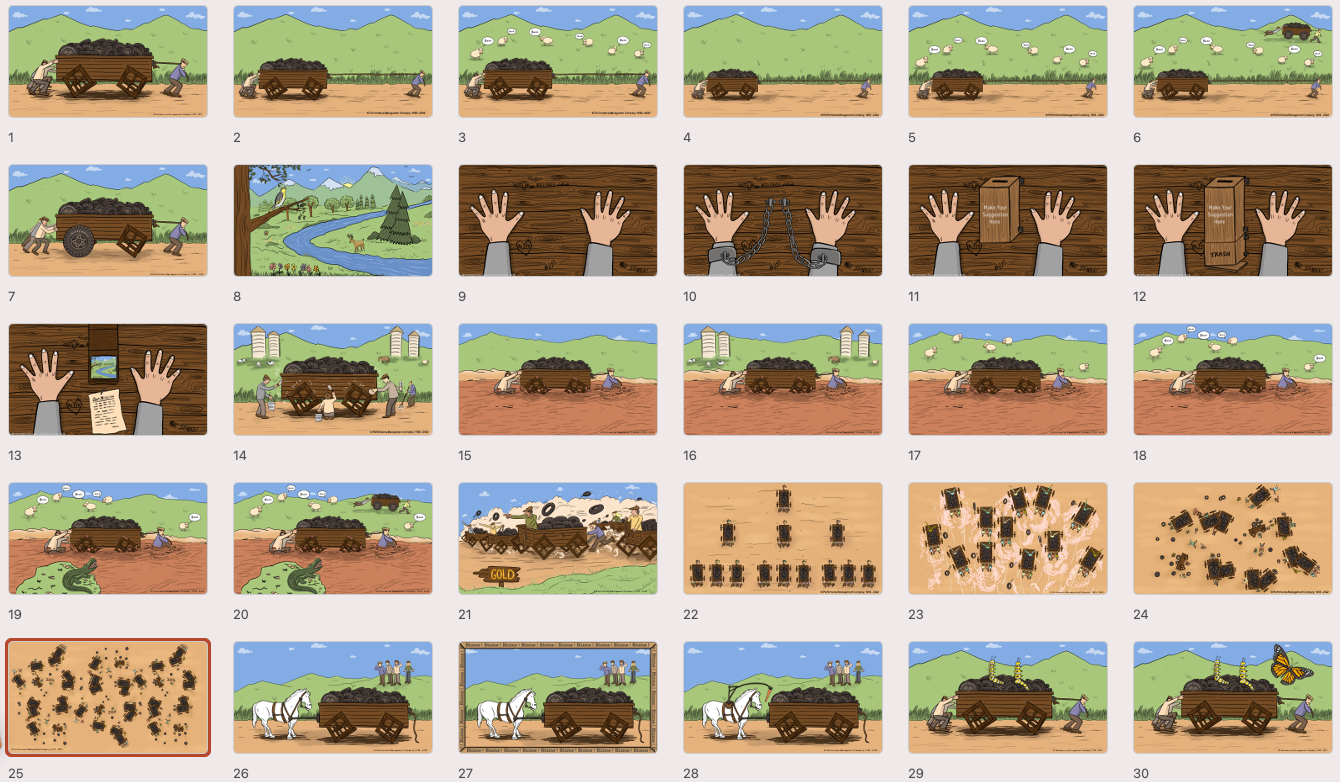
The first thirty of the catalog of images and themes
When simple, visual metaphors meet simple, behavioral rules, the result is a culture where people can see the wagon, feel safe to speak up, and participate in the slow, steady compounding of better work. That is where Einstein’s SIMPLE, Kaufman’s multidisciplinary lenses, and the Square Wheels framework all roll together.
Go Ahead! Grab a FREE copy of the Stupidly Simple “Square Wheels One” and roll your team forward more better faster:
Click to download the FREE Square Wheels One image under Creative Commons license
—
For the FUN of It!
 Dr. Scott Simmerman is a designer of team building games and organization improvement tools.
Managing Partner of Performance Management Company since 1984, he is an experienced presenter and consultant who is trying to retire!! He now lives in Cuenca, Ecuador.
You can reach Scott at scott@squarewheels.com
Learn more about Scott at his LinkedIn site.
Square Wheels® are a registered trademark of Simmulations, LLC
and images have been copyrighted since 1993,
© Simmulations, LLC 1993 – 2026
What I’m About:
My Square Wheels blog and website exist to help leaders, trainers, and facilitators make work smoother, more engaging, and more human. I focus on practical tools for process improvement, organizational change, and workplace collaboration that spark insight and deliver measurable results.
And I am convinced, after 30+ years of using Square Wheels®, that it is the best facilitation toolset in the world. One can use it to involve and engage people in designing workplace improvements and building engagement and collaboration. It is a unique metaphorical approach to performance improvement and we can easily license your organization to use these images and approaches.
By blending proven facilitation methods, creative problem-solving, and engaging team activities, my mission is to support organizations in building energized, sustainable cultures of involvement and innovation.
Through accessible — and often free — resources and virtual facilitation tools, I aim to help teams everywhere collaborate more effectively, innovate continuously, and take ownership of their improvement journey.
#SquareWheels #InnovationAtWork #TeamEngagement #FacilitationTools #WorkplaceImprovement #EmployeeEngagement #CreativeProblemSolving #OrganizationalDevelopment #LeadershipTools #collaboration #leadership #motivation #communications #enablement #leadership #CreativeCommons #enablingperformance #teamwork #flow #simple



0 Comments