

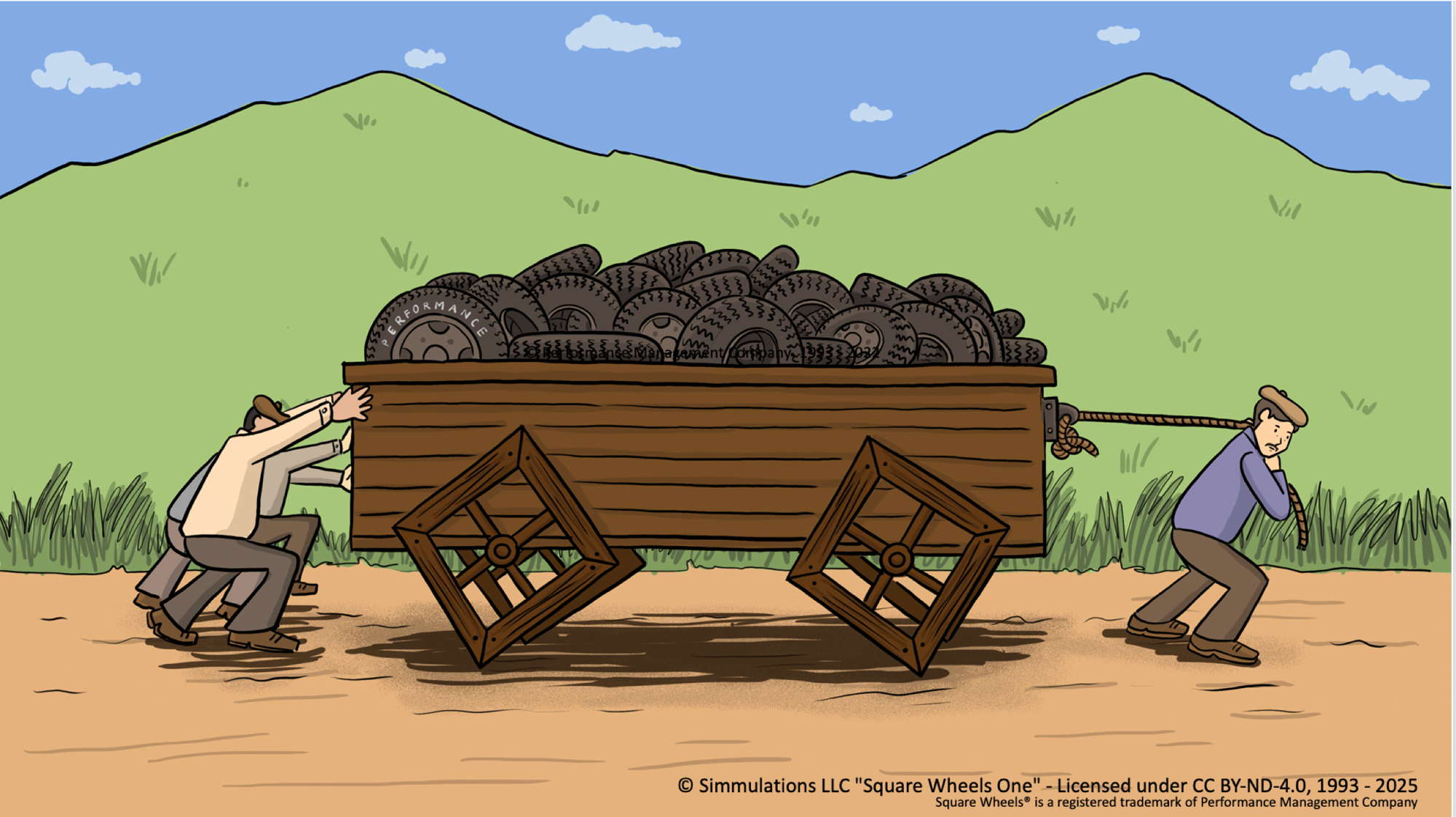
 “Generative Imaging” for Organizational Change focuses on leadership and organizational development. Here are workable ideas for supervisors and managers interested in generating commitment to change.
Supervisors are stuck in a kind of hellscape: constant pressure for results, endless change initiatives, disengaged teams, and not nearly enough authority, time, or support. So much being done TO them. And, most of the “solutions” tossed at them are still old-school: fix the structure, roll out another program, demand more accountability. None of that changes the conversations people are actually having about work. And 70% of the supervisors are, quite rightly, disengaged from their work (Gallup, 2025). (data / blog)
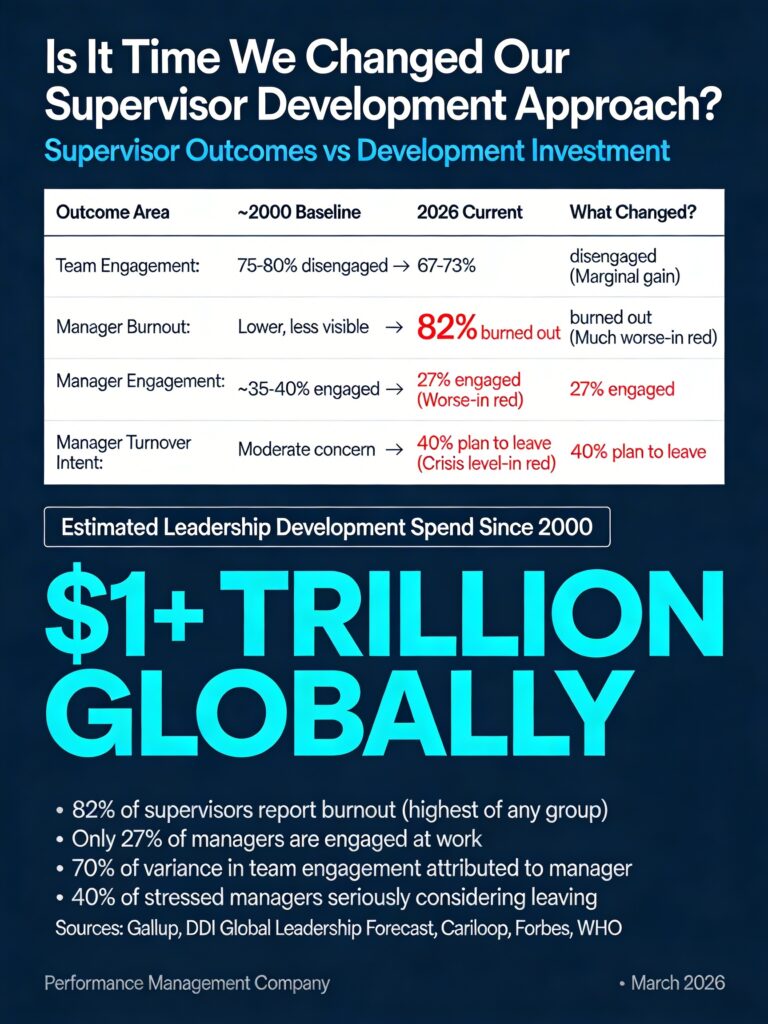
On the other hand:
Gervase Bushe’s dialogic organization development ideas – combined with my Square Wheels® metaphor – can give supervisors, and any manager, actually, a very practical and pragmatic way forward. They don’t need a new program and lots of trainings (that seldom actually happen, anyway). Supervisors need better conversations, anchored in better images, that invite people to help them reinvent the work.
(Don’t get hung up on the word “Dialogic” – it just means talking!)
From “hellscape” to host
Supervisors sit in the worst of the worlds. Senior leaders announce change or some new initiative. Employees look to supervisors to explain it, fix it, and often to protect them from it because they do not feel safe. Supervisors get squeezed from all sides. That grind creates three predictable patterns:
-
They become the “message carrier” instead of an actual leader.
-
They spend more time defending decisions than improving work.
-
Their team stops bringing them their best ideas, because they don’t believe anything will change. 79% of workers are currently disengaged. (Gallup, 2025)
Bushe’s dialogic lens suggests a different role: supervisor as host of conversations that change the way people see their work, themselves, and each other. You don’t have to know the answers; you have to create the conditions where new and often better answers can emerge. If you’d like to dive deeper into his dialogic change thinking that underpins this approach, I recommend Gervase Bushe’s, ‘An Introduction to Advances in Dialogic Organization Development.’
Square Wheels® gives anyone a concrete way
to do easily host such conversations..
Square Wheels as a generative image
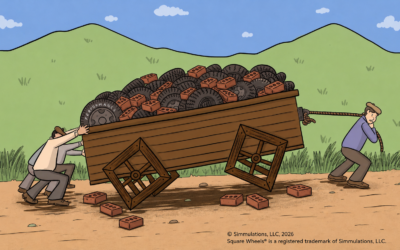
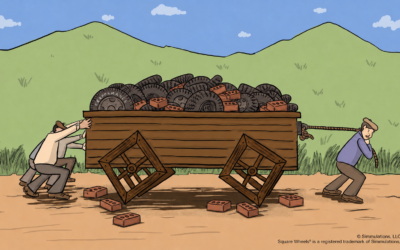
Square Wheels is a simple image and concept: a wagon rolling on Square Wheels, a leader out front pulling, people in back pushing, and a pile of Round Wheels already in the wagon. The power is that everyone can see their own workplace in it.
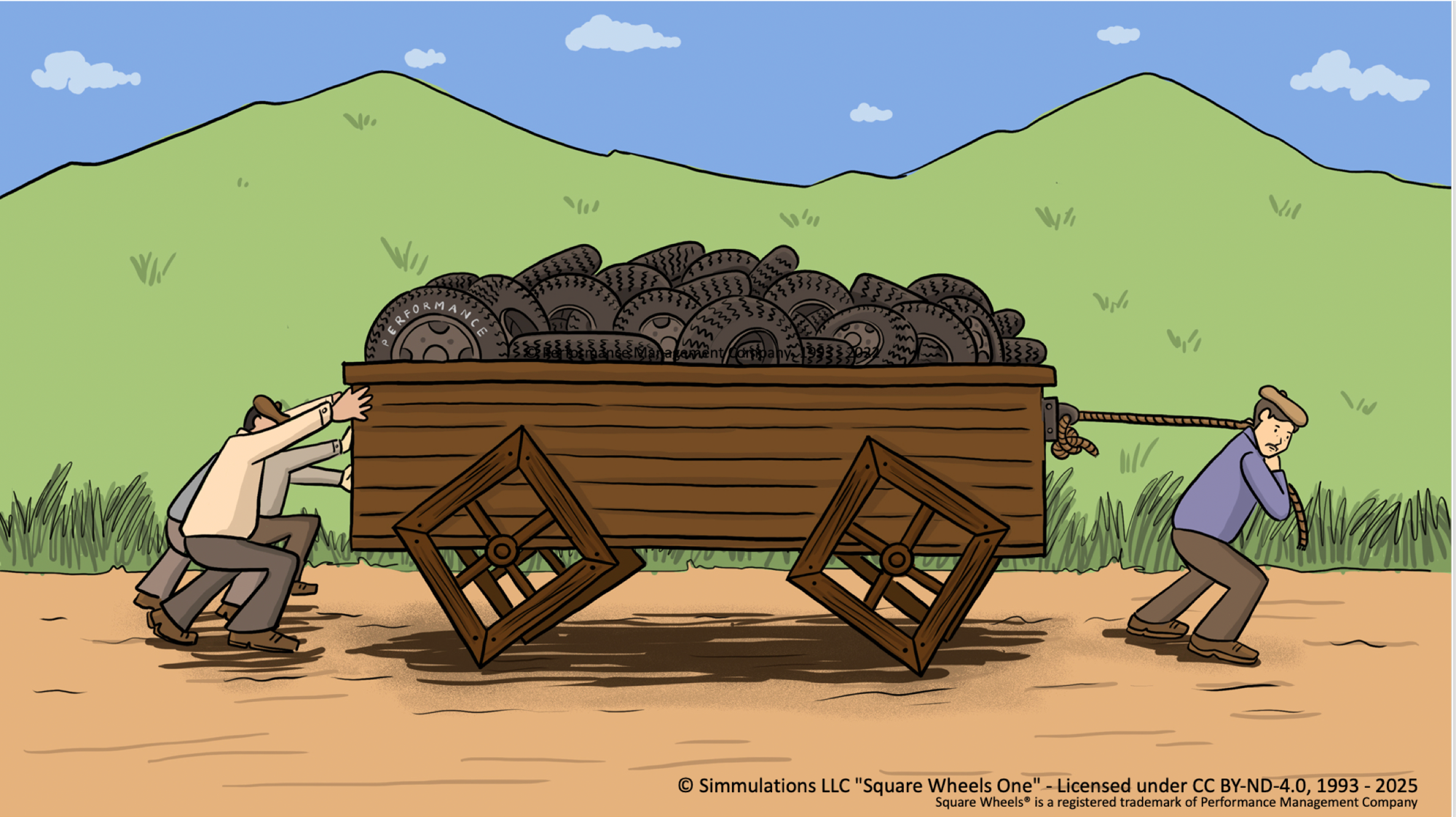
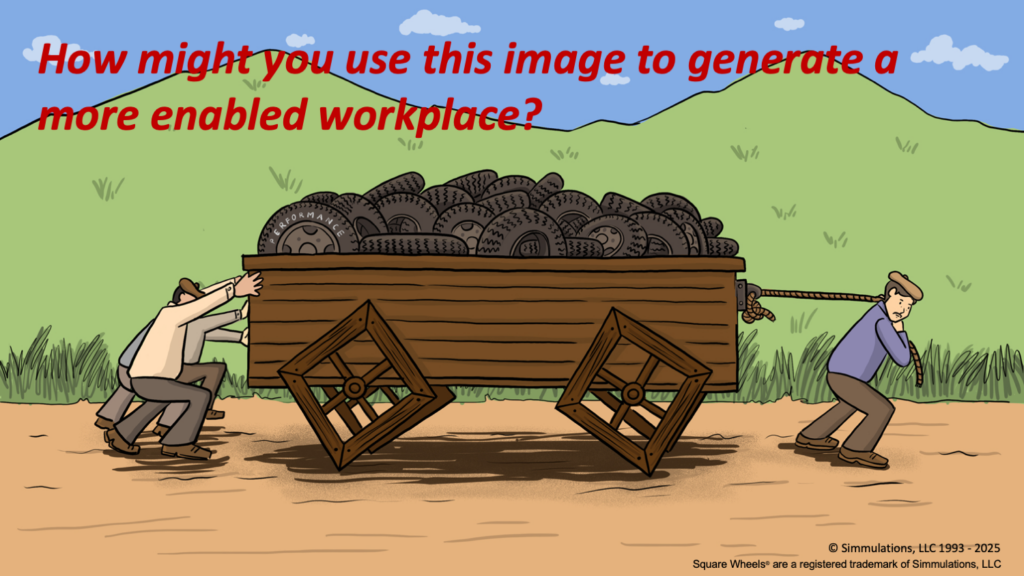
Used dialogically, the cartoon becomes a generative image: it doesn’t tell people what to think; it invites them to make meaning:
-
“Where are the Square Wheels in our work right now?”
-
“What Round Wheels do we already have that we’re not using?”
-
“Who feels like they’re pulling, and who feels like they’re pushing?”
- “What happens in your body when you imagine this change—do you notice your shoulders, your breath, your jaw, your gut?”
When you put this image in front of and with your team and you ask those questions, you are doing organizational development work in miniature. You are shifting the conversation from blame and frustration to curiosity and possibility without a big program or a consultant in the room. This is leadership; this is enabling people.
This is not just a mental exercise in imagining a better future; it is also a somatic one. As leaders and team members picture new ways of working and innovating, they are also tuning into what their bodies are telling them – tightness, openness, constriction, or ease – as real-time data about whether a proposed future feels safe, possible, and energizing. Feeling safe to make changes is an important factor in change.
Three supervisor moves that build innovation and engagement
Below are four specific moves any supervisor can use, built from dialogic organizational development principles and the Square Wheels metaphor.
1. Make work discussable
In a supervisor hellscape, a lot of the real problems are “undiscussable.” People talk about them in the hallway, not in the meeting. Your first job is to make reality discussable—safely.
Try this:
-
Bring the Square Wheels image and give copies of it at your next team meeting.
- Ask them to discuss the image in general. (If you get the FREE SWs One image from clicking here, you also get a trainer’s guide and suggestions.)
-
Ask people to silently jot down thoughts and answers to two prompts:
-
“What feels like a Square Wheel in our day-to-day work?”
-
“What feels like a Round Wheel we’re not using enough?”
-
-
Then, in pairs or trios, have them share what they wrote before you go to full group.
You are doing three powerful things at once:
-
You are doing storyASKING; you are asking your people to create some storylines about issues and opportunities in the workplace and you are generating active involvement and some ownership of the ideas.
-
You depersonalize the issues by locating them on the wagon, not in individuals.
-
You lower the risk by starting with small-group conversations.
-
You signal that you want to hear about friction and improvement ideas. This will be them telling you!
Innovation rarely starts with a brainstorm; it starts with people finally being able to tell the truth about how things really work. You are asking them to get emotionally involved in looking for ideas that make for a better workplace.
Generative conversations are not just about the content of what people say; they’re about how bodies are showing up in the room. Crossed arms, a frozen smile, a held breath, or a slumped posture are data. Somatic awareness invites supervisors to notice these cues in themselves and others and to slow down enough to work with them.
-
Before a tough conversation, pause for 30 seconds to feel your feet on the floor, lengthen your exhale, and notice where you’re tense. This kind of regulated presence calms your nervous system and signals safety to others.
-
When someone is silent or withdrawn, instead of filling the space, you might say: “I notice you’ve gotten quiet as we talk about this—what’s happening inside right now?’”
2. Shift the story from “them” to “us”
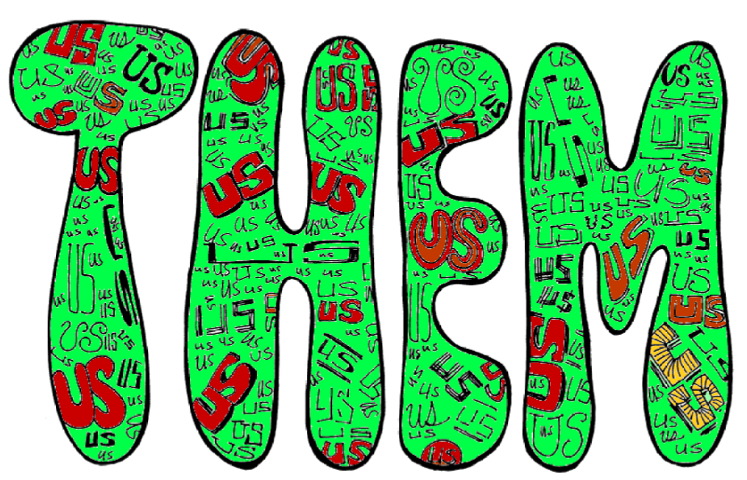
We hear about “THEM” all the time, but often they are really made up of “US!”
In most workplace environments, the dominant story is about “them”:
-
“They never listen.”
-
“They keep changing the rules.”
-
“They won’t give us the tools we need.”
Some of that may be true, but it’s also paralyzing. You can’t build innovation or engagement on resentment alone.
Use Square Wheels to pivot the storyline toward actual possibilities:
-
After people share their Square Wheels, ask: “Which of these do we control, influence, or only live with?”
-
Group ideas into three buckets on a flipchart or digital board: Control, Influence, Live With.
-
Then focus your energy on the Control and Influence buckets.
Now you’re helping the team rewrite the narrative:
-
From “They make us use awful systems”
-
To “We can redesign how we use this system day to day, and we can influence how it’s configured next quarter.”
You are not ignoring the realities of constraint; you are naming them and then deliberately moving the conversation toward local action. That shift from victim of change to agent of improvement is the heart of engagement.
3. Engage and Involve to evoke
Often, supervisors are reluctant to shake up the wagon because they are in fear of pushback and active resistance. What you will find in using Square Wheels One and this suggested approach is that, because YOU are not pushing, they are much more likely to engage.
When someone pushes back on change, they’re rarely just being ‘difficult.’ Very often, a raw nerve has been hit—an old pattern of threat or shame—and the body reacts before the story forms. Heart rate increases, breathing shallows, muscles tense, and then the mind rushes in to justify the reaction with a familiar narrative.”
Then give a practical coaching question:
-
Instead of arguing with the story, ask: ‘What are you feeling in your body as we talk about this change?’ and ‘If that sensation could speak, what would it say?’ This shifts the conversation from blame to curiosity.”
4. Treat ideas as prototypes and possibilities, not promises
One reason supervisors feel trapped is that every change feels high-risk: if an idea doesn’t work, it becomes “another failed initiative.” So you get cautious, your people get cynical, and nothing new survives. Many of them have the experience that their ideas have little or no actual value because nobody ever listens…
“An idea unused is a useless idea.”
A dialogic stance says:
Test ideas in the smallest possible way; let reality teach everyone. Make continuous improvement continuous.
Here’s how that looks in practice:
-
From the Round Wheels list, pick one low-cost and relatively simple idea the team believes might reduce friction and improve flow.
-
Frame it explicitly as a 30-day prototype, not a permanent solution. Start it and talk about it as you roll forward.
-
Agree on simple, concrete evidence you’ll look for:
-
“We’ll know this is working if we cut our rework by half.”
-
“We’ll know this is working if customer callbacks drop.”
-
-
Put dates on the calendar for a short review conversation as this rolls forward. Demonstrate your support and that actions are desired, not just words. Let everyone know what is expected.
You’re doing two important things:
-
Lowering the emotional and political cost of trying something new.
-
Building a rhythm of experimentation and learning into the team’s culture.
Over time, this habit of “Round Wheel experiments” creates a steady stream of small innovations that your people own.
And note:
The Round Wheels of Today will become
the Square Wheels of Tomorrow.
Bringing dialogic leadership behaviors into the room
Bushe’s Clear Leadership work adds another layer: how you show up in these conversations matters as much as the tools you use. A few simple behavioral commitments make a big difference:
-
Be transparent about your own experience: “Here’s one of my Square Wheels as your supervisor.” That vulnerability opens the door for honesty.
-
Stay in inquiry longer than you’re comfortable: ask, “Say more about that,” instead of jumping into explanation or defense.
-
Separate intent from impact: when someone describes a painful Square Wheel, resist the urge to argue. Ask something such as, “That’s the impact—what did you think the intent was?” Be willing to learn that your good intentions aren’t landing.
-
Own your part without owning everything: “I can’t fix the entire system, but I can commit to these three changes in how we run this team.”
You’re modeling the kind of leadership that makes it safe for people to speak up and experiment. That psychological safety is not fluffy; it is the platform on which all innovation and engagement rest.
A simple “Square Wheels Dialogic” meeting you can run
Here is a 60 minute meeting you can run with your team, with no slides, no fancy tools, just a handout or digital image of the wagon:
-
Set the frame (5 minutes)
-
“We all feel friction in our work. We’re going to use this simple image to talk about where things are rough and what we can improve together.”
-
-
Individual reflection (5 minutes)
-
Show the image. Ask people to write down: one Square Wheel, three Round Wheels.
-
-
Small-group conversation (15 minutes)
-
In groups of 2–3, share what you wrote. Ask: “What patterns are you feeling or hearing?”
-
-
Full-group harvest (20 minutes)
-
Capture Square Wheels on one chart, Round wheels on another.
-
Ask: “What surprises you? What feels familiar?”
-
-
Control / Influence / Live With (15 minutes)
-
For each Square Wheel, ask: “Do we control this, influence this, or just live with it?”
-
Mark them accordingly.
-
-
Pick one Round Wheel experiment (10–15 minutes)
-
Choose one idea from the Control/Influence side that you can pilot immediately.
-
Define the 30-day test and schedule a follow-up.
-
If you repeat a version of this every so often (weekly to start and monthly down the road), you build an ongoing dialogic practice into the fabric of your supervision. You’re not just “running a meeting”; you’re gradually transforming a hellscape into a place where people believe their ideas matter and their work can get better.
Why this is good for you as a supervisor
This approach doesn’t remove the external pressures you get from above. But it does shift your day-to-day experience and maybe you can train your manager if they are paying attention, because the framework is useful for their other supervisors:
-
You stop being the sole problem-solver and become the convener of problem-solvers.
-
You get earlier visibility into issues, instead of being surprised when things blow up.
-
Your people feel ownership over small wins, which feeds motivation and reduces the emotional drag you carry alone.
-
You build a reputation, both upwards and sideways, as an actual leader whose teams learn and adapt, not just react, comply and complain. This becomes noticeable pretty quickly because the enabled workforce has a different vibe.
In a world where the demands on supervisors keep rising, dialogic tools like Square Wheels are not a luxury. They’re a portable, practical way to create better conversations, new ideas, and more engaged teams, starting right where you are right now.
The above are all suggestions, not dogma. Like what you like and choose to try to do some things differently that aligns with your goals and desired outcomes. Understand the basics and generate your own script. And understand that doing things differently DOES cause some discomfort. The above represents many alternatives you can experiment with if you are looking to drive change and improvement. Do what fits and what feels right to you.
It should feel good to get your people involved in helping to solve some workplace improvement issues, for you and for them.
If you’re tired of pushing the same old wagon with the same old Square Wheels, grab my Square Wheels image to get started and put it to work in your next meeting. Use the image to make the “undiscussable” discussable, spark safer conversations about what’s not working, and visually pull out the Round Wheel ideas your people are already carrying around.
Download the free Square Wheels One image and facilitation toolkit here, drop it into your slides or collaboration whiteboard, and test it with your team this month. One picture, one 60‑minute conversation, and you’ll never look at workplace innovation and engagement the same way again.
If you’d like to dive deeper into the dialogic change thinking that underpins this approach, I recommend reading Gervase Bushe’s “An Introduction to Advances in Dialogic Organization Development” which gives supervisors and practitioners a clear overview of the dialogic OD mindset, contrasts it with traditional diagnostic change, and explains core ideas like generative images and emergent change—all of which reinforce how and why Square Wheels® conversations really work.
And, Have More FUN Out There!
—
For the FUN of It!
 Dr. Scott Simmerman is a designer of team building games and organization improvement tools.
Managing Partner of Performance Management Company since 1984, he is an experienced presenter and consultant who is trying to retire!! He now lives in Cuenca, Ecuador.
You can reach Scott at scott@squarewheels.com
Learn more about Scott at his LinkedIn site.
Square Wheels® are a registered trademark of Simmulations, LLC
and images have been copyrighted since 1993,
© Simmulations, LLC 1993 – 2026
What I’m About:
My Square Wheels blog and website exist to help leaders, trainers, and facilitators make work smoother, more engaging, and more human. I focus on practical tools for process improvement, organizational change, and workplace collaboration that spark insight and deliver measurable results.
And I am convinced, after 30+ years of using Square Wheels®, that it is the best facilitation toolset in the world. One can use it to involve and engage people in designing workplace improvements and building engagement and collaboration. It is a unique metaphorical approach to performance improvement and we can easily license your organization to use these images and approaches.
By blending proven facilitation methods, creative problem-solving, and engaging team activities, my mission is to support organizations in building energized, sustainable cultures of involvement and innovation.
Through accessible — and often free — resources and virtual facilitation tools, I aim to help teams everywhere collaborate more effectively, innovate continuously, and take ownership of their improvement journey.
#SquareWheels #InnovationAtWork #TeamEngagement #FacilitationTools #WorkplaceImprovement #EmployeeEngagement #CreativeProblemSolving #OrganizationalDevelopment #LeadershipTools #collaboration #leadership #motivation #communications #enablement #leadership #CreativeCommons #enablingperformance #teamwork #dialogic #imagegeneration

0 Comments