
The focus of this post is Patti Smith’s song “People Have the Power” and redesigning meetings with Square Wheels and FLOW
There’s a line from a Patti Smith song that has been looping in my head as I work with ideas about managers improving the facilitation of their meetings, better enabling of action, and the implementation of improved workplace performance flow:
“People have the power… to dream, to rule, to wrestle the world from fools.”
Patti Smith
Her’s is an anthem for social change, but it is also a pretty good description of what’s possible inside a conference room or Zoom call. In most organizations, participants absolutely do have the power: the power to see and discuss the Square Wheels®, to imagine better round wheels, and to make choices about how to redesign things to better enable work to actually get done. Power is about having the intrinsic motivation for improvement and for decreasing resistance to change while improving innovation. Yep. (Listen here)
What’s missing is not power to change; What’s missing is
a facilitation process and a meeting design that releases it.
The illusion of powerless meetings
-
The core lyric of “People have the Power” maps perfectly to meetings where everyone’s ideas, questions, and objections are expected, not merely tolerated.
The power to dream, to rule
To wrestle the earth from fools
But it’s decreed the people rule
-
The song’s story is about awakening, realizing one’s voice matters, and acting collectively, which parallels moving from passive status meetings to active problem‑solving sessions.
Walk into a typical staff meeting and you’ll often see a familiar scene:
-
One person talks or even presents powerpoints; everyone else listens (or pretends to). (They are on their phones with the remote meetings.)
-
Reports are read out loud, even though everyone has the slide deck or the printout of information.
-
Real issues stay underground because there’s no safe way to surface them; it is easier to just stay quiet.
If Patti Smith sat in the back of many of these meetings, she might reasonably ask, “If people have the power, why does it feel like only a few voices matter?”
This is where the Square Wheels metaphor becomes uncomfortably accurate. The wagon is rolling along on Square Wheels: things work, but they do not work smoothly. People feel the thump‑bump‑thump of poorly designed meetings, unclear priorities, and friction-filled processes. Yet simple observation shows that the round wheels that are already in the wagon. The ideas for improvement already exist in the heads of the people who do the work. We know how to improve meetings.
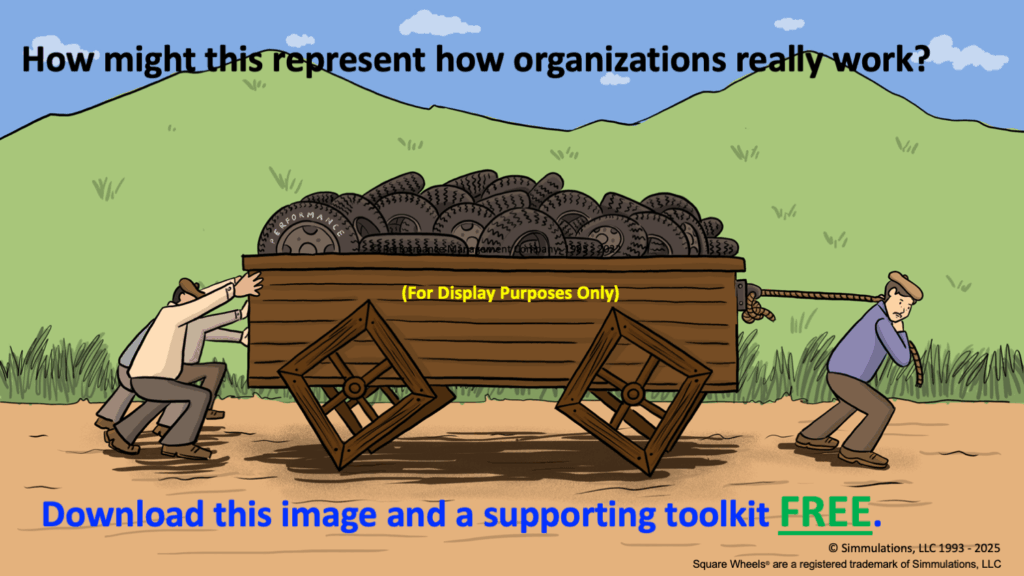
Click on the image to download the FREE Square Wheels® One image and instructor’s guide under a Creative Commons license
The problem is not a lack of ideas or energy. The problem is that the way we run meetings suppresses both.
From status updates to “people have the power” sessions
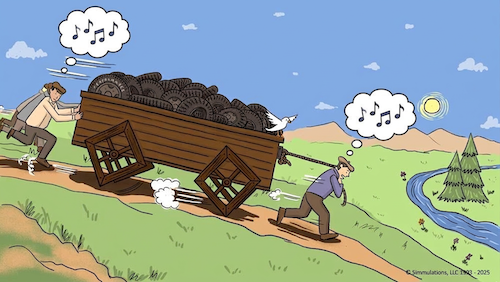
It’s good to get things rolling!
Imagine taking the song, “People Have the Power” and treating it as a design spec for your next meeting:
-
Everyone comes in knowing they will be asked to see and discuss the Square Wheels, not hide them or pretend they do not exist.
-
Everyone expects to help invent and implement round wheels, not wait for someone else’s plan.
-
The facilitator / leader is there to manage process and safety, not to own the content.
Here’s how a facilitator using Square Wheels could turn that chorus into a concrete practice.
1. Open with the Square Wheels image and metaphor, not the memo
Instead of starting with slides and updates, start with an image. Show the simple Square Wheels wagon you can get for free: a leader pulling, a team pushing, Square Wheels on the axles, and round ones in the wagon.
Ask a few short, open questions:
-
“Where do you see our Square Wheels around meetings or workflow?”
-
“What feels bumpy, slow, or frustrating right now?”
-
“Where are the unused Round Wheels—the ideas we haven’t tried yet?”
In that moment, you’re telling people, “You have the power to name reality here.” That is the first step toward empowerment: making it safe to accurately describe what is actually happening.
2. Move from complaint to co‑creation
Patti Smith wrote the song to remind people of both individual power and collective power—the power “through our union [to] turn the world around.” In facilitation terms, this is the shift from isolated grumbling to shared problem‑solving.
Listen, I believe everythin’ we dream
Can come to pass through our union
We can turn the world around
We can turn the earth’s revolution
After surfacing Square Wheels, have people work in small groups with the image in front of them:
-
Group 1: “Square Wheels in how we start meetings.”
-
Group 2: “Square Wheels in decisions and follow‑through.”
-
Group 3: “Square Wheels in collaboration across functions.”
Then pose a simple challenge:
“If people have the power, what round wheels could we put on this wagon in the next 30 days?”
You are channeling frustration into specific, testable round wheel ideas and possibilities: better agendas, clearer roles, visual decision logs, quick experiment cycles—whatever your team actually needs. The magic is that the ideas are theirs, not the facilitator’s.
3. Link Round Wheels to FLOW
In my recent writing, I’ve focused on how Square Wheels conversations can generate FLOW: that state where people feel absorbed, energized, and in control of meaningful work. Flow is not just an individual psychological experience; it is shaped by how the work system actually runs.
When teams use the Square Wheels image to redesign meetings, they often:
-
Reduce friction: less wasted time, fewer unclear expectations, more focused conversations.
-
Increase autonomy: more ownership of agenda items, clearer delegation of next steps.
-
Strengthen meaning: people see how their ideas directly change how the team works.
Research shows that flow partly mediates the link between feeling un-dis-empowered and actually taking charge. People who experience flow are more willing to propose and implement improvements—exactly the round wheel behaviors we want. “People Have the Power” becomes literal: the meeting design gives them the conditions to use the power they already had.
What the facilitator actually does differently
A facilitator or manager using Square Wheels One and this empowerment frame is not a charismatic hero. They are more like a careful stage director, setting up scenes where people can act. The Play is The Thing.
Some specific moves:
-
Design “rounds,” not monologues: everyone speaks early, even if only to answer a short question about some perceived current Square Wheel.
-
Make the image do the heavy lifting: keep the Square Wheels wagon in view as a shared language for friction and opportunity.
-
Normalize dissent as data: treat every Square Wheel comment as a contribution to improvement, not a complaint.
-
Anchor each idea in action: every round wheel idea gets at least a small experiment, an owner, and a due date.
Over time, the message is consistent: Your perceptions matter here. Your ideas matter here. Your experiments matter here. That’s what “people have the power” looks like in a Tuesday morning ops meeting.
Bringing it all together
Patti Smith wrote that she wanted the song to “remind the listener of their individual power but also of the collective power of the people, how we can do anything.” That line could be a mission statement for a Square Wheels‑based culture.
-
The Square Wheels image makes the friction visible and discussable without blame.
-
Round Wheels represent the improvements people already see but may not yet feel safe to propose or implement; they are possibilities until they become actionable and implementable.
-
Well‑designed meetings become the vehicle for turning individual insights into collective change and workplace flow.
Put the song and the image together, and you get a simple leadership challenge:
Don’t just tell people they have the power.
Design your meetings and use the discussions
so they can actually use the outcomes.
And when the wagons finally start rolling on Round Wheels and the work begins to flow, you will hear it: a different kind of music in the room. It may not sound like Patti Smith, but you will recognize the rhythm. It’s the sound of people who have the power, and who have finally been invited to use it.
—
For the FUN of It!
 Dr. Scott Simmerman is a designer of team building games and organization improvement tools.
Managing Partner of Performance Management Company since 1984, he is an experienced presenter and consultant who is trying to retire!! He now lives in Cuenca, Ecuador.
You can reach Scott at scott@squarewheels.com
Learn more about Scott at his LinkedIn site.
Note that I often use Perplexity AI to help research and generate ideas for my posts.
Square Wheels® are a registered trademark of Simmulations, LLC
and images have been copyrighted since 1993,
© Simmulations, LLC 1993 – 2026
What I’m About:
My Square Wheels blog and website exist to help leaders, trainers, and facilitators make work smoother, more engaging, and more human. I focus on practical tools for process improvement, organizational change, and workplace collaboration that spark insight and deliver measurable results.
And I am convinced, after 30+ years of using Square Wheels®, that it is the best facilitation toolset in the world. One can use it to involve and engage people in designing workplace improvements and building engagement and collaboration. It is a unique metaphorical approach to performance improvement and we can easily license your organization to use these images and approaches.
By blending proven facilitation methods, creative problem-solving, and engaging team activities, my mission is to support organizations in building energized, sustainable cultures of involvement and innovation.
Through accessible — and often free — resources and virtual facilitation tools, I aim to help teams everywhere collaborate more effectively, innovate continuously, and take ownership of their improvement journey.
#SquareWheels #InnovationAtWork #TeamEngagement #FacilitationTools #WorkplaceImprovement #EmployeeEngagement #CreativeProblemSolving #OrganizationalDevelopment #LeadershipTools #collaboration #leadership #motivation #communications #enablement #leadership #CreativeCommons #enablingperformance #teamwork #storytelling #storyasking

0 Comments