
It comes down to this: We CANNOT expect involvement and engagement if we play the Blame Frame Game. We simply cannot motivate people when we make them defensive.
(Note: This was originally published in 2014 and I thought to update this since I have had questions about The Blame Frame and motivation in the workplace. I hope you like it.)
How can we expect innovation and process improvement if we are not actually encouraging our people to share their thoughts and ideas and to try new things to improve how things work? How can we move away from them feeling blamed and defensive about their workplace into an un-dis-empowered and un-dis-engaged positive resource state?
Attack creates defensiveness; and performance appraisal and constructive criticism can certainly feel like an attack in the perception of the workers:
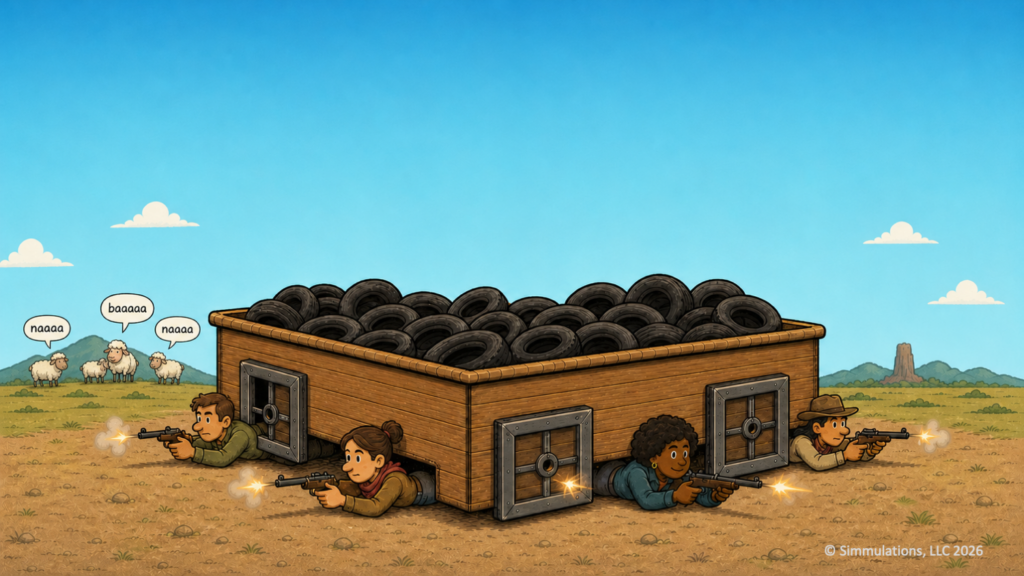
Circling the wagons and defending is NOT going to improve performance and the Spectator Sheep see that clearly
The Paradox of Perception
If we ask managers how they manage, they tend to give all the right answers. But is that really their tendency to act and perform in reality? Are their answers really about helping improve motivation and performance in their workplaces? Or, are we just helping them build the fortresses from which they defend themselves?
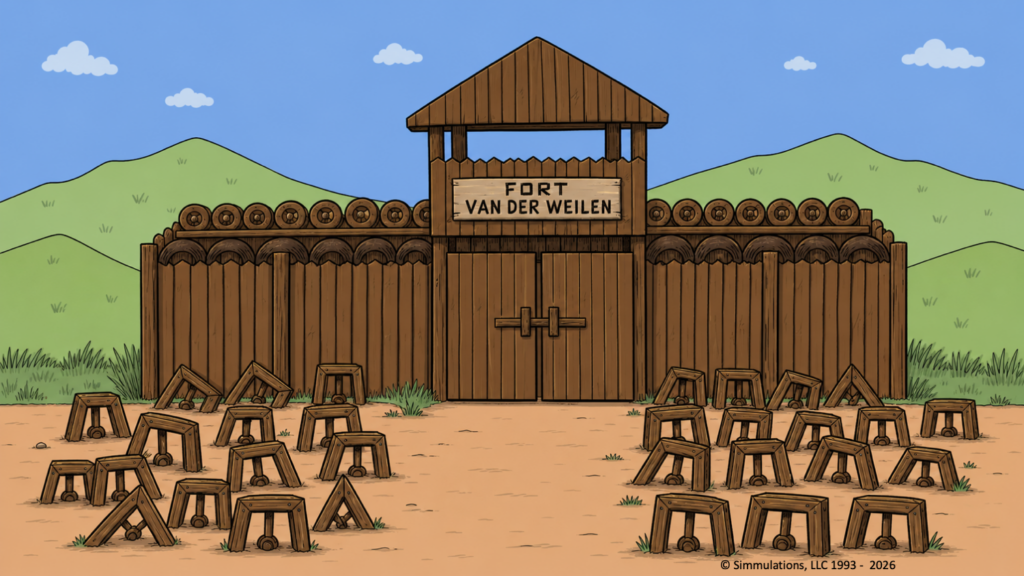
People build Fort Van Der Weilen when they feel they are under constant attack
In my “Keeping Things Simple – Involving and Engaging” blog, I shared this cartoon that we call, “Trial and Error“.

In the above image, 4 negatives for every positive.
In dozens of workshops, when I would ask managers to comment on the above illustration, they always focus on what is wrong, The ratio of negative to positive comments is about 4 : 1 and, if anything, the peer support appears more clearly in reactions to the different negative themes. The outlying positive comments do not generate many more positives.
In other words, four comments would focus on something negative about what they perceived was happening and what people in the image were doing wrong for every one comment on a good thing the managers might spot, such as they are stepping back and looking for more improvements and that the horse, will in reality push a wagon.
Mothers usually call this “constructive criticism,” but I am not sure what good purpose it serves to continually point out what people are doing wrong, “even if it is for your own good.” as we so often hear as kids and teenagers (and workers, in so many instances!).
What the managers tend to do looks like this. Then overlay a frame of blame for what is happening, as if that will somehow improve things.
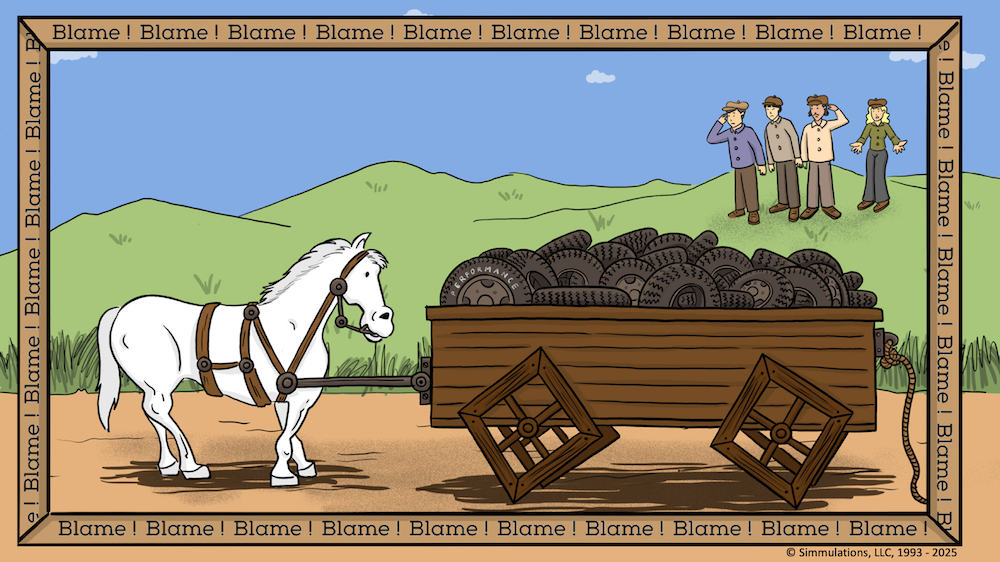
blame blame blame blame blame blame blame blame
A Blame Frame will not serve to improve motivation or make things better. If anything, this blame frame will make innovation harder and decrease the likelihood of people trying to be involved and engaged. People attacked will build the forts to protect themselves and peer pressure can work directly against management’s best interests.
Choose to look at things differently.
Note they this work team did add a horse to the wagon movement issue — more horsepower, as it were — and a definite paradigm shift. And YOU probably have not considered whether this might actually work. WILL a horse push a wagon? What if the next step simply looked like this:
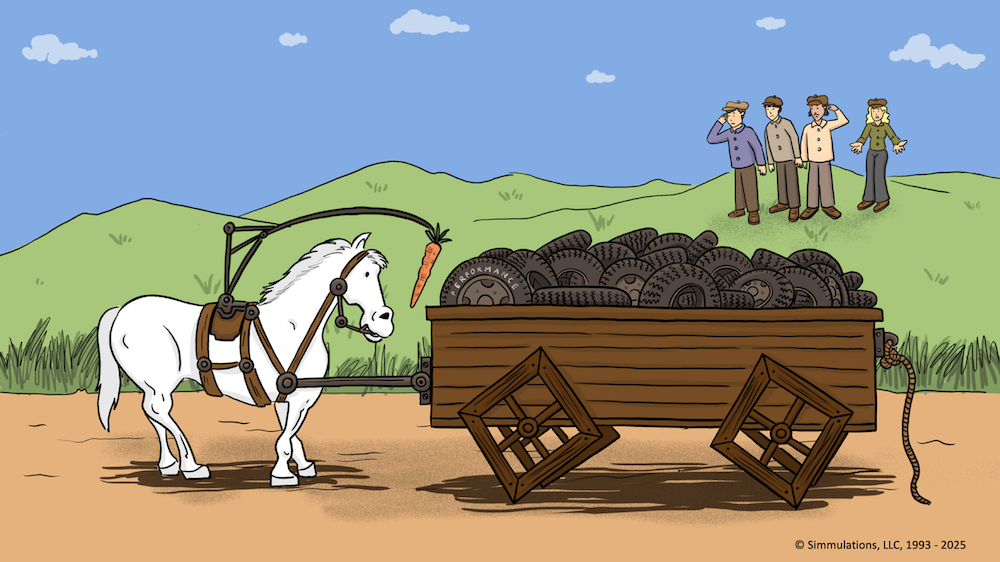
We add the carrot and get rid of the Blame Frame and all of a sudden, the horse WILL push the wagon!
WILL a horse push a wagon?
This are clear historical examples of a cart-like vehicle pushed from behind, but the strongest accounts do not establish that the animal was specifically a horse.
Pliny the Elder, in the first-century CE, described animals pushing a two-wheeled harvesting cart with an ox “with his head pointing towards the cart.” This would cause less damage to the crops when harvesting.
And a modern experimental reconstruction used a donkey named Marius, harnessed behind the collecting box, and successfully demonstrated the pushing arrangement, showing useful evidence of how this worked. Note that for a passenger wagon, this would put the exhaust pipe behind the wagon, which would make a difference in a town like Charleston, SC; an improvement for the passengers for sure.
ALL of us need to focus more on the innovative steps to improvement and the reality that change is a requirement in the workplace. So is support and encouragement — every book on leadership will comment on that but that is not congruent with the behavior of many managers.
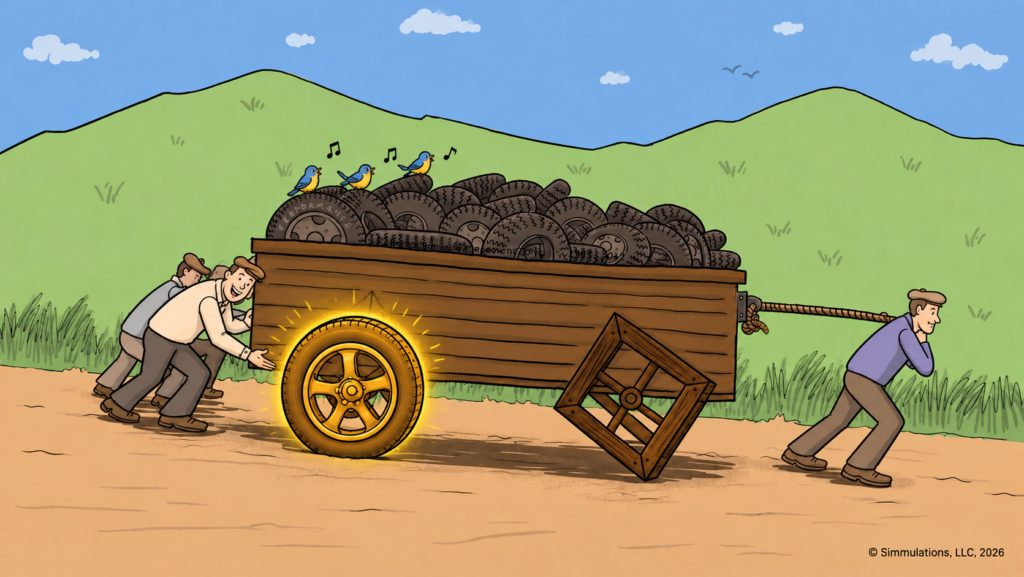
Improvement is a continuous process, one that requires celebration of what is accomplished and continued reflection on possibilities and potential shifts in resource utilization. One might think that there is a train in their future?

—
For the FUN of It!
 Dr. Scott Simmerman is a designer of team building games and organization improvement tools.
Managing Partner of Performance Management Company since 1984, he is an experienced presenter and consultant who is trying to retire!! He now lives in Cuenca, Ecuador.
You can reach Scott at scott@squarewheels.com
Learn more about Scott at his LinkedIn site.
Square Wheels® is a registered trademark of Simmulations, LLC
and images are © Simmulations, LLC 1993 – 2026
Note: Please do not take my images and think about using them. It can generate a whole heap of problems given international copyright law and trademark law. Read this article for more information.
See a detailed overview of my tools, background and experiences by clicking here.
What I’m About:
My Square Wheels blog and website exist to help leaders, trainers, and facilitators make work smoother, more engaging, and more human. I focus on practical tools for process improvement, organizational change, and workplace collaboration that spark insight and deliver measurable results.
And I am convinced, after 30+ years of using Square Wheels®, that it is the best facilitation toolset in the world. One can use it to involve and engage people in designing workplace improvements and building engagement and collaboration. It is a unique metaphorical approach to performance improvement and we can easily license your organization to use these images and approaches.
By blending proven facilitation methods, creative problem-solving, and engaging team activities, my mission is to support organizations in building energized, sustainable cultures of involvement and innovation.
Through accessible — and often free — resources and virtual facilitation tools, I aim to help teams everywhere collaborate more effectively, innovate continuously, and take ownership of their improvement journey.
#SquareWheels #InnovationAtWork #TeamEngagement #FacilitationTools #WorkplaceImprovement #EmployeeEngagement #CreativeProblemSolving #OrganizationalDevelopment #LeadershipTools #collaboration #leadership #motivation #communications #enablement #leadership #CreativeCommons #enablingperformance #teamwork #storytelling #storyasking #enablement #disruptiveengagement #un-dis-engagement #un-dis-empowerment #innovation
© 2026 Simmulations, LLC. Please note that “Square Wheels®” is a registered trademark of Simmulations, LLC. and materials, original wagon line art, text, and visual designs are protected. Original line art by Roy Sabean, used under rights owned by Simmulations, LLC and formerly Performance Management Company, a sole-proprietorship of Dr. Scott J. Simmerman. Original concept and source artwork © Simmulations, LLC; derivative visuals sometimes created with assistance from Perplexity Pro AI.

0 Comments