
Square Wheels: What they are and why they’re the world’s best facilitation tool — and ideas on how you can use them to enable performance
Most workplaces roll forward on “Square Wheels” – things that technically work but feel rough, inefficient, and frustrating. Square Wheels® tools give managers and facilitators an effective, visual way to help people see those bumps, talk about them safely, and generate better “round wheel” ideas together. In a single image and a simple process, you get engagement, insight, and a pathway to real improvement.
In this post I’ll explain what these Square Wheels® tools are, why they work so well with every audience from frontline supervisors to senior executives, and how you can use them to make any meeting or workshop more powerful and memorable. And, you can get the main image for FREE with a Creative Commons license for use. (You can find more information and download the Free Square Wheels One image here.)
-
What the Square Wheels tools actually are
-
Why the metaphor works across cultures and levels
-
How to run a simple Square Wheels session to enable change
-
When to use Square Wheels versus other team‑building approaches
-
Where to get the core images and toolkits
What are the Square Wheels tools?
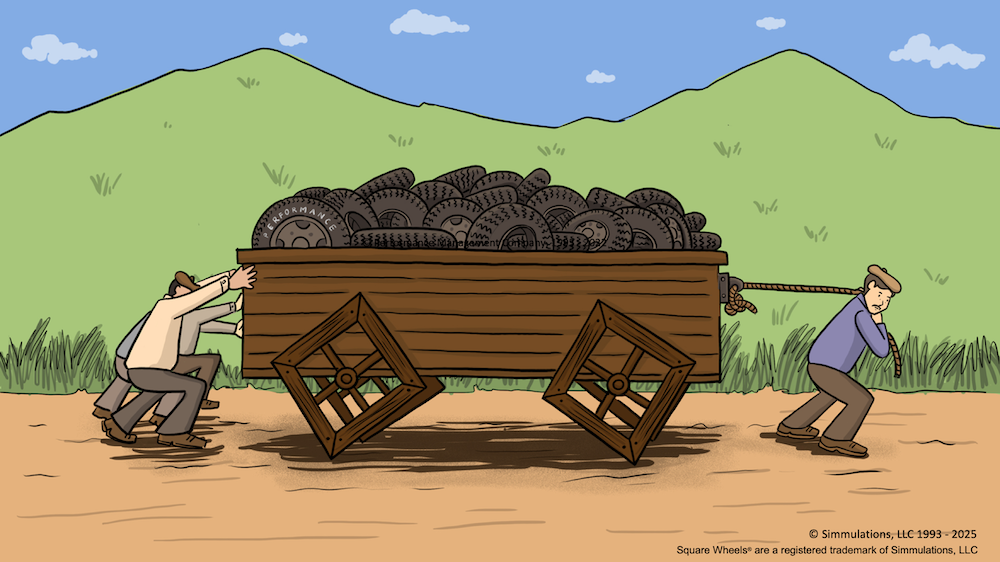
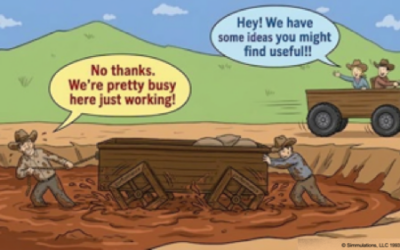
Square Wheels tools are a set of simple, visual metaphors and facilitation processes that help people talk about how work “really” happens and how it could be improved. The core image shows a wagon with square wheels being pushed and pulled along, while perfectly good round wheels already exist but are not yet being used. It is instantly recognizable, slightly funny, and endlessly useful.
Square Wheels One looks like this, which serves to frame the related frameworks and metaphors.
Over the years, I’ve created many dozens of related images – line art, LEGO® scenes, and these new full‑color images – that all focus on how organizations actually work. Each image becomes a prompt to ask, “How might this represent how things really work around here?” People project their own realities onto the images and quickly start describing their own Square Wheels and round wheel possibilities.
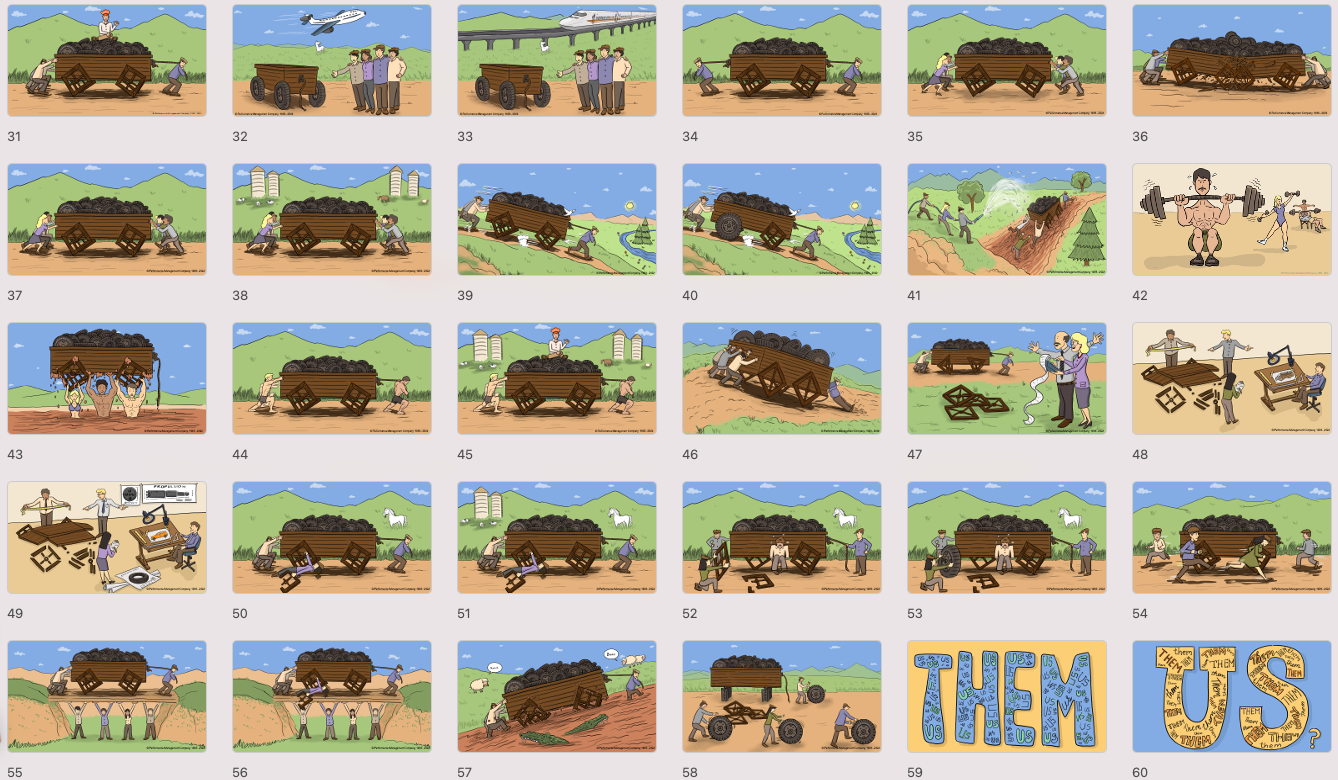
Some of the different related supporting images around Square Wheels
Because they are “just cartoons,” the tools feel safe and non‑threatening. And because they are metaphorical and open‑ended, they surface serious issues, opportunities, and insights that might never appear in a normal meeting or survey. And I know of nothing better to use to create the cognitive dissonance that motivates change.
Some of the 100+ responses we have gotten to the Square Wheels One image in different live sessions:

Why do Square Wheels work so well?
Square Wheels images are amazing because they combine three powerful elements: a vivid metaphor, a projective tool, and a structured group process.
First, the metaphor is instantly understandable.
People immediately see that the wagon is rolling, but not very well. The wooden Square Wheels represent things that work but do not work smoothly; the round wheels represent better ideas and processes that already exist but are not being used. That simple contrast creates cognitive dissonance – a natural tension between “the way things are” and “how they could be better” – and that tension motivates problem solving.
Second, the images function like a projective psychological tool.
Just like a Rorschach inkblot, different people see different things in the same image based on their experience, role, and history. They project their beliefs, frustrations, and hopes onto the wagon, the puller, the pushers, and the workplace environment. That makes the conversation personal, relevant, and rich without it feeling like a personal attack.
Third, the facilitation process is straightforward but powerful.
You give people time to think individually, talk in small groups, and then build collective themes and priorities. You move from “what do you see?” to “what are our Square Wheels?” to “what round wheel ideas could we implement?” The process creates ownership, alignment, and practical next steps. It enables people to be actively involved and engaged, really powerful impacts.
The result is a toolset that consistently generates active involvement, divergent thinking, collaboration, and concrete action items – with almost any audience, in almost any culture, in surprisingly little time.
What issues can the Square Wheels metaphor help you address?
Because Square Wheels is so flexible, facilitators use it in a wide range of situations. At a high level, the metaphor supports several core themes:
-
Inefficiency of current processes – making it easier to talk about outdated systems, broken procedures, and unnecessary friction.
-
Innovation and improvement – helping people imagine better ways of doing things and see “round wheels” that already exist.
-
Employee engagement and ownership – involving team members in identifying problems and generating solutions, instead of just reacting to top‑down change.
-
Change management – using the shift from square to round wheels as a simple picture of how change feels and why it’s necessary.
-
Visualization of problems – turning abstract complaints into concrete images that everyone can see and discuss.
-
Collaboration across departments – using wagon‑train images and similar scenes to talk about silos, resource sharing, and cross‑functional work.
Once a group has “Square Wheels language,” issues and ideas become easier to name. People start saying things like, “That’s a big square wheel we’ve been dragging around,” or “We’ve got a round wheel idea here we should implement.” This is not some complicated and difficult tool to try to embed somehow but a really simple framework with incredible race validity.
How do you run a simple Square Wheels session to enable change?
You can run a powerful Square Wheels session in 60–90 minutes with almost any group size if you follow a few simple steps. (Or, you can do it as a flash, 10-minute conversation to get things rolling.)
1. Show the image and set the stage
Display the core Square Wheels image (or another one that fits your theme) and ask people to look at it silently for a minute. Then ask a simple, open question such as:
-
“How might this represent how things really work around here?”
-
“Where do you see square wheels in this picture?”
-
“What might the round wheels represent in our work?”
This opens the door to safe, metaphorical discussion.
2. Use small groups to generate ideas
Have participants work in small groups (4–6 people at a table or breakout) to share what they see. Encourage them to list:
-
The square wheels they notice in the image and in their own work.
-
The round wheels – ideas, resources, processes – that already exist but are underused.
The diversity of perspectives is where the real value appears.
3. Build a collective picture and prioritize
Ask each group to share a few key points with the whole room. Capture:
-
The most important square wheels people agree are holding them back.
-
The most promising round wheel ideas that could be implemented.
Then help the group cluster and prioritize these into a short list of high‑impact changes.
4. Move from ideas to commitments
For each priority square wheel, ask the teams to propose at least three round wheel ideas or actions. Then ask:
-
“What can we do in the next 30 days to start rolling on one of these round wheels?”
-
“Who needs to be involved, and what support is required?”
This last step turns a creative discussion into a practical implementation plan – even if it’s just a first step. It is really simple to link the use of the metaphor to the ideas of conscious competence, to know you know.
What makes Square Wheels the “world’s best facilitation tool”?
After more than 30 years of using Square Wheels with every kind of audience – from 12‑year‑old students to senior executives, in small teams and in very large groups around the world – I’m totally convinced it is one of the most versatile and robust facilitation toolsets available. (And you can find more information about the origin of these tools here.) I’ve been to 1000 workshops and seminars, like many of you, and I have never seen anything work better.
Here are a few reasons why:
-
It works with almost any audience. People at all levels “get it” quickly and enjoy the process, regardless of function, culture, or industry. And the language of Square Wheels is universal!
-
It scales from small groups to hundreds of participants. You can use it in a quick staff meeting or a major conference general session. My biggest interactive session was 1500 people and the energy was amazing.
-
It supports many facilitation goals. Engagement, problem solving, continuous improvement, leadership conversations, innovation, culture change – the same images can be used for different objectives with different questions. It enables people to choose to do things differently through their choices.
-
It is simple to learn and use. Internal managers and supervisors can run sessions effectively with a clear guide; you don’t have to be a full‑time professional facilitator. Anyone can engage people by showing the image and simply asking, “How might this represent how things really work?”
-
The metaphor sticks. People remember the images and conversations years later and keep using “Square Wheels” and “round wheels” as part of their internal language about improvement. I have had people tell me about participating in one of my sessions more than 20 years later!
In practice, Square Wheels becomes a reusable platform: you can return to the same images over months and years as your team tackles new issues and opportunities. I literally have users who have used the images for three decades in their organizational development efforts.
The round wheels of Today
become the Square Wheels of Tomorrow.
When should you use Square Wheels vs. other team‑building approaches?
Square Wheels is not a ropes course, an escape room, or a heavy business simulation. It fills a different, highly practical niche that relates directly to the workplace.
Square Wheels is especially useful when:
-
You want a low‑logistics, high‑impact way to start honest conversations about real work.
-
You need to involve many people quickly in surfacing issues and ideas.
-
You’re working with supervisors, managers, and intact teams who have been living with the problems every day.
-
You want to build active ownership involvement for improvement by having people generate and choose their own solutions.
A key principle for generating innovation and for leading change:
Nobody ever washes a rental car.
For larger, more immersive events where you want teams to experience complex collaboration, competition, and implementation under time pressure, The Search for The Lost Dutchman’s Gold Mine is often a better choice. Square Wheels and Dutchman complement each other: one focuses on visualizing and discussing reality; the other lets people live through it in a simulation.
Why a single image can change the conversation
The power of Square Wheels isn’t just in the image; it’s in what happens when people talk about it and see what they see. The image gives you:
-
A neutral theme to talk about, so criticism of systems doesn’t feel like criticism of people.
-
A shared reference point that cuts across hierarchy and language.
-
A very simple repeatable process you can use in different meetings to keep improvement moving.
Once something in your organization is labeled as a “Square Wheel,” it becomes something that obviously needs to be addressed – and everyone understands that the round wheels already exist somewhere. That simple mental model can shift how people look at problems for years. This gap between square and possible round creates the cognitive dissonance that is a primary driver of motivation to change.
Quick FAQs about using Square Wheels
1. Do I have to be a professional facilitator to use Square Wheels?
No. Most of the time, internal managers, HR professionals, or learning leaders can run Square Wheels sessions effectively with clear instructions and a bit of preparation. The key is creating psychological safety, asking good questions, and giving people time to think and talk. You can make these tools excellent tools for your facilitation and training business. My goal is to get supervisors to use these simple tools to deal with the 79% worker disengagement.
2. How much time do I need for a useful Square Wheels session?
You can do meaningful work in 60–90 minutes if you focus on a single theme such as engagement, collaboration, or process improvement. Longer workshops simply give you more time for deeper problem solving, prioritization, and action planning.
3. What kinds of groups are Square Wheels best for?
Square Wheels works well with intact work teams, supervisor and manager cohorts, cross‑functional project teams, and leadership groups. The core idea is to bring together people who share a reality and give them a safe way to surface issues and generate “round wheel” ideas.
If you want a ready‑to‑use way to bring this into your organization, you can start with the core Square Wheels® images and facilitation toolkit and use the simple process above to run your own sessions with teams, supervisors, and leaders. Let’s collaborate and build out your toolkit for improvement,
—
For the FUN of It!
 Dr. Scott Simmerman is a designer of team building games and organization improvement tools.
Managing Partner of Performance Management Company since 1984, he is an experienced presenter and consultant who is trying to retire!! He now lives in Cuenca, Ecuador.
You can reach Scott at scott@squarewheels.com
Learn more about Scott at his LinkedIn site.
Square Wheels® are a registered trademark of Simmulations, LLC
and images have been copyrighted since 1993,
© Simmulations, LLC 1993 – 2026
What I’m About:
My Square Wheels blog and website exist to help leaders, trainers, and facilitators make work smoother, more engaging, and more human. I focus on practical tools for process improvement, organizational change, and workplace collaboration that spark insight and deliver measurable results.
And I am convinced, after 30+ years of using Square Wheels®, that it is the best facilitation toolset in the world. One can use it to involve and engage people in designing workplace improvements and building engagement and collaboration. It is a unique metaphorical approach to performance improvement and we can easily license your organization to use these images and approaches.
By blending proven facilitation methods, creative problem-solving, and engaging team activities, my mission is to support organizations in building energized, sustainable cultures of involvement and innovation.
Through accessible — and often free — resources and virtual facilitation tools, I aim to help teams everywhere collaborate more effectively, innovate continuously, and take ownership of their improvement journey.
#SquareWheels #InnovationAtWork #TeamEngagement #FacilitationTools #WorkplaceImprovement #EmployeeEngagement #CreativeProblemSolving #OrganizationalDevelopment #LeadershipTools #collaboration #leadership #motivation #communications #enablement #leadership #CreativeCommons #enablingperformance #teamwork #facilitation #enablement

0 Comments