
The “Supervisor Hellscape” Wicked Problem is an organizational reality globally and we must Step Back from the Wagon fix it and enable people to perform.
Executive Summary
Supervisors form the backbone of organizational performance. Yet across industries, supervisors report record levels of stress, burnout, and disengagement. This situation, what I call the Supervisor Hellscape, reflects not just poor training or misaligned incentives but a wicked problem: an interdependent, systemic issue that defies simple fixes and requires overall organizational commitment to address.
Drawing on the Square Wheels metaphor and supporting tools, this report proposes that leaders at every level step back from the wagon, to disengage and reflect on the entire system that shapes supervisory work. Instead of training individuals to survive chaos and resist burnout, organizations must redesign their wagons so supervisors can actually lead effectively.
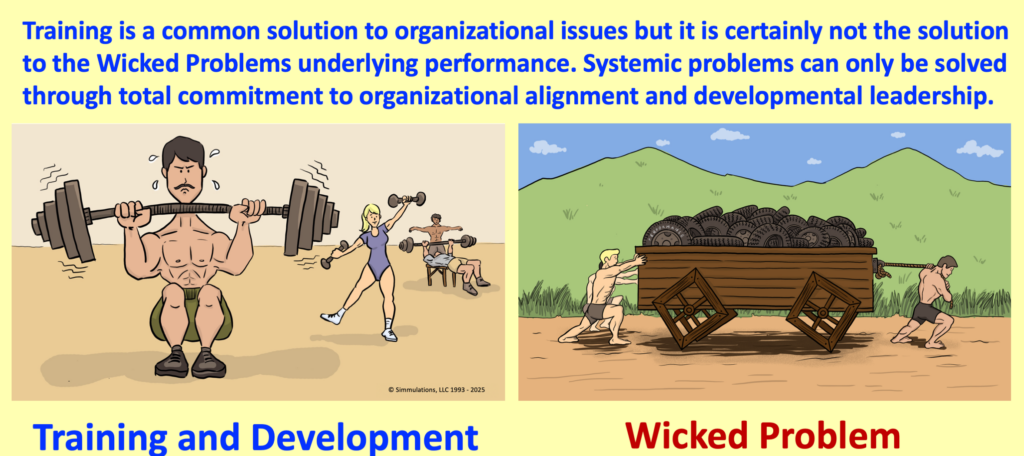
Why your Supervisor Hellscape is a Wicked Problem
Supervisors sit at the crossroads of organizational performance — too often caught between upper management’s expectations and frontline realities. Across industries, we’re seeing what I’ve been calling a Supervisor Hellscape, a global workplace environment where supervisors are undervalued, overworked, undertrained, and overstressed, yet held accountable for engagement, productivity, quality and culture.
For decades, we have been treating this as a typical HR or training issue and not a real issue for senior managers who are often too isolated from the workplace. It is often viewed as something fixable with a new competency model, a workshop, or coaching program. But when we look more closely, we see that supervisor ineffectiveness has all the fingerprints of a Wicked Problem.
A Wicked Problem, as Thomas Friedman and others have described it, is one that resists quick fixes or permanent solutions. It involves tangled systems, where culture, communication flows, workload expectations, and morale are all interacting in ways that make simple interventions insufficient. Solutions aren’t ever final; they’re just “better or worse.” And each attempt at improvement often creates unintended, sometimes irreversible negative consequences. For many supervisors, the pin has hit the balloon and they are disengaged (Gallup, 2025).
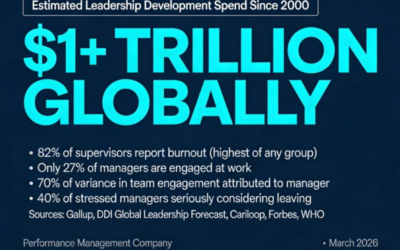
When 70% of your supervisors are disengaged,
you have a real organizational problem with most everything.
Supervisors are operating in complex, high-demand conditions shaped by contradictory expectations:
-
Performance pressure from above (deliver metrics, implement change, drive engagement).
-
Emotional labor from below (mediate conflicts, coach employees, generate results, ensure well-being).
-
Operational overload from sideways (cross-department coordination, compliance, and reporting).
The Supervisor Hellscape framework fits a Wicked Problem description perfectly. It’s rooted in:
-
Role overload, where supervisors juggle technical performance, compliance, engagement, and emotional support.
-
Systemic disconnects, where senior leaders and HR design processes without really understanding their real-world frictions and hands-on realities, combined with organizational silos blocking collaboration.
-
Limited feedback loops, where supervisors’ voices don’t influence organizational redesigns.
-
Cultural inertia, where fixing supervisor stress is seen as a personal issue, not a systemic operational one.
As defined by Horst Rittel, Thomas Friedman, and others, a Wicked Problem:
-
Has no definitive formulation — it evolves as you try to solve it.
-
Has no true or false solutions — only better or worse.
-
Has complex and interconnected causes and consequences.
-
Resists standard templates for solutions.
Supervisor effectiveness (aka, the Supervisor Hellscape) fits this perfectly. It’s tangled in structures (reporting lines), cultures (micromanagement norms), and outdated HR systems (competency frameworks that ignore real work complexity). “Fixing” one element — say, a new coaching course — barely scratches the surface because the friction is built into the wagon’s design. Remember that 70% of the supervisors, globally, are disengaged!
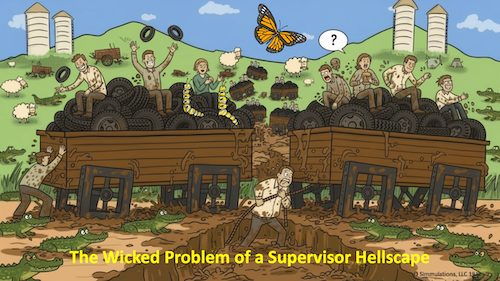
Research shows your Supervisory Hellscape Wicked Problem is unsustainable:
-
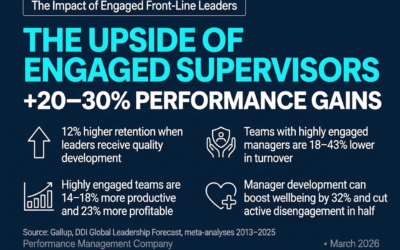
Meta-analyses of engagement show that poor supervisor support explains at least 60% of variance in employee engagement and retention, with similar impacts on productivity.
-
Front-line managers account for about 70% of the variance in team engagement scores, making the supervisor layer the single biggest lever for performance and retention in the organization.
- Roughly 79% of workers are disengaged, meaning most employees are watching the Square Wheels go around rather than fixing them, and supervisors sit at the center of that disengagement pattern.
-
Around 60% of new managers receive no formal leadership training, and about 82% of leaders describe themselves as “accidental managers,” creating a massive, systemic capability gap in the very roles that shape culture and engagement.
-
Employees working for untrained or ineffective managers are 56% more likely to be disengaged, and about 33% say bad management makes them less motivated to do their work, turning supervisor skill deficits directly into lost performance.
-
Supervisors themselves are burning out: managers are about 36% more likely to report burnout than individual contributors and 24% more likely to say they are considering leaving their roles in the next six months, which means the “hellscape” is driving out the very people expected to fix it.
(even more statistics and metrics and links to data sources are here)
Modern organizations have become a maze of interdependent parts, each shaped by its own agendas, pressures, and priorities. Whether we’re talking about corporate hierarchies, cross-functional silos, HR systems, or layers of management, the workplace often mirrors a living ecosystem that’s grown dense and tangled over time.
In that environment, supervisors are the ones trying to make it all work, juggling performance demands, compliance pressures, and people needs without enough clarity, support, or empowerment. It’s easy to look at that mess and conclude that fixing it is impossible, that the system is too complex and everyone’s incentives too misaligned. But complexity isn’t the enemy — misalignment and inertia are.
What organizations need most now isn’t another initiative or training series; it’s better leadership architecture and real enablement systems that give supervisors room to lead, learn, and actually make work work.

The reality and the perception of reality. Alignment is critical to performance.
Bringing in Square Wheels® tools to implement round ones
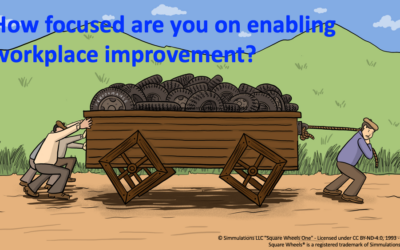
This is where the Square Wheels metaphor and visuals becomes practical diagnosis and a useful tool for change, not just storytelling. Ask most supervisors how things are going, and you’ll hear about friction, inefficiency, and exhaustion. They’re pushing and pulling a wagon with Square Wheels and not being able to implement round ones. And these are good people trapped in a problematic system that makes progress harder than it needs to be.
Square Wheels invites people to “step back from the wagon” — to pause the grind long enough to look objectively and collectively at our processes and policies. What’s slowing things down? What’s missing from the wagon? How can we start replacing some Square Wheels with round ones that actually roll?
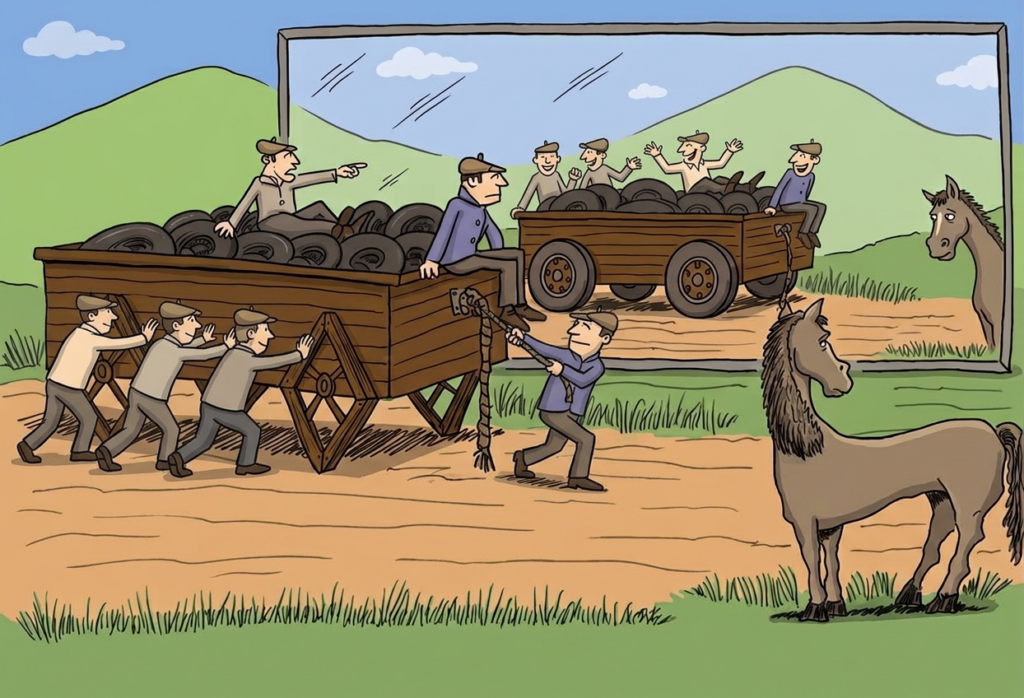
We need to get the work teams starting to reflect on the possibilities for improvement. It all starts with them! We need the focus of the supervisor.
In the case of supervisor effectiveness, stepping back helps leaders admit that the problem isn’t about the individuals. It’s about the system design — how expectations and supports have been misaligned over time. When supervisors are caught in a wicked system, every improvement effort needs reflection and iteration. And their people DO have ideas for making improvements in how things are done.
The path forward isn’t a single fix; it’s a continuous cycle: diagnosis, dialogue, redesign, implementation and continued listening. Using Square Wheels images and facilitated sessions helps organizations generate that shared understanding — surfacing frustrations and reframing them as engineering challenges rather than personal failings.
Turning Wickedness into Learning
A wicked problem doesn’t mean hopelessness; it means ongoing learning. With tools like Square Wheels, leaders can convert organizational noise into actionable conversations. Supervisors gain the language and structure to describe what’s not working without fear of blame, and teams begin co-creating better wheels together.
If we frame supervisor stress and burnout as a wicked problem, we shift the mindset from “why can’t they cope?” to “what design choices are creating the friction?” That’s the essence of engagement — not pushing harder, but learning to roll smarter.
What I am going to do below is wander around the workplace a little and offer up some different ideas and alternatives, since this IS a wicked problem. Some may resonate and some may not but I offer them up as possibilities. Roll with the ones that resonate!
Applying the Square Wheels Lens
Complex organizational challenges are rarely solved from inside the wagon or at the top of the organization. Often, the middle manager sits on top and can only feel the thumps and bumps and they may not actually see solutions. This is different from the “hands on view” of the workers and thus their ideas are critically important for generating change and ownership involvement in addressing the problems.
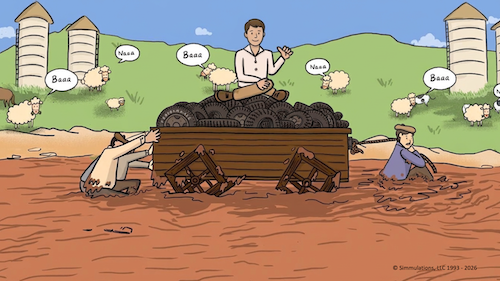
Middle managers tend to ride on top of the wagons, aware of the thumping and bumping but not the causes of the problems. They cannot fix the wicked problems.
The Square Wheels metaphor invites leaders to ask their people and to step back, observe, and rethink how work actually happens. Supervisory challenges, especially those producing burnout and disengagement, often stem not from individual failings but from the mechanics of the system — Square Wheels thumping and bumping and making progress unnecessarily difficult.
The methodology unfolds in three key steps:
Step 1: Stepping Back from the Wagon
Before launching another initiative or coaching program, leaders must create reflective space to examine supervisory work as it truly is. This means pausing the constant motion of “performance management” long enough to ask:
-
Which parts of the system create unnecessary friction?
-
What’s missing? — What is the support, permissions, clarity, or tools do the supervisors need?
-
Who’s pushing versus steering? Are executives aligned with grounded realities? Are they out MBWA or doing Gemba Walks?
A facilitated Square Wheels session visualizes this discussion. Participants sketch or annotate how their wagon currently moves — who does the heavy pushing, where obstacles arise, and what “round wheels” (ideas for improvement) might be lying unused in the background.
This simple act of stepping back and asking for ideas reframes complaints into systems improvement language. It transforms individual frustration (“I’m drowning in reports”) into structural insight (“Our reporting process is our biggest Square Wheel”). We need to enable fixes.
Step 2: Engage People in the Discovery Process
The power of Square Wheels enablement lies in shared sense-making. Instead of diagnosing problems from the top down, invite supervisors and their teams to identify where the wheels are square. Common examples include:
-
Duplicative administrative work.
-
Misaligned priorities across departments.
-
Conflicting metrics that penalize collaboration.
-
Communication overload coupled with poor feedback flow.
-
Policies that add compliance friction without clear value.
They can give you dozens of these, based on my experience facilitating similar groups. When these barriers surface collectively, teams can distinguish between “controllable quick fixes” and “structural drags.” This creates emotional safety — supervisors stop blaming themselves for systemic friction and start co-creating improvements with peers.
Example:
In a regional logistics firm, middle managers reported spending over 10 hours weekly on redundant administrative reporting. This can be hundreds of hours in large organizations for weekly reports that often are not even useful. Using the Square Wheels model, they mapped those Square Wheels in a workshop. The discovery? Different divisions were requiring separate but overlapping status updates. The round wheel was obvious once visualized: consolidate data entry and share automated dashboards. Six months later, reporting time dropped by 40%, and burnout scores declined by nearly one-third while throughput improved measurably.
Or, read about The Hubcap Report here.
Step 3: Prototype Round Wheels
Recognizing friction isn’t enough — organizations must use the cognitive dissonance about issues and opportunities to pilot round wheels and iterate. These prototypes can take many forms:
-
Clarify supervisory boundaries (reducing “invisible” expectations).
-
Adjust metrics to include team development and collaboration quality, not just output and measure failures as successes.
-
Simplify reporting and approval processes using digital collaboration tools.
- Try to eliminate some of the reporting that is not highly valuable or reduce the frequency of reporting from weekly to monthly. This is EASY!
-
Rebalance workloads by redistributing accountability more equitably across functions. Give the average performers more to do.
-
Introduce reflective pauses — quarterly supervisor roundtables or peer-learning forums — so continuous improvement remains continuous.
Prototyping emphasizes learning, not perfection. Every test produces new insights about what works and what creates unintended consequences — consistent with the nature of wicked problems. The goal isn’t a final fix, but continuous refinement toward smoother rolling performance. Develop a culture of implementing improvements and understand that things are continually shifting.
4. Organizational Implications and Levers for Action
Addressing the Supervisor Hellscape demands that organizations approach development as systemic design, not remedial training. Supervisors don’t need more resilience training workshops; they need systems and tools and permissions to implement changes that make their work sustainable.
Six actionable levers can guide transformation:
-
Clarify the Work System
Move beyond static job descriptions. Conduct activity-based workload mapping to quantify how supervisors actually spend time versus what the organization expects. The insights will expose deep misalignments between formal roles and lived reality. And there is plenty of benchmark data out there. -
Build Feedback Loops
Create mechanisms where supervisors can safely raise system-level feedback — workflow gaps, policy overload, or cross-functional tension — and ensure leadership responds visibly. A closed-loop process signals psychological safety and organizational maturity. -
Align Metrics
Replace pure output measures with enablement metrics — indicators that assess how supervisors empower, coach, and sustain their teams. Balanced Scorecards or OKR frameworks can integrate such metrics. (Read more about Moneyball Metrics here) -
Enable Peer Learning
Formalize communities of practice or “supervisor circles.” These peer forums shift learning from top-down training toward collaborative problem-solving, where supervisors share both wins and wheel-spinning frustrations. -
Simplify Tools and Technology
Supervisory overload often hides in technological bloat. Simplify dashboards, communication channels, and analytics platforms to reduce cognitive drag. Each extra click, report, or meeting adds friction to the wagon. -
Revisit Leadership Assumptions
Executives must view supervisory strength as a collective capability rather than a trait of heroic individuals. Develop systems that design support — not reliance on personal endurance — into the organization’s structure.
5. Framework for Implementation: The Square Wheels Diagnostic
To operationalize these insights, organizations can deploy a structured, conversation-driven process — the Square Wheels Diagnostic. This integrates systems thinking, participative design, and iterative learning. This is great for you systems thinkers:
This model embodies Rittel’s maxim that wicked problems cannot be “solved” by experts alone — the system must be engaged in solving itself.
Each phase deepens engagement, producing both insight and commitment. The discovery and dialogue stages build belonging and trust, while design and deployment generate tangible operational improvements. Continuous Continuous Improvement is the operational goal.
I hope that you find a few silver bullets within the above content. The Truth is Out There and we CAN focus on the work and the supervisors to make significant overall improvements in how things really work within your organization. My long view is that we MUST make improvements at the front-line to really impact people and performance.
If I can help, connect with me,
—
For the FUN of It!
 Dr. Scott Simmerman is a designer of team building games and organization improvement tools.
Managing Partner of Performance Management Company since 1984, he is an experienced presenter and consultant who is trying to retire!! He now lives in Cuenca, Ecuador.
You can reach Scott at scott@squarewheels.com
Learn more about Scott at his LinkedIn site.
Note that I often use Perplexity AI to help research and generate ideas for my posts.
Square Wheels® are a registered trademark of Simmulations, LLC
and images have been copyrighted since 1993,
© Simmulations, LLC 1993 – 2026
What I’m About:
My Square Wheels blog and website exist to help leaders, trainers, and facilitators make work smoother, more engaging, and more human. I focus on practical tools for process improvement, organizational change, and workplace collaboration that spark insight and deliver measurable results.
And I am convinced, after 30+ years of using Square Wheels®, that it is the best facilitation toolset in the world. One can use it to involve and engage people in designing workplace improvements and building engagement and collaboration. It is a unique metaphorical approach to performance improvement and we can easily license your organization to use these images and approaches.
By blending proven facilitation methods, creative problem-solving, and engaging team activities, my mission is to support organizations in building energized, sustainable cultures of involvement and innovation.
Through accessible — and often free — resources and virtual facilitation tools, I aim to help teams everywhere collaborate more effectively, innovate continuously, and take ownership of their improvement journey.
#SquareWheels #InnovationAtWork #TeamEngagement #FacilitationTools #WorkplaceImprovement #EmployeeEngagement #CreativeProblemSolving #OrganizationalDevelopment #LeadershipTools #collaboration #leadership #motivation #communications #enablement #leadership #CreativeCommons #enablingperformance #teamwork #storytelling #storyasking

0 Comments