
Three Things about The Managers Who Will Survive the AI Era and help their people and organizations prosper that are not about “Leadership.”
The question is no longer whether AI will change the structure of organizations. It already has.
Jack Dorsey, for example, cut more than 4,000 of Block’s roughly 10,000 employees this year and told shareholders those jobs are “not coming back,” pointing directly to AI productivity gains as the reason (from Reuters and The Guardian).
Bayer eliminated roughly 40 percent of the management positions in its U.S. pharmaceutical division as part of a deliberate push to flatten the hierarchy and push decisions down to self-directed teams (Fortune).. Bayer board member Heike Prinz put a number on the ambition: from as many as twelve layers between the CEO and the customer down to five or six across the whole company (BioPharma Dive).
Organizations are getting flatter. Layers are being removed. Companies are no longer hiring supervisors and management of people is changing with increased spans of control and using AI to provide performance feedback. And the managers who aren’t paying attention are going to find themselves on the wrong side of a shift moving faster than most people realize.
The more useful question isn’t whether organizations will change. It’s whether you will be one of the managers who survives and thrives when they do.
Three Things That Will Determine Your Future
The managers who come out of this era stronger are not necessarily the most technically sophisticated or the most senior. They do three specific things well: they create clarity, they build real relationships across the organization, and they lean into change instead of defending the status quo.
Here’s the part nobody is saying out loud: all three of these are exactly the problems I’ve been using a simple wagon cartoon to solve for more than thirty years. My Square Wheels® One illustration (below) shows a wagon rolling on wooden Square Wheels, thumping and bumping along, while a whole bunch of perfectly good round wheels sits unused in the cargo behind (Performance Management Company blog post). It’s a picture of every organization I have ever worked inside and outside. And it turns out to be a pretty precise diagnostic for who survives a flattening organization and who doesn’t.
Clarity: Stop Pulling the Wagon Blindly
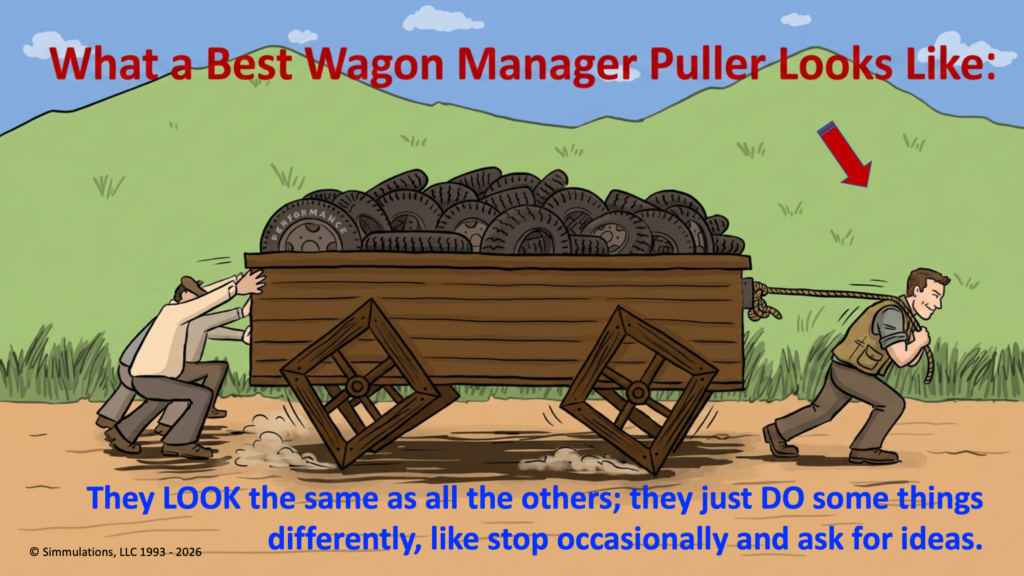
Someone has to set the priorities. Someone has to decide what success looks like this quarter, in this market, and say it in a sentence people can repeat back — not bury it in a 14-slide deck. AI can analyze data and automate a process, but it cannot walk into a room and decide what matters most for your team, right now. That’s a human judgment call, and it’s the first thing that separates managers who get cut from managers who get promoted. The system will help, but the manager’s insights and the peoples’ ideas will make things happen.
In Square Wheels terms, the Wagon Puller who never turns around to look at the wagon is the manager creating the confusion. Clarity is the person at the front stopping the wagon just long enough to say and share, “Here’s where we’re going, here’s what matters, here’s why.” Three things I suggest managers do this week:
- Name your three to five priorities out loud, in one sentence each. If you can’t fit them on an index card, you don’t have priorities — you have a wish list.
- Ask your team to repeat your priorities back to you, unprompted. If they can’t, you don’t have clarity. You have a memo nobody read.
- Kill one initiative that isn’t in your top five. Clarity isn’t what you add. It’s what you have the discipline to stop pulling.
This last one is about getting rid of the red bricks that exist in your organization.
See this short blog on Red Bricks and Square Wheels One.
Relationships: Step Away from Your Wagon and Look Around
The managers who will thrive in this new world aren’t the ones who run their own team well and disappear into their office. They’re the connectors, the people who work cross-functionally, break down silos, and build trust with people who don’t report to them and never will. Vertical, top-down authority is worth less every year Bayer and Block-style flattening continues and will continue. Horizontal influence — moving people and projects across an organization because of your influence without relying on your title — is worth more.
(see this blog on MBWA and Gemba Walks)
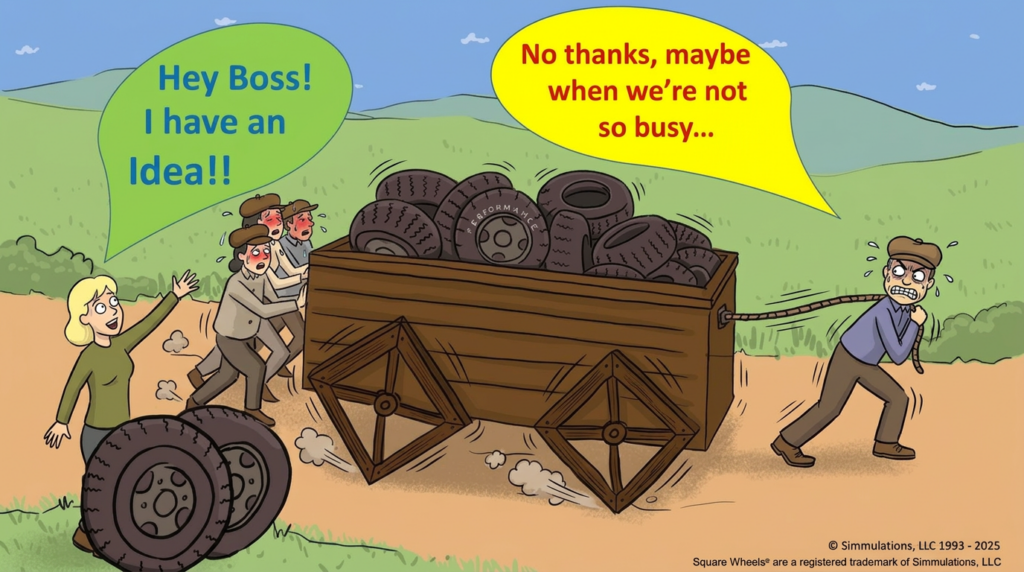
This is the single most consistent finding from 3+ decades of Square Wheels facilitation work: “All of us know more than any of us.” Every group I’ve ever run through my engagement and innovation exercise generates pragmatic ideas the manager never would have found alone, simply because the Wagon Pushers feel and see things the Wagon Puller cannot see from the front. If you’re not known, both inside and outside your own team as someone who does this, that’s worth you fixing before the org chart gets flatter and does it for you.
- Make problems discussable. Ask people what’s slowing them down without triggering blame. That single behavior is the biggest driver of whether people tell you the truth.
- Ask a question this week you’ve never asked before: “What’s a round wheel — a better way of doing something — that already exists somewhere in this organization but that nobody’s using?” Ask it in a department that isn’t yours.
- Build one relationship a month with someone two levels away or in a different function. Horizontal capital compounds. Vertical authority doesn’t.
Change: The Round Wheels Are Already in the Wagon
The managers who get cut first are the ones who defend the status quo, who are skeptical of new tools, who say out loud they’re “not really a change person.” That’s no longer a personality quirk organizations can afford to accommodate. The managers whose value is rising are the ones spending evenings experimenting with what AI agents can actually do, showing up to meetings with current vocabulary, and treating change as the job rather than an interruption to it.
Here’s the twist most people miss about my metaphor: the ironic cargo in that wagon is a big pile of round rubber tires. The solution to the bumpy ride is already onboard. It’s sitting right there. Nobody has to invent it. Someone just has to stop, look back, and choose to install it (LinkedIn). As that Arby’s commercial used to say, “We have the meats!”
or
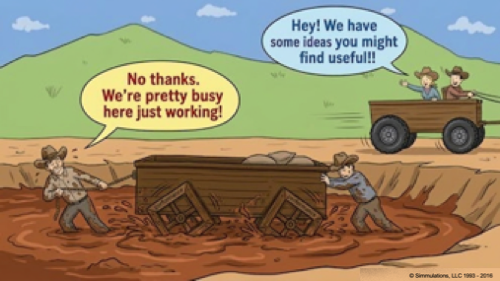
AI tools today are exactly that round wheel cargo. The capability is already available to most people managing their workplaces; what’s missing is the willingness to play with the wagon wheels and find things to innovate and implement, all the while involving and engaging their people and doing things WITH them rather than TO them. (see this blog on dealing with resistance)
- Block two hours this week to test one AI tool on a real piece of your work — not a demo, an actual deliverable. Get your people involved with this test and followup the results and make changes where applicable based on their honest feedback.
- Ask each of your direct reports to name one Square Wheel in their own job — a process that works but doesn’t work smoothly — and one round wheel already sitting somewhere in the organization that could fix it. There are dozens of blogs about this. (here)
- Retire something old before you adopt something new. Every round wheel you install becomes tomorrow’s square wheel eventually. Managers who lean into change keep checking the wheels, not just installing them once and declaring victory. (ThIs is Red Brick Thinking)
What This Means Right Now
Who really knows…
But some things seem pretty visible and pretty predictable.
Organizations are not going to eliminate all middle management. The idea that AI replaces the entire management hierarchy is an overcorrection. But the number of layers, and the number of managers and supervisors, is going to keep shrinking — at Bayer, at Block, and at the company you work for whether or not it has made headlines yet. If headcount in management is at 80 percent of today’s level a year from now and 50 percent two years from now, the managers left standing will be the ones who were already creating clarity, building relationships, and leaning into change before the cuts arrived.
The Bottom Line
Managers who create clarity, build real relationships, and lean into change aren’t just going to survive the AI era — they’re going to be more valuable in it, because those are exactly the things no machine can replicate. The round wheels — the better ways of leading, connecting, and adapting — are already in your wagon. The only question is whether you’re going to keep rolling on the square ones because that’s what you’ve always done, or stop the wagon long enough to put the better wheels on.
The window to get ahead of this is open. It will not stay open indefinitely.
—
For the FUN of It!
 Dr. Scott Simmerman is a designer of team building games and organization improvement tools.
Managing Partner of Performance Management Company since 1984, he is an experienced presenter and consultant who is trying to retire!! He now lives in Cuenca, Ecuador.
You can reach Scott at scott@squarewheels.com
Learn more about Scott at his LinkedIn site.
Note that I often use Perplexity AI to help research and generate ideas for my posts.
Square Wheels® are a registered trademark of Simmulations, LLC
and images have been copyrighted since 1993,
© Simmulations, LLC 1993 – 2026
Note: Please do not take my images and think about using them. It can generate a whole heap of problems given international copyright law and trademark law. Read this article for more information.
What I’m About:
My Square Wheels blog and website exist to help leaders, trainers, and facilitators make work smoother, more engaging, and more human. I focus on practical tools for process improvement, organizational change, and workplace collaboration that spark insight and deliver measurable results.
And I am convinced, after 30+ years of using Square Wheels®, that it is the best facilitation toolset in the world. One can use it to involve and engage people in designing workplace improvements and building engagement and collaboration. It is a unique metaphorical approach to performance improvement and we can easily license your organization to use these images and approaches.
By blending proven facilitation methods, creative problem-solving, and engaging team activities, my mission is to support organizations in building energized, sustainable cultures of involvement and innovation.
Through accessible — and often free — resources and virtual facilitation tools, I aim to help teams everywhere collaborate more effectively, innovate continuously, and take ownership of their improvement journey.
#SquareWheels #InnovationAtWork #TeamEngagement #FacilitationTools #WorkplaceImprovement #EmployeeEngagement #CreativeProblemSolving #OrganizationalDevelopment #LeadershipTools #collaboration #leadership #motivation #communications #enablement #leadership #CreativeCommons #enablingperformance #teamwork #storytelling #storyasking

0 Comments