
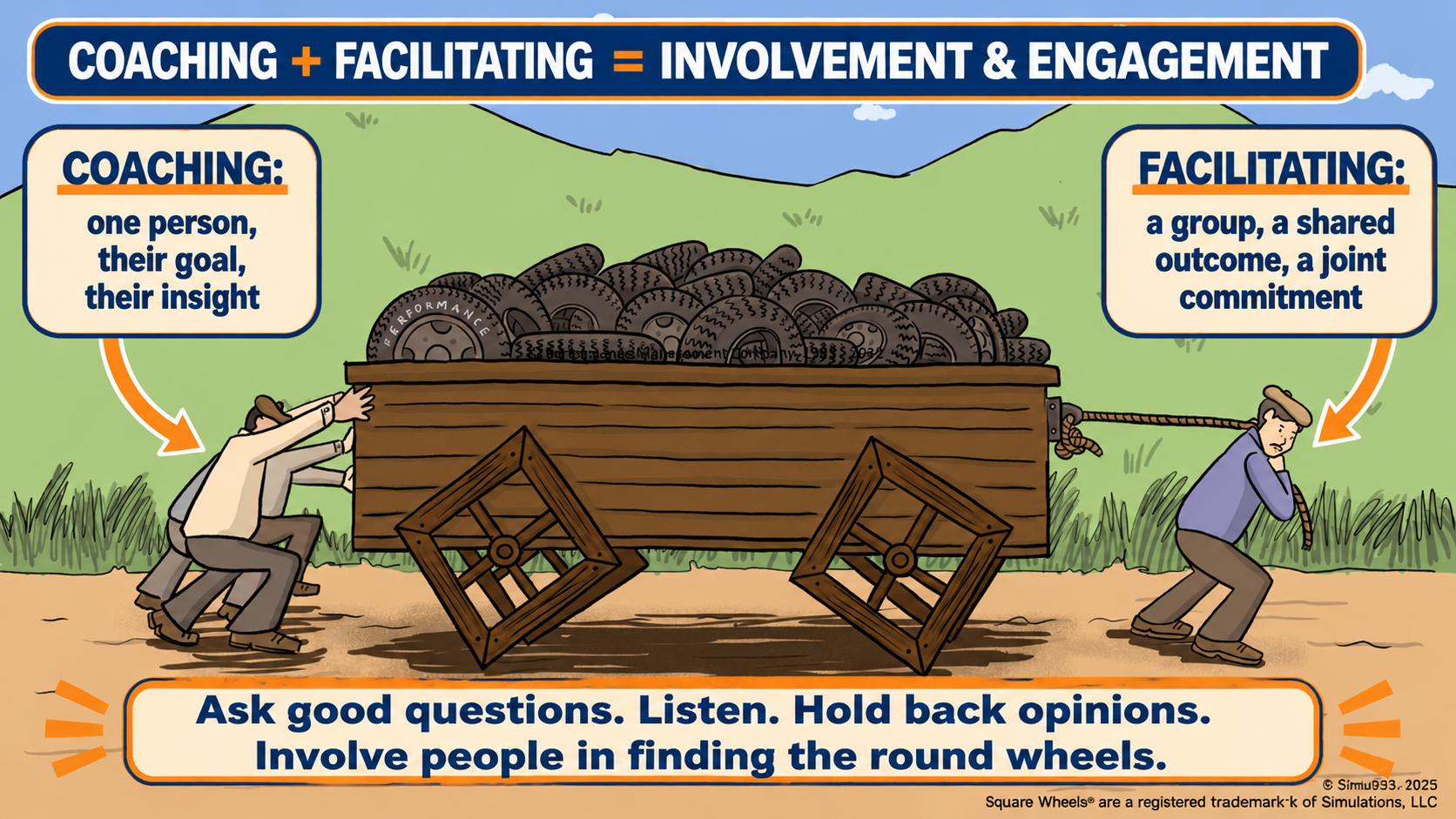
Coaching, Facilitating, and the Supervisor Hellscape and letting the Square Wheels tools do the heavy work of moving everything faster forward.
Supervisors are expected to coach individuals, facilitate teamwork and collaboration, hit their numbers and fix broken processes, usually with no training in the first two and some possibility of the latter. One way out is to teach them one simple tool for their leadership toolkit. They can use Square Wheels One as a shared image, coaching one person at a time about it, and facilitating the whole team toward generating and implementing some round-wheel ideas.
Why The Supervisor Hellscape Is REAL and impacting workplaces, people and performance
Gallup’s 2026 global report finds only 20% of employees were engaged in 2025, at a cost of about $10 trillion in lost productivity, globally. Gallup also reports that managers account for 70% of the variance in team engagement. One caution: Gallup’s actual wording is “at least 70%.” A badly operating workplace has many many impacts on organizational quality, productivity and performance, overall. And the managers are suffering.
The people carrying that load are struggling badly. As of August 2026, 58% of managers were watching for or actively seeking a new job, and only 29% were engaged . Supervisors are the point of greatest leverage and also the point of greatest strain. Giving them a simple, repeatable tool is cheap compared with the cost of losing them.
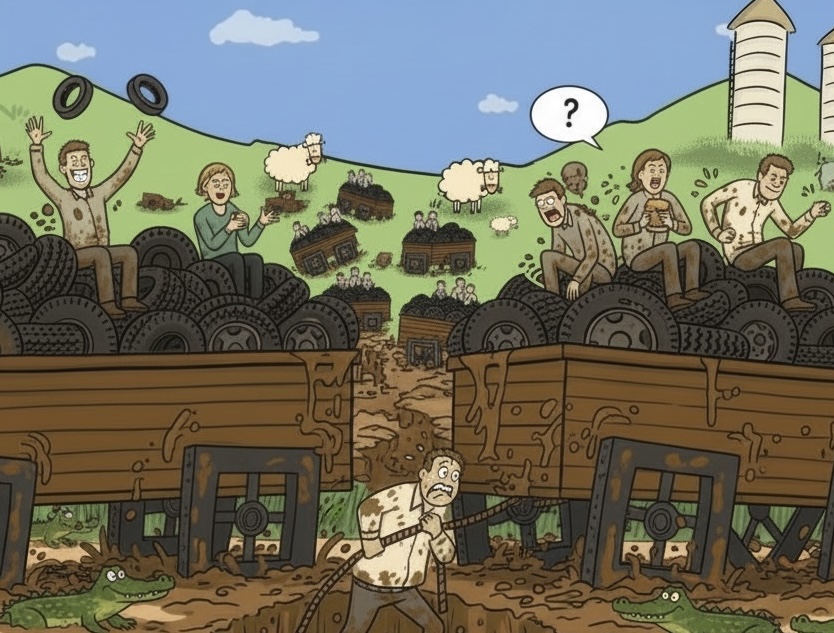
I’ve written about this Hellscape a lot and if the above information is not convincing, check out the massive amount of information here in my blog, which I am regularly updating. Click on the image.
Two Jobs That Look Alike
Nick Martin’s LinkedIn post and graphic make the key point that coaching and facilitating share skills (good questions, listening, holding back your own opinion) but are different jobs. Nick lists five differences:
-
Who: coaching is one person and what’s going on for them. Facilitating is a group and what’s going on between them.
-
Agenda: in coaching, the client sets the goal. In facilitating, the outcome is usually agreed beforehand.
-
Questions: coaching goes deeper (“What’s really stopping you?”). Facilitating brings in more voices (“Who sees this differently?”).
-
Safety: coaching is private. Facilitating is public, so the facilitator designs for safety with written rounds, pairs and anonymous input.
-
Outcome: coaching changes one person’s thinking or behavior. Facilitating produces something the group owns together.
His test question for any request is: “Do you need one person to change, or a group to agree?”
Supervisors face both situations every day, often within the same hour. Many managers never learned to tell them apart. So they lecture, rescue or avoid, which is a large part of the mud underpinning the hellscape.
Where Square Wheels Images and metaphors fit the improvement paradigm
Square Wheels One shows a wagon with wooden Square Wheels, loaded with round rubber tires. People push and pull to move it forward, and nobody stops to ask about the wheels. The image is projective, in that people put their own perceived reality of the workplace onto different aspects of the image. (Find my best article about facilitating with Square Wheels images here.( (Get a FREE copy of the image below by clicking on the image.)
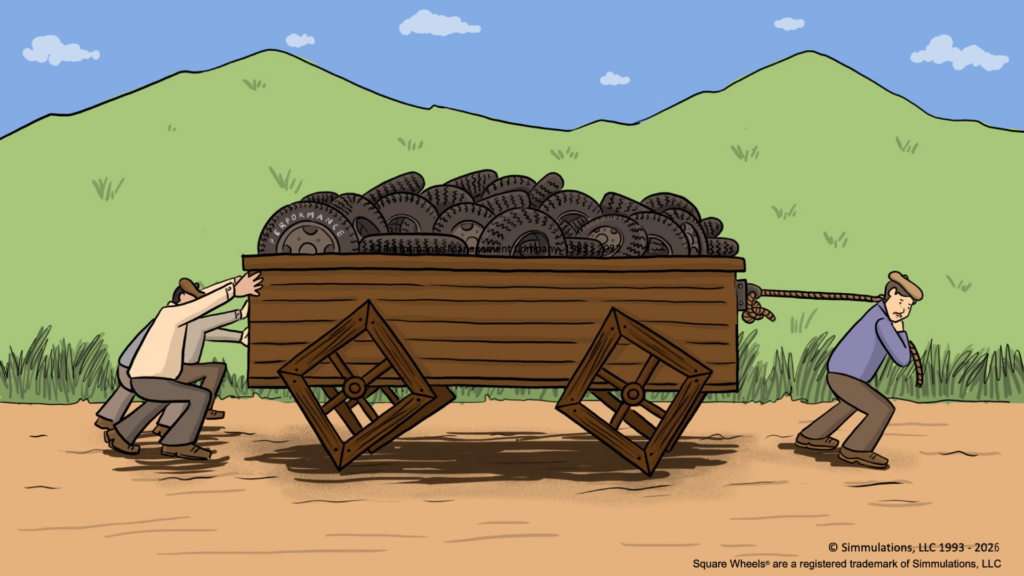
The image above is a neutral image with no reality, so people can talk about “that wagon” instead of “my boss” or “my job.” That removes much of the risk Martin describes happening in public settings when people are discussing performance in low-performing workplaces with different frictions.
Square Wheels One works as a bridge between the two skills:
-
In coaching, it is a projective prompt. “Where are you on this picture? What’s your wagon? What would a round wheel look like for you?” This gets past defensiveness faster than “What’s wrong?”
-
In facilitating, it is a structured way to collect many views. Everyone writes their own caption or idea first, then shares in pairs or posts anonymously, then the group clusters and selects.
-
Across both, the same image gives the supervisor or front-line manager a common language. The private coaching conversation and the team session point at the same picture.
The Supervisor’s Four-Step Routine
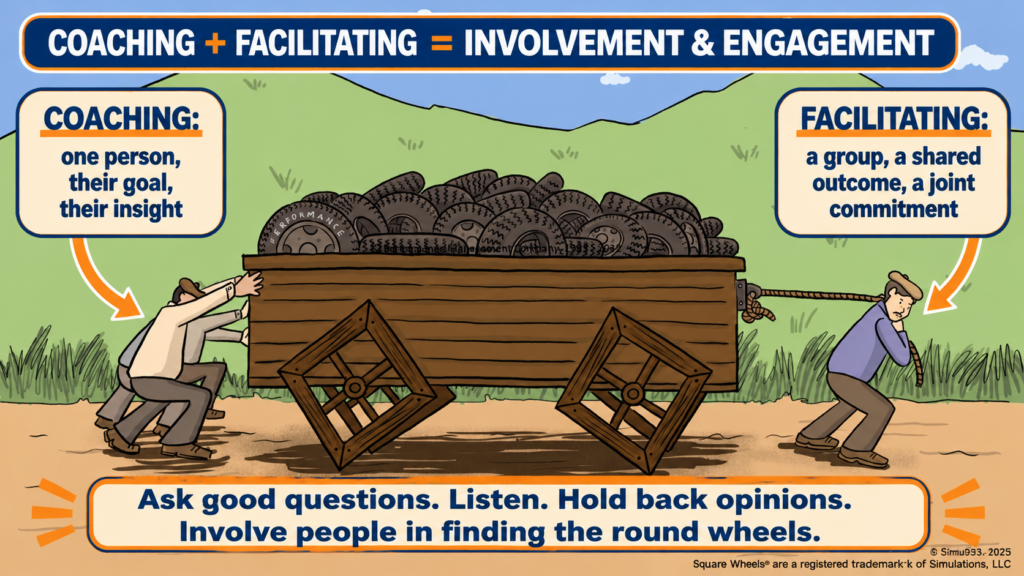
One – Diagnose. Ask Martin’s question: one person to change, or a group to agree? Choose the mode before you open your mouth.
Two – Coach one-on-one. Show the picture. Ask, “What is the wagon in your work? What are the square wheels? What’s one round-wheel idea you could try?” The employee sets the goal and you follow their thinking.
Three – Facilitate the team. Put up the same picture. Run a written round, then pairs, then a group share. Ask, “Who sees this differently?” and “What could we try this month?” The group agrees the outcome and owns it.
Four – Close the loop. Pick one or two ideas, assign owners, and revisit in two weeks. Back in one-on-ones, coach people on their part of the follow-through.
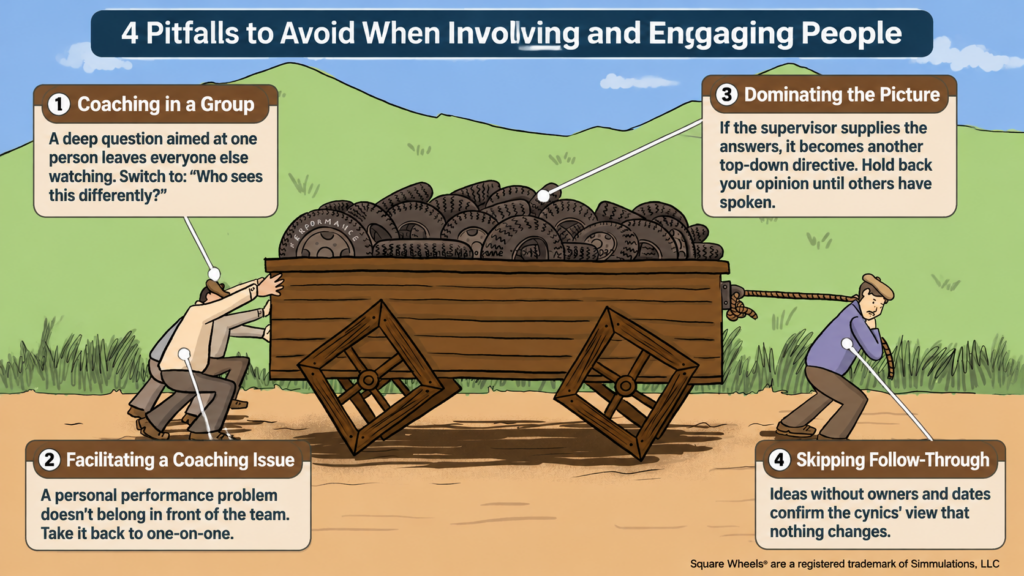
Pitfalls to Avoid when involving and engaging people in the workplace:
-
Coaching in a group. A deep question aimed at one person leaves everyone else watching. Switch to “who sees this differently?”
-
Facilitating a coaching issue. A personal performance problem doesn’t belong in front of the team. Take it back to one-on-one.
-
Dominating the picture. If the supervisor supplies the answers, the exercise becomes another top-down directive. Hold back your own opinion until others have spoken.
-
Skipping follow-through. Ideas without owners and dates confirm the cynics’ view that nothing changes.
The Takeaway – Supervisors can coach and facilitate and both work to impact performance
Supervisors don’t need to become professional coaches or certified facilitators. They need to recognize which situation they are in, use a safe shared picture of the wagon, pushers and puller to start the conversation, generate possibilities and follow through. In a workplace where only one in five people feels engaged, that routine is a practical place to start. This can help to enable them to Act Different!
What is The Supervisor Hellscape?
The Supervisor Hellscape is the workplace reality in which front-line supervisors are promoted for doing the work, not for leading people. They get little training and more direct reports, and they keep carrying their own individual-contributor tasks, all while being told to “engage” their teams. Gallup finds that managers account for roughly 70% of the variance in team engagement. Yet only 45% of frontline supervisors received any supervisory training in the past year, and global manager engagement has dropped to 22%. The people who most shape engagement are the ones the system leaves most overwhelmed, so they disengage and demotivate their people. The wagon keeps rolling on Square Wheels. It is a design flaw in the system and not a character flaw in supervisors.
I’ve been trying to describe this apparently common workplace reality and to share some simple and effective tools to positive impact the supervisors and the workers. We CAN do this if we choose, we can involve, engage and enable people to work differently.
—
For the FUN of It!
 Dr. Scott Simmerman is a designer of team building games and organization improvement tools.
Managing Partner of Performance Management Company since 1984, he is an experienced presenter and consultant who is trying to retire!! He now lives in Cuenca, Ecuador.
You can reach Scott at scott@squarewheels.com
Learn more about Scott at his LinkedIn site.
Square Wheels® is a registered trademark of Simmulations, LLC
and images are © Simmulations, LLC 1993 – 2026
Note: Please do not take my images and think about using them. It can generate a whole heap of problems given international copyright law and trademark law. Read this article for more information.
See a detailed overview of my tools, background and experiences by clicking here.
What I’m About:
My Square Wheels blog and website exist to help leaders, trainers, and facilitators make work smoother, more engaging, and more human. I focus on practical tools for process improvement, organizational change, and workplace collaboration that spark insight and deliver measurable results.
And I am convinced, after 30+ years of using Square Wheels®, that it is the best facilitation toolset in the world. One can use it to involve and engage people in designing workplace improvements and building engagement and collaboration. It is a unique metaphorical approach to performance improvement and we can easily license your organization to use these images and approaches.
By blending proven facilitation methods, creative problem-solving, and engaging team activities, my mission is to support organizations in building energized, sustainable cultures of involvement and innovation.
Through accessible — and often free — resources and virtual facilitation tools, I aim to help teams everywhere collaborate more effectively, innovate continuously, and take ownership of their improvement journey.
#SquareWheels #InnovationAtWork #TeamEngagement #FacilitationTools #WorkplaceImprovement #EmployeeEngagement #CreativeProblemSolving #OrganizationalDevelopment #LeadershipTools #collaboration #leadership #motivation #communications #enablement #leadership #CreativeCommons #enablingperformance #teamwork #storytelling #storyasking #enablement #disruptiveengagement #un-dis-engagement #un-dis-empowerment #innovation
© 2026 Simmulations, LLC. Please note that “Square Wheels®” is a registered trademark of Simmulations, LLC. and materials, original wagon line art, text, and visual designs are protected. Original line art by Roy Sabean, used under rights owned by Simmulations, LLC and formerly Performance Management Company, a sole-proprietorship of Dr. Scott J. Simmerman. Original concept and source artwork © Simmulations, LLC; derivative visuals sometimes created with assistance from Perplexity Pro AI.


0 Comments