
Employee Appreciation Day: Some ideas for supervisors to stop the Wagon, Ask and Enable the People About Better Wheels. Some things to do.
For frontline managers, Employee Appreciation Day (Friday March 6, 2026) feels like just one more thing on a crowded to‑do list—another email, another event to organize, another “initiative.” HR sends out a nice message and posts a banner on the intranet, tells the supervisors to orders donuts, and then everyone goes back to the same frustrating workload that same day!
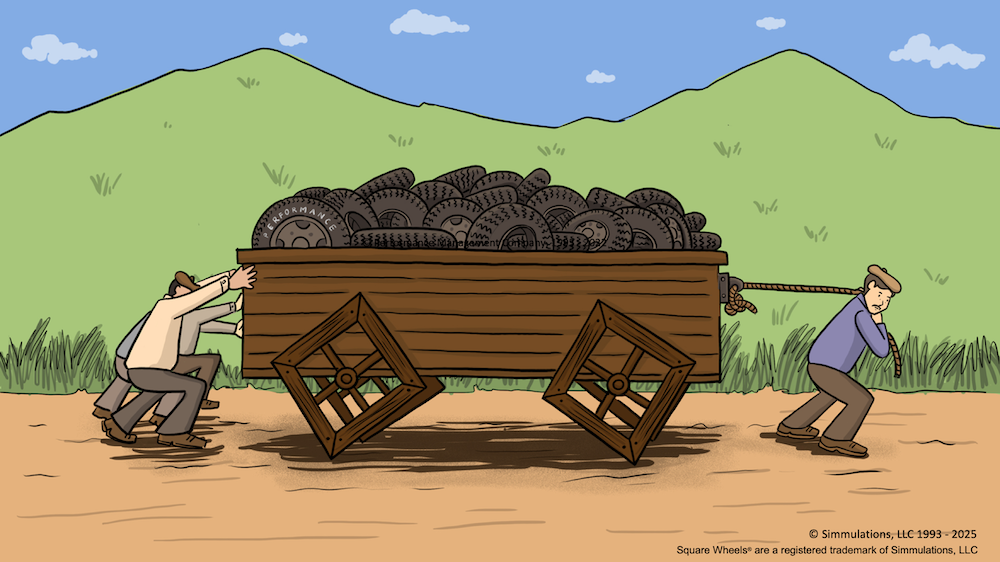
The reality of how things are probably working. Get it FREE
But the people pushing your wagon really don’t need one more slogan. They need you to notice their reality, listen to their ideas, and fix the stuff that makes work harder than it needs to be. That is what real appreciation looks like from the front line: not just “thank you,” but “I see you, I hear you, and I’m willing to change the wheels with you.”
This is where your Square Wheels wagon becomes more than a metaphor. Work is thumping along on those Square Wheels, people are pushing hard from behind, and you, as the manager, are out in front, pulling. Everyone feels the bumps, but no one is talking about the wheels to improve the journey.
Employee Appreciation Day is your prompt to stop the wagon, turn around, and say, “Let’s talk about how to make this roll better.”
When you do that, appreciation stops being an unmemorable, once‑a‑year HR thing and becomes a continuous, shared effort to make work better for everyone. So, let’s do it. Here are a variety of real ideas:
1. Reframe Appreciation: From a “Thank You” to “Let’s Improve This Together”
A simple “thank you” is nice and polite. A specific, work-focused “thank you” contingent to workplace performance is a lot more powerful. Frontline workers are not hungry for generic praise; they are hungry for managers who understand what it actually takes to get the work done and who will collaborate with them to make that work more doable.
As a frontline manager, reframe appreciation as a three-part practice:
-
Notice effort and impact.
-
Name it specifically.
-
Invite ideas that make that effort easier or more effective.
Instead of the vague: “Thanks, team, for all your hard work,” try something like after some discussion about Square Wheels One, that you can get for free by clicking on the image above:
-
“I see how much effort it takes to push your wagon with Square Wheels. I appreciate how you’ve kept it moving even when the process fights us. Let’s talk about what would make this work feel smoother and smarter.”
That simple shift sends a very different message. You are telling people three things at once: “I see the struggle, I value your contribution, and I’m willing to change the system with you.” That is appreciation at a higher level, and it is exactly what workers on the front line rarely get.
Dan Pink’s DRIVE video about motivation is 10 minutes of pure gold
There is also a somatic and emotional dimension to this kind of appreciation. When people feel chronically unseen or taken for granted, their bodies carry that: tight shoulders, shallow breathing, the low‑grade fatigue of bracing all day. When you move from generic thanks to specific, work‑focused appreciation, you are not only shifting the conversation, you’re helping nervous systems settle and reducing stress. As Peter Vadja would say, the move is from “armored and guarded” to “open and receptive.” When you name real effort and invite ideas, people literally feel safer in their bodies, which is what allows honest dialogue and creative problem‑solving to emerge.
2. Stop the Wagon: Create Space for Real Conversations
The first visible act of appreciation is not a gift card, donuts or a party. It is stopping the constant headlong rush long enough to talk about the work itself. On the front line, the pressure to “keep the wagon moving” is absolutely relentless. If you never pause, you never really show people that their experience matters.
On Employee Appreciation Day, schedule a short “Stop the Wagon” huddle:
-
Call a 20–30 minute meeting with your team, ideally during a time when everyone can attend without added stress.
-
Show / describe the wagon: “Here’s our work. What are our Square Wheels—the things that slow us down, frustrate us, or create rework?”
-
Ask everyone to name ONE thing that makes their work harder than it needs to be. No speeches, no justifications—just short, honest statements.
-
Capture all ideas where everyone can see them: whiteboard, flipchart, shared document, or digital board. Do not argue, defend, or explain yet. Just listen and write.
This kind of huddle is not just a cognitive exercise; it is a somatic experience. When you pause the rush, stand in a circle, and give people space to speak, you are inviting them out of “fight, flight, or freeze” and into a more grounded presence.
You can actually reinforce that by modeling it yourself by slowing your breathing, relaxing your posture, making eye contact, and listening without interrupting. Vadja’s work reminds us that people first need to feel emotionally and physically safe before they can tell the truth about their Square Wheels. Your calm, regulated presence becomes a silent form of appreciation: “You don’t have to brace yourself around me; it’s okay to be real.”
Stopping the wagon says, “Your time and your experience matter enough for us to pause production and think together.” That simple pause is itself a form of respect. It tells people you are willing to sacrifice a little short-term speed to create long-term sanity.
A good blog on how to show workplace respect.
3. Ask About Better Wheels: Turn Appreciation into Enablement
Naming the Square Wheels is only half the equation. If you stop at “What’s broken?” you risk creating a complaint session. The real power comes when you ask about better wheels. This is what turns appreciation into enablement: you are not just hearing complaints; you are inviting your people to co‑design improvements.
Use questions like:
-
“If we could change one thing to make this smoother, what would it be?”
-
“What small tweak would make this part of the job less frustrating?”
-
“Where do you see a Round Wheel we’ve been ignoring?”
Then, go deeper with follow‑ups:
-
“Tell me more about how that slows you down.”
-
“What have you already tried to work around this?”
-
“Who else would need to be involved to fix this?”
Here, the emotional field matters as much as the questions themselves. When someone finally names a Square Wheel that has bothered them for months, there is often frustration, embarrassment, or even shame in the mix.
Vadja’s somatic perspective would say: notice that energy instead of pushing past it. If a voice tightens, if someone’s face flushes, if there’s an awkward laugh, you can slow down and normalize the feeling: “I can hear this has been really stressful. It makes sense you’d feel that way.” That brief emotional acknowledgment lets the “charge” discharge a bit. Only then do people feel free enough – in their bodies and in their hearts – to move from venting into genuine problem‑solving about rounder wheels.
As you ask and listen, you are recognizing your people as experts in their own work, not just hands on the wagon. You are treating their ideas as valuable assets, not as noise. For frontline employees who are used to being told what to do, this is a powerful signal of trust.
4. Enable: Remove Obstacles and Share Ownership
Appreciation becomes real when something
actually changes because people spoke up.
That is the “enable” part of “ask and enable your people about better wheels.” If you collect ideas but nothing happens, you undermine trust. If you act on ideas and give credit, you build it.
As a frontline manager, you do not need to fix everything. Start by picking one or two Round Wheel ideas that are:
-
Within your control or influence.
-
Likely to make a visible difference.
-
Quick enough to implement that people see movement within days or weeks, not months.
Examples might include:
-
Simplifying a form or approval that everyone hates.
-
Adjusting a shift schedule that creates constant stress around childcare or commute times.
-
Clarifying a fuzzy process that causes rework and finger‑pointing.
-
Removing a non‑value‑add report or meeting that eats up time without improving results.
When you implement a change, do three things:
-
Name where the idea came from: “This was Maria’s suggestion, and a few of you said the same thing.”
-
Explain what you did: “Here’s what we changed and why.”
-
Connect it back to appreciation: “You speaking up about this is exactly what makes us better. Keep the ideas coming.”
When people see their ideas become reality, the culture shifts from “they don’t listen” to “it’s worth it to speak up.” That is daily appreciation in action, and it comes directly from your choices as a frontline manager.
5. Make It Daily: A Simple “Better Wheels” Ritual
Employee Appreciation Day is a great launch point, but the real impact comes when you bake this into everyday management. The front line is where policies, processes, and customer expectations collide; if you do not create tiny, regular spaces for “better wheels” conversations, frustration will quietly build back up.
Here is a simple weekly or daily practice you can adopt:
-
Micro‑huddles
At the end of a shift or team meeting, take two minutes to ask, “What Square Wheel did we feel today?” and “What Round Wheel should we test this week?” Capture one or two ideas and commit to following up. -
One‑on‑ones
Add one standing question to each one‑on‑one: “What’s one thing that’s making your job harder than it should be?” Even if you cannot fix it immediately, the fact that you are asking regularly signals respect and concern. -
Idea visibility
Keep a visible list of Square Wheels and Round Wheels—a simple board, page, or channel where people can see what’s been raised and what’s been acted on. Update it as changes happen so the team sees progress. Make looking at it rewarding, like a “Days without Accident” board.
The more you normalize this, the more your people experience appreciation not as an annual event, but as a steady pattern of listening, responding, and removing friction.
6. Use Recognition Language That Connects to Better Wheels
How you phrase appreciation matters. You want to connect recognition to both behavior, innovation and improvement so that people see themselves as contributors to workplace improvement, not just as hard workers pulling the same old wagon. Help them help everyone.
Instead of generic praise, try language like:
-
“When you pointed out that bottleneck, you helped us see a Square Wheel we’d been ignoring.”
-
“Your idea for batching this work is a real Round Wheel. You just made everyone’s day easier.”
-
“I appreciate that you didn’t just complain; you brought a solution we could test, and it’s already paying off.”
You are reinforcing three core messages:
-
It is okay to talk about problems.
-
It is valued to bring ideas.
-
The team benefits when someone speaks up.
That kind of recognition sticks with people long after the free pizza is gone.
7. Special Ideas for Employee Appreciation Day (Frontline Edition)
To make Employee Appreciation Day itself stand out and still align with your “better wheels” theme, consider a few focused activities that fit front‑line reality:
-
Run a “Best New Wheel” mini‑challenge
Ask everyone to submit one idea that would make the work smoother, safer, or smarter. Recognize and implement at least one quickly, and publicly thank the person or small group whose idea you’re acting on. -
Host a “Square Wheels Story” session
Invite people to share quick stories about “Square Wheels we’ve lived with” on your team. Laugh about the absurdities, then pick one story to turn into a real improvement project with clear next steps. -
Write personal notes that link effort and impact
For each person, write a short note: “Here’s the Square Wheel you helped us see, here’s the Round Wheel you helped us install, and here’s why it matters for our team and our customers.” Keep it specific and practical, not fluffy.
All of these say, “We appreciate you not only for what you do, but for how you help us do it better.”
And there are dozens of such lists of ideas online like this one.
Call‑to‑Action for Frontline Managers
This Employee Appreciation Day, do not settle for sharing pizza and a nice email. Use the day to do something that actually changes how work feels. Stop the wagon. Ask your people about the Square Wheels they are living with, and work with them to find and test better wheels.
Pick one small improvement you can implement in the next week, and make a point of telling the team whose idea it was and how it will make their work easier. Then, commit to one “better wheels” conversation every week for the next month.
You do not need a bigger budget to show real appreciation. You need curiosity, follow‑through, and the courage to say, “I can’t fix everything, but I can change something—and I want to change it with you.”
That is what Employee Appreciation Day can look like when a frontline manager stops the wagon, asks, and enables their people about better wheels.
Help people really feel appreciated while helping your team to make substantive improvements in how things are done. Make a difference!

—
For the FUN of It!
 Dr. Scott Simmerman is a designer of team building games and organization improvement tools.
Managing Partner of Performance Management Company since 1984, he is an experienced presenter and consultant who is trying to retire!! He now lives in Cuenca, Ecuador.
You can reach Scott at scott@squarewheels.com
Learn more about Scott at his LinkedIn site.
Square Wheels® are a registered trademark of Simmulations, LLC
and images have been copyrighted since 1993,
© Simmulations, LLC 1993 – 2026
What I’m About:
My Square Wheels blog and website exist to help leaders, trainers, and facilitators make work smoother, more engaging, and more human. I focus on practical tools for process improvement, organizational change, and workplace collaboration that spark insight and deliver measurable results.
And I am convinced, after 30+ years of using Square Wheels®, that it is the best facilitation toolset in the world. One can use it to involve and engage people in designing workplace improvements and building engagement and collaboration. It is a unique metaphorical approach to performance improvement and we can easily license your organization to use these images and approaches.
By blending proven facilitation methods, creative problem-solving, and engaging team activities, my mission is to support organizations in building energized, sustainable cultures of involvement and innovation.
Through accessible — and often free — resources and virtual facilitation tools, I aim to help teams everywhere collaborate more effectively, innovate continuously, and take ownership of their improvement journey.
#SquareWheels #InnovationAtWork #TeamEngagement #FacilitationTools #WorkplaceImprovement #EmployeeEngagement #CreativeProblemSolving #OrganizationalDevelopment #LeadershipTools #collaboration #leadership #motivation #communications #enablement #leadership #CreativeCommons #enablingperformance #teamwork #employeeappreciationday #employeeappreciation #reinforcement

0 Comments