
Ask 5 people what is slowing things down, and you probably get 5 different answers. Each person has a view, and they perceive things differently. There are always improvement ideas within a team that you can and should look into implementing.
The supervisor sees missed deadlines. Team members see different reasons: an approval process that turns a ten-minute decision into a two-day wait; unrealistic timelines and competing priorities; too few people at certain times, and too many meetings that leave too little time to do the work. One employee knows a faster workaround, but it has never made it as an accepted procedure. Another stopped offering ideas after one was dismissed in a meeting.
They work in the same place but they do not experience the same workplace experience. And things could be better. Any surprises here?
Those differences are not obstacles to getting “the real story.” Together, they make for a better account of what is happening. Yet supervisors can easily mistake their own view for the complete picture especially when reports, deadlines and meetings keep reinforcing it.
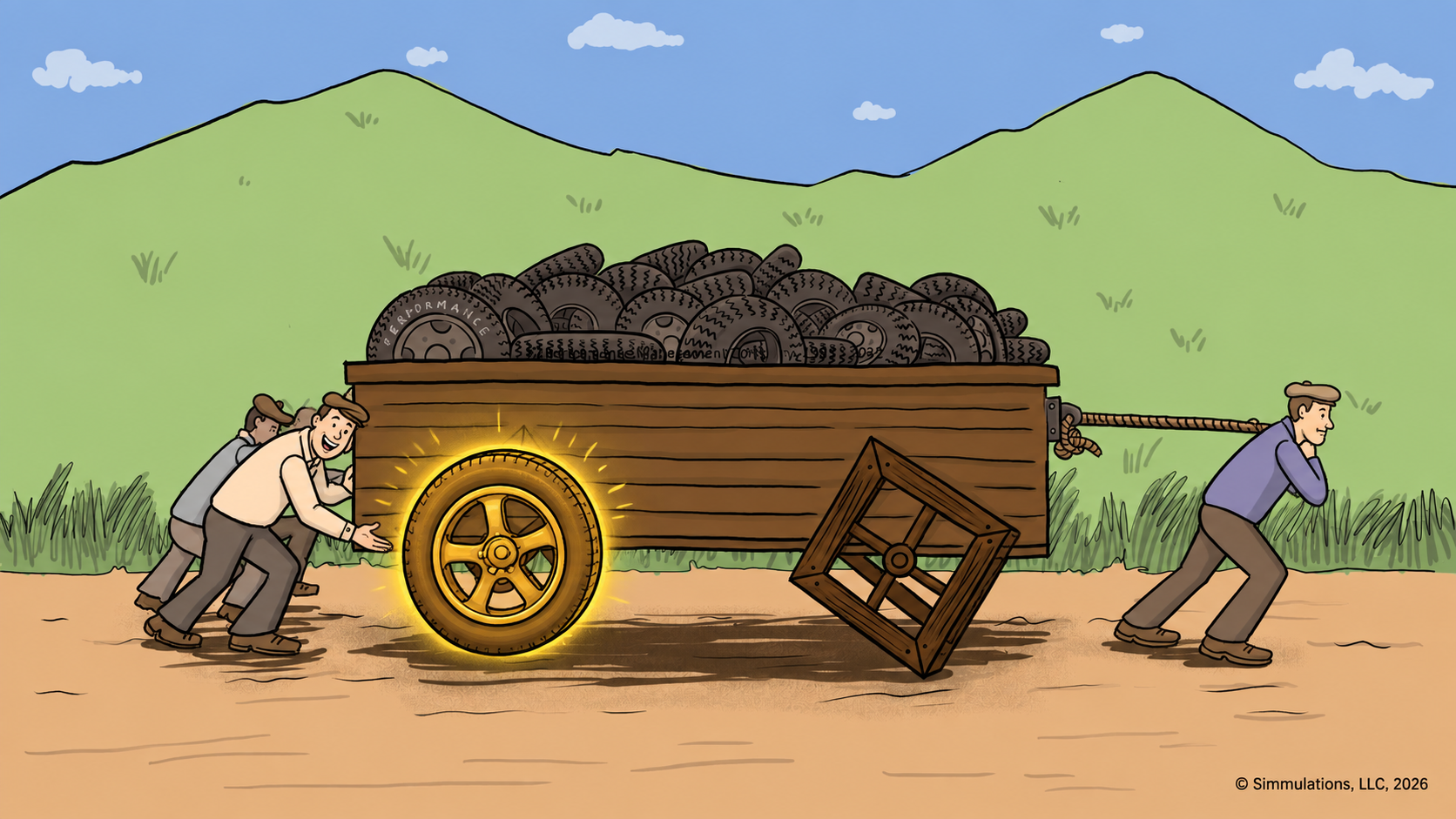
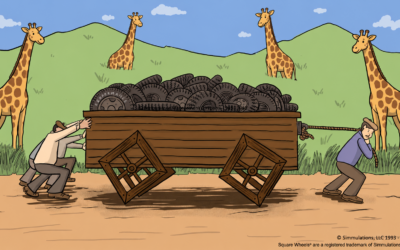
My Square Wheels® images and discussion tools give a team a way to put those different perceptions on the table without starting with blame. Show people a wagon rolling on wooden Square Wheels, with round wheels sitting unused as its cargo, and ask: “What do you see?” The discussion that follows can reveal not only where work is getting harder, but also what the team knows about making it easier.
That is where the Square Wheels images become more than illustrations or cartoons. They give supervisors a way to directly ask, “What are we seeing that we have stopped noticing?”
The brain is not a camera
A recent article on perception makes a provocative point: what we experience is not an unfiltered recording of the world. Our brains interpret incoming information through experiences, expectations, memories and context. The article calls attention to predictive processing, the idea that the brain uses expectations to help make sense of sensory information, then adjusts when new information does not fit. (here) And using images generates the context of one’s thinking.
That is a useful lens for managers, provided we do not stretch the neuroscience too far. Researchers have found evidence consistent with predictive processing, including neural responses to unexpected events. They also caution that the precise mechanisms remain debated and that some findings have other possible explanations. Yet there are some obvious useful realities.
We should not claim that a cartoon “rewires the brain.” But we do know that asking people to examine their assumptions alongside new evidence is a sensible way to challenge an incomplete picture of work. Images are projective tools and can be an incredibly useful tool to generate discussions and look at perceptions our people have about the workplace and working.
More Resources:
My blog, “Square Wheels, Positive Imagining, and Workplace Innovation” directly answers why visuals help produce workable ideas: the wagon gives people a shared picture of current frictions, while the round wheels prompt them to imagine and consider alternatives, build on one another’s observations, and identify an improvement to test and address the friction.
Different perceptions are not just something to reconcile;
they are absolutely great raw material for innovation.
And active involvement will enable motivation to change.
A companion article,“Unlocking Better Problem Solving” goes further into using different visual images to generate ideas about bottlenecks, priorities and cross-team handoffs.
Consider a supervisor who expects silence in a meeting to mean agreement. Once that expectation takes hold, a quiet room may seem to confirm it. But silence could also mean uncertainty, fatigue or reluctance to contradict the boss. The supervisor needs more information, not greater confidence in a guess. We need to improve the accuracy of our decision-making and we need differing perspectives to optimize the outcomes. Feedback and involvement will generate this.
Put the wagon between you and your people
In the familiar Square Wheels One image, people push and pull a wagon rolling on wooden Square Wheels while round rubber tires are actually its cargo. The image of thumping and bumping does not assign blame or prescribe a solution. It lets each person recognize something different: unnecessary frictions, effort that keeps things moving, or resources already available but not being used. That open-ended quality is central to how the images are used as discussion prompts.
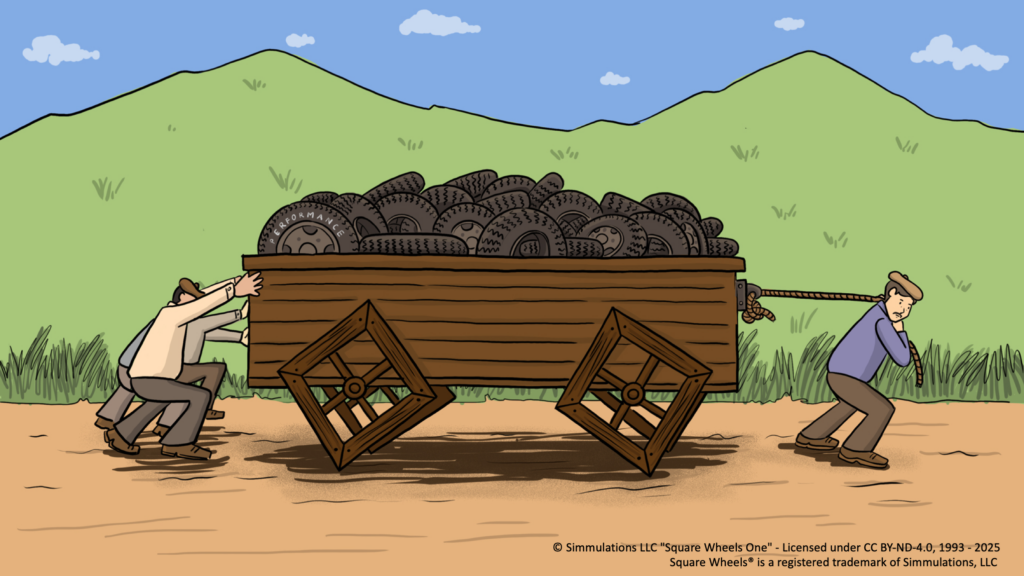
Simply, a supervisor can begin with: “What do you notice?” Then: “How might this represent the way our team works?” Only after people have described the image in general does the conversation turn to local examples: “Where are our Square Wheels?” and “What Round Wheels might we already have?”
This post spells out the idea-generation stages more explicitly, “World’s Best Tool for Engagement—Square Wheels” has participants reflect individually, compare observations in small groups, select one Square Wheel, and brainstorm at least three Round Wheels before choosing an action.
This sequence of engagement matters. We give people a shared object to discuss in general before asking them to name a sensitive workplace problem. It also makes the supervisor’s interpretation one contribution rather than the official answer. The image does not change the team’s reality by itself; it helps the team gather a fuller account of it, sharing their ideas for action.
Facilitate Engagement, not Agreement
Inviting ideas is not enough if employees expect a penalty for speaking honestly. A review of 16 studies in healthcare and public-safety workplaces found that inclusive leadership, communication climate and power dynamics were associated with psychological safety — the shared sense that people can take interpersonal risks, such as raising a concern. It suggested that a workplace culture characterized by trust, transparency, and open communication fosters greater psychological safety and improved teamwork and well-being. The practical lesson is clear enough: how a supervisor receives an uncomfortable observation matters as much as the invitation to offer one.
Here is a simple way to put that lesson to work:
1 – Show the image and give everyone a few quiet minutes to write down what they notice.
2 – Ask people to share interpretations in pairs before opening the discussion to the full team.
3 – Collect examples of Square Wheels without immediately explaining, defending or correcting them.
4 – Ask what Round Wheels — skills, ideas, beliefs, tools or relationships — are already available.
5 – Sort the issues into what the team can control, influence or must escalate.
6 – Choose one small improvement to test, agree on what evidence would show whether it helped, and set a date to review it.
This follows the facilitation approach described in Square Wheels resources: use the image to surface different experiences, then turn the conversation toward a practical experiment.
For example, suppose a team identifies repeated required approval checks as a Square Wheel. The supervisor may believe those checks are essential; employees may experience them as avoidable delay. Rather than settle the disagreement by rank, they could trace a few recent requests, identify where errors were actually caught, and test a simpler route for one low-risk category. They can look at the benefits and the costs. The discussion changes what everyone knows. The test changes what everyone can do.
The challenge is to identify issues and allow your people to help resolve them; this creates the intrinsic motivation to do even more things down the road… And teams learn from teamwork, especially when it is cross-functional in nature.
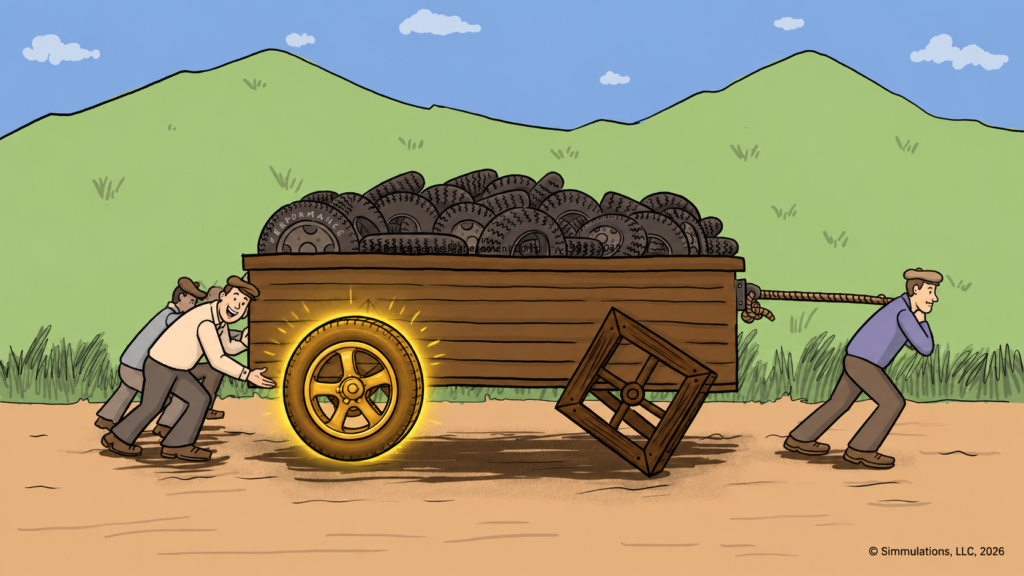
People call me, “The Square Wheels Guy” but I am REALLY about implementing ROUND wheels!
Change the evidence your people experience
“Changing perceived reality” must not mean persuading employees
that a difficult workplace is fine. That is NOT engaging them for change.
If staffing is inadequate or an approval process is broken, a more cheerful story will not fix it. Nor will more complaining about it. Perceptions become more constructive when people can speak candidly, compare their accounts and see credible action follow.
For a supervisor, that may be the most important Round Wheel in the wagon: a team’s knowledge of how the work actually happens. Use the image to uncover it. Then make one improvement visible. The next time people look at the workplace, they will have something new to see—not because you told them to think differently, but because together you made a difference.
Frequently asked questions
1. How can people experience the same workplace so differently?
People notice and interpret events through their roles, past experiences and expectations. A supervisor may focus on a missed deadline, while an employee sees the approval delays that contributed to it. Neither view tells the whole story; discussing both can reveal what needs to change.
2. How do Square Wheels images help supervisors start a useful discussion?
The wagon gives everyone a shared image to interpret before they discuss potentially sensitive problems. A supervisor can ask, “What do you notice?” and then, “Where do we have Square Wheels in our work?” That makes it easier to explore friction without immediately blaming a person.
3. What should a supervisor do after the team identifies its Square Wheels?
Choose one issue the team can influence and test a small improvement. Agree on what would count as progress, then return to the team with the results. Listening can change a supervisor’s understanding; visible follow-through can change the team’s experience.
—
For the FUN of It!
 Dr. Scott Simmerman is a designer of team building games and organization improvement tools.
Managing Partner of Performance Management Company since 1984, he is an experienced presenter and consultant who is trying to retire!! He now lives in Cuenca, Ecuador.
You can reach Scott at scott@squarewheels.com
Learn more about Scott at his LinkedIn site.
Note that I often use Perplexity AI to help research and generate ideas for my posts.
Square Wheels® are a registered trademark of Simmulations, LLC
and images have been copyrighted since 1993,
© Simmulations, LLC 1993 – 2026
Note: Please do not take my images and think about using them. It can generate a whole heap of problems given international copyright law and trademark law. Read this article for more information.
See a detailed overview of my tools, background and experiences here.
What I’m About:
My Square Wheels blog and website exist to help leaders, trainers, and facilitators make work smoother, more engaging, and more human. I focus on practical tools for process improvement, organizational change, and workplace collaboration that spark insight and deliver measurable results.
And I am convinced, after 30+ years of using Square Wheels®, that it is the best facilitation toolset in the world. One can use it to involve and engage people in designing workplace improvements and building engagement and collaboration. It is a unique metaphorical approach to performance improvement and we can easily license your organization to use these images and approaches.
By blending proven facilitation methods, creative problem-solving, and engaging team activities, my mission is to support organizations in building energized, sustainable cultures of involvement and innovation.
Through accessible — and often free — resources and virtual facilitation tools, I aim to help teams everywhere collaborate more effectively, innovate continuously, and take ownership of their improvement journey.
#SquareWheels #InnovationAtWork #TeamEngagement #FacilitationTools #WorkplaceImprovement #EmployeeEngagement #CreativeProblemSolving #OrganizationalDevelopment #LeadershipTools #collaboration #leadership #motivation #communications #enablement #leadership #CreativeCommons #enablingperformance #teamwork #storytelling #storyasking #enablement #disruptiveengagement #un-dis-engagement #un-dis-empowerment #innovation

0 Comments