
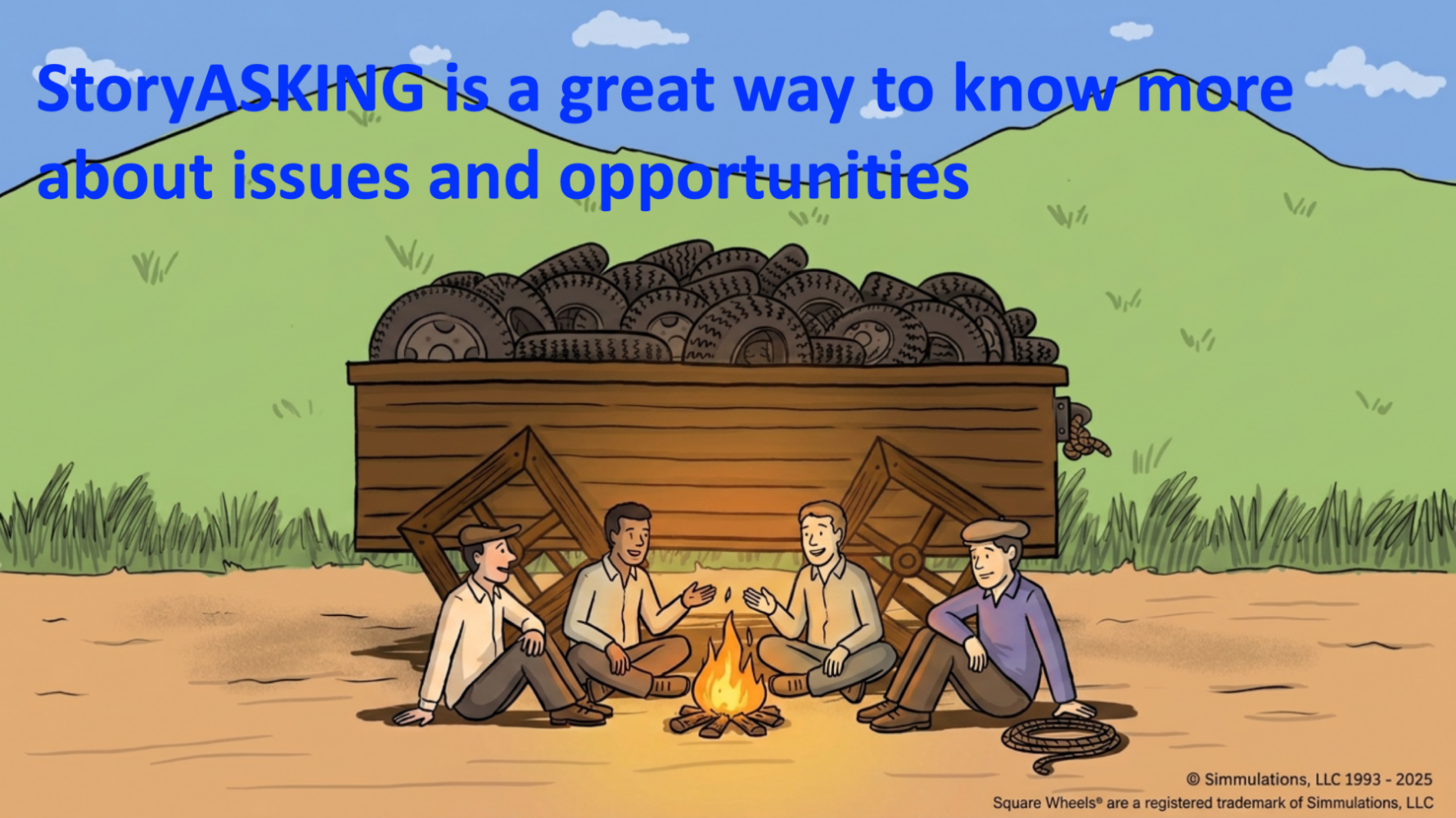
Storytelling is good. StoryASKING is really much better, a simple leadership approach that builds real ownership and active engagement.
“Great leaders are great storytellers.” We’ve all heard it — and lately, storytelling is having a real resurgence. But here’s the catch few seem to notice: when the leader does most of the talking, everyone else defaults to listening. And listening is a pretty passive sport with a good bit of divergence. People might mentally walk away informed or even entertained but that doesn’t mean they feel any ownership of the key ideas or concept. And without feeling ownership and active involvement, is actual engagement really happening?
StoryASKING flips that script.
Instead of polishing and performing your own stories, you invite people to share theirs around an important theme. And, although their stories will be different than yours, you can guide them to develop their ideas with guided imagery and prompting so that their focus is your focus.
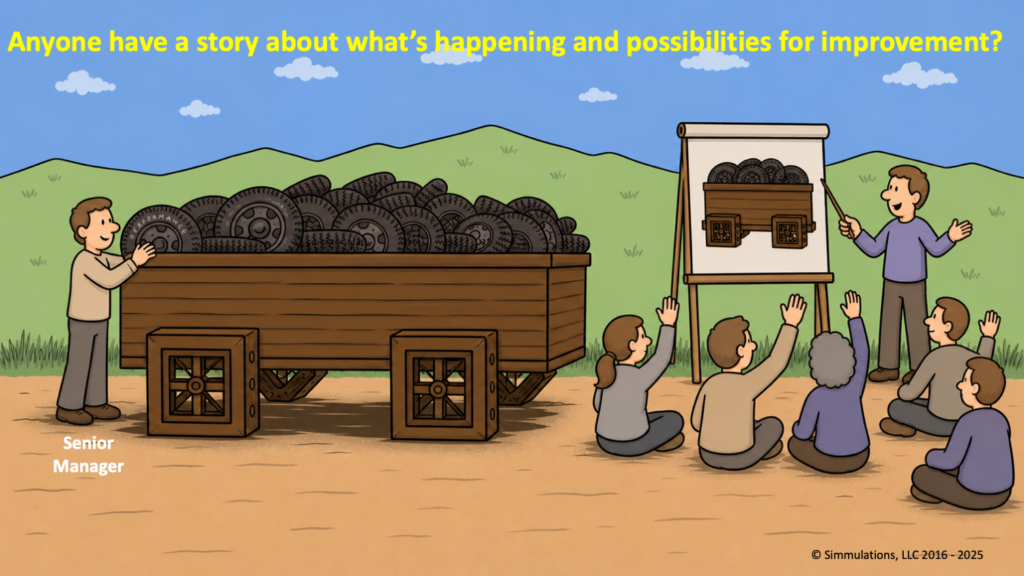
Guide the storyasking to be about improving systems and processes and other ideas around performance.
With guided imagery and prompting, you can get your people to develop their ideas so that their focus is your focus.
You use images, metaphors, questions, and curiosity to pull out their experiences of where things are working well and where they are stuck and needing improvements. In the process, you transfer psychological ownership for the work from your narrative to the team’s narrative.
StoryAsking is where engagement, initiative, and continuous improvement actually live. Enable ongoing discussions about their personal and organizational issues and opportunities helps them to help you.
Since your people see things differently than you do, this is also a form of active listening for their issues and opportunities for change. Let’s start with guiding a discussion around the ideas for improving how things work in the organization.
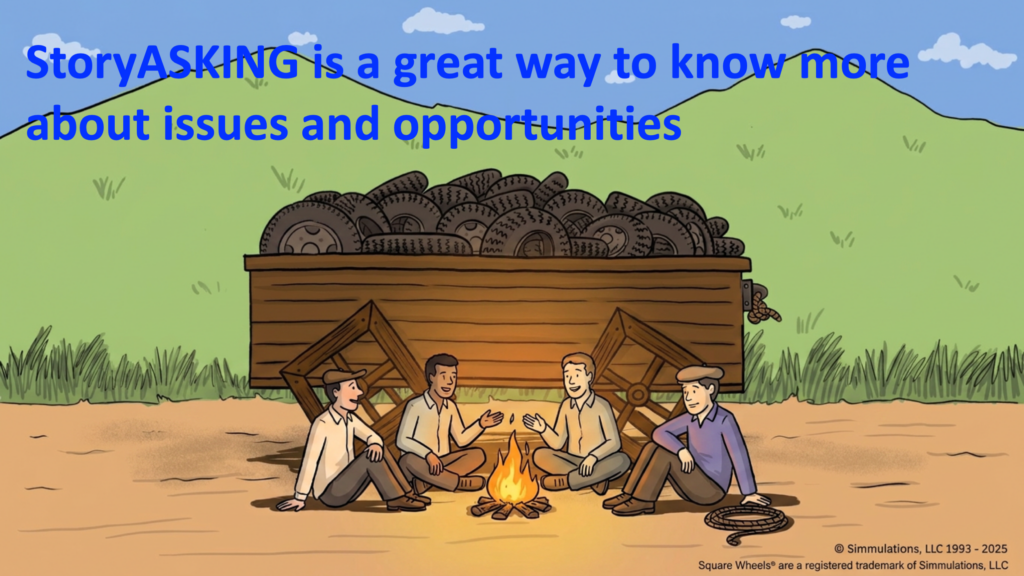
Asking about perceived issues and opportunities is a powerful tool for engagement and innovation. Make meetings a campfire!
Why StoryASKING Beats StoryTelling
Traditional storytelling has its place in the development of a culture and has been used to communicate ideas for eons. A good story can:
-
Set direction and context for a group.
-
Illustrate a value or principle with clarity.
-
Create a sense of history and identity. Stories are memorable.
But it also has built‑in limitations when it comes to communicating with teams about organizational improvement:
-
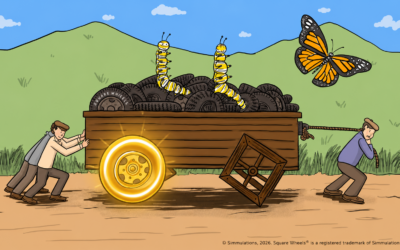
It is one‑way. You talk, they listen. And they hear what they hear and maybe not the story you are telling. (See the Caterpillar / Butterfly Joke to understand this difference.
- Storytelling is somewhat of an art-form. It takes skill and time to polish and perfect.
-
Stories usually center around the leader’s perspective, which may not align with the group’s realities, the issues and opportunities and perspectives they share. It may clang.
-
It can unintentionally signal that the “right” answers already exist and that YOU know the answer. And not everyone will hear the same message.
I tell my story of telling a joke for over a decade, thinking that MY answer and the learning lesson was about resistance to change and that the story made it clear. But presenting in Hong Kong, the small audience seemed confused so I asked them to discuss the story and tell me what it meant. Instead of MY ANSWER, they generated 21 different answers to this one story. It was an amazing learning lesson for me and broke my assumption that a story has one meaning to all people. You can see this learning lesson in more detail here:
“Teaching The Caterpillar to Fly” – The Caterpillar / Butterfly Resistance Joke
StoryASKING does something very different.
When you ask people to describe what they see and feel around the work, you:
-
Turn listeners into contributors.
-
Surface realities that leadership or some individuals may not see.
-
Create a shared, co‑authored picture of the current state.
-
Build commitment because people hear their own words supported and reflected back.
In other words,
StoryTelling is about your message.
StoryASKING is about their meaning.
And meaning is what drives ownership, generating commitment and best enabling change and innovation.
Why Images Make StoryASKING Easy
It is hard for people to open up if the conversation feels vague or personal. Abstract questions like “How’s morale?” or “What could we improve?” often produce rehearsed superficial answers.
Images change that. And, ASKING about images like what they see in Square Wheels® One is a simple way to generate ideas that can enable performance change.
Note: I’m making this FREE to download and use so let’s focus on using Square Wheels One as an image to kick off some storyASKING:
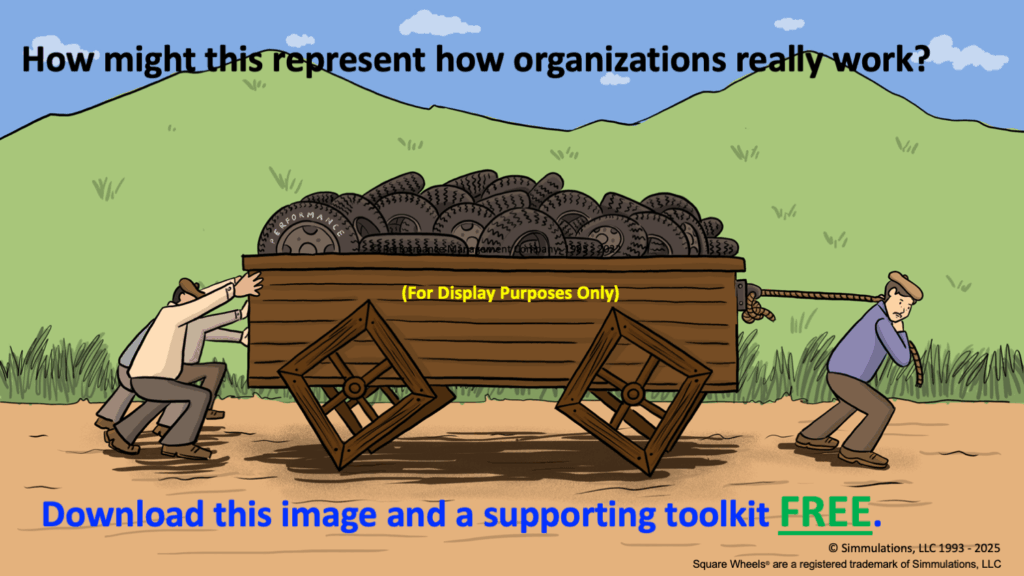
Download the FREE Square Wheels® One image and instructor’s guide with a Creative Commons license for use.
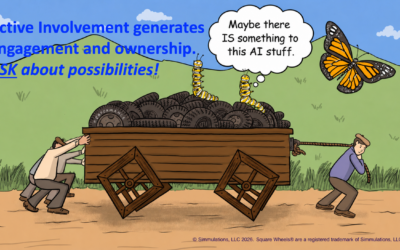
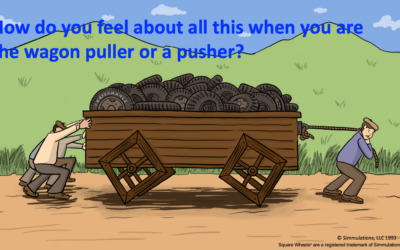
A metaphorical image (like the wagon full of people pulling and pushing with wooden Square Wheels®) lets people project their reality onto something safe and non‑personal. They can comment on the picture and tell a story around what might be happening. They see and talk about idea that they see and consider.
When you put an image in front of a group and simply ask, “Where are you acting in this picture?” you get several advantages:
-
Safety – They are talking about the cartoon, not attacking a person.
-
Specificity – People point to concrete elements in the image: the wagon, the wheels, the road, the people.
-
Emotion – Humor and metaphor bypass some of the defensiveness and allow more honest comments.
-
Language – You capture their exact phrases, which are far more powerful than any consultant’s jargon.
That language becomes the raw material of ownership. Once people hear their own words written on a flip chart or typed into a shared screen, they start to see the situation as “ours to change,” not “theirs to explain.”
How StoryASKING Builds Ownership
StoryAsking strengthens ownership in at least four practical ways.
-
People own the diagnosis When the team is the one identifying the square wheels, the roadblocks, and the round wheels already lying around, they own the description of reality. It is no longer management’s story about what is wrong; it is their story about what is true.
-
People own the solutions Once the issues are in their words, it is natural to ask, “What could we do about this?” Because the problems were surfaced by the group, there is less resistance to exploring solutions. The conversation shifts from “Why don’t they fix this?” to “What are we willing to try?”
-
People own the experiments StoryAsking is perfect for small tests and experiments. When someone suggests a round wheel, you can ask, “What small step are we prepared to test before we meet again?” The team chooses the experiment, defines what “better” would look like, and commits to trying it. That is ownership at a very practical level.
-
People own the story going forward When you come back later and ask, “How is our picture different now?” people remember what they said last time. They can see whether anything changed because of their ideas and actions. Over time, this creates a reinforcing story: “When we talk honestly about the work, things improve.”
A Simple StoryASKING Loop Any Manager Can Run
You do not need a big initiative or a long workshop to use StoryAsking. You can build it into regular conversations using a simple four‑step loop and we give you a free, powerful, bomproof tool to make your workplace enablement more likely:
-
Show an image. Use a metaphorical picture of work (like Square Wheels One, a wagon, a journey, a team working to make progress) that is clearly “not us” but feels familiar enough to be relevant.
-
Ask for observations. Ask questions like:
-
“Where are you in this picture?”
-
“What looks most like our reality right now?”
-
“Where do you see the square wheels?”
Capture exact phrases as people talk.
-
-
Turn comments into actions. Group similar comments and ask:
-
“Which of these do we want to focus on first?”
-
“What is one small round wheel we are willing to test this week?”
-
“Who wants to take point on moving this idea forward?”
Agree on one or two simple experiments, not a massive project list.
-
-
Revisit and rewrite the story. In your next meeting, bring back the same image and your notes. Ask:
-
“What happened with the round wheel we chose?”
-
“What feels the same, and what feels different?”
-
“If we drew this picture again today, what would we change?”
This closes the loop and reinforces the sense that conversations lead to visible change.
-
Run this loop regularly and you will find that people begin to show up with ideas already half‑formed. They are anticipating that their stories and suggestions matter.
Everyday StoryASKING Moves For Supervisors
Here are a few ways frontline leaders can use StoryAsking without needing a formal program or extra budget.
1. Start huddles with an image and a question
Once a week, put a simple image on the wall or screen and ask one short question. Let two or three people share, capture their words, and pick one concrete improvement to try. This takes 10–15 minutes and builds a rhythm of participation.
2. Use StoryAsking in one‑on‑ones
Instead of only reviewing tasks and metrics, occasionally show the image and ask, “Where are you in this picture lately?” or “Which part of this wagon feels most like your job right now?” This opens the door for people to share frustrations, insights, and ideas they may not raise otherwise.
3. Anchor problem‑solving in shared stories
When something goes wrong—a missed deadline, a quality issue, a customer complaint—resist the urge to jump straight into explanation mode. Start with the image and ask, “If this incident were a moment in this picture, where would we be?” Then use their answers to guide root‑cause analysis and improvement.
4. Use StoryAsking to support change
Whenever a new system, process, or strategy is coming in, use the image to ask, “What square wheels are we hoping this change will fix?” When people connect the change to problems they have already described, they are more likely to support it and to help make it work.
Generating Culture Change, One Story At A Time
You cannot mandate ownership. You can, however, create the conditions where ownership is the natural response.
StoryAsking is one of those conditions. It is a habit, not a program. It requires curiosity more than charisma, and a few good images more than a few great speeches.
When managers consistently:
-
Ask instead of tell.
-
Listen instead of defend.
-
Capture instead of dismiss.
-
Act instead of explain.
then people start to believe a different story about work: “What I see and say here matters. My experience is part of the picture. My ideas can make things better.”
That belief is the foundation of involvement, initiative, and engagement. And you do not have to wait for a corporate rollout to start. You can begin with the very next image and idea you share and the very next question you ask.
—
For the FUN of It!
 Dr. Scott Simmerman is a designer of team building games and organization improvement tools.
Managing Partner of Performance Management Company since 1984, he is an experienced presenter and consultant who is trying to retire!! He now lives in Cuenca, Ecuador.
You can reach Scott at scott@squarewheels.com
Learn more about Scott at his LinkedIn site.
Note that I often use Perplexity AI to help research and generate ideas for my posts.
Square Wheels® are a registered trademark of Simmulations, LLC
and images have been copyrighted since 1993,
© Simmulations, LLC 1993 – 2026
What I’m About:
My Square Wheels blog and website exist to help leaders, trainers, and facilitators make work smoother, more engaging, and more human. I focus on practical tools for process improvement, organizational change, and workplace collaboration that spark insight and deliver measurable results.
And I am convinced, after 30+ years of using Square Wheels®, that it is the best facilitation toolset in the world. One can use it to involve and engage people in designing workplace improvements and building engagement and collaboration. It is a unique metaphorical approach to performance improvement and we can easily license your organization to use these images and approaches.
By blending proven facilitation methods, creative problem-solving, and engaging team activities, my mission is to support organizations in building energized, sustainable cultures of involvement and innovation.
Through accessible — and often free — resources and virtual facilitation tools, I aim to help teams everywhere collaborate more effectively, innovate continuously, and take ownership of their improvement journey.
#SquareWheels #InnovationAtWork #TeamEngagement #FacilitationTools #WorkplaceImprovement #EmployeeEngagement #CreativeProblemSolving #OrganizationalDevelopment #LeadershipTools #collaboration #leadership #motivation #communications #enablement #leadership #CreativeCommons #enablingperformance #teamwork #storytelling #storyasking

0 Comments