

Ditch the Training Manual: Facilitate with Square Wheels images to drive real workplace performance, innovation and engagement.
Take a look at your organization. Are people working incredibly hard just to inch forward? Are they exhausted, frustrated, and complaining about the “bumpy ride” and not making progress? Do things feel stalled and are people frustrated?
When so many managers see a lack of progress, their knee-jerk reaction is almost always the same: “We need a training program!” (Just ask your training department!) We assume that if people are struggling, it’s because they don’t know how to do their jobs. So, we pull them off the floor, put them in a conference room, and subject them to hours of training and development to teach them new skills. Training builds strengths.
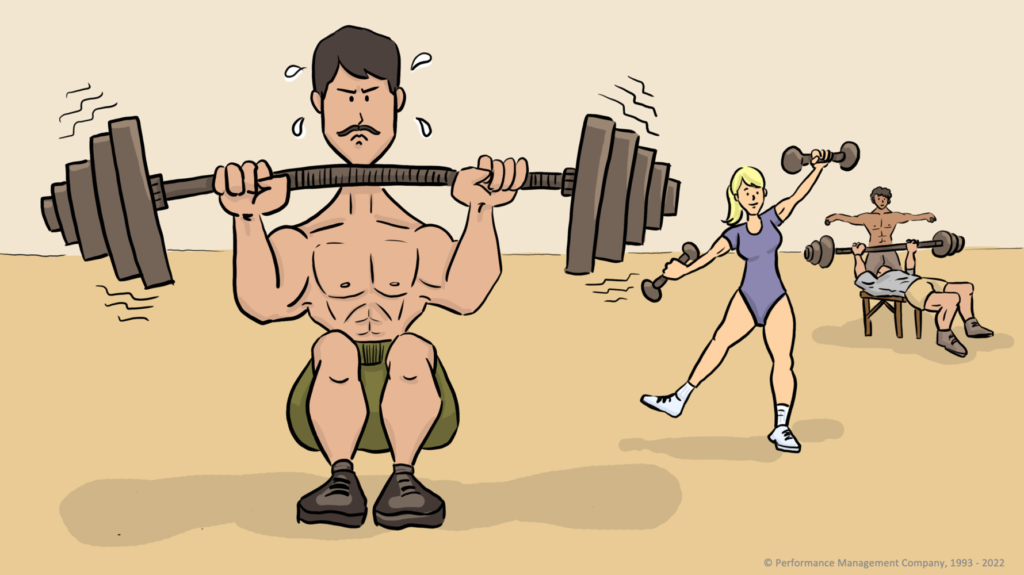
Training builds strengths and capabilities
But what if a lack of skill isn’t the problem at all? What if the “training problem” is something else?
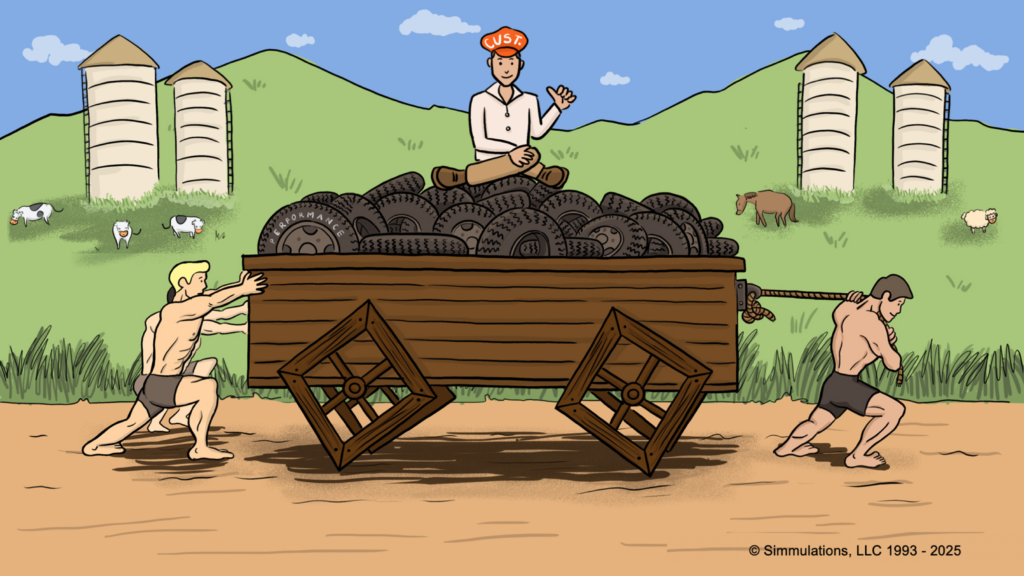
Not every problem can be solved with training…
Enter Bob Mager: The Choice to Perform
Legendary performance expert Robert Mager famously challenged the default “training” mindset. When faced with a performance issue, Mager suggested asking one simple, provocative question:
“If their life depended on it, could they do the task?”
If the answer is yes, you do not have a training problem. Training will not fix many performance issues and it will not address the issue of choice.
You cannot train someone to want to do something. If they already possess the skill, the issue is environmental, systemic, or motivational. They are making a choice not to perform optimally because the system is rewarding the wrong behavior, punishing the right behavior, or simply making the job too incredibly difficult.
Training people on skills they already have won’t
change their choices. It just makes them more cynical.
And if you change the extrinsic rewards, you may see improvements but now you must continue those rewards to generate the desired behavior.

THIS is NOT how to improve an organization — It is meant to be funny — but these acts will show if there IS a motivation problem. Intrinsic Motivation is far better.
The Power of the Square Wheels Metaphor
This is where the classic Square Wheels® One illustration becomes a game-changer for the average supervisor. Using it is how to create motivation to improve and it is how to generate a more positive workplace culture. (get it free with a toolkit)
Imagine this common reality: A leader is straining to pull a wagon rolling on wooden Square Wheels. The team is working hard, pushing from behind. It’s a terrible, inefficient, bone-jarring journey and everyone is very glad when the day is over. But right there, in the back of the wagon, exist a game changing, whole cargo of round rubber tires.
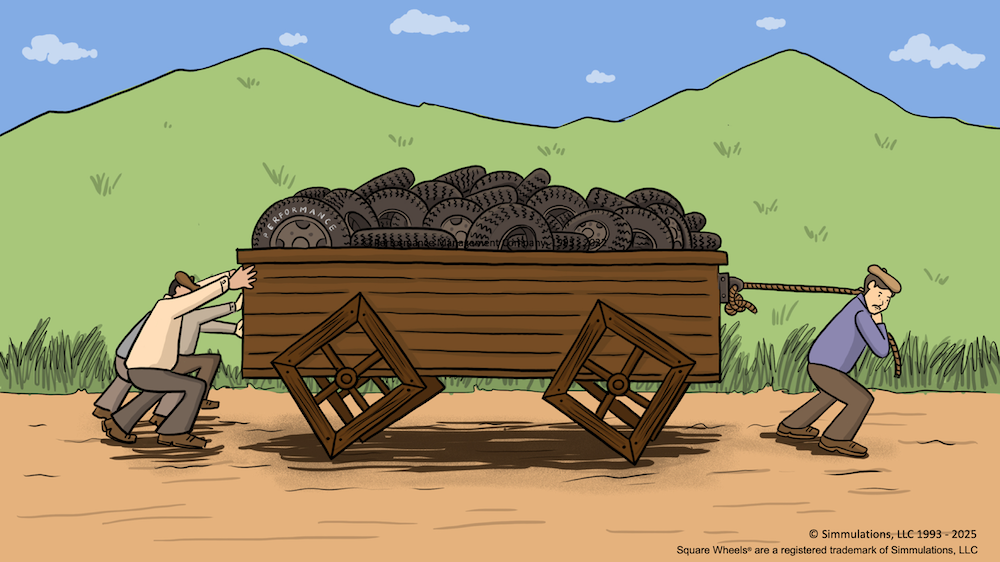
Instead of forcing your team through another disconnected training seminar that takes significant time out of the productive schedule, put the Square Wheels One image in front of them and ask a question to get things rolling: “How does this represent how things really work in most organizations?”
This simple act shifts the engagement dynamic completely:
-
- It validates their reality that things are not working smoothly. It acknowledges that the work is hard and the systems are often clunky.
- It triggers engagement and active involvement, not defensiveness. People love to point out the Square Wheels (inefficiencies) in their daily jobs that could be corrected.
- It reveals the round wheels. Your people already know the solutions (the round wheel possibilities are already in most wagons). They just haven’t been asked, or they’ve been too busy pushing to stop and install them.
When people identify their own “round wheel possibilities,” they take active ownership of the potential solutions. You aren’t training them to change; you are facilitating an environment where they choose to perform better because the improvement was their idea.
Updating the Metaphor: New Square Wheels Images
There are LOTS of ideas out there; Here is me just playing with ideas to improve my own work. I asked Gemini to consider possibilities and I used Perplexity to produce the ideas into new images. I call this continuous continuous improvement, an idea from The Department of Redundancy Department! (grin).
AI can be a useful tool to generate considered alternatives and you can use Praxis Live as such a tool around my Square Wheels images. Mike Martin and I are building stuff!
To keep this concept fresh and tackle modern workplace challenges, I generated some ideas for new Square Wheels illustrations that can spark deeper conversations:
-
The “Tech Overload” Wagon
The Image: The wagon still has square wheels, but it is heavily loaded with shiny rocket engines, giant computers, and robotic arms. However, none of the tech is plugged in. The team is still manually dragging the heavy wooden frame by a rope, looking completely overwhelmed.
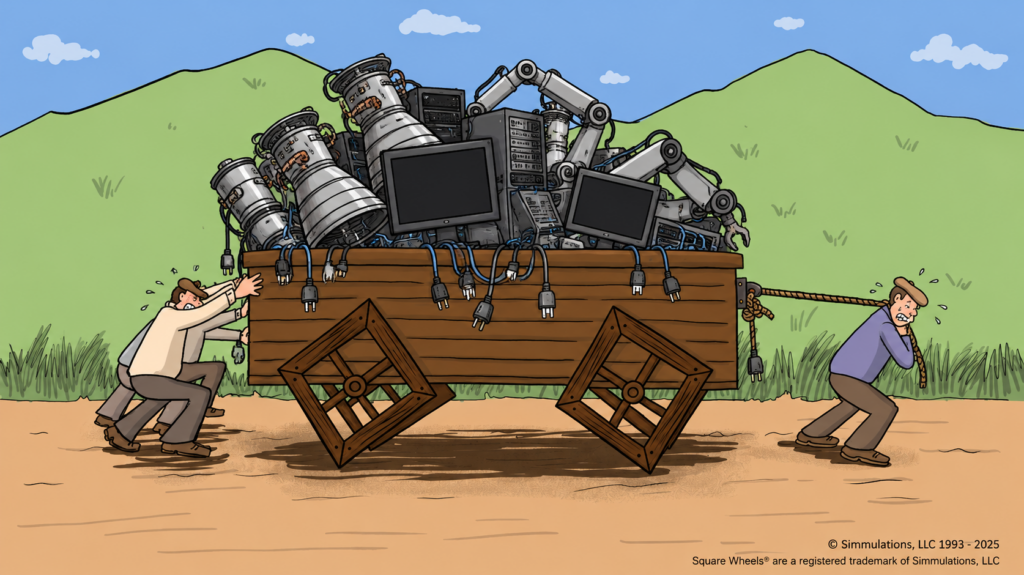
The Lesson: Throwing expensive new software or AI at a problem doesn’t fix a fundamentally broken process. It just makes the heavy wagon heavier. We need to stop and integrate the tools properly.
-
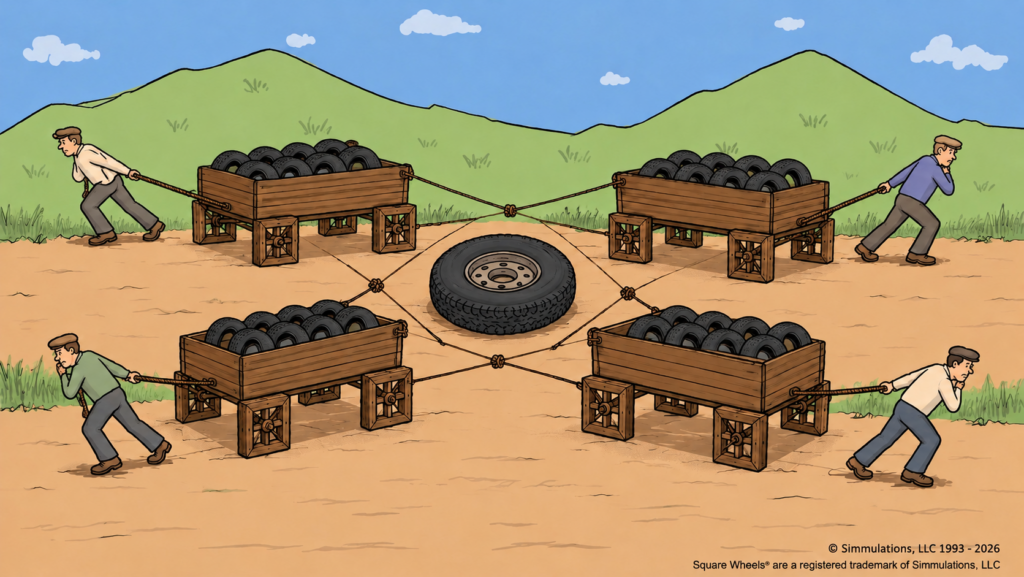
The “Remote Silo” Wagons
The Image: Instead of one big wagon, there are four tiny, individual wagons—all with Square Wheels. They are tied together by a tangled web of string. Each team member is pulling their own little wagon in a slightly different direction. A giant, shared round wheel sits in the middle of them, unused.
THIS prompt generated two images. The first I am calling “Interdepartmental Collaboration”:
And the second adds my Spectator Sheep who always see things differently:
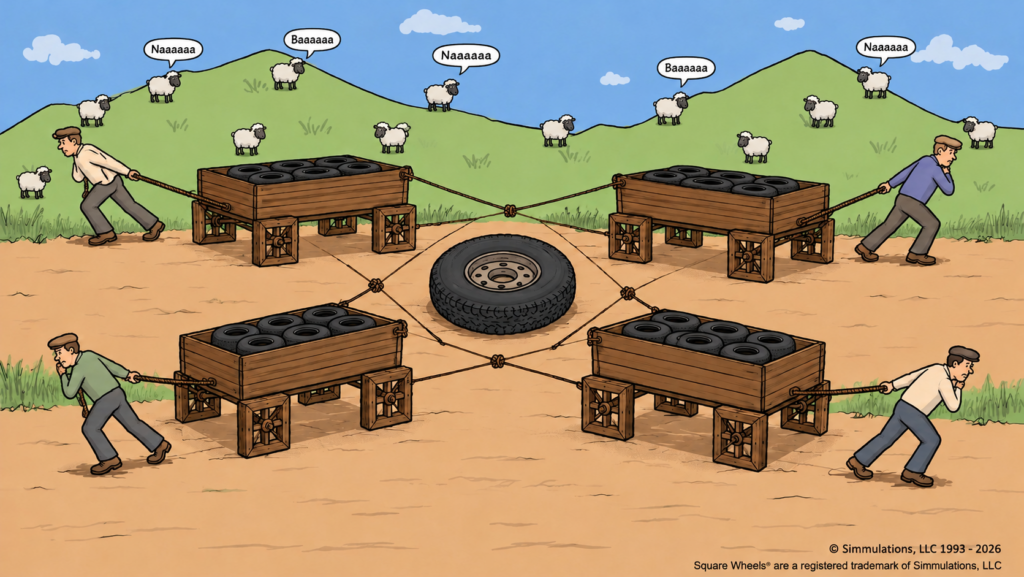
The Lesson: Remote and hybrid work and even a lack of shared focus between departments can lead to fragmented efforts. Everyone is working hard in their own silo, dealing with their own clunky processes, failing to realize that collaboration is the round wheel they need. And, in the case of the Spectator Sheep, ignoring some feedback that might be beneficial
-
The “Golden Handcuffs” Wagon
The Image: The wagon has Square Wheels, and the round rubber tires are securely locked inside a thick glass display case in the wagon bed. The team members pushing from the back actually wear the keys to the display case on necklaces around their necks, but they are looking down at the mud, pushing too hard to notice.
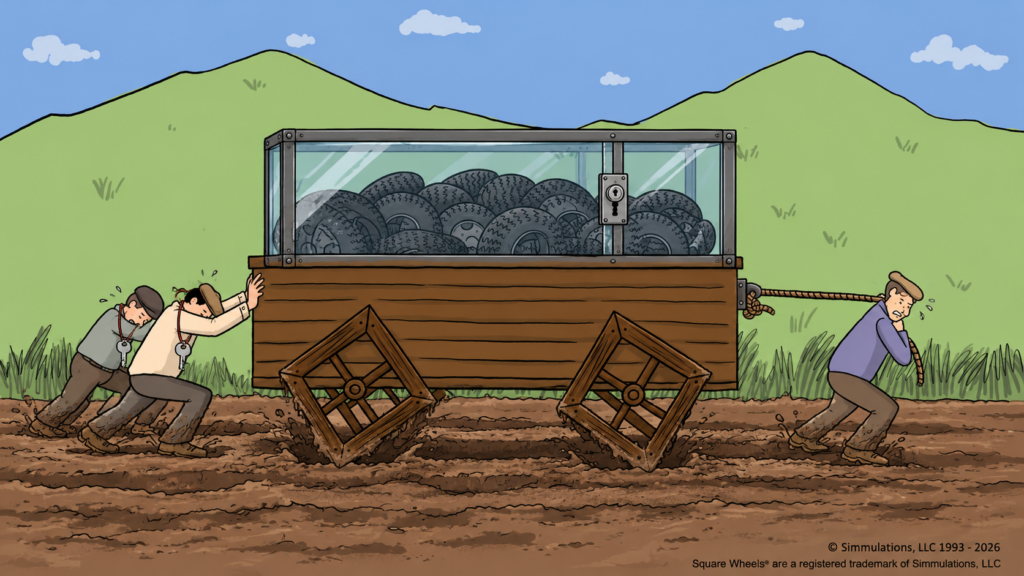
The Lesson: Empowerment and micromanagement. Employees often have the authority (the keys) to make things better, but the culture or the sheer volume of work keeps their heads down. Leaders need to tell them it’s okay to stop pushing and unlock the solutions. “Don’t Just DO Something, Stand There.” Let’s stop and make some improvements
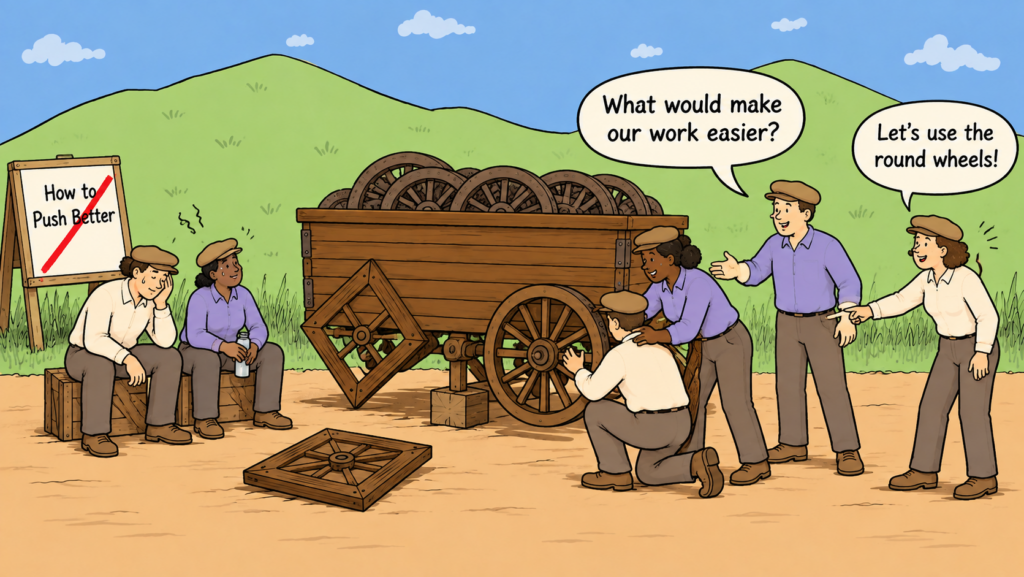
Stop Training. Start Facilitating.
The image: If your team is exhausted from pushing a square-wheeled wagon, don’t send them to a class on “How to Push Better.” Use the metaphor to start a conversation. Fix the environment, listen to their ideas, and watch as they actively choose to swap those square wheels for round ones. This one got reframed into a more positive image than my regular stuff on training ineffectiveness:
Lastly:
Generating Ideas by asking for Involvement
I simply added this from my image library, because I feel it suggests where we should be heading in our work cultures and with our training and engagement actions. This is part of my UN-dis-engagement series, part of my enablement thinking:
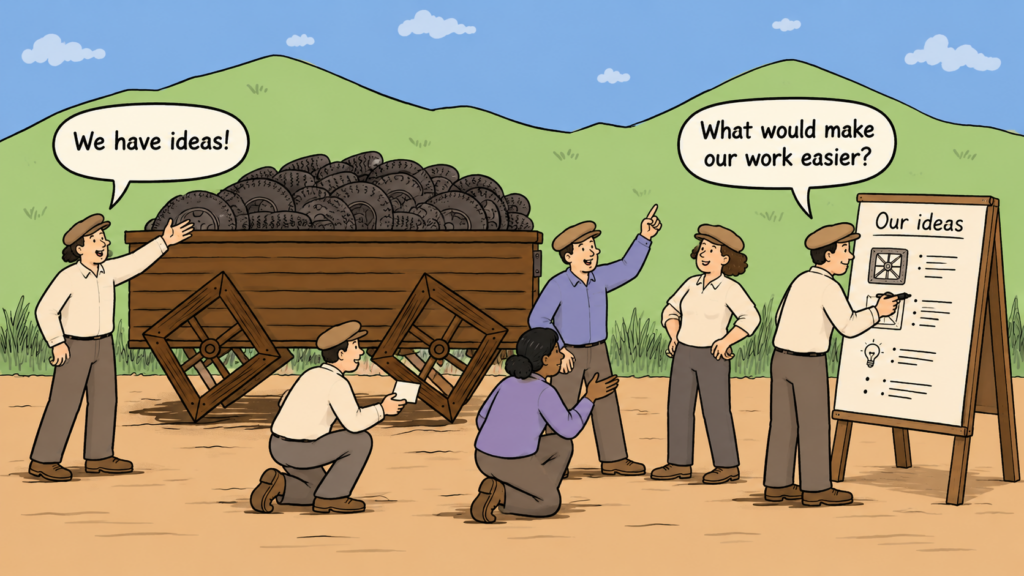
Let’s collaborate,
—
For the FUN of It!
 Dr. Scott Simmerman is a designer of team building games and organization improvement tools.
Managing Partner of Performance Management Company since 1984, he is an experienced presenter and consultant who is trying to retire!! He now lives in Cuenca, Ecuador.
You can reach Scott at scott@squarewheels.com
Learn more about Scott at his LinkedIn site.
Square Wheels® is a registered trademark of Simmulations, LLC
and images are © Simmulations, LLC 1993 – 2026
Note: Please do not take my images and think about using them. It can generate a whole heap of problems given international copyright law and trademark law. Read this article for more information.
See a detailed overview of my tools, background and experiences by clicking here.
What I’m About:
My Square Wheels blog and website exist to help leaders, trainers, and facilitators make work smoother, more engaging, and more human. I focus on practical tools for process improvement, organizational change, and workplace collaboration that spark insight and deliver measurable results.
And I am convinced, after 30+ years of using Square Wheels®, that it is the best facilitation toolset in the world. One can use it to involve and engage people in designing workplace improvements and building engagement and collaboration. It is a unique metaphorical approach to performance improvement and we can easily license your organization to use these images and approaches.
By blending proven facilitation methods, creative problem-solving, and engaging team activities, my mission is to support organizations in building energized, sustainable cultures of involvement and innovation.
Through accessible — and often free — resources and virtual facilitation tools, I aim to help teams everywhere collaborate more effectively, innovate continuously, and take ownership of their improvement journey.
#SquareWheels #InnovationAtWork #TeamEngagement #FacilitationTools #WorkplaceImprovement #EmployeeEngagement #CreativeProblemSolving #OrganizationalDevelopment #LeadershipTools #collaboration #leadership #motivation #communications #enablement #leadership #CreativeCommons #enablingperformance #teamwork #storytelling #storyasking #enablement #disruptiveengagement #un-dis-engagement #un-dis-empowerment #innovation
© 2026 Simmulations, LLC. Please note that “Square Wheels®” is a registered trademark of Simmulations, LLC. and materials, original wagon line art, text, and visual designs are protected. Original line art by Roy Sabean, used under rights owned by Simmulations, LLC and formerly Performance Management Company, a sole-proprietorship of Dr. Scott J. Simmerman. Original concept and source artwork © Simmulations, LLC; derivative visuals sometimes created with assistance from Perplexity Pro AI.

0 Comments