
Most managers try to change attitudes with more data, more logic, and more PowerPoint, and then wonder why nothing actually changes. Simple. The people are Spectator Sheep and not co-creators.
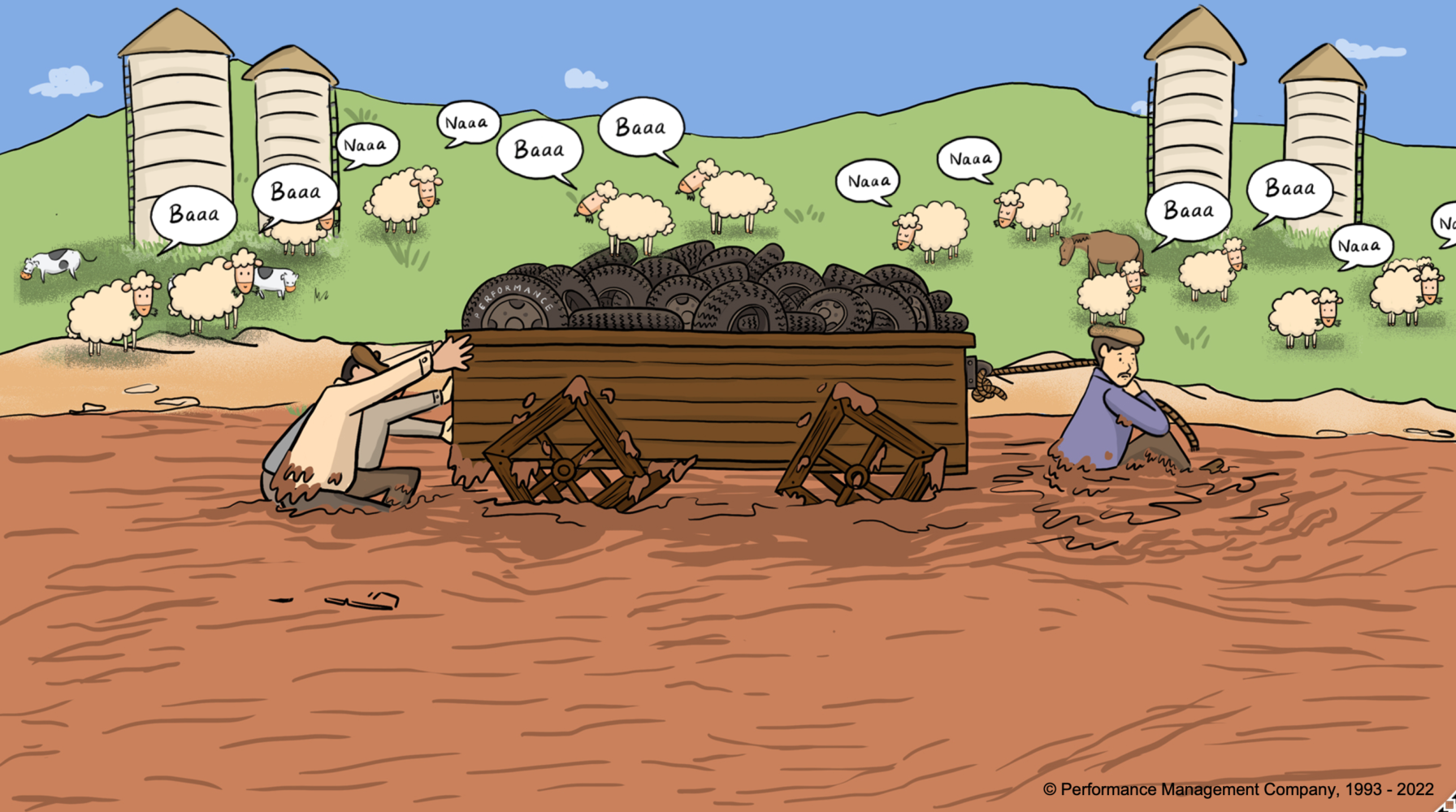
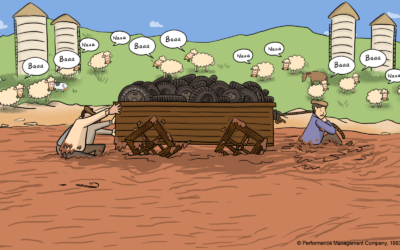
Using the Square Wheels® images give you a very different lever for change and enablement: you can use a simple image of a clunky thumping wagon, some Spectator Sheep observers, some mud of reality and a few visible silos to quietly disrupt old thinking and invite people to create a new story about involvement, innovation, and change, one where they are the main characters.
Why facts don’t move people
We live in a world drowning in data about engagement, productivity, and innovation, yet attitudes at work often remain stubbornly stuck. Cognitive research shows that people rarely change their minds because of facts and that they protect their existing beliefs, filter out disconfirming evidence, and cling to what feels safe and familiar. (See the data about the Supervisor Hellscape here.)
At work, that means you can show charts on engagement, customer complaints, or process waste and still get mostly nods and compliance, not genuine commitment to do anything differently. They may be watching, but they are mentally remote. People’s opinions are rooted in identity, social belonging, and past experiences, so they defend and maintain their current “this is how I do things around here” story even when the numbers say otherwise.
Using Square Wheels to create safe, actionable cognitive dissonance
The genius of the Square Wheels® metaphor is that it lets people see their reality without feeling attacked. A wagon thumping along on wooden Square Wheels loaded with a cargo of round ones instantly captures the absurdity of how many organizations operate: lots of effort, lots of noise, and obvious better ways not being used. It is also about personal performance.
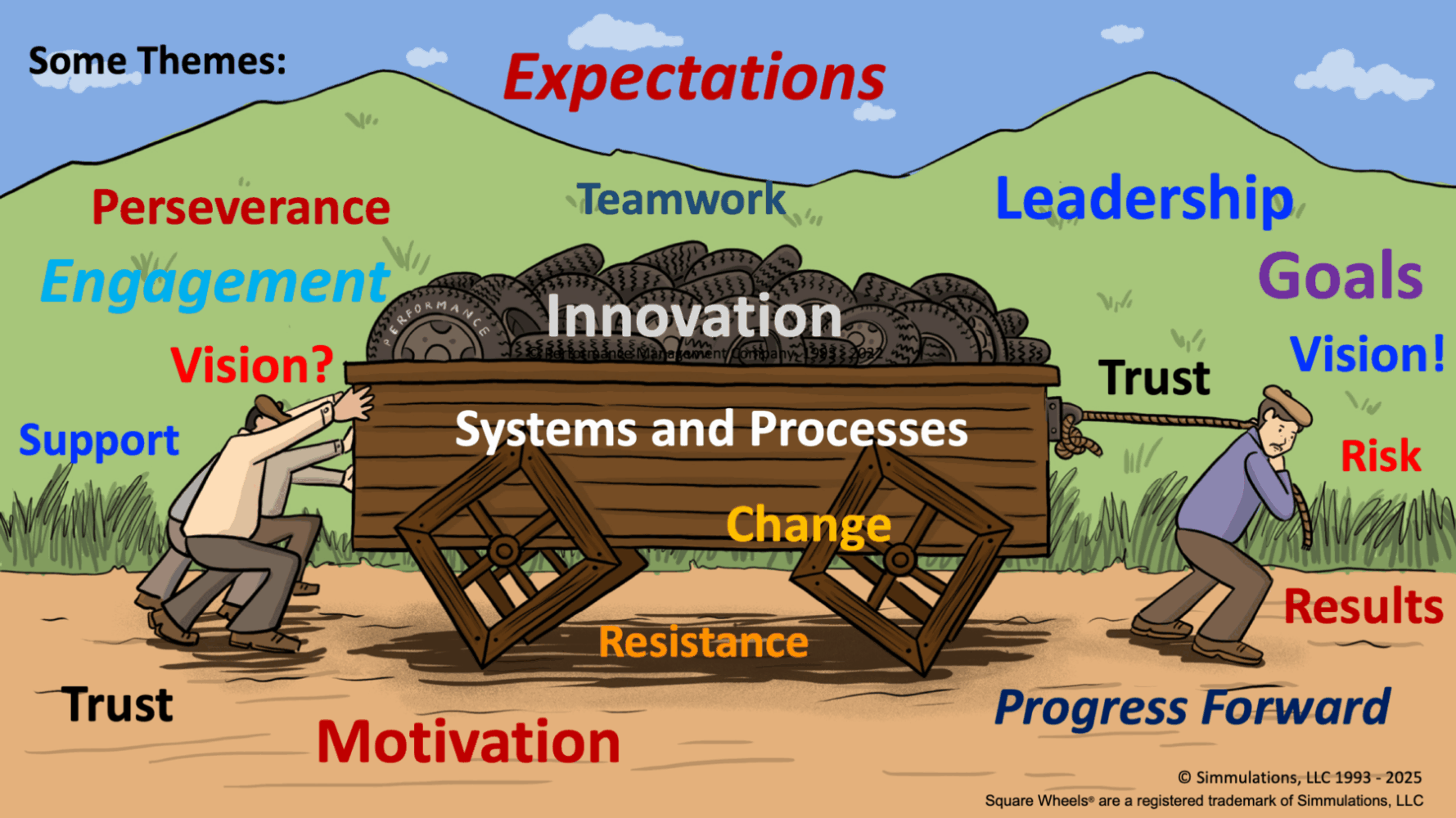
There are many different themes that open for discussion when using Square Wheels One
When you, as a supervisor, show that image and simply ask, “Where are the Square Wheels around here?” you’re not presenting “The Answer”; you’re inviting people to surface what they already know but rarely say. That gentle tension—recognizing their own workplace in the cartoon—is the kind of gap from cognitive dissonance that opens the door to new attitudes without triggering defensiveness.
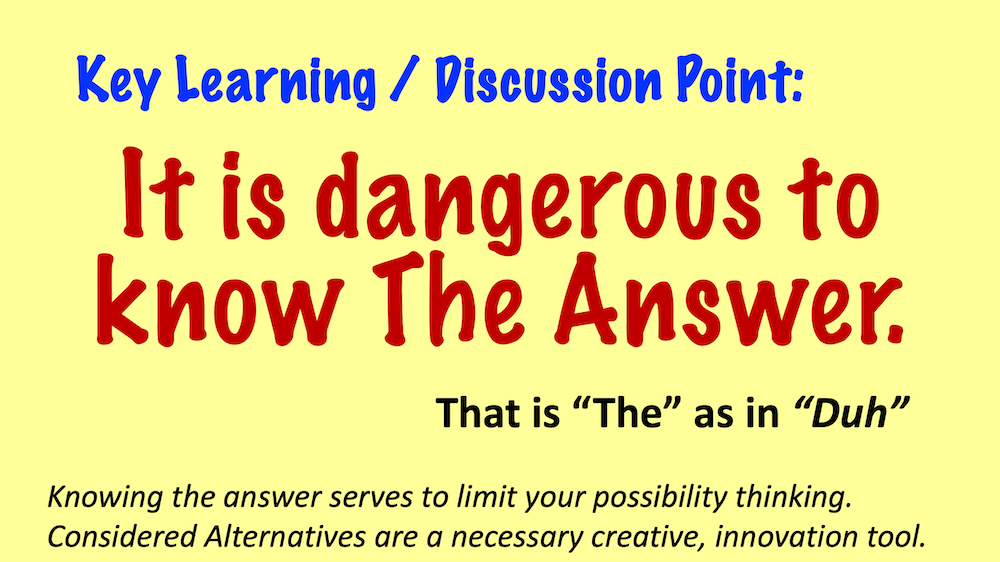
When anyone already “Knows The Answer,” they are generally limiting engagement and missing divergent ideas that they have not considered.
Spectator Sheep and the power of Voice
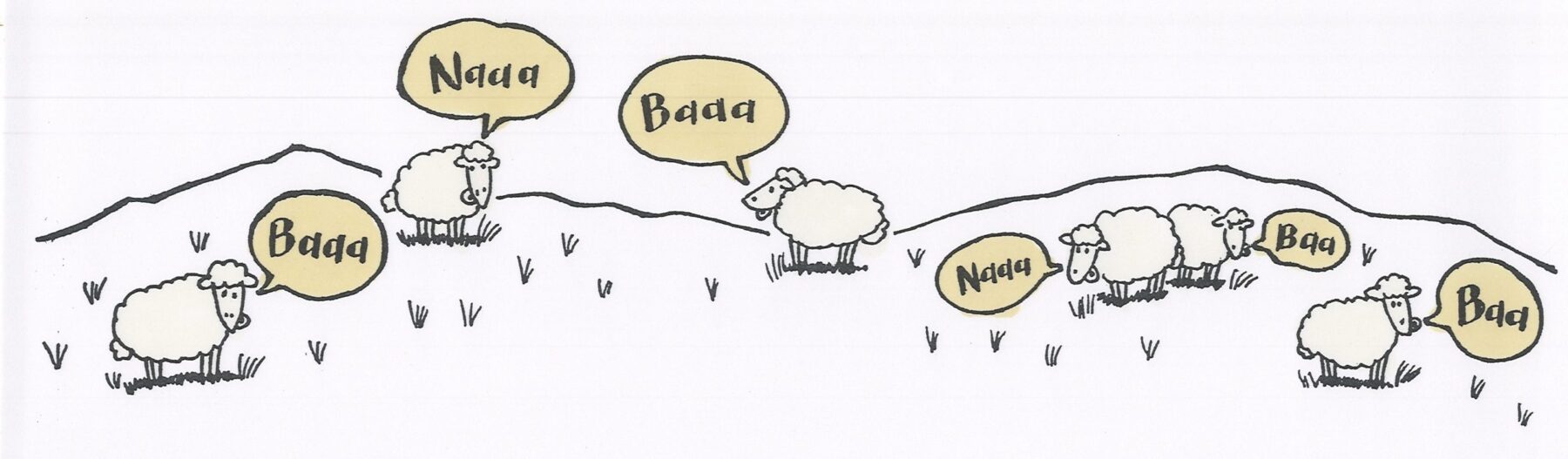
In most workplaces, there is a visible group of “Spectator Sheep,” people who stand back, comment from the sidelines, and rarely engage directly. They are not clueless and they have perspective; they are cautious and feel divergent. They watch the wagon, see the mud, see the misaligned silos, and quietly bleat their “naaaaa” and “baaaaa” about how things are going.
Research on belief and behavior change is quite clear: people are more likely to reconsider their positions when they feel heard, respected, and emotionally safe, not when they are told they’re wrong, generating resistance.
When you invite the Spectator Sheep into a structured conversation about the image: “If you were one of these sheep, what would you be saying as you watch this wagon?”, you give them psychological cover (aka dissociation) to express real concerns without making it personal. That act of voicing, in a metaphor, is the first step from passive disengagement toward constructive involvement.
Breaking silos with a shared image
Silos show up clearly in the Square Wheels scenes: pushers can’t see where they’re going, pullers don’t see the mud, and nobody seems to see the round wheels in the wagon. Each group has part of the picture, but the whole system stays stuck. That’s a pretty good description of cross-functional life in most organizations, right?
As a supervisor, you can put different people into and around the same image—operations, support, front-line roles—and ask each group, “What do you see from your side of the wagon?” Since they are talking about an image, not accusing each other, they can surface the real barriers, misalignments, and dumb processes that everyone endures but no one feels safe to challenge. In that shared conversation, people start to see that their “silo truth” is only one slice of a bigger, more complex reality. That shift in perspective is a prerequisite for any real attitudinal change about collaboration and innovation and change.
While the actual situation may be complex, some solutions are often simple and obvious.
What actually changes minds (and how to do it with Square Wheels)
There are several levers that help change minds more reliably than facts: story, emotion, identity, and participation. The Square Wheels images let you operationalize all four in very practical supervisor behaviors.
Here’s how:
-
Tell a story, not a statistic
Instead of opening a meeting with, “Engagement is at 46%,” open with the Square Wheels wagon and a simple narrative: “This is us on a busy Monday. We’re pushing hard, but we all know there are round wheels we’re not using yet.” Stories and metaphors bypass resistance and pull people in where numbers often push them away. Let them see themselves… -
Create emotional safety through metaphor
When people critique the wagon, the mud, the rope, or the sheep, they are really critiquing their workplace, but from a safe distance. That distance lowers the emotional threat level, which makes people far more willing to question assumptions and consider alternatives. As a supervisor, your role is to protect that space: you listen, you paraphrase, you avoid defending the current “wagon design,” and you capture ideas visibly and intentionally. -
Align change with identity and pride
People don’t want to feel like resisters; they want to feel like contributors. When you ask, “If we were the team pushing this wagon, what would we want to be proud of six months from now?” you connect improvement to their sense of competence and identity. They stop seeing change as something being done to them and begin to see it as something they are smart enough to shape. -
Move from discussion to co-created experiments
Minds change most when people take part in designing and testing the new way, not when they are told to comply. After generating a list of “round wheel” ideas from the image, ask the group to pick one small, low-risk change they can test in the next two weeks. Label it explicitly as an experiment, not a mandate. That framing invites curiosity instead of fear and lets people experience the new story — “we’re a team that tries and learns” — in real behavior and workplace reality.
A simple supervisor script you can actually use
First, grab the main Square Wheels One image along with a simple and more expansive toolkit by clicking on the image below:

Here is a compact sequence you can adapt for your next team session. There are more details and options in the toolkit mentioned above. Note that what follows are ideas and not a script.
-
Show the image
Display the Square Wheels wagon and give people a quiet minute to just look. -
Ask neutral observation questions
Start with, “How might this image represent how things really work?” Then move on to “How might this represent how things really work here in our workgroup?” Avoid attacking them. Identifying problems is good, so identify as many as you can. Get them to stretch.Then, maybe try: “Where is the mud in our world? If you were one of those sheep, what might you be saying?” Capture their comments on a flip chart or shared document. Have participants capture the ideas. Use one of the electronic tools. But capture the ideas!
-
Connect to their reality
Now ask, “Where do we see these Square Wheels in our work?” and “What round wheels do we already have that we’re not using?” You’ll hear concrete issues, workarounds, and underused ideas. -
Co-create one or two small experiments
Invite: “Looking at this list, what’s one thing we could try in the next two weeks that would make our wagon roll a little smoother?” Let the team choose and shape it. Define what “success” would look like. -
Close with identity and commitment
End by naming the new story: “What I’m hearing is that we’re not just pushing a wagon anymore; we’re a group that looks for round wheels together.” Ask each person for one sentence on what they’re willing to do differently before the next meeting.
From Spectator Sheep to co-designers of change
Spectator Sheep: pretty easily identified…
The real opportunity for a supervisor is not to “drive” change harder, but to host better conversations. The Square Wheels images are simple, playful tools for doing exactly that. They let your people safely critique the current wagon, reveal the mud and silos, and give voice to the spectator sheep in ways that would be politically risky if you tried to do it head-on.
When you consistently use those images to invite observation, story, and small experiments, you help your team write a new narrative about themselves: “We are not just passengers or sheep; we are the mechanics of this wagon.” Over time, that story does what facts almost never do; it quietly, persistently changes minds about involvement, innovation, and the possibility of real workplace changes down the road.
—
For the FUN of It!
 Dr. Scott Simmerman is a designer of team building games and organization improvement tools.
Managing Partner of Performance Management Company since 1984, he is an experienced presenter and consultant who is trying to retire!! He now lives in Cuenca, Ecuador.
You can reach Scott at scott@squarewheels.com
Learn more about Scott at his LinkedIn site.
Square Wheels® are a registered trademark of Simmulations, LLC
and images have been copyrighted since 1993,
© Simmulations, LLC 1993 – 2026
What I’m About:
My Square Wheels blog and website exist to help leaders, trainers, and facilitators make work smoother, more engaging, and more human. I focus on practical tools for process improvement, organizational change, and workplace collaboration that spark insight and deliver measurable results.
And I am convinced, after 30+ years of using Square Wheels®, that it is the best facilitation toolset in the world. One can use it to involve and engage people in designing workplace improvements and building engagement and collaboration. It is a unique metaphorical approach to performance improvement and we can easily license your organization to use these images and approaches.
By blending proven facilitation methods, creative problem-solving, and engaging team activities, my mission is to support organizations in building energized, sustainable cultures of involvement and innovation.
Through accessible — and often free — resources and virtual facilitation tools, I aim to help teams everywhere collaborate more effectively, innovate continuously, and take ownership of their improvement journey.
#SquareWheels #InnovationAtWork #TeamEngagement #FacilitationTools #WorkplaceImprovement #EmployeeEngagement #CreativeProblemSolving #OrganizationalDevelopment #LeadershipTools #collaboration #leadership #motivation #communications #enablement #leadership #CreativeCommons #enablingperformance #teamwork

0 Comments